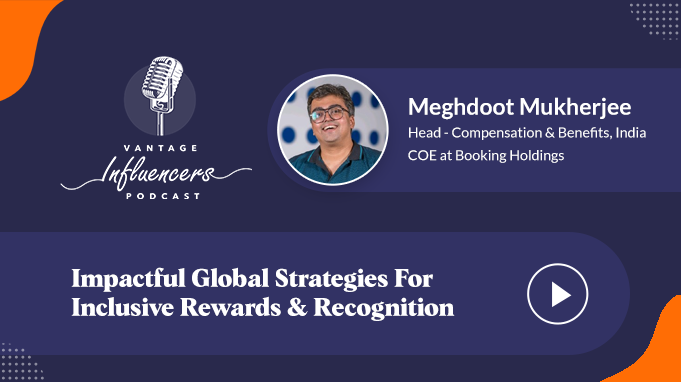
Impactful Global Strategies For Inclusive Rewards & Recognition
Episode Overview
Meghdoot Mukherjee opens the conversation by reframing a debate that most organizations still get wrong, treating diversity, equity and inclusion as a values statement rather than a design requirement for rewards and recognition. He argues that inclusivity has to be built into compensation, benefits and wellbeing programs at the design stage, not patched in after complaints surface. To make the point concrete, he walks through how gender pay gap analysis actually works inside large organizations, breaking the workforce into cohorts and manager groups to catch systemic bias that gets buried when leaders only look at company-wide averages. He also challenges a common assumption that recognition programs land differently for men and women because of what motivates each group, arguing instead that any gap in outcomes points to structural bias rather than a real difference in what drives performance.
The conversation then turns to why a single global rewards template rarely survives contact with more than one country. Meghdoot uses a recognition program he helped design across several markets to show how a one-size-fits-all framework can end up being the least inclusive option on offer, satisfying no local workforce because it tries to satisfy all of them at once. He contrasts regulatory environments, from pay transparency laws reshaping hiring practices in parts of the world to maternity leave standards that vary sharply by country, to explain why local flexibility needs to sit inside a shared global framework rather than outside it. He closes by describing where rewards and recognition is heading next, away from one-size-fits-all benefits and toward hyper-personalized offerings, shaped by data, that let individual employees and entire teams choose rewards that actually fit their lives.
Episode Highlights
- Inclusive rewards and recognition strategies must be designed for inclusivity from the outset, not retrofitted after gaps in outcomes are identified.
- Gender pay gap analysis works best when workforces are broken into cohorts and manager groups, since aggregate data can mask bias hiding inside individual teams.
- There is no evidence that rewards motivate one gender more than another; disparities in outcomes point to systemic bias rather than differences in what drives performance.
- A single global recognition framework rarely works across markets with different cultural expectations, from high-touch recognition cultures to teams who prefer an annual bonus over frequent praise.
- Regulatory context shapes reward strategy directly, from pay transparency laws reshaping hiring in some countries to maternity leave protections that vary widely by geography.
- The next phase of rewards and recognition is personalization at scale, letting individuals and entire teams choose rewards that fit their own lives rather than a fixed catalog.
About the Guest
Meghdoot Mukherjee, Head of Compensation & Benefits at the India Center of Excellence for Booking Holdings
Meghdoot has spent over 13 years working across strategic business partnering, program management and capability building, with deep experience in total rewards, talent and organizational effectiveness, and people technology. In his current role, he is responsible for setting up the Compensation and Benefits function for Booking Holdings in India.
Connect with Meghdoot on LinkedIn
Host
Sanjeevani Saikia, Vantage Influencers Podcast Host
What You Will Learn
- How to design compensation, benefits and wellbeing programs with inclusivity built in from the start, rather than treating it as an add-on.
- Why gender pay gap analysis needs to look at cohorts and manager groups, not just company-wide averages.
- Why there's no real evidence that rewards motivate one gender better than another, and what actually drives the outcome gap.
- Why a single global recognition framework rarely works, and how to give local markets room to adapt it.
- How pay transparency laws and maternity leave standards differ by country, and what that means for a global rewards strategy.
- How organizations measure whether their R&R programs are actually working, from employee listening surveys to retention data.
- Where personalization is taking rewards and recognition next, including team-level reward choices.
Key Topics & Timestamps
| Timestamp | Topic |
|---|---|
| 00:00 | Why inclusive rewards and recognition matter |
| 01:48 | Meghdoot's career journey in HR and total rewards |
| 03:00 | Key considerations for global inclusive R&R strategies |
| 06:48 | Building genuinely inclusive R&R processes |
| 15:16 | R&R strategies that move the needle on employee wellbeing |
| 22:05 | Why R&R needs differ across geographies |
| 27:02 | Challenges of implementing inclusive R&R across borders |
| 33:00 | Measuring the impact of R&R programs |
| 37:09 | Emerging trends: personalization and team-based rewards |
| 43:18 | Closing thoughts |
Full Transcript
Click to read the full episode transcript
Welcome to the Vantage HR Influencers Podcast. This podcast is sponsored by Vantage Circle, the simple and AI-powered rewards and recognition platform for employee engagement.
Ever heard the phrase numbers don't lie? Well, let's talk about numbers then. Deloitte reveals that companies promoting diversity are thriving, boasting a staggering 2.3 times higher cash flow per employee. And if that's not impressive enough, Gartner chimes in with the revelation that inclusive teams can supercharge performance by a jaw-dropping 30% in high-diversity environments. These statistics underscore the undeniable value of diversity and inclusion in the workplace.
But there's a missing piece of the puzzle: recognizing and rewarding diverse contributions. That's where our discussion today comes in. We are delving into the pressing need for impactful global strategies in crafting inclusive rewards and recognition programs. These are not just feel-good initiatives, they are vital tools for driving success and ensuring every member of your team feels valued.
Sanjeevani Saikia: So, dear listeners, welcome to another episode of the Vantage Influencers Podcast. I'm your host, Sanjeevani Saikia, and today we have with us Meghdoot Mukherjee, Head of Compensation and Benefits, India CoE, at Booking Holdings. Let's begin our conversation with him.
Hi Meghdoot, thank you so much for joining in today's conversation.
Meghdoot Mukherjee: Hi Sanjeevani, thanks for having me here. The pleasure is all mine.
Sanjeevani Saikia: Before we dive into today's topic, Meghdoot, I'd love to hear a bit about your professional journey so far.
Meghdoot Mukherjee: Yeah, so let me keep it short and sweet. Sanjeevani, I'm in the 13th or 14th year of my professional journey. I started way back in 2010 in an HR tech role, moved across a number of organizations in multiple roles after that, typically looking at things like learning and development and sales capability building at one of the largest paint companies in India. I spent close to half a decade in customer-facing consulting roles, largely HR consulting, across multiple industries. And for the last four years, I've been leading total rewards, first at another organization in the travel industry and now at Booking Holdings in India. That's my journey. Happy to go deeper on any specific area you'd like me to talk about.
Sanjeevani Saikia: Wonderful, that's perfectly fine. Thank you so much for sharing your journey with us, I truly appreciate it. So, Meghdoot, with your permission, I'd like to begin today's conversation on the topic.
Meghdoot Mukherjee: Sure, looking forward to it.
Sanjeevani Saikia: Great. As you know, many companies today recognize the importance of fostering inclusive environments that cater to their workforce's diverse needs. In this context, I believe considering strategies for rewards and recognition becomes very crucial, as it directly impacts employee wellbeing and productivity. So, according to you, what are some of the key considerations for companies looking to develop global strategies for inclusive R&R, particularly in today's diverse workforce?
Meghdoot Mukherjee: I think, Sanjeevani, thanks for asking this question, it's one that's pretty close to my heart. Topics like diversity are no longer "good to do" topics, they're absolutely essential for businesses to thrive and grow. Even when we talk about R&R and reward strategies, I think it's important for all of us to go back to the wider part of the conversation: diversity and the need to create an inclusive workplace. As we mature as a country and as a society, there's a need to include more people into our formal workforce and create avenues for more talented people to come in and work. Rewards and recognition play a very key role in enabling that journey.
If I deep-dive into the different elements of rewards and recognition, whether it's compensation, benefits, wellbeing programs, or workplace enablement, there's a need to design programs and create strategies with a conscious lookout for inclusiveness. Be it a total rewards strategy, a total compensation strategy, or a total wellbeing strategy, one of the key design considerations should be inclusivity at all points in time.
From a benefits standpoint specifically, that might mean being conscious of the fact that we employ diverse talent, and asking how we make life easier for that diverse talent. Can we ensure our insurance programs are gender-inclusive? Are any of our benefits inadvertently excluding a set of employees? I think it's important that when we're creating a strategy, part of our design considerations is to be more flexible and more inclusive in our approach, so that we're not consciously excluding a group of our employees or colleagues.
Sanjeevani Saikia: Yes, it does. Again, creating R&R initiatives that genuinely reflect and respect the diverse backgrounds and preferences of employees is imperative. And I believe that by understanding cultural norms and individual preferences, companies can ensure their programs are truly inclusive. To get a better understanding of this, I'd like to ask how organizations can ensure their initiatives are truly inclusive. Are there any particular standards or norms you follow?
Meghdoot Mukherjee: Yeah, again, a great question. There are certain process or systemic interventions that companies like ours put in place to keep processes fair and inclusive, so they account for people from different backgrounds and can clearly flag when systemic discrimination is happening in a part of the organization. Let me give you a couple of examples.
One very common practice, and one we're doing more of ourselves, is gender pay gap analysis. If you look at the literature available globally, women employees in equivalent roles often lag behind their male counterparts on compensation, even when the roles are comparable. Is this a practice any organization would consciously want to continue? Definitely not. But we're talking about organizations that employ thousands of people, and a process can drift and become unfair over time without anyone intending it to.
So what organizations typically do, sometimes annually, sometimes more often, is work with consulting partners to run detailed studies, breaking the workforce into cohorts and manager groups, and run statistically valid analysis to check whether there's systemic discrimination between groups of employees. If you look at large pools of data, it often looks like everything is fine. But the value of breaking data into the right cohorts and team groups is that it surfaces issues that might otherwise be hidden inside a large aggregate, so you can isolate the cases and take corrective action.
That's one specific example that organizations invest real time and money in, gender pay gap analysis has become a growing trend, and a lot of leading organizations run it on a regular cycle. There are also conscious efforts, including at Booking Holdings and at other organizations, to run sensitization workshops so unconscious bias can be addressed through proper training, coaching and mentoring, so we're not propagating a workplace that has a negative impact on the broader community.
So those are some of the systemic approaches organizations take to address inclusivity challenges and appreciate diversity within their workgroups.
Sanjeevani Saikia: There's one more thing I'm curious to ask, and I'd love to know your take on this. When we talk about R&R, do you think R&R initiatives work better to motivate male employees than female employees, or is it the other way around?
Meghdoot Mukherjee: Yeah, look, from an objective standpoint, any R&R program should have a clear objective: we want certain behaviors in the organization. There are two broad levers to drive those behaviors. One is training or sensitizing people to appreciate those behaviors. The other is creating the right incentives for people to demonstrate them, bonus plans and incentive plans are the instruments organizations typically lean on to reward and shape behavior and drive outcomes.
Now, there's no data showing that a particular type of R&R program, whether it's awards, bonuses or incentive programs, motivates one group of employees better than another, that it works better on male employees than female employees. There's no hard data for that specific claim. What we have seen, and there's plenty of data on this, is that because of mindset challenges that show up at work, one group, typically men, often ends up at an advantage compared to women when some of these rewards are distributed.
This isn't unique to any one organization, it's a broader trend across organizations and countries, and a large part of the movement in the DEI space is about addressing exactly this. So historically, yes, R&R outcomes have suited one group of employees more than the other. Men are typically at an advantage in outcomes, but that's not because rewards work better at motivating men, it's a systemic challenge society has carried for a long time. You see the same bias outside formal corporate workplaces too, for example in sports, where male athletes are often paid very differently from female athletes for similar levels of competition. Largely this is a systemic, societal challenge we're dealing with, and the way forward is a conscious, systemic approach to disassociate reward outcomes from the biases society has carried, so we can take the best path forward in a more structured way.
Sanjeevani Saikia: Although there's no hard data to support that claim, your response was really good and it answered my question, thank you, Meghdoot. Now, moving on. Across multinational corporations, we've seen examples of R&R strategies that have worked well in fostering better employee experiences, from flexible benefits to wellness programs and even mindfulness sessions. These initiatives have made a significant positive impact on employee wellbeing globally. So it would be great if you could share some insights into R&R strategies that have had a significant positive impact on employee wellbeing at a global scale.
Meghdoot Mukherjee: Yeah, Sanjeevani, thanks for asking this, it's very pertinent in today's context. Employee wellbeing has moved to the front and center, largely as a response to how we've evolved as a society post-COVID. If you look at the world of benefits and wellbeing, it was primarily compliance-driven for a long time, in India as well as in some more mature economies, though economies in the West had a slightly more evolved approach. In India specifically, we were compliance-driven and checklist-driven, the approach was to offer a baseline set of benefits and wellbeing initiatives as a good-to-have.
That's changed significantly since around 2021 and 2022. If you look at any industry report, they all point in one direction: across generations of the workforce, whether Gen X, who are largely 45-plus today, millennials, who are broadly 28 to 30-plus, or Gen Z, who are 22-plus, wellbeing and benefits have started to matter more, and the appeal of a strong wellbeing offering has grown.
Companies have responded with a few strategies. First, wellbeing and benefits budgets have grown. Second, companies have started looking at flexible benefit offerings as a cornerstone, because not every employee has the same needs at the same life stage, so why paint everyone with a single benefits and wellbeing strategy? The idea is to differentiate, make it more personal and relevant, and give employees a choice of benefits that make sense for them. An employee with aging parents and children might value family insurance highly, while a Gen Z employee starting their career might care more about a gym membership or the ability to spend an equivalent amount on their own capability development. Organizations have started consciously building in choice so employees can pick benefits that suit their own lifestyle needs.
Second, a lot of organizations have added sponsored wellness initiatives, things like annual medical checkups and more advanced coverage that would have been unusual a few years ago but are now a fairly standard offering, encouraging employees to get preventive wellness checks so risks can be caught and addressed early. Organizations are also sponsoring dental and vision programs, on the logic that while you can't cover every possible expense, dental and vision treatment tends to be especially expensive, so being the first line of defense there matters. And yes, organizations are spending time, effort and resources, not just money, on mindfulness and wellbeing conversations, because wellbeing ultimately starts with self-awareness. It's only once an employee is aware of the wellbeing options available to them that the journey actually begins. So companies are investing in enablement, communication and awareness building to make these offerings more relevant to a multi-generational workforce.
Sanjeevani Saikia: This one I'd like to ask you about is demographics. Is R&R demographic-specific? I have a sense that European countries may not offer as many employee engagement or R&R resources as India or the United States might. Do you think that differs by geography?
Meghdoot Mukherjee: Yes, it does. If you look at demographic splits like age and gender, I don't think you'd see much of a differentiation. Where you do see a difference is across locations and countries, for a couple of reasons.
First, different geographies have very different societal norms and cultural contexts. Countries in the West, particularly in Europe, tend to be flatter, more egalitarian societies with stronger government-provided protection against certain risks. Societies in India, by contrast, are still fairly hierarchical, with significant power distance across levels, and our social security net isn't as strong as what exists in a developed country in the West, especially in Europe. If you compare our social security programs to those in Scandinavia, Denmark, Finland, or even the Netherlands and the UK, we fall short, and that creates a strong appetite among employees in India for employers to help cover some of that gap.
The US is arguably an even more extreme case in some ways. Despite having certain evolved protections, labor regulation in the US is generally lighter, which means worker rights are more diluted, and there's a real desire from employees for organizations to step in, for example with sponsored time off or paid parental leave. In India, by law, every female employee is entitled to six months of maternity leave, that's a legal protection. In parts of Europe, I have colleagues who can take partial-pay maternity leave for 15 to 20 months, whereas in certain US states there's no paid maternity leave concept at all, though some organizations have started offering it themselves because employees increasingly expect protection for their job and income when they have a child, for example paid leave for four to six months to take care of their family. So cultural context plays a very important role.
Sanjeevani Saikia: Yeah, Meghdoot. Despite the potential benefits of inclusive R&R strategies, implementing them on a global scale can pose unique challenges due to cultural differences and regional regulations. I strongly believe navigating these obstacles requires careful consideration of cultural sensitivities, legal requirements and practical constraints. So first, in what ways do cultural differences and regional regulations pose challenges to implementing inclusive R&R strategies, and how do you suggest companies address them?
Meghdoot Mukherjee: I'll take a step back here, you've highlighted two things: cultural differences and evolving regulation. Let me give you an example. Organizations today typically have teams spread across geographies, and the instinct is to want to be diversity-conscious and inclusive, and design one solution that serves work groups across all locations. But because cultural contexts differ so much, a single linear program designed centrally often doesn't work everywhere.
I'll give you an example of a recognition program I helped set up at an earlier organization, across three or four countries on very different continents with very different cultural contexts. Some countries, like India, expect frequent, high-touch recognition. Other countries, in the West and in Israel, are comfortable being recognized once a year through a pay revision or an annual bonus, and wouldn't particularly welcome a very frequent R&R program that thanks them for every small thing.
What typically happens is that in the desire to be inclusive across the board, organizations end up building one framework meant to accommodate every country, and that ends up creating a complicated system that doesn't actually suit the business needs of any single country. The lesson is that while diversity and inclusiveness should absolutely be a design consideration, as I said earlier, you also need to build in room to localize programs, especially around rewards, recognition, benefits and compensation, so they stay relevant to the local market.
So while the core theme, being inclusive and appreciating a diverse workforce, applies to a global program like recognition that touches employees everywhere, the framework needs enough room for localization so that different cultural contexts are accounted for, and countries have the freedom to make their own choices on frequency, quantum and other pieces that fit their local business needs.
On the regulatory side, a very important thing to watch is that Western countries, particularly the US and, increasingly, the European Union, are seeing much stronger legislative movement, which is pushing pay transparency to the forefront. For example, in the US, for many positions you're now required to post pay ranges when hiring, so candidates can see the market range for a role and make an informed decision. Does that regulation apply in a country like India? No. Does it apply broadly across the wider region either? Also no. These are more evolved practices that those societies have adopted in their ongoing effort to drive inclusivity and transparency. As a country, we haven't reached that point yet, it's a journey that will take time to mature into. On the legislative side in India, the Maternity Act is a good case in point, we've tried to bring in some best practices from Europe to create safeguards for women in the workforce, but there's still a fair distance left to travel.
Sanjeevani Saikia: I'm sure measuring the effectiveness of inclusive R&R programs is essential for organizations to assess their impact and make necessary adjustments. This may involve collecting employee feedback and analyzing metrics such as satisfaction rates, retention, and overall productivity levels. So how do you recommend organizations approach evaluating their R&R initiatives at a global scale, given the diverse needs and expectations of their workforce?
Meghdoot Mukherjee: That's a great question. In today's world, there's a cost attached to every dollar spent on a program. Typically, organizations lean on internal listening mechanisms to gather feedback on benefits and wellbeing programs, and slice that data by diversity groups to see whether favorability ratings are similar or whether there's a pocket of employees facing a specific challenge that needs addressing. Organizations often run these surveys every six months or so to check whether they're doing the right things and whether anything more needs to change.
It's also worth looking at two other areas. One, in a world that's heavily driven by social media, organizations carry reputational risk or reputational opportunity on platforms like Glassdoor, where every organization gets rated across pillars like career development, wellbeing, wellness, compensation, and so on. It's important for organizations to keep an eye on that reputational exposure, or, on the flip side, to use strong ratings as a branding tool to attract talent.
Third, it's worth looking at outcome metrics, retention being an obvious one, but broken into more meaningful cuts: new-hire retention, regretted attrition, critical-talent retention, diverse-talent retention, and tracking those over time as changes are made to wellbeing, wellness, benefits and R&R programs, then comparing the data over a timeline to see whether the changes actually moved the needle. The honest challenge is that running a true outcome analysis usually requires isolating the effect of a single change, which is difficult for a small pilot group in a reward program in a way that's easier to do for something like a learning program. So in practice, organizations tend to combine traditional listening mechanisms with external signals like social media ratings, and cross-check that against end outcomes to verify whether a program is actually working.
Sanjeevani Saikia: Meghdoot, we're arriving at the end of today's episode, but before we let you go, there's one last thing both our listeners and I would love to know your take on. Looking ahead, what emerging trends do you see in the development and implementation of R&R? Is there a particular trend you're noticing at this point in time?
Meghdoot Mukherjee: Great question. As we move into an increasingly technology-driven world, the trend I'd point to is personalization. If you look at the overall journey, organizations started with a one-size-fits-all approach, whether for compensation, benefits, or wellness, and wellness was largely non-existent early on. From there, organizations moved to a more customized approach, offering slightly different compensation or benefit elements for different functions, departments or locations. I think we've moved past both the one-size-fits-all stage and the customization stage, and as technology has enabled it, we're now moving toward personalized benefits, wellbeing, and R&R, using the wealth of everyday working and living data to design programs customized to the needs of large groups of employees. That can mean more flexibility in overall benefit packages, and it can mean personalizing recognition choices too.
Take a simple example. Traditionally, if you did well on a project, your manager gave you a certificate, a standard pat-on-the-back reward. Then the norm evolved to add a small monetary element alongside the certificate, a cash voucher or an e-commerce voucher of a set value. Now the trend is toward personalization: a bunch of newer, digital-first companies are giving employees an actual choice, saying, we appreciate what you did, here's a set amount, choose what actually makes sense to you, whether that's a product or an experience for you and your family.
Some companies have taken this further into team settings. If a team comes together and delivers an outcome as a group, they should be recognized as a team, not as a set of individuals, so organizations are giving teams a pool of choices they can use together, something that fosters team building and a culture of collaboration, reinforces the traits the organization wants to encourage, and still gives people choice in how they use it. Technology is what makes this kind of hyper-personalization practical, both in terms of running these programs and budgeting, managing and continuously improving them based on feedback.
That said, business cycles will keep cycling through good times and lean times, that's always been true, so there will be times when budgets are flush and times when it's harder to sustain some of these practices. What that means is there'll be greater scrutiny on every dollar spent, more of an ROI conversation: do we actually need this, does it create real impact for the employee, is it relevant to them? And that reinforces the case for personalizing offerings so they're targeted and relevant rather than one-size-fits-all, treating employees as internal customers and trying to meet the needs they actually have in their lives.
Sanjeevani Saikia: Great, so we've reached the end of today's episode. Do you have any message for our listeners? They'll be delighted to hear it from you. Our audience might also want to stay in touch with you after this podcast, so it would be great if you could tell them how they can reach out to you.
Meghdoot Mukherjee: Yeah, I get a lot of energy from talking to and connecting with people, so I'm available on LinkedIn, and anyone interested is welcome to reach out, I'd genuinely enjoy an interesting conversation. As a message to listeners, thank you for being part of this discussion and for being such an engaged audience. But I think the key takeaway, if I can leave you with one, is this: we've spent this conversation talking about diversity, inclusion, and a range of R&R threads across compensation, benefits and wellbeing, but I'd urge all of you to step back and ask the wider question, why are we doing what we're doing, and how does it connect to our business philosophy and strategy? Even when we launch a program, does it genuinely make sense, does it add value to the business? Because I think it's only when we can answer that question honestly that we create programs that both appreciate diversity and are inclusive, and are aligned with what the business actually needs, and with the aspirations people have for themselves.
Sanjeevani Saikia: Thank you so much, Meghdoot, for joining today's episode. We're really grateful to have had you with us today, thanks a lot.
Meghdoot Mukherjee: Thank you so much, the pleasure was all mine.
FAQ
What makes a rewards and recognition strategy genuinely inclusive rather than just diverse on paper?
According to Meghdoot Mukherjee, inclusivity needs to be a design consideration from the start, not an afterthought. That means auditing programs like insurance, benefits and recognition frequency for whether they unintentionally exclude any group of employees, and running structured gender pay gap analysis by breaking the workforce into cohorts and manager groups rather than relying on company-wide averages that can hide bias.
Do rewards and recognition programs actually motivate men and women differently?
There is no hard data showing that R&R programs, whether awards, bonuses or incentives, motivate one gender better than the other. What the data does show is that men have historically ended up at an advantage in R&R outcomes, which points to systemic, societal bias rather than any real difference in what motivates performance.
Why do global recognition programs often fail when rolled out the same way in every country?
Cultural expectations around recognition vary sharply by country. Some workforces expect frequent, high-touch recognition, while others are comfortable being recognized annually through a bonus or pay revision. A single rigid framework built to satisfy every market at once often ends up satisfying none of them, so global programs need a shared core with room for local customization.
What's the next major shift in rewards and recognition strategy?
Personalization. Organizations are moving past one-size-fits-all and even customized-by-function approaches toward hyper-personalized rewards and benefits, powered by data, that let individual employees and entire teams choose the rewards that genuinely fit their lives.
Related Reading
Also listen on