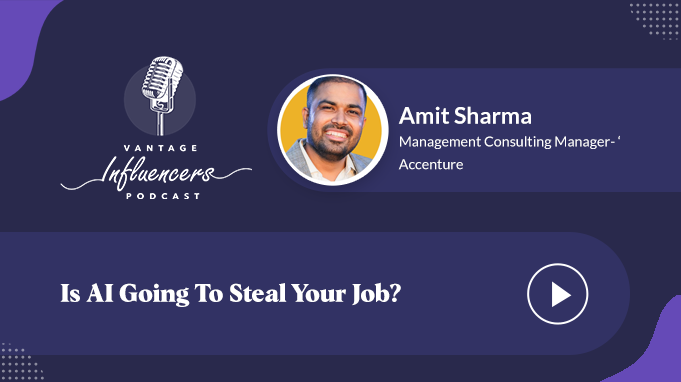
Is AI Going To Steal Your Job?
Episode Overview
Amit opens with a blunt take on the AI hype cycle: most of what people fear or celebrate about artificial intelligence today is shaped more by science fiction than by how the technology actually works. He walks through AI's real evolution, from a chess-playing bot beating a world champion in the 1990s to a system that taught itself an entire game with no human data at all, and argues that the tools everyone is suddenly obsessed with are, by his own admission, still fairly rudimentary. Along the way he pushes back on the idea that any one chatbot is uniquely revolutionary, pointing instead to who controls the most data as the real deciding factor in how this plays out.
From there the conversation turns to the harder question: what happens to jobs. Amit lays out a case that automation will not simply replace people one for one, but will hollow out repetitive tasks while pushing human roles further up the value chain, especially in HR. He is equally candid about the risks, walking through real-world examples of biased hiring algorithms and uncomfortable ethical dilemmas that come with letting machines make decisions on our behalf. He closes on a more hopeful note, making the case that human connection, empathy, and learning agility will matter more, not less, as automation spreads, and that the skills employers value will keep fragmenting into narrower, faster-changing micro-skills.
Episode Highlights
- AI's real breakthroughs trace back further than most people think, from a chess bot beating a world champion in 1997 to a self-taught system that beat the reigning AI chess champion without any human training data.
- Widely-hyped chatbots are, in his words, extremely basic technology that mostly resurfaces existing information rather than creating something new.
- Whoever controls the largest and highest-quality dataset, not whoever has the flashiest interface, will end up winning the AI race.
- Responsible AI is about fairness, privacy, and accountability, but real-world hiring algorithms have already shown how badly that can go wrong when trained on biased historical data.
- Automation will not erase jobs evenly. Repetitive, bottom-rung tasks disappear first while human roles move up the value chain, particularly in HR.
- Human connection and empathy are becoming more valuable, not less, as machines take over routine work, and learning agility will separate people who stay relevant from those who don't.
About the Guest
Amit Sharma, Management Consulting Manager at Accenture
Amit is an expert in transformation who has spent the last 8 years working at the nexus of technology and experience. His ability to develop content by fusing research, technology, and personal opinions has earned him a reputation as a top thought leader. This year, NHRD named him one of the Top 10 HR influencers, and People Matters named him one of the youngest Emerging Leaders. He has led significant projects across the world, including overseeing 800 workers across three continents as the HR Head for Tenshi Lifesciences in a previous role, and brings experience spanning line roles, consulting, and customer experience.
Host
Susmita Sarma, Vantage Influencers Podcast Host
What You Will Learn
- How artificial intelligence has actually evolved, from 1990s chess-playing bots to today's large language models
- Why widely-hyped chatbots may be less revolutionary than the headlines suggest
- What "Responsible AI" means in practice, and where it has already gone wrong
- The ethical dilemmas AI creates once it starts making decisions on our behalf
- What fraction of jobs are realistically at risk from automation, and which ones are safest
- Why learning agility and human connection will matter more as AI takes over routine tasks
Key Topics & Timestamps
| Timestamp | Topic |
|---|---|
| 01:16 | Amit's corporate journey so far |
| 02:42 | How AI has progressed in recent years, across diverse industries |
| 13:39 | Core areas where we can expect to see AI advancements at work |
| 16:22 | What is Responsible AI? |
| 19:39 | The shopping cart dilemma and the ethics of AI decision-making |
| 22:12 | What fraction of employment will be lost to automation? |
| 29:35 | What percentage of current jobs will be improved by AI? |
| 32:40 | Will AI create new job opportunities in the future? |
| 37:56 | What the future of work will mean for jobs and skills |
Full Transcript
Click to read the full episode transcript
In the recent years, artificial intelligence has aided in automating some monotonous jobs that humans perform across industries. It has contributed to increase the value that humans deliver in their job roles, but there is also a growing concern that automation may replace people, leaving us with no viable employment opportunities. So where does artificial intelligence go from here? Does it go from good to better or to worse? With this technology beginning to be really used in the workplaces, the discussion is becoming more heated.
Hi everyone, this is Susmita from the Vantage Influencers Podcast, in conversation with Amit Sharma, the Management Consulting Manager at Accenture. In this episode, you will know if AI is going to steal your job. So stay tuned and let's welcome our guest. Welcome to the show Amit.
Amit Sharma: Thanks for having me Susmita.
Susmita Sarma: Thanks for your time today Amit. So before moving on to the topic, would you like to tell us about yourself and your corporate journey?
Amit Sharma: Well, I think I started my life journey in a small town and then I moved on across the world. I graduated with a degree in HR and then I started my career in a manufacturing firm, started with typical HR roles of HR business partners, moved on to COE roles, performance, talent, and then did some project work there. From there I moved on to a pharma company where I was leading organization design globally for them, organization development globally for them. And then I was on an expatriation to South Africa for a good three and a half years, then COVID happened. I had to come back. I joined an Indian startup with around 800 people as their head of HR. And currently I'm working with Accenture Strategy. I am a Management Consulting Manager with them. So I've had the entire gamut of experience right from line roles, consulting roles, CX roles. So it's been a very interesting career till now.
Susmita Sarma: Brilliant career graph Amit.
Amit Sharma: Thank you.
Susmita Sarma: So moving forward with the topic today, Amit, is AI going to steal your job? So we use AI practically like every day and it has become a part of our lives today. So before we dig into how AI will affect human job roles and capacities, would you please explain how AI has progressed in the recent years, taking into account diverse roles and industries?
Amit Sharma: Sure. Thanks for asking this question, Susmita. Thanks for having this topic because you know, it's so pertinent right now. There are so many influencers talking about AI since chat GPT has come out. And I think a lot of how we think of AI has been shaped by Terminator movies and so on. We think it's a big thing whenever any machine replicates human intelligence, right? So any machine which does anything beyond basic common sense or basic calculation is basically artificial intelligence. And often, when I'm talking to students, I tell them it's not a new concept, it goes back to the 1950s. But I think it was only in 1997 when the world first really noticed AI, and a lot of that history goes to IBM. In 1997, IBM had one of their AI bots, Deep Blue, and it beat Gary Kasparov, the chess grandmaster, and the whole world was stunned. They were like, something big has arrived, how can someone beat Gary Kasparov? Then for the next 14 years, AI was lying low, growing quietly as a new technology. And then IBM Watson, which was and still is one of the most advanced AI systems in the world, won Jeopardy, which involves a very complex set of questions to win. And the world noticed again.
A few years after that, Google also started launching their own kind of chat interface. My favorite story in the evolution of AI, and one of the least mentioned, is that once everyone knew about IBM's bot beating Kasparov, Google created a bot called AlphaZero. They said they weren't going to teach it chess, not even an opening strategy, just the basic rules. Then they said this bot was going to play against Stockfish, which was the world's AI chess champion at the time. Without any training and no data on how humans have played for the last hundred years, which Stockfish had, AlphaZero beat Stockfish so comprehensively that the world was shocked. It didn't lose a single match. That was the first time people realized AI becoming self-sufficient and learning without humans had become a reality.
But coming back to your question on the evolution of AI, generally any technology's evolution depends on two or three factors. In the case of AI, it has always been computational power, Moore's Law, which says computing power keeps doubling every few years. The biggest factor for the evolution of AI is data availability. Most of the AI we have right now operates using machine learning, which means it looks at data and then learns, creating its own learning algorithms. Right now, the differentiator between a good AI and a great AI, and whoever wins this race for AI, will be whoever has the maximum amount of data. As the world has expanded, our data has grown, especially in the last 15 years, and that's why AI has experienced such growth. From a user point of view, the last factor would be internet speed. Earlier, you could ask a question but it would take a couple of minutes to get a response. Now it's almost immediate.
One thing I also want to add is that nowadays we've started seeing AI purely as a chatbot, which is not the case. AI is everywhere. When you're watching something and a platform asks if you're still watching, or when an app suggests content based on what you watched yesterday, or when you apply for a loan and they look at your past transaction data, or when you're typing and it suggests a better sentence structure, all of that is AI. I think almost everything you use right now has AI in it. Gaming is one of the best places to look at when you want to see AI's potential. Earlier, you had game characters, NPCs, that had a basic brain of their own, that was AI, and it's been there for maybe 20 years now. Now you have games where your choices decide the story, all happening using artificial intelligence and pre-taught scenarios. So basically, every industry you can think of uses AI in some form. But the artificial intelligence we have right now, and I know it's a controversial statement, is very rudimentary. Almost every industry has AI, but I wouldn't say any of them have been radically and completely transformed by it, except for a very few, because AI still has at least five years of evolution left. It's very basic right now.
Susmita Sarma: And nowadays everyone is talking about chat GPT, right? So is it just a chatbot or is it something so special that it's disrupting the tech industry as a whole?
Amit Sharma: It's a difficult question, but I like being honest and open about this. I'll say that chat GPT is not the most advanced technology the world has seen, to be honest. Then why is it so much in the news? There are two reasons. Microsoft released a similar chatbot back in 2016. Meta released a bot called Blender Bot in 2022. So it's not the first advanced chatbot. What happened is, to get technical, it's a large language model chatbot, but Google came up with something in 2017 that is key to this, which is the transformer architecture. Before the transformer technique, we used a different approach where every word was treated the same. So if I said a sentence, every word was treated as a single, disconnected unit, and that's why the response quality of previous chatbots was so poor. In 2017, Google came up with a way to look at the whole sentence, look at every individual word, and then use vectors to first assign importance and then assign the relationship between words. Chat GPT has used the transformer model brilliantly. That's the one thing that differentiates it and makes it more intelligent than a lot of what we've seen before. But again, I'll say chat GPT is an extremely basic chatbot in some ways. It only has training data up to 2021, it doesn't even know what happened in 2022. There's a research paper the team released describing how hundreds of people were used to train it: some people ask a question, others answer it, chat GPT also answers those questions, and another team rates whether it's a good or bad answer. It's like training a dog, good dog, bad dog. The reason I say it's rudimentary is because chat GPT is essentially going around the internet, finding things that already exist, and then tweaking them for you. It's making things that were already searchable on Google easier to find and reorganize.
But the reason chat GPT is so hyped is because tech and internet influencers need to hype it, otherwise their own relevance falls. Chat GPT can write code, but that capability has existed for the last five years on other websites. There are AI tools where you can give basic commands and it creates a presentation for you, or where you can tell it you've closed a new business lead and it will go log the entry into your CRM system directly. Those are more advanced than chat GPT in some ways. I think chat GPT is very high on publicity. I'll make a prediction, and I'm sure we'll come back to this recording five years from now: I think a much larger player is going to eclipse chat GPT, simply because in AI, the deciding factor is always how much data you have, and the biggest data holders haven't fully entered this race yet, for business reasons. When they do, they'll dominate, and then likely someone else, less bound by regulation, will out-compete even them, because different regions have very different rules for how much data companies can use. I also think that once the novelty wears off, only a fraction, maybe 20 to 30 percent, of overall search queries are actually going to want a conversational AI response. So it's not going to be as world-changing as people think, at least not yet. Right now I read on social media about founders saying they let go of their marketing team because chat GPT can do the work. I'll say this, and I know it's controversial: most of those claims are exaggerated for attention. The technology isn't evolved enough yet to fully replace people.
Susmita Sarma: So quickly moving on Amit, it would be great if you can talk about some of the core areas where we can expect to see advancements when it comes to AI, because it's definitely going to progress significantly in the coming years, isn't it?
Amit Sharma: I think you're right, AI is definitely going to progress significantly. The first thing that will happen, and it's already happening with tools like chat GPT, is that AI is going to help human beings a lot. It's going to be that friend you call to find things out. It will take away basic, repetitive work and help people do more with the work that remains. That's something that will happen over the next year or so, as AI evolves and as people get better at asking it the right questions. Even right now, tools already available in workplace software will take meeting notes for you, summarize open action items, and suggest what to write next. So one of the first things is that AI will start complementing human beings, making their lives easier. Then AI will be used a lot for decision-making, hopefully better decision-making. For example, workplace collaboration tools already have features that will tell you which teams are working in silos, by looking at the tone of emails and communication patterns. There was an experiment at an Ivy League institution where they gave everyone a wearable device and just had them go about normal workdays. Based on the device data alone, they could tell who the most influential and talented people were, based on tone and interaction patterns. Interviews will be automated too. So decision-making comes after that basic complementing stage. And then will come the AI automation revolution, where it starts taking over entire end-to-end responsibilities, even in fairly complex roles.
Susmita Sarma: Thank you for bringing up those points Amit, your expertise on the subject matter is evident and greatly appreciated. So moving forward, I came across research that says only 35% of global consumers trust how firms implement AI, and 77% believe corporations should be held accountable for how they use it. So apart from reaping its benefits, it's high time enterprises become aware of new and pending regulations and the procedures they must follow to ensure compliance. This is where the role of Responsible AI comes into play. So would you like to take a moment to describe what Responsible AI is?
Amit Sharma: Responsible AI is a term I think Google has been the flag bearer for. They have a page dedicated to it outlining the principles they work with. Basically, Responsible AI is about using AI with the right intentions: being fair, inclusive, and making sure security and privacy are built in. It's almost like their old motto, don't be evil. If you're using AI to remove biases, that's Responsible AI. If I take a step back, and forgive a bit of social commentary since I'm from a social science background, I mentioned earlier those older chatbots from Microsoft and Blender Bot. Within the first 48 hours of launch, both became extremely racist and sexist. This happened within about a week, and both chatbots were shut down by their companies because of the public backlash. I think we live in a different era of influencers now, otherwise even chat GPT would likely have already faced similar shutdown pressure, given that it's been shown to give instructions for illegal activity, make sexist or racist comments, or reproduce code from other sources without credit. So there's a lot that falls under the Responsible AI umbrella.
The second part is that AI now has a responsibility not just to guide you, but to give a final answer that's actually accurate. Google learned this the hard way, with a massive stock hit because their AI gave a few factually incorrect statements in a promotional demo. Interestingly, a competitor gave a similarly wrong response around the same time but didn't see the same market reaction, because we don't hold every company to that same standard of accountability yet. One nice example of Responsible AI: someone asked an AI assistant to write a cover letter, and it declined, saying that would be unfair to other applicants. That's a good instinct. But who decides what's ethical? One of the world's top e-commerce companies was using AI for hiring, training it on the historical selection patterns of their own recruiters. You have to feed data to the AI, right? They eventually realized their AI was so biased that it was systematically filtering out women, and filtering out anyone with a name it associated with a particular ethnicity, regardless of whether that was mentioned anywhere on the CV. So they decided to stop using AI in that recruitment process altogether. And then there's a bigger conversation happening now around what's sometimes called constitutional AI, where companies are trying to bake ethical guardrails directly into how the model behaves.
The last thing I want to bring up, and this is something I'm personally very interested in, is the difference between Responsible AI and ethics. There's something called the shopping cart dilemma that's worth exploring here.
Susmita Sarma: I've heard of it but I'm not entirely sure what it means. Would you like to explain that to us?
Amit Sharma: Sure. Imagine there's a self-driving car, say a Tesla, and you're sitting in it. It has AI behind the wheel. You're driving down a road, and there are four children playing on the road. If the car swerves to save them, there's a 90% chance you die instead. Now the AI has to decide: does it save those four children at your cost, or does it save your life and let the children be hit? Now make it more complex: there are ten children on the road, but it's you and your baby in the car. If you try to save the children, both you and your baby die. How do we decide? This is one of those dilemmas we'll keep struggling with as we go forward. Someone even joked that eventually, knowing how the world commercializes things, you might be able to buy a car that's programmed to prioritize your life for a higher price, versus a cheaper car programmed to prioritize the other person's life. And now you have to make that purchasing decision. Responsible AI and ethics in AI are things you're going to hear a lot about, and honestly, for the next five to seven years, we're going to handle this poorly, which we already are.
Susmita Sarma: So it's definitely an emerging field, and there's still a lot of work to be done to ensure it's developed and deployed in an ethical and responsible manner, isn't it? So now coming to the main point we really want to focus on today, what fraction of jobs will be lost to automation? To brief, it's argued that we'll be left behind if we don't implement AI, but with AI, human jobs will also be reduced in some ways. Automation is likely to affect different jobs differently, with some being replaced entirely and others being transformed but not necessarily eliminated. It's also said automation may create new job opportunities in technology, analysis, and design. So I have three questions for you here, Amit, in your opinion. First, what fraction of employment will be lost to automation?
Amit Sharma: It's a very difficult question, and I'll tell you why. There's a lot of prediction out there, saying something like 30% of jobs will be affected by a certain year. But historically, whenever there's been a disruptive technology, mobile phones, the internet, whatever it might be, those big predictions have usually been wrong by at least a factor of two, if not more. If you ask for my personal prediction, I think we may be the last generation that goes to work the traditional way. The nine-to-five as we know it will be over for almost 90% of us. By the time the next generation comes along, most people may be living in a largely jobless structure where most of the work is done by AI, though we'll likely be taken care of through mechanisms like universal basic income, which is already being discussed seriously. I like going back in history here. During the Industrial Revolution, when the steam engine arrived, the same argument came up every time: technology doesn't leave people behind, it just shifts what they do, and eventually more jobs are created. But human beings really only have two kinds of skills, physical and cognitive. Physical skills are something machines have already taken over, which is why people shifted toward cognitive skills, coding and similar work. Now AI is coming for cognitive skills too, including coding itself, and it's not obvious there's another rung to climb after that.
Coming back to the Terminator reference I made earlier, that kind of movie set us up to imagine this as one AI versus one human. But that's not the real dynamic. It's one human versus potentially millions of networked AI systems. When one AI learns something, it can teach that to an entire network instantly. When a human learns something, it generally stays with them, and they might pass it on to a handful of people around them. So the first shift in thinking has to be that this isn't a one-on-one contest. Second, it's not just that AI is coming for existing jobs. There are advancements happening in other fields simultaneously. Biomedical engineering, for instance, is advancing quickly, to the point where devices could eventually read certain signals from your brain in real time. Take creativity as an example. People often say AI can't be creative, can't write real songs or poems with the emotional resonance a human can. And right now, that's largely true, AI can generate the words, but not necessarily the feel. But now think about what happens if AI and biomedical engineering combine, the way companies working on brain-computer interfaces are already exploring. Ten years from now, imagine a device that knows exactly which beats and words you respond to emotionally, and knows your own personal history well enough to write something tailored only to you, hitting the exact emotional notes a human artist might reach for you by chance. Combine that with therapeutic applications, guiding someone gradually from denial to acceptance during grief, for example, and creativity starts to look like something that can be engineered too.
Susmita Sarma: So isn't that a bit of a dangerous thing as well, for the future?
Amit Sharma: You're right that in a way it reads our minds, but let me put it this way. I think our minds are a bit overrated. What is the mind, really? We think of ourselves as endlessly complex, but at a basic level, the mind is just a set of chemical responses to stimuli. So yes, I completely agree, this could be very, very dangerous, especially combined with all the other technology evolving alongside it. Even in everyday life you can already see mildly unethical uses of AI. For example, if I'm talking about a certain product out loud near my phone, and then I open a social media app and suddenly see an ad for exactly that product, that's AI, and it's not a particularly ethical use of it. Initially, a lot of this gets pushed back on. Governments say don't do this, don't do that. But historically, it usually takes one major disruptive event for society to loosen those restrictions. Look at the two World Wars, some of the worst periods in human history, yet also periods of enormous scientific advancement. In the next couple of decades, some similarly disruptive event, another major crisis of some kind, could be the trigger that causes us to let a lot of these guardrails slip, the way we've done historically. I really hope that's not the case, but I don't think the current trajectory, where AI is already listening to us and making decisions for us in the background, is particularly reassuring either.
Susmita Sarma: And Amit, I'd also like to know, what percentage of current jobs do you think will be improved by AI?
Amit Sharma: I think that would be 100%, for sure. If you look at how jobs are currently structured, take HR as an example. Initially, HR had to do a lot of manual work: pushing paper, managing forms, and so on. Now a lot of that is handled by ERP systems. The next phase of evolution, and this will happen for pretty much every job, is that repetitive, redundant tasks get automated. In HR, a lot of effort used to go into handling basic queries, telling employees what a policy is or where to apply for something. That's already being handled by chatbots in a lot of companies. Someone can just ask a bot what their leave balance is instead of going to HR and waiting five minutes for an answer. So AI is going to enrich essentially every job in that sense. Then comes the next phase, which is AI supporting decision-making. Right now there's a rush across every HR software platform to build skill-matching and internal marketplace features. Five years ago, if you wanted to find the best person for a role, you'd have to ask around or advertise externally, even within your own company. As AI matures here, it already flags people within an organization who are strong fits for a role before that role is even posted externally. The next level of evolution beyond that is AI inferring your skills automatically, from the projects you've worked on, rather than you manually entering them. This moves every job up the value chain, especially HR. There will likely be fewer people in HR roles, but the work they do will carry far more strategic weight than answering routine queries. The same trend will apply broadly. Basic coding will increasingly be handled by AI, and the human role shifts to directing and refining that work. If someone wants to build something as an entrepreneur, they may not need to code at all, AI will help them build with no-code tools. So overall, AI is going to push almost every job a little higher up the value chain over the next few years, and in some cases it already has.
Susmita Sarma: Also, I believe you'll agree that AI will create new job opportunities in the future.
Amit Sharma: I think it already has. Huge amounts of capital have been invested into AI, and that has created a lot of new roles, coders and beyond. There's a popular meme about a news helicopter: a cameraman used to film aerial news footage, and the joke is that within a decade both the cameraman and the pilot lost their jobs to a drone. It's a funny meme, but it's factually a bit misleading, because flying that drone well isn't a one-person job either. You typically need someone piloting it, someone managing the camera, someone monitoring altitude and safety, and so on. Similarly, defense forces have started replacing some fighter pilots with drone operations, and while that's technically one pilot's job changing, a single military drone might require a team of around 30 people to operate and support it. So technically, AI is creating jobs, often better, more specialized jobs, and that trend is likely to continue. That said, some job categories will genuinely be under threat. If autonomous driving becomes mainstream, it would create jobs for the engineers managing that system, but it would also put well over a hundred million driving-dependent jobs globally at risk, and that's a much larger number than the jobs created to replace them. Similarly, very routine, low-complexity roles, security guards monitoring for basic movement, for instance, are more exposed, since AI can already handle detection and access control well. But most corporate-style jobs will likely stay and actually improve, and a lot of new, value-adding roles will emerge where AI does the analysis and humans make the decisions and take the actions based on it.
Susmita Sarma: So it all means that AI will have all the knowledge, the data, and the information, but ultimately it's a human who operates the machine.
Amit Sharma: In certain scenarios, the basic idea behind AI is that eventually it becomes independent enough to manage tasks on its own. But I think initially, and for a long while, it'll work like this: AI surfaces the data, and either a human makes the final decision, or AI recommends a decision but a human still signs off on it. For at least the next ten to twenty years, I think AI will mostly play a supporting role to humans handling the more difficult judgment calls. There's a saying that there's no substitute for human ingenuity, and as of right now, I don't think AI has reached that point. We'll have to wait and see how far it can actually go.
Susmita Sarma: We also talk a lot nowadays about empathy, respect, and freedom in the workplace, all the human connections, feelings, and emotions that we try to maintain at work. So once AI replaces certain roles, are these things going to stay?
Amit Sharma: There's a pattern here. The fewer people you need to generate a given amount of revenue, the more valuable each of those remaining people becomes, and that's something technology has consistently shown us. Once that happens, the importance placed on people actually goes up, and that's why the future increasingly belongs to HR. Imagine an organization that used to need a sales force of a hundred thousand people to hit a certain revenue target, and now, because of AI-driven digital marketing and sales tools, only five people are needed to generate the same result. Those five people become incredibly valuable, worth investing heavily in, because they're now generating that same outsized outcome. So the importance of the people who remain in these roles is going to keep rising every year, and that's actually great news for HR, because it usually comes with higher budgets and a stronger mandate to invest in people. I think the pandemic already pushed conversations about empathy and human connection to a completely different level of seriousness, and I believe they're here to stay permanently. I do think AI can eventually get quite good at detecting how you're feeling, even detecting when you're not being fully honest. But if you need to actually be made to feel a certain way, genuinely supported or understood, that has to come from another human being. So you're right, these things are genuinely important, and they're not going away.
Susmita Sarma: And talking about the modern workforce's future, young people need to bring more than just knowledge into this workforce. Apart from leveraging AI for their own benefit, the most important skills for the future include critical thinking, creativity, curiosity, and communication. So what do you think the future of work will mean for jobs and skills, Amit?
Amit Sharma: On skills, you'll see a real trend shift. We used to talk endlessly about competencies, and those competency frameworks stuck around for five, ten years at a time. Right now, if you look at any of the major HR software providers or major thought leaders in this space, you'll barely find the word competency being used anymore. It's been replaced by skills. Give it a couple more years, and even skills as a category will get replaced by micro-skills. What's happening is that what we used to lump together as a broad skill or competency is now being broken down into much more specific pieces, because of how fast AI and workplace movement are evolving. Saying someone is a good presenter or has good communication skills is too broad now. We need to get very specific: this is exactly what this person does well, these are the three micro-skills behind it, and this is precisely how it helps them do this particular job better. That's one of the biggest shifts happening in the entire skills and learning space.
The other thing worth mentioning is a report from the World Economic Forum, which found that the half-life of a skill has dropped to around four years, and for technical or coding skills specifically, it's closer to two to three years. To put that in perspective, if you learn a skill today, within four years roughly half its market value or relevance is likely gone, and within about eight years, the entire skill may hold little practical value at all. It's even worse for coding and other fast-moving technical skills. What this means practically is that people are going to be doing a lot more relearning and reapplying of skills on an ongoing basis, and that's already happening and will only accelerate. Learning agility is going to be the real differentiator, for companies, for employees, for individuals. If you're someone young listening to this, remember that in earlier generations, someone could learn one narrow technical skill and coast on it for twenty, thirty, even forty years. Today, you could be one of the best in your field at a particular technical skill, and be largely outdated within five years. So learning agility is going to define who stays relevant. Anyone who stops learning now is going to become irrelevant eventually, even if not immediately, simply because the world keeps moving.
The second point ties back to the Gary Kasparov story I opened with. When AI beat him, it was a watershed moment, but the reaction wasn't "let's stop playing chess altogether." That's not how humans work, we're naturally resilient. What happened instead is that people started using AI to train chess players. Now everyone, not just grandmasters, can practice against AI opponents tuned to a specific style or difficulty level, completely free. So two things happened: we started using AI as a learning tool, and that capability got democratized and made freely available. I think the same pattern will play out for learning and skills more broadly. Right now, if you want to learn to code, you take a course and learn from an instructor. In a few years, you'll likely be coding directly, with AI giving you real-time feedback: this part is good, this part isn't, here's a better way to write it. Initially that kind of tool will be paid, and eventually it'll become free, that's just the pattern with how these things tend to play out. So overall, AI is going to make people's working lives significantly better as this unfolds. There is, of course, a real downside and risk, since AI itself is ultimately controlled by people, and we have to hope it continues to be used with good intent, the way it largely has been so far.
Susmita Sarma: So it would be great if we're trained and equipped to operate alongside machines, rather than against them, isn't it?
Amit Sharma: That's exactly where things are headed. It will always be humans and machines complementing each other.
Susmita Sarma: That's very well said. And young workers should be trained for that. I think we should have an ecosystem where we teach about machines and AI right from the school level, isn't it?
Amit Sharma: Schooling is actually a very sensitive subject for me, if you ask me. I don't know why the schooling model created a hundred or more years ago is still largely what we follow today, still treating every seven-year-old as identical and putting them all in the same grade, teaching them all the same material through rote learning. What you said is genuinely important. A hundred, a hundred fifty years ago, there were no computers, no AI. Simply knowing things and having access to information was the differentiator between success and failure, that's essentially how we used to define who was exceptionally capable versus who wasn't. That's not the reality anymore. Information is now readily available to everyone. Interpreting it and applying it well is what separates success from failure today, and honestly, our school and college systems don't really prepare people for that. And it's not just school and college. Even for someone already working as an HR professional, it's worth recognizing that the way my generation learns is genuinely different from how someone a decade younger learns, and you have to adapt how you teach and train accordingly. Like you said, technology and learning need to evolve together. If that doesn't happen, whatever people learn is only going to stay valuable for a very short window of time.
Susmita Sarma: Well, thank you so much, Amit, for all that you've shared today. Honestly, your knowledge and understanding of the field of AI are truly impressive, and I was amazed by the depth and breadth of your insights. So if our audience wants to connect with you further, where can they find you?
Amit Sharma: Sure. The first thing I'd want to say is that when you look at the entire AI conversation, there's both a doomsday view, which is the lens I largely took today, and a more optimistic prediction about AI being an overwhelmingly positive force, which is a conversation I could have another day. There's actually a well-known public conversation between a prominent historian and an AI scientist where they deliberately argue opposite sides of this, one focused on the risks, the other on the upside. I'd recommend anyone interested go find and watch that. But if you want to reach me, I'm quite active on LinkedIn, I post almost every day or every other day, so that would be the best place to find me. My name is fairly common, but adding my company name should help narrow it down. You can also find me on Twitter, where I'm a bit more informal and opinionated, under a handle referencing HR.
Susmita Sarma: And I just want to clarify, don't listen to this podcast and walk away thinking everything is doomed. We're all just predicting the future here.
Amit Sharma: Exactly. The next time you talk to me, I could easily be arguing the completely opposite side, about how AI is going to make the world a genuinely better place.
Susmita Sarma: Sure Amit. Thank you for your time today, for sharing your knowledge and expertise with us. Truly appreciate it.
Amit Sharma: Thank you so much, Susmita, for having me and for asking such great, pertinent questions. It was great.
Thanks for listening to the Vantage HR Influencers Podcast. Please do subscribe to the Vantage HR Influencers Podcast on Apple Podcasts, Spotify, and our YouTube channel for new episodes.
FAQ
Is AI actually going to steal your job?
Not in a simple, one-for-one way. Amit Sharma argues that automation hits repetitive, low-complexity tasks first while pushing most human roles further up the value chain rather than eliminating them outright. Very routine jobs are more exposed, but most corporate roles are more likely to be transformed than erased.
What is Responsible AI?
Responsible AI means building and using AI systems with fairness, inclusion, privacy, and accountability built in from the start. Real-world failures, like hiring algorithms trained on biased historical data that filtered out women and candidates from certain backgrounds, show what happens when these principles are skipped.
Will AI create new jobs even as it automates old ones?
Yes, according to Amit, though not always in equal numbers. Automating a task like flying a reconnaissance drone can still require a team of specialists to operate and support it, so AI often creates more specialized roles even as it removes simpler ones. The net effect varies significantly by industry.
What skills will matter most as AI takes over routine work?
Learning agility tops the list, since the World Economic Forum estimates the half-life of a skill has dropped to around four years, and even less for technical skills. Beyond that, human connection, empathy, and judgment become more valuable precisely because they are the hardest things for AI to replicate.
Related Reading
Also listen on