Leveraging Employee Feedback to Shape Policies and Enhance Engagement
Episode Overview
Pooja Malhotra opens this episode by drawing a sharp line between collecting feedback and truly listening to it. She walks through why formal mechanisms like an annual global engagement survey need to work alongside informal channels, such as regular HR business partner check-ins, ask-me-anything sessions, and open town halls, and why leaning on just one of these leaves real employee sentiment unheard. From there, she shares concrete examples of how a single engagement survey theme around career growth and upskilling turned into a company-wide learning platform, a global job architecture project, and a locally designed program built around the specific skills employees said they wanted.
The conversation then moves to trust: what it actually takes for employees to feel safe sharing honest feedback, and why closing the loop on that feedback matters as much as collecting it. Pooja explains how confidentiality safeguards, third-party survey administration, and consistent follow-through build the kind of psychological safety that keeps people willing to speak up. She also discusses how AI is starting to speed up feedback analysis without replacing the human judgment and empathy that HR business partners bring to interpreting it, and closes with practical guidance for leaders on staying open to feedback, acting on it quickly, and having honest conversations before issues turn into blind spots.
Episode Highlights
- Pooja Malhotra distinguishes true listening from simply collecting data, pointing to the need for both formal engagement surveys and informal channels like HR business partner check-ins and ask-me-anything sessions.
- She shares how engagement survey feedback directly led to major policy changes, including a company-wide learning platform rollout and a global job architecture project to clarify career pathways.
- At a local level, similar feedback shaped a targeted program built around the specific skills employees said they wanted to develop.
- Building trust requires strong confidentiality safeguards, such as third-party survey administration and suppressing scores for very small teams, alongside open forums where leaders answer questions directly.
- AI is speeding up how feedback is analyzed into trends and themes, but human empathy and judgment from HR business partners remain essential to interpreting it well.
- Leaders build lasting trust by staying open to feedback, acting on it quickly, and having honest, consistent conversations with their teams instead of waiting for problems to surface on their own.
About the Guest
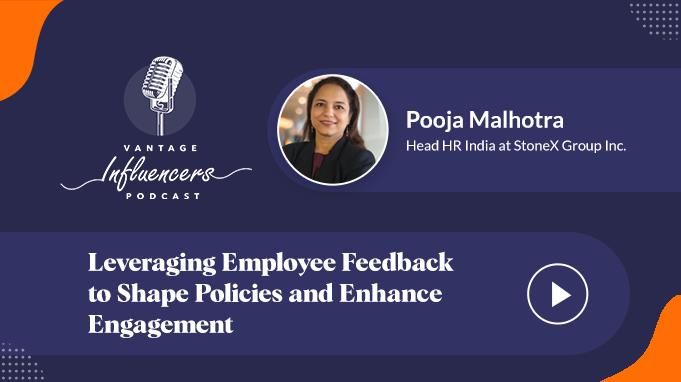
Pooja Malhotra, Head HR India at StoneX Group Inc.
Pooja Malhotra is a seasoned HR leader with over 20 years of experience across HR and business roles spanning global capability centers and large multinational organizations. She currently serves as Head of HR for StoneX India GCC, where she leads people strategy, HR policy design, compensation and benefits, and employee engagement for the region. Prior to StoneX, she was VP, Chief of Staff for the Platform Solutions division at Goldman Sachs in Bengaluru, and before that led HR for the British Council Shared Services Centre in the UK, where she helped build its HR framework and policies from the ground up. Pooja is known for reducing attrition, driving high employee satisfaction, and improving internal job mobility through effective HR practices.
Connect with Pooja on LinkedIn
Host
Riha Jaishi, Vantage Influencers Podcast Host
What You Will Learn
- How to distinguish true employee listening from simply collecting feedback data
- How formal engagement surveys and informal channels work together to surface honest input
- How feedback has directly shaped global and local policy changes, from learning platforms to job architecture projects
- What it takes to build the psychological safety employees need to share honest feedback
- How AI is changing feedback analysis without replacing human judgment
- What leaders can do to actively integrate feedback into decision-making instead of passively accepting it
Key Topics & Timestamps
| Timestamp | Topic |
|---|---|
| 00:00 | Cold open and episode introduction |
| 01:15 | Pooja Malhotra's HR career journey across StoneX, Goldman Sachs, and British Council |
| 03:08 | What true listening means beyond just collecting survey data |
| 06:58 | How engagement survey feedback shaped global and local policy changes |
| 11:58 | Building trust so employees feel safe giving honest feedback |
| 17:26 | How AI and engagement platforms help turn feedback into action |
| 22:55 | Using feedback to predict workforce trends and behaviors |
| 27:02 | What leaders can do to actively integrate feedback into decisions |
Full Transcript
Click to read the full episode transcript
Welcome to the Vantage Influencers podcast. This podcast is sponsored by Vantage Circle, the simple and effective recognition platform for employee engagement.
Riha Jaishi: Hello, everyone. Welcome back to another episode of the Vantage HR Influencers podcast. I'm your host, Riha, and today we're diving into a topic that's crucial for modern organizations: how to leverage employee feedback to reshape policies and drive deeper engagement. As work environments evolve, so do employee expectations. What worked in the past no longer really applies to shaping a thriving workplace culture. Employees want to be heard, and their feedback can be the key to creating policies that not only address their needs but also foster stronger engagement and retention. And to help us break this down, I'm joined by Pooja Malhotra, Head HR India at StoneX Group Inc. Welcome to the show, Pooja. It's a pleasure to have you with us today.
Pooja Malhotra: Thank you. Thank you, Riha. Pleasure is all mine.
Riha Jaishi: We are equally delighted. So to kick things off, Pooja, can you briefly take us through your professional journey so far? We are eager to learn about your journey.
Pooja Malhotra: Thank you, Riha. Like you said, I currently work with StoneX. It's a global capability center based in Bengaluru, however we have two locations, Pune and Bengaluru. I head human resources for the StoneX GCC India, and I also help StoneX manage other India entities that they are in the process of setting up. Before StoneX, I was with Goldman Sachs for about a year and nine months in a different, more business-connected role as Chief of Staff in the Platform Solutions division. And before Goldman, I was Head HR for British Council's GCC in Noida for 11 years. Before that, I was with Evalueserve in Gurgaon, where I joined as entry-level junior HR and, by the time I left six years later, was Senior Manager for Human Resources. Evalueserve gave me a lot of exposure, from general HR to corporate HR and finally leading the entire HR business partnering team. So overall, about 20-plus years in HR, particularly in the global capability center industry, which we are seeing evolve as we speak.
Riha Jaishi: That's such an inspiring journey, Pooja. Thank you so much for sharing your experience.
Pooja Malhotra: Thank you, Riha.
Riha Jaishi: Okay, so now with your permission, I would like to delve into our topic further, shall we?
Pooja Malhotra: Sure, sure. Absolutely. Go ahead.
Riha Jaishi: We often hear about the importance of employee feedback, but what does it actually mean to truly listen? And how does it really differ from just collecting data?
Pooja Malhotra: I think true listening, and not just collecting feedback and data, is about establishing and instituting strong processes around what helps us listen. You could have formal and informal processes. An example of a formal process is an engagement survey. At StoneX, we run an annual engagement survey, typically in March every year. This is global, done across the firm, and then we look at results regionally and globally and try to analyze the data. Informal listening can be done in multiple ways. HR business partners are absolutely key to maintaining that connect and bond, both with leaders and with employees. At StoneX, especially for India, we give our employees both formal and informal channels, locally and regionally, to reach out to HR. For example, maybe every six months we'll do an ask-me-anything session with HR, especially after a policy has changed, or once a year or once every six months we'll do HR Connects, and we try to ensure that at least 80% of the organization attends. There will be some structure to those conversations where we give updates, but a large part of it is free-flowing, where people can ask any question. Sometimes it leads to very interesting debates, and as an HR business partner you understand what the pulse is, what is going on in people's minds, and what their worries are. Typically, the engagement survey is a very important tool because it helps collect and analyze data. It's a great tool to show our leaders how the trends are moving, and it helps leaders interpret the results and take actions, which we have seen in our engagement survey journey, especially here at StoneX and in my previous organizations too.
Riha Jaishi: Pooja, these are some interesting initiatives you've shared about establishing processes for formal and informal listening, and how engagement surveys are crucial and how StoneX has implemented them for proper feedback. It really sounds like organizations need to take that extra step to show they are genuinely engaging with feedback and using it to drive change, right?
Pooja Malhotra: Yes, absolutely. It's very important, because otherwise it doesn't establish that circle of trust. If you take feedback from people but don't do anything about it, there will be a point when people stop giving feedback. There has to be an action. You have to close the feedback loop and the communication loop around it.
Riha Jaishi: Okay, so now moving ahead, can you give an example, Pooja, when feedback had directly led to a major policy change?
Pooja Malhotra: I can talk about a global policy change and a local policy change. The feedback that came in our engagement surveys, about a couple of years ago, the Global Engagement Survey at StoneX told us there was a lot of feedback around career development, upskilling, training, and people's growth. People were concerned because they thought we should have more opportunities and more avenues available for it. That led to two big initiatives. One was investing heavily in LinkedIn Learning, so today anybody who joins StoneX globally gets a LinkedIn Learning license with suggested career pathways that people can take to understand StoneX's culture and competencies better, and managers can suggest pathways for building specific skills, both technical and soft skills. That was a big policy change from a couple of years back. Also based on that feedback, we started a global job architecture project, which aims at clarifying global career levels and titles so people can see growth, see career pathways, and see what the next level looks like, with LinkedIn Learning as one of the tools available to support that. Those are two global examples of a key policy change. I can also talk about a local example. We received similar feedback for India in the last engagement survey: people agreed there is a job architecture project and LinkedIn Learning, but asked what we could do locally to help them develop technical and other domain skills and get to know the business better. So with a specific team, we started a three-month program to identify the specific skills employees wanted to develop. From a broader list, we shortlisted skills such as building smart dashboards and reducing manual work through better reporting, and effective communication. One of these has already been delivered and the other is in the process of being delivered, and I think that's something people really appreciated. Both globally and locally, these are instances of where people said something, we heard it, and we ensured we did something about it so people could see the change and the outcome for themselves.
Riha Jaishi: Pooja, these are some really powerful examples of how feedback influenced policy. StoneX literally heard the employees and made the necessary implementations and changes. It really shows that when organizations act on feedback, it not only addresses the issue but also strengthens the bond with employees, which you've been able to establish.
Pooja Malhotra: Absolutely. It's about intent. Doing a survey and taking feedback from people has to be done with the right intent, which is to hear what people have to say. Of course, we cannot cater to everyone's wish list, but we try to understand the trend and what people are trying to tell us, and if there is something we can do as an employer to contribute to people's growth and careers, and if it's fair, then we will definitely act on it.
Riha Jaishi: Yes, absolutely. Now, moving ahead. One of the challenges with employee feedback is ensuring employees feel their voices are heard. How can organizations build that trust so employees feel safe enough to share their honest feedback?
Pooja Malhotra: This aspect of feedback sharing is absolutely critical. There are two schools of thought: one is about anonymous feedback, and the other is that some leaders believe we should create such a safe space that it's okay for everyone to stand up and voice what they feel. At StoneX, we believe in giving people multiple opportunities across both areas. There are strong processes that define how people can give feedback in a confidential and safe space where anonymity is maintained. Our engagement survey, for example, is not run through an in-house tool; a third party conducts the survey, and there are specific guardrails built around how the data is looked at and analyzed. For instance, if a team has fewer than five people, the scores are not shown, because then you could actually identify who gave that feedback. There are guardrails like that, and leaders also communicate to people before the survey starts that it is absolutely confidential and that a third party maintains the anonymity and confidentiality. On the other hand, we also give people platforms where, say, when leaders are visiting India, we organize connects with interns or specific teams, and there's always an open Q&A portion. People ask very interesting questions. We do regional town halls and global town halls; we had one last week where people could ask our executive committee any question. Most questions were taken up, even ones around regional nuances, and our executive committee took time to answer them. There's a feature called Ask ExCo on our internal website, where people can ask a question to any executive committee member, and if they choose to, they can ask in a confidential manner. So having those strong processes is important, along with what I said earlier about closing the feedback loop. People will continue to give feedback if they believe somebody is listening and doing something about it. That builds trust: if I say something, there is a listening ear, an opportunity where the management team, the executive committee, or human resources listens to the feedback I give and does something about it. I think both things are important: having strong processes and guardrails in place, and having the intent to close the feedback loop.
Riha Jaishi: Pooja, you've made some important points here. First, about the processes you mentioned to ensure feedback flows through different channels and styles, and second, about closing the feedback loop. I think that's the most important part, that intent of listening to employees and actually putting it into action so the process continues.
Pooja Malhotra: Yeah, that's absolutely true. At StoneX we have both: strong global processes that give people trust that their feedback is confidential, and local processes where, as HR business partners, we ourselves go and listen to people, and we also encourage our leaders to go to people, understand their concerns, and then work with the leaders to close the loop and plan actions that are visible and have specific outcomes.
Riha Jaishi: That's great. So how are tools like AI or employee engagement platforms changing the game here, Pooja? And what role do they really play in turning feedback into meaningful action?
Pooja Malhotra: AI is changing the game in every field, including human resources. We are already using AI to analyze our engagement survey feedback; there's an option to generate heat maps across teams and across the feedback themes coming in, and AI does that for you. AI will make the analysis of feedback far faster and quicker and give specific trends to look at, but you have to apply some human knowledge and intelligence too. That's why I keep saying HR business partners need to know the pulse on the ground, to not just blindly believe what AI is telling you, but to understand that AI is another tool giving you a faster analysis, and then as an HR business partner you add your own analysis to what AI gives you. Both have to go hand in hand. AI will make it faster, for sure. One of the goals for the global HR teams this year is to explore how AI can help improve employee experience. We're looking at different agents that can help through self-service, or a policy-trained agent that can answer people's questions, and while people use these agents, there will be an analysis of the kinds of questions being asked, which tells us which policies or benefits need to be better explained to people. One of the most popular queries we get is around benefits, for example insurance benefits. These are huge policy documents sitting on our SharePoint, and I believe every organization has that. But every person, every new hire, and even tenured employees, will have questions when they specifically face a situation, because they won't look at the insurance policy at the start of the year. So what can we do to help them understand better? Is there a chatbot or an agent that can analyze their specific queries and answer basic questions up front, saving both the employee's time and the HR business partner's time, for a better experience overall. Those are some of the priorities. AI is certainly one of the priorities we will work on in StoneX, especially in HR, looking at how we can apply AI not just for efficiency but also to improve employee experience.
Riha Jaishi: So this thing about AI that you mentioned, Pooja, about making feedback analysis faster and quicker, I guess that's one of the major key takeaways, and how it has to go hand in hand with the human, personal, and analytical aspect as well. And how AI can be leveraged for enhancing employee experience is another key point you made. So these AI tools are really making it easier, or at least faster, for HR teams to respond in real time and accelerate the feedback process in organizations, right?
Pooja Malhotra: Absolutely. One of the things I believe is that feedback delayed, action delayed, is action denied. If I gave feedback today and action was taken nine months later because somebody was analyzing data on spreadsheets, that's not the employee experience we want to deliver. If there's low-hanging fruit, if there's an action that needs to be taken immediately, AI will support that, because it gives you data points and things you or your leaders can act on. That's one of the uses I'm really looking forward to from AI implementation.
Riha Jaishi: Well said, Pooja. Okay, moving ahead. What do you think, Pooja, about how organizations can use feedback to predict trends and behaviors within the workforce?
Pooja Malhotra: We've spoken a lot about the data around feedback and how it can be analyzed. I said AI can help generate faster data analysis, but you also have to use your human quotient, and that human quotient is empathy. As an HR business partner, you have strong ears on the ground, you connect with people, and you hold regular informal and formal conversations with them. You'll understand how and when to use that empathy along with hard data analysis from AI. Also, the analysis and the themes it generates can certainly lead to several actions and indications of what specific steps need to be taken, and the intent has to be there with management and leaders to close the loop on that feedback. Another important factor, which I've mentioned before, is that HR business partners have to maintain strong connections with both their leaders and their people, because HR business partners are in a unique position to build that bridge and bring leaders closer to people. That's really where they can be the champions of organizational culture, understanding that in a specific pocket there are certain issues, alerting the leaders, working with them to create a joint action plan, and helping support the leaders in putting that action plan in place. I think these aspects will help us predict trends and behaviors, and HR, specifically HR business partners, sit right in the middle of that.
Riha Jaishi: So this thing about empathy, Pooja, that you mentioned, I guess that's the most crucial point here, that every HR leader out there should try to focus on. Empathy is the core of every process and every organization, and this point about building connections with leaders and employees is also one of the major factors in predicting trends and behaviors within the workforce.
Pooja Malhotra: Yes, absolutely, and I see it playing out every day, not just here at StoneX but in my previous organizations too. HR business partners play a very crucial and important role in bringing leaders and people together, and they sit on a wealth of information in terms of feedback, whether gathered through surveys that might be annual, semi-annual, or even monthly in some cases, and through other channels and opportunities HR business partners create, like HR Connects, open forums, and ask-me-anything sessions. All of this contributes to understanding what people are thinking on the ground and what should be our action plan, but everything has to be done in partnership with the business and the leaders.
Riha Jaishi: Absolutely. So now, while we try to wrap it up, what can leaders do to actively encourage and integrate feedback into their decision-making process rather than just passively accepting it?
Pooja Malhotra: Be open to feedback. Leaders have to be open to feedback; I think that's a very critical leadership trait. I've seen several instances here at StoneX. For example, I mentioned the executive committee town hall that happened last week; it's actually a regular feature that happens every quarter, where the executive committee takes questions directly from people, either sent before the town hall or asked live. I've found our executive committee leaders to be absolutely open to answering questions and open to feedback. There's also Ask ExCo, a feature on our internal website where anybody can ask any question of our executive committee. That tells me our leaders at StoneX are absolutely open to feedback, and that's the first step. The second leadership trait I'd talk about is the intent to take action. Being open to feedback is one thing, but what do you do with it? There has to be an intent to take action, and quicker, timely action. It cannot wait for months. Today's world is very different, and especially with a multi-generational workforce, you need to be very conscious about how much time you take to act. Our executive committee is absolutely clear about the organization being nimble in decision-making, so my confidence is there that our leadership today is open to feedback, ready to take action, and will take action. I think another trait leaders, and even middle managers and mid-layer leaders, can display is having open conversations with their teams about what they can do better and what they can change. Sometimes, in the whirlwind of putting out fires, it's difficult to maintain an objective point of view, and even as leaders you develop a few blind spots. But if you have an open and trustful relationship with your team, and this won't happen in a day, a leader may need to ask multiple times, maybe five or ten times, before some feedback trickles down to them, it's about doing that consistently and closing the feedback loop. If a leader does that, I think that's how they build trust with people, so that feedback can be shared, acted upon, and any feedback can be given.
Riha Jaishi: Pooja, these are some amazing pointers that leaders should really implement or look forward to in the feedback process. That openness to feedback in leaders is one essential thing, and intent to take necessary action, but definitely in a quicker and timelier manner as you said, and having honest conversations with team members, which is one of the best ways to build trust, along with closing the feedback loop. These are things all the leaders out there who haven't really been able to pull this off should focus on and try to implement.
Pooja Malhotra: Oh, absolutely. In fact, there are several tools available today for leaders to build their self-awareness too. They can take self-assessments that tell them their strong areas and where they should develop, and that builds self-awareness and openness. There's a lot of work leaders have to do for themselves in that space, and for me that's self-development. Keep asking for feedback from your teams, from the people you work with, your peers, your colleagues. Everybody will have something to say and a different blind spot for you.
Riha Jaishi: Absolutely, and consistency should be the key, right?
Pooja Malhotra: Consistency. Oh, yes, absolutely.
Riha Jaishi: Okay, Pooja, we have finally come to the end of our session. Thank you so much, first of all, for joining us today, Pooja, and sharing incredible insights. It's been more than a pleasure hearing your perspective on leveraging employee feedback to shape policies and enhance engagement, and we truly appreciate your time and expertise. I'm sure everyone tuning into this session is inspired by your expertise and is walking away with a wealth of information to ponder.
Pooja Malhotra: Thank you so much, Riha. Pleasure is all mine. It's always great talking to Vantage Circle and people like you. Thank you so much. You have a good day.
Riha Jaishi: Thank you once again, Pooja. And to our listeners out there, thank you for tuning in. We hope you found today's conversation as enlightening as we did. So until next time, take care, and we'll see you soon.
FAQ
What is the difference between collecting employee feedback and truly listening to it?
According to Pooja Malhotra, collecting feedback is simply gathering data through surveys, while true listening requires strong formal and informal processes that let people speak freely, such as annual engagement surveys alongside HR business partner check-ins, ask-me-anything sessions, and open town halls. Listening also means analyzing what the data is telling leaders and acting on it, not just recording it.
How can organizations use employee feedback to shape HR policies?
Pooja shares that engagement survey themes around career growth and upskilling directly led to a company-wide learning platform, a global job architecture project to clarify career levels, and a locally designed program built around the specific skills employees wanted to develop. The pattern in each case was the same: identify a recurring theme in the feedback, design a policy or program around it, and make sure employees can see the resulting change.
How can companies build trust so employees share honest feedback?
Trust comes from strong confidentiality safeguards, such as using a third-party survey administrator and suppressing results for teams too small to stay anonymous, combined with open forums like town halls and executive Q&A features where leaders answer questions directly. Just as important is closing the feedback loop: employees keep giving honest feedback only when they see that it leads to action.
What role does AI play in analyzing employee feedback?
Pooja explains that AI is already being used to generate heat maps and identify themes across engagement survey feedback, making analysis significantly faster than manual review. However, she stresses that AI should complement, not replace, the human empathy and on-the-ground judgment that HR business partners bring when interpreting what the data actually means for people.
Related Reading
Also listen on