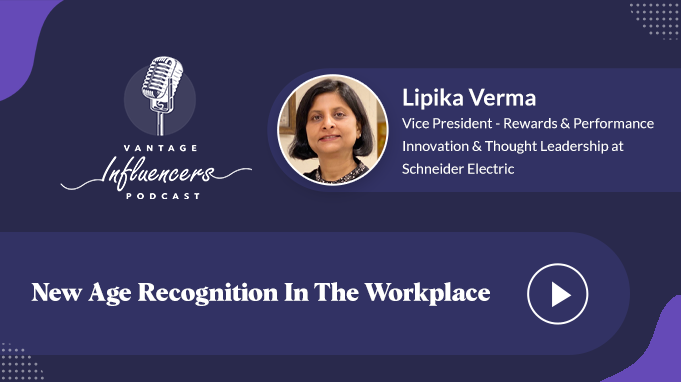
New Age Recognition In The Workplace
Episode Overview
Lipika Verma opens the conversation by reframing recognition as part of a larger total rewards philosophy, something that sits alongside compensation, benefits, and career development rather than as a nice-to-have layered on top. She argues that when recognition is genuine, timely, and aimed at the right person, it becomes one of the most powerful levers for keeping people motivated, more so than isolated perks or one-off gestures. She also digs into what happens when recognition goes wrong, describing how uneven or performative recognition breeds envy on teams and pushes people to keep score against their colleagues instead of focusing on their own contribution.
To make the case personal, she shares a story from her own childhood, about winning a painting competition and the memory of her parents watching from the audience, to show how early recognition experiences can shape a person's drive for decades. From there she moves into practical territory, listing the recognition mistakes she sees most often, from tying recognition to arbitrary metrics to letting it arrive months too late, and makes the case that recognition cannot be a top-down responsibility alone; peers thanking peers, she says, carries just as much weight as praise from leadership. She closes by pushing listeners to extend that same instinct for gratitude beyond the office, toward the people at home who rarely hear a thank you.
Episode Highlights
- Recognition sits within a total rewards framework alongside compensation, benefits, and development, and Lipika argues it deserves equal weight, not an afterthought.
- Genuine, timely, and well-targeted recognition beats generic, blanket praise; trying to recognize everyone equally can dilute its impact.
- Uneven recognition breeds envy; the fix is open dialogue with managers and a culture that thanks effort even before results fully land.
- A childhood memory of winning a painting competition shows how early recognition can shape a lifelong drive to do good work.
- The most common recognition mistakes: attaching it to arbitrary metrics, letting it arrive too late, and treating it as a leadership-only responsibility instead of a peer-to-peer habit.
- Lipika closes by urging listeners to carry the same habit of gratitude home, toward partners, children, and household help who rarely hear a thank you.
About the Guest
Lipika Verma, Vice President - Rewards and Performance Innovation & Thought Leadership at Schneider Electric
Lipika leads Schneider Electric's global rewards strategy as part of the company's center of expertise for rewards and performance. Her remit spans total rewards and performance strategy, tracking industry trends, and designing rewards solutions across the organization. Before this role, she was Director of Rewards for Global Supply Chain, and earlier led the rewards function for India and the Pacific region, where she also drove Schneider Electric India's wellbeing agenda.
Connect with Lipika on LinkedIn
Host
Susmita Sarma, Vantage Influencers Podcast Host
What You Will Learn
- How recognition fits into a total rewards strategy alongside pay, benefits, and development.
- What separates genuine recognition from performative or metric-driven recognition.
- How to handle the envy and resentment that uneven recognition can create on a team.
- Why peer-to-peer recognition matters as much as recognition from managers and leaders.
- The most common mistakes organizations make when building a recognition program.
- How a simple habit of saying thank you, at work and at home, shapes long-term motivation.
Key Topics & Timestamps
| Timestamp | Topic |
|---|---|
| 01:37 | Lipika's background across HR, business partnering, and rewards roles |
| 02:47 | What makes recognition genuinely great, and why it sits inside total rewards |
| 04:16 | The envy recognition can create, and how leaders should handle it |
| 07:50 | Best practices: social recognition platforms, team awards, and simple thank-yous |
| 09:49 | A childhood story about a painting competition that shaped her view of recognition |
| 12:48 | The top three mistakes organizations make with recognition |
| 15:57 | What she'd change about how people give recognition, at work and at home |
| 17:26 | A recent book recommendation from her reading list |
Full Transcript
Click to read the full episode transcript
Welcome to the Vantage HR Influencers Podcast. This podcast is sponsored by Vantage Circle, the simple and AI-powered rewards and recognition platform for employee engagement.
Recognition-rich cultures are the need of the hour. We now need to rethink rewards and recognition systems for a better employee experience due to shifting employee expectations. For example, in crucial times, using cutting-edge and creative incentives to recognize outstanding performance with experiential gifts can energize employees and promote their well-being. The previous few months have seen significant support from technology as well. Digital acceleration enabled company leaders, HR professionals, and executives to quickly adjust and assure workplace collaboration. In the current environment, operational procedures and R&R initiatives continue to benefit from digitization's capacity to improve employee experience and engagement. In this podcast, let's learn more about new age recognition in the workplace. We'll discuss a few ideas for new age employee recognition solutions for a greater employee experience, the common mistakes we make in recognition, maintaining equality in rewards and recognition, and much more.
Susmita Sarma: Hi everyone, I'm your host Susmita, and for this podcast I have with me Lipika Verma, who is currently in the role of Vice President, Rewards and Performance Innovation and Thought Leadership for Schneider Electric. Welcome to the show, Lipika.
Lipika Verma: Hi Susmita, good to meet you too.
Susmita Sarma: Thank you so much for being here in this podcast today, Lipika. So can you tell us about your background and your path towards rewards and performance innovation and thought leadership, before we move on to today's topic?
Lipika Verma: Sure. So just to talk a little bit about myself, Susmita, I'm an HR professional and I've been working for the last 25 years across different industries, in roles spanning HR business partnering and rewards. Currently I'm working with Schneider Electric in the role of Vice President, Rewards and Performance Innovation and Thought Leadership, and I lead the center of expertise for rewards and performance functions globally for Schneider Electric.
Susmita Sarma: Brilliant, so I'm with the right person today with the right topic. When I ask you this question, I'm reminded of some recognition efforts that I received, and my colleagues received, in some of my previous organizations. Some were really powerful, while others were completely tacky and no one actually believed in them. So let's ask this question: starting at the top, what is great recognition, and what makes it so crucial for you?
Lipika Verma: All right, so in today's context, if you really look at organizations and look at the elements of attraction, motivation, and retention of talent, we talk about a total rewards philosophy, which means we talk about compensation, we talk about benefits, we talk about development, as well as environment. And when I say environment, it has a lot of pieces to it. It's related to the relationship with the manager, the overall work life you have in the company, the culture of the organization, and last but not least, recognition, which holds an extremely important place as far as the environment of the organization is concerned. So as part of total rewards, I think recognition is something that's a topmost priority, and it's one thing that really helps an individual perform better, stay motivated, and keep the journey going in a positive manner overall.
Susmita Sarma: Yeah, so surely genuine recognition goes beyond just saying that Susmita is our number one employee. It's really trying to understand who Susmita is, what motivates her, and why she's passionate about what she's doing at the workplace, isn't it?
Lipika Verma: Yeah, absolutely.
Susmita Sarma: So also, Lipika, talking about recognition, if it's not done the proper way, it may impact others negatively, causing a lot of envy on teams or creating attitudes, like that person is always getting credit while I'm not getting credit for my work. So how do you like to discuss this dilemma, this envy, and do you have any other stories from the shadows of recognition?
Lipika Verma: Yeah, absolutely, and that's something we need to be mindful of as leaders in the organization. Recognition is an extremely pertinent topic, and it has to be done right by leaders, by managers, and even by employees. When we talk about recognition, there are three things I feel are very important: the element of being genuine when you're actually recognizing someone, it needs to be timely, it needs to be spontaneous, and we need to target the right person or the right set of team members when we're recognizing. It can be anything, monetary or non-monetary recognition, but I think the tone of the culture needs to be set by the leadership team, by all the managers, and by all employees, because peer-to-peer recognition today is also equally important. Now, there may be situations when someone feels they're not getting recognized while other teams have been. There has to be a dialogue with the manager, and the person needs to be thanked even if there's just a little bit of motivation we're seeing from the employee. The culture has to be very genuine, so it's not about being very democratic or trying to recognize each and every individual equally. Recognition has to happen for something that's more than what's expected of the employee, more than business as usual. And in those situations, if the communication has been done properly through the leaders, if the culture is set up so that we genuinely recognize great effort, then we don't see that bad feeling existing in the minds of employees. One additional thing I wanted to talk about is peer-to-peer recognition. Even a simple thank you goes a long way. When we give that thank you to an individual and share our gratitude, it also helps the individual feel motivated and perform at their best. So that's where I'll leave it, but I think it's all about culture, and how the tone of the recognition culture has been set up in the company.
Susmita Sarma: Indeed, Lipika, executing recognition in a way that feels personal, fair, and relevant to the team's objective is truly an art, and a struggle at the same time. It's definitely not as simple as saying "wow, you're incredible" as one sentence, but acknowledging that you actually did this, and your work has helped us in these many ways. So, Lipika, would you like to give us some pointers on building a successful team culture that includes recognition? What are some of the best practices you've adopted for the same in your organization?
Lipika Verma: Yeah, so I think one thing is, of course, we've gotten into a social recognition platform, which means that whenever you're recognizing someone in the team, the entire set of team members is aware of it. The entire network of employees or co-workers is aware of it, and that really helps because we're all social beings, and we all want to be recognized in front of others. So a social recognition platform goes a long way when it comes to recognition and a successful team culture, so to say. The other thing I wanted to talk about is that team recognition is extremely important, because we know one person in a company cannot be successful without the support of others and of team members. So if there are initiatives that are more targeted toward teams, if there's a team award coming through, I think that really helps in further motivating employees and delivering results, really going that extra mile. That's another thing. And the third element, which I already touched on, is that a simple thank you, when a person has gone a little bit beyond expectation, really helps in building that culture of recognition, the culture of thank you, the culture of a pat on the back. That really goes a long way within the organization.
Susmita Sarma: Brilliant. So on a very personal note, are these the ways you'd want to feel recognized at work, Lipika? Or is there something extra you'd expect from the workplace?
Lipika Verma: I think it's always great to be recognized, and it's something that keeps me motivated in my work on a personal basis. So at this juncture, if you ask me on a personal note how I'd like to be recognized at work, maybe, if you're okay with it, I can narrate a quick story from my childhood.
Susmita Sarma: Yes, yes, for sure, please continue.
Lipika Verma: I remember when I was quite young, probably in grade two or so, I used to do very good paintings. There was an inter-school competition I participated in, and I won a prize, the second rank in that entire competition, within a set of schools in the city I was in. I have very vivid memories of the day the prize distribution function was held, seeing my parents sitting in the front row of the auditorium, and going up to receive that prize. I think that was the first time I actually got recognized in front of so many parents and children, and I still have vivid memories of it. I remember coming back home, and my mom still tells me that we slept with the trophy in my hand that night. That's where I think the journey around how recognition helps a child do better and excel in their work started for me. Personally, that was when it just felt so good that I started doing my best in whichever area I was involved in, be it studies, be it any kind of additional work, be it even household work. I started doing everything with perfection and to the best of my capabilities. And the story hasn't changed. As a child, what I witnessed, and the impact recognition had on my life, has still made a difference to what I am today as a professional. It helps me drive myself in the best possible way, deliver in the best possible way, and give the organization something that's very meaningful, to the best of my capability. So that's my personal story, but I hope it resonates.
Susmita Sarma: Really, and thank you for sharing this with us today. So moving forward, Lipika, if I ask you to point out the top three mistakes one might make in recognition, what would those be?
Lipika Verma: I think it should be some of the elements I touched upon earlier. It needs to be genuine, and it needs to come from the heart. So it's not just for the sake of recognizing someone, or to hit some metric a company needs to achieve, like saying a manager needs to recognize a certain number of people by the end of the year. Instead of attaching metrics to the entire process, I think the most important thing is that recognition needs to be genuine and come from the heart and the mind, saying, okay, this person has gone that extra mile and therefore needs to be recognized, or the team has delivered great things and therefore needs to be recognized. So genuineness of recognition is extremely important. The second thing I'd talk about is the element of timeliness. Recognition, if given two months later, doesn't make much sense, so as soon as a person has done a credible job, we need to recognize them then. How you link the entire recognition process into your working ecosystem is very important. Today, as organizations work on tools like Teams or Outlook, if there are integrations happening, or if the recognition platform is available on your mobile phone, it becomes very easy and timely. That's extremely important, and we need to make sure we're able to give a seamless experience to employees and leaders when it comes to recognition. The other thing I'd say is that it's not something that can only be driven from the top. It's not only that managers or leaders have to recognize, it also has to happen from the bottom. So if I'm very happy with the contribution from a peer of mine on a project we're co-leading, and I recognize my peer, that's brilliant. If we're able to follow these three things, genuineness, timely recognition, and making sure it's not just the role of leaders and managers but of the entire set of employees in the organization, it should work out well in my view.
Susmita Sarma: Brilliant, thank you, Lipika. So if I ask you, if you could change something in the world of work or leadership, what would that be?
Lipika Verma: All right, so I think many times employees, managers, or leaders are very hesitant to recognize, or they feel a little bit lazy to go and recognize in a spontaneous manner. That's something I want to drive as a change, not only in my organization but even otherwise, on a personal basis too. How often do you thank your partner, your spouse, your children, the people who are your domestic help or your drivers? I think we as human beings are not very good at saying a simple thank you to others, and that's something I feel should be inculcated as a culture in us, not only in the office but even at home.
Susmita Sarma: Absolutely, we need to be thankful, we need to show our gratitude, and as I said, a simple thank you goes a long way, and that's true for any individual, not only in a professional setup. Nicely answered, thank you, Lipika, for this answer as well. So is there anything you've read or listened to lately that you think our listeners might enjoy? Any book, podcast, or movie, anything?
Lipika Verma: I was just going through an autobiography by a well-known woman business leader. As a woman leader myself, I was trying to see what she talked about in terms of the different elements she faced throughout her career. Honestly, I could relate to so many things she spoke about, especially in the context of children and career, and managing everything and making sure you're good at everything, both personally and professionally. So that's one book I thoroughly enjoyed, and I read it just a couple of months back. I enjoyed it because I was able to relate to it. That's the one thing I wanted to mention here.
Susmita Sarma: Brilliant. Lipika, we're almost at the end of this podcast. Is there anything else you'd like to add?
Lipika Verma: I would just say that we as leaders in the organization really need to enhance the culture of recognition in the company, because that's a need for every human being. Given that there are wonderful technology platforms available in the market, I think it's pertinent and important for us to leverage technology to help motivate people further and encourage them through social recognition. As I said, it's the gratitude, it's the thank you, that really helps drive human behavior in a positive manner. So I'd like to say, say a simple thank you for good work done. That's where I'll leave it. Susmita, I hope it was useful for the listeners.
Susmita Sarma: Yes, for sure, for sure, Lipika. Thank you once again. I'd like to know, if our listeners want to reach out to you for something more they want to know, how can they reach out to you?
Lipika Verma: Sure, I'm pretty much available on LinkedIn and quite active there, so I'd encourage all my listeners to reach out to me there, if that helps.
Susmita Sarma: Sure, I'll be adding your LinkedIn link in our show notes, Lipika.
Lipika Verma: Sure, that would be wonderful. Thank you, Susmita.
Susmita Sarma: Thank you so much for this conversation today, Lipika. Thank you for taking the time and going so in-depth with all your answers. I appreciate all that we discussed today on such an important topic, and I'm sure our listeners would love this episode. So thanks once again, and hope to hear from you again soon.
Lipika Verma: Thank you, Susmita. It was lovely being with you and talking through this conversation on recognition. Thanks again for having me here. Thank you.
FAQ
What is Lipika Verma's philosophy on genuine recognition?
She sees recognition as part of a broader total rewards philosophy, alongside compensation, benefits, and development. For it to work, it has to be genuine, timely, spontaneous, and aimed at the right person, rather than being attached to a quota or metric.
How can leaders avoid recognition-driven envy on their teams?
Lipika suggests keeping communication open, so anyone who feels overlooked can have a direct conversation with their manager, and building a culture where genuine effort beyond business as usual is what gets recognized, rather than trying to recognize everyone equally.
What are the biggest mistakes companies make with employee recognition?
The three she highlights are: tying recognition to arbitrary metrics instead of genuine effort, letting recognition arrive too late to feel meaningful, and treating recognition as something only leaders and managers are responsible for.
Why does peer-to-peer recognition matter as much as recognition from managers?
Lipika argues that no one succeeds in a company without the support of colleagues, so recognition shouldn't only flow top-down. A simple thank you between peers, she says, builds the same culture of appreciation as recognition from leadership.
Related Reading
Also listen on






You might also like
 Employee Recognition
 Humanizing the Workplace Through Recognition
 Employee Recognition
 Scaling Culture Without Losing Its Soul as Recognition Drives Growth Inside and Out
 Employee Recognition