Reinventing The Organisation For The Post COVID-19 Phase
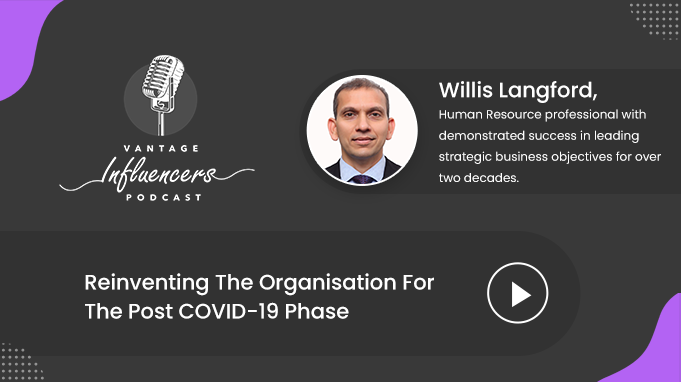
Episode Overview
Willis Langford joined the podcast in the middle of the COVID-19 pandemic to talk about what reinventing an organisation actually looks like once remote work stops being an emergency measure and starts becoming a permanent design choice. His central argument is unambiguous: continuous learning is no longer a nice-to-have skill, it is the only currency that keeps a workforce relevant when technology, workplace norms, and the shape of work itself can change overnight. He pushes back on the idea that a full return to the office marks a return to normal, arguing instead that hybrid and remote arrangements are here to stay because they already show measurable productivity gains and because leading employers are redesigning benefits and policies around them.
Willis also digs into the mechanics that make remote work sustainable at scale: manager trust and empathy, outcome-based ways of tracking performance, and the rise of gig and contingent talent as a rational response to how fast skills now go stale. He walks through both conventional and modern ways to measure employee engagement, cautions leaders against assuming quieter team members are less engaged, and closes with a simple philosophy for anyone stepping into a disrupted job market: treat every crisis as a source of opportunity and build your career around helping other people succeed.
Episode Highlights
- Remote work is becoming a permanent fixture rather than a pandemic-only trend, backed by data showing remote employees gain roughly 15 extra productive days a year and by top tech companies already downsizing office real estate.
- Tracking productivity in a distributed workforce needs both digital infrastructure, such as project management and real-time collaboration tools, and manager-level skills like trust-building and empathy.
- Gig and contingent work will keep growing because technology cycles now move faster than traditional employment models, and digitization makes remote collaboration on shared projects far easier than before.
- Career development in a project-based economy means owning your own learning curve instead of waiting for a formal training calendar; lifelong learning has replaced the old idea that knowledge alone is power.
- Engagement can be measured through a mix of conventional signals, like attendance, retention, and project delays, and newer tools like pulse surveys and eNPS, but every method ultimately traces back to basic human needs.
- Outcome-based roles and rotating team leadership give quieter employees a real chance to be recognized in remote settings, where visibility no longer depends on being the loudest voice in the room.
About the Guest
Willis Langford, Head of Human Resources at a Market-Leading Semiconductor Company
Willis Langford is a result-driven, customer-focused human resource professional with more than two decades of experience leading strategic business objectives across multiple industries, from construction engineering to distribution. He began his career in audit with one of the Big Six accounting firms in the early 1990s before moving into accounting and then human resources, and he has spent over a decade specializing in organisational development. He is certified by DDI (Development Dimensions International) and Korn Ferry International (Lominger) in leadership, interviewing skills, and competency modeling, and he was recognized as one of the Top Indian CHROs to follow on LinkedIn (2020) by ekincare.
Host
Rohit, Vantage Influencers Podcast Host
What You Will Learn
- Why continuous learning, not static knowledge, is becoming the core currency of career security
- How to track productivity and performance across a distributed team without relying on invasive monitoring
- What is driving the rise of gig and contingent talent, and how organisations are adapting compensation and benefits around it
- Which conventional and modern metrics, including eNPS, can be used to measure employee engagement
- How outcome-based roles and rotating leadership responsibilities help quieter employees get recognized in remote settings
- What advice Willis gives to people building an HR career in the middle of a crisis
Key Topics & Timestamps
| Timestamp | Topic |
|---|---|
| 00:11 | Introduction and guest background |
| 00:39 | How Willis got his start in HR |
| 01:54 | Will remote work become permanent after COVID-19? |
| 03:50 | Tracking productivity and monitoring performance remotely |
| 06:47 | Gig workers and the rise of contingent talent |
| 10:59 | Transitioning from full-time employee to project-based work |
| 14:01 | Metrics for measuring employee engagement |
| 18:04 | Identifying high performers in an outcome-based, remote setup |
| 22:50 | Willis' favorite business book |
| 23:22 | HR leaders and CEOs Willis follows |
| 24:21 | Advice for young HR leaders |
Full Transcript
Click to read the full episode transcript
Welcome to the Vantage HR Influencers Podcast. This podcast is sponsored by Vantage Circle, the leading employee benefits and engagement platform.
Rohit: Hi, this is Rohit from the Vantage HR Influencers Podcast. I'm thrilled and excited to have Willis Langford, who is the HR head for a leading semiconductor company. He focuses on people strategy, organizational wellbeing, leadership training, employer branding, and employee engagement. Willis is an alumnus of Pondicherry University. Welcome to the show, sir.
Willis Langford: Thank you so much, Rohit. Appreciate you getting me on the show, and I'd love to share all my experiences with you. Thank you.
Rohit: Awesome. So, how did you get your start in HR? What got you excited about entering this field of human resources?
Willis Langford: Well, it's a matter of destiny, I guess, in my case. HR happened to me by chance and not by choice. I started my career with one of the Big Six firms, back in the early 90s, in audit. From there, I moved on to accounting and then into human resources. There have been many mentors along the way who have influenced my career. But what really got me going was the human touch involved in making any profession successful. Interacting with people is the most complex interaction when compared to dealing with other resources. Because of the feelings exchanged and the emotions attached, it's been the most fascinating journey for me to be able to coach, mentor, and motivate people. I love what I do, which is helping individuals find their true potential by accelerating their success. So here I am in human resources, and I'm enjoying every bit of it.
Rohit: Thank you. Right. We've recorded this podcast during the COVID times, and there's a lot of talk about whether remote work will be permanent or not. Do you think remote working is going to increase in the months to come, and is it something that's going to be there forever in most companies?
Willis Langford: Good question, because that is literally the new norm right now. I'd rather say going back to the office is going to be the new norm in the years to come. Remote working isn't new, but with the hard reality of COVID-19, it's forced organizations to encourage and foster remote working or work from home. Recent research claims that people working remotely are more productive by at least an additional 15 days a year compared to people working from office. Secondly, we're already seeing many world-leading tech companies asking employees to work from home, some of them going as far as saying work from home forever, and only come into office when you need collaboration. Operators, especially in the services and IT sectors, are already shedding close to 30-40% of their real estate by allowing employees to work from home. Some organizations are even going to the extent of bringing back a furnishing allowance, so people can work comfortably from home, adding that as an element or benefit to their package. But I want to caution everyone listening that this isn't going to be a runaway shift either. We'll have serious challenges working remotely, considering we're social animals, and we'll have to overcome them. But in short, this is something that's here for the future.
Rohit: And since we've talked about challenges in the work-from-home culture, how can companies track productivity and monitor performance? Are there any tools, or what are the best strategies managers should use to track and monitor employee performance?
Willis Langford: Fantastic question, and that's definitely going to be a challenge, but we have to overcome it nonetheless. I'd look at this in two parts, the hard part and the part associated with soft skills. Digital tools are going to be the focus of the future. Today, when we talk about cloud-based systems and real-time entry into systems, the focus is going to be on proper infrastructure and productivity tools, for example, project management software. I know organizations don't love attendance trackers, but you need some way of knowing your employees are engaged and with you on a project. Online collaborative software is going to be very important too, because the days of someone saving work on their laptop and emailing it to you are gone. There's going to be a lot more collaborative, real-time working between team members across geographies or even cities. We also need proper mechanisms to track expectations, targets, and completion dates. And the most important part of all these digital tools is something like what you and I are doing right now, having a conversation, or better still, a face-to-face conversation virtually. That's going to be important for measuring and tracking productivity. But what employers are slowly beginning to realize, after getting into this culture of remote working, is the managerial competencies needed for this kind of tracking. Managers need to build trust, because your team members aren't in front of you, you can't see their body language, and you definitely can't make eye contact with them. In a meeting, you look around, ask a question, and see someone nodding, and you know they've got it, they know the target and the deadline. So you have to build trust. The second part is empathy, which is a buzzword for managers today, and it's genuinely one competency that will make them successful. When you speak to employees at home, they could be dealing with disturbances, their family, their kids, noise at home, network issues. If you just keep pushing targets and tracking productivity without empathy, the element of engagement is lost. So that's the soft side employers should also focus on when tracking productivity and reviewing performance.
Rohit: Right. Would gig workers or contingent workers become more prevalent in companies going forward? Or do you think full-time employment won't be as prevalent 15 or 20 years down the line?
Willis Langford: Well, companies talked about project workers or contingent workers in the early years too, we've seen this in the unorganized sector for decades, piecemeal workers and the like. But now with the gig economy coming in, and gig is essentially short-term, project-based, contingent work, employers are already facing increased challenges due to fast technological advancements and changes in workforce demographics. Employers have realized that overnight, things could change; technologies don't have a long lifeline anymore, a lifetime of five, six, eight years could change overnight. So you need employees equipped with skills and competencies that can keep pace. That's one reason organizations are moving toward a gig workforce. The second reason is cost savings, no retirals, no carry-over liability for unpaid leave or other benefits, gradually adding up to significant savings for the organization. Today, it's also a lot more feasible because of digitization. In earlier years, digitization wasn't as widespread, so fewer organizations could think of gig workers, because IP transfer between people happened in the office. Now everything is on the cloud and connected remotely, so it's a lot easier. There are also a few things that will fundamentally change the spectrum of human resources. In earlier years, loyalty was a lot more important. But with the gig economy kicking in, employees will need to be more adaptable to change and more dexterous, so they can take on new challenges and new technologies. As a result, people may not stay for long, because skills may only be needed for a short project, six months, a year, and then they move on. That kind of loyalty won't be an inherent characteristic in employees going forward, which is a different way of looking at things compared to the past. Let me give you a small example. If you look at the pandemic we're in, you'll see a lot of companies pivoting. Companies that used to manufacture automotive parts are now making masks. Companies that made garments are now making sanitizers. There's a lot of change happening, and because of these technological shifts forced by COVID-19, people will need to change faster and organizations will need employees who are adaptable. Research also tells us that today, at least one in five workers are contingent, working on projects, or gig. Before COVID hit, the projection was that 45% of the workforce would be gig workers by the end of 2020. That's a huge number, and now, with COVID-19 having kicked in, I think that figure is only going to go up. So I think it's going to be a win-win for both employer and employee, because demographics have changed and technological advances are happening fast. So brace yourself and be ready for gig work to kick in further.
Rohit: And you made a very interesting point about loyalty between employees and employers, but it's a two-way relationship. How do you look at the transition from being an employee to becoming a contingent worker or project worker? What does an employee need to do to be adaptable and understand that this could be the arrangement for the long term, given that a lot of people are looking at project work only?
Willis Langford: Good question, because one of the areas employees need to focus on is how they transform their careers, how they really take charge of it. There isn't going to be a one-size-fits-all situation anymore, whether from the employer or employee standpoint. Earlier, HR might announce a session, say on decision-making, and whoever wanted to attend would come in. That's going to change. It's going to be very hand-picked and customized to whatever the needs of the moment are, that's from the employer standpoint. From the employee standpoint, I'd say there's going to be more emphasis on a long-term development plan, because in the short term, everyone will be scrambling to adapt to whatever changes come. Let me give you a couple of examples. When we talk about present-day learning, we're talking about the blended 70-20-10 approach, where you learn 70% from your own experience, 20% from mentors and others, and only 10% from formal classroom learning. That's a significant shift, because when you're talking about career development and how someone manages the shift from being a regular employee to a project worker, you're talking about being self-independent and self-reliant in what you can learn at any given time. One of the things that has also changed in the future of work is that earlier, knowledge was power. Now, lifelong learning is power. So for this new generation of jobseekers, one of the key things is staying on the learning curve constantly, so they're well equipped. If you look two levels higher, at the mid-level, they need to be equipped with change-management techniques, decision-making techniques, and be transparent communicators. And at the top end of the leadership track, you're talking about being involved in stretch assignments and projects with impactful outcomes. So there's going to be a mixed bag of expectations across junior, mid, and senior level professionals looking to advance in their industries. But the key, as I mentioned, Rohit, is that you've got to be a lifelong learner, to adapt and learn to adapt to change.
Rohit: No, you're absolutely right, you've got to be a lifelong learner to really take things to the next level. Willis, I want to understand what metrics are used to measure employee engagement, especially during these times. How are you looking at measuring employee engagement among your teams?
Willis Langford: Good question, because employee engagement, in my opinion, actually drives the top line and the bottom line of a business, and I'm a big believer that engagement has to be high for an organization to be successful. I look at it in many ways, and today we're talking about a data-driven economy, everything is data and analytics, so we need a lot of data points. I'd like to look at it both the conventional way and a slightly more modern way, where you're also looking at behaviors. Starting with the conventional way, you look at statistics on delayed projects, statistics on leave and attrition, statistics on availability, how often someone is available for a first call for a meeting or a project, you can sense how engaged they are from that. You also look at retention rates and how involved people are in contributing ideas at meetings. These are all conventional ways, but you back them with data points and analytics to gauge engagement. Then there's the other, more generic part, engagement pulse surveys and happiness index surveys. And quite frankly, Rohit, though some might feel it infringes on privacy, I've noticed quite a few companies getting into mood-meter technology, cameras at the entrance using face recognition instead of biometric scanners, and someone can pull up a report across the company at the click of a button showing what everyone's mood was like. Imagine getting a mood-meter index on a Monday morning, is he as happy as he was on Friday evening? That's another signal. Now the question is how you do this in a virtual world, we'll come to that a little later. There are also external signals, employees use platforms like Glassdoor, Facebook, LinkedIn, or Twitter to find out what the trend is around a company's engagement, so you can also look at it from an employer perspective, how are you perceived out there. Other aspects include stay interviews or returning employees. Not everyone wants to welcome back a returning employee, but at the same time, they can be some of your best brand ambassadors, coming back to say, I checked out the outside world, and this company is genuinely good too. And then you have two modern techniques. There's eNPS, the employee net promoter score, based on one simple question, rated on a scale of one to ten, how likely are you to recommend working at this company to a friend or colleague. You get detractors, rated zero to six, passives, rated seven and eight, and promoters, rated nine and ten, and then you use the standard NPS formula from there. That's another mathematical way to do it. But what I really want to impress upon everyone listening is that, at the end of the day, we're dealing with human beings, and I'd go back to the age-old Maslow's hierarchy of needs, it all comes back to that: physiological needs, safety needs, belonging, and self-actualization, essentially telling people, you're wanted, you're valued. Employee engagement isn't something purely mathematical that we can measure, but these are the many ways one can definitely try, and I've seen success doing this in the past.
Rohit: Right. When you're working physically alongside other employees, it's easy to identify high performers. Do you think all roles can be more outcome-based, so high performers can be identified easily, especially in a remote setup where everyone is working differently? Should all roles now be more outcome-based, and how do you build and identify these high performers in a systematic way?
Willis Langford: Wow, this is a loaded question, a million-dollar question really. Engagement, as you rightly point out, is easy and straightforward to measure in face-to-face situations. But especially in today's world, in a remote setting, it becomes a lot tougher and more challenging. That said, it's not impossible to measure. The second part of your question is whether people who are more vocal or outgoing measure up more in terms of engagement, and I think that's a mixed bag too. Let me answer both parts. One of the key things you need in today's world to keep a remote workforce engaged is communication. Senior leadership needs to communicate clearly and let people know they're part of the organization's overall goal, that sends a strong, reassuring message. The same goes further down, from the manager, and even among peers, making sure everyone is collaborative and using tools like Slack or Google Hangouts to stay connected with each other. But the key is empowering people remotely in a way that still sets them up to succeed. And like you rightly said, someone who voices their opinion more gets noticed, while someone more reserved or quiet might lose out. But the reality of virtual working is that everyone has to make their presence felt through whatever virtual means they have available. Let me give you an example of how organizations can make this happen. In conventional times, you'd have one project manager leading a project from start to finish. But in the new trend of virtual working, having a rotational lead empowers the entire team and makes everyone feel connected. It's no longer just the person who speaks up the most who becomes the lead, now someone quieter or more introverted also gets an opportunity to lead. That does two things: it empowers that person, and it makes them feel wanted and valued because they've been given the lead. I've seen this work very well in organizations that have tried it, I've done it myself. It's a strong way to raise engagement because you're empowering people directly. The second thing organizations are doing today is a lot of generic engagement activities, online learning contests, online sharing sessions, virtual meetings for business as well as virtual meetings just for fun. I've seen many organizations recently run team-building activities like online yoga, Zoom quizzes, singalongs, fitness sessions, online gaming, and so many others. These give a chance to people who are more vocal as well as those who are potentially just as good but less extroverted, to still be part of it and show their capabilities by participating. One thing I heard from an organization recently that was particularly interesting: they held their month-end celebrations and awards by inviting family members to join the call and watch. Believe it or not, even the CEO was dancing with his kids, which gave everyone, employees and their families, a sense of oneness and openness. That's another way you can drive engagement even in a remote setup, and organizations doing this see much higher engagement scores after these kinds of activities.
Rohit: Right, very nicely put. I want to move to a lighter topic, what's your favorite business book?
Willis Langford: Well, it's an older one than what the modern generation might think of, but it's "Winning" by Jack Welch, and I like it because he talks about fostering a culture where people feel free to contribute their ideas and speak their mind, which is very applicable today and ties back to your earlier question.
Rohit: We'll put that in the show notes. And do you follow any HR leader or CEO whom you admire, that younger listeners should follow as well?
Willis Langford: Good question. In today's world, I like to pick a few. I like Ratan Tata for his ethics and ethical principles. I like Mark Zuckerberg, for starting young, for the drive and will to win in the marketplace, and for doing bold things now too, including his investments in India in a telecom company, that combination of technical expertise and the will to take risks. And the last person, and this might surprise people who know me, is Richard Branson. Some might call him a show-off, but honestly, who doesn't want to showcase their good qualities and their achievements? I'd tell people you should also celebrate your successes. That's why I admire these three.
Rohit: Right. What's one piece of advice you'd give to young HR leaders, especially in these tough times, graduating in the middle of a pandemic, who want to build their careers?
Willis Langford: I'll explain this in two parts. First, to the youngsters looking to enter the HR profession: stay the course, nothing has fundamentally changed, these are just examples of the kinds of challenges you'll find, but we should look for opportunity in adversity. That's my advice to them. To those already in the field looking for guidance, my simple advice is to be a servant leader, so you can accelerate other people's success. Today we live in a fairly self-centered world where everyone thinks WIIFM, what's in it for me. If you can accelerate someone else's success, you'll end up successful as well.
Rohit: That's great advice. What's the best way people can reach out to you and learn more about your work?
Willis Langford: Well, I'm very active on LinkedIn, and I was fortunately recognized recently as one of the leading CHROs in India to follow there. I enjoy sharing my experience with people, so they can reach out to me on LinkedIn as a starting point, and we can take it from there. I really appreciate you asking, Rohit.
Rohit: Thank you, Willis, for taking the time to speak with us. I really enjoyed our conversation.
Willis Langford: Thank you, sir, I appreciate it, and thanks for the opportunity. Have a wonderful day.
Thanks for listening to the Vantage HR Influencers Podcast. Do subscribe to the Vantage HR Influencers Podcast on Apple Podcasts and Spotify for new episodes.
FAQ
Is remote work here to stay after COVID-19?
Willis Langford argues yes, but with a hybrid twist. Research showing gains of roughly 15 extra productive days a year for remote workers, combined with major tech companies already scaling back office space, means a partial return to the office is more likely to become the "new normal" than a full return to pre-pandemic routines.
How can managers track productivity in a remote team without micromanaging?
Willis splits the answer into two parts: the right digital infrastructure, such as project management tools, collaboration software, and real-time check-ins, and the right managerial mindset, specifically trust and empathy, since managers can no longer rely on body language or eye contact to gauge whether someone understands a task.
What is eNPS and how does it help measure employee engagement?
eNPS, or employee net promoter score, asks employees to rate on a scale of one to ten how likely they are to recommend their company to a friend or colleague. Respondents are grouped into detractors (0-6), passives (7-8), and promoters (9-10), and the resulting score is one of several tools Willis uses alongside pulse surveys and conventional data like attrition and retention rates.
Can quieter employees be recognized as high performers in a remote setup?
Yes. Willis points to practices like rotational project leadership, which gives less vocal or more introverted team members a chance to lead and be noticed, as a concrete way organizations can make sure recognition isn't limited to whoever speaks up most in meetings.
Related Reading
Also listen on