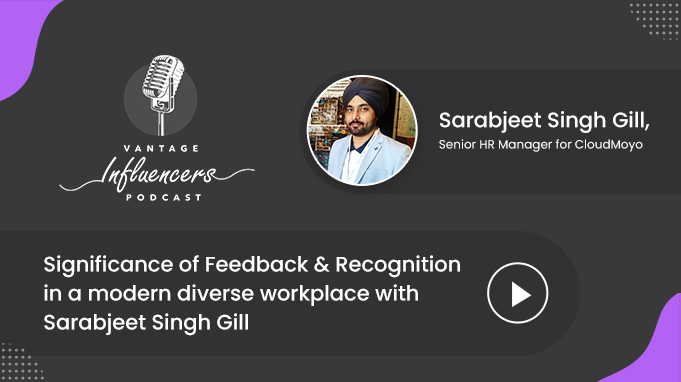
Significance of Feedback & Recognition in a modern diverse workplace with Sarabjeet Singh Gill
Episode Overview
Feedback conversations tend to go wrong in one of two directions: managers either sugarcoat the message to avoid friction, or they let it turn personal and defensive. Sarabjeet walks through the CEDAR feedback model, a structure built around clarifying, explaining, discussing, agreeing, and reviewing, and explains why keeping feedback factual and evidence-based rather than opinion-based is what makes it land without damaging the relationship. He also breaks down a second framework for the reverse situation, where a leader is on the receiving end of feedback and needs to stay open rather than defensive while still being honest about what they will and will not act on.
The conversation then moves to the harder question of sustaining engagement when teams are fully remote. Sarabjeet argues that traditional annual engagement surveys are no longer enough on their own, and makes the case for continuous signals like employee Net Promoter Score, tracked alongside softer indicators such as leave patterns and participation in company activities. He also discusses what actually keeps remote employees engaged day to day, from digital-first HR practices to gamifying virtual initiatives, and how a leader can tell early when someone has quietly disengaged, well before it shows up in a formal review.
Episode Highlights
- Sarabjeet explains the CEDAR feedback model (Clarify, Explain, Discuss, Agree, Review), a framework he has used for over a decade to keep feedback constructive rather than confrontational.
- He recommends describing the specific situation and its impact, using facts rather than personal opinions, to keep critical feedback objective.
- He introduces a four-step approach for leaders receiving feedback: acknowledge the reaction without getting defensive, explore what is driving it, validate what was heard, and refocus on what can realistically change.
- On measuring engagement remotely, he points to employee Net Promoter Score, anonymous review platforms, and behavioral signals like leave patterns as more reliable indicators than a single annual survey.
- He outlines practical ways to keep remote teams engaged, including virtual coffee sessions, online wellness activities, and gamifying initiatives so participation feels worthwhile rather than mandatory.
- He shares early warning signs of a disengaged employee, such as reduced input in team meetings, missed deadlines, and unplanned leave, that a manager can catch before it becomes a bigger issue.
About the Guest
Sarabjeet Singh Gill, Senior HR Manager, CloudMoyo
Sarabjeet Singh Gill is a leading HR professional with more than a decade of experience, currently working as Senior HR Manager at CloudMoyo. He holds an MBA focused in HR from Symbiosis Pune and has worked as an architect for people, processes, systems, and culture on complex business initiatives. His areas of expertise include HR business partnering, HR transformation, talent management, performance management, people analytics, and employee engagement. He is an active contributor to publications like PeopleMatters, AllThings Talent, IIMJobs, and HR Katha, and a frequent speaker at industry and college events in Pune and Mumbai. He has been recognized as one of the "100 Top Tech HR Minds" in India by the World HRD Congress and as "Visionary Leader of the Year" at the 2nd Edition of the Future Leaders Summit and Awards, organized by UBS Forum.
Connect with Sarabjeet on LinkedIn
Host
Rohit, Vantage Influencers Podcast Host
What You Will Learn
- How the CEDAR feedback model (Clarify, Explain, Discuss, Agree, Review) can make feedback conversations more constructive
- Why being factual and objective, rather than relying on personal opinion, is key to giving critical feedback
- A four-step technique for leaders to receive feedback without becoming defensive
- How employee Net Promoter Score works and why it is a useful engagement metric alongside traditional surveys
- Practical ways to keep remote employees engaged, from virtual activities to gamification
- Early warning signs that an employee has become disengaged
- How to build a self-correcting company culture from day one, rather than aiming for a "perfect" one
Key Topics & Timestamps
| Timestamp | Topic |
|---|---|
| 00:10 | Introduction |
| 00:31 | How Sarabjeet got into HR |
| 02:19 | How to give effective feedback to employees |
| 04:23 | How frequently leaders should give feedback |
| 05:46 | How to give critical feedback without damaging the relationship |
| 07:37 | Metrics to measure employee engagement |
| 09:50 | How the employee Net Promoter Score (eNPS) is calculated |
| 10:26 | How leaders should take feedback from their team |
| 13:10 | How to increase employee engagement in a remote setup |
| 14:59 | How to identify a disengaged employee |
| 16:48 | How to set the right culture in a growth-based company |
| 19:22 | Whether a fully remote work culture can last forever |
| 21:03 | How CloudMoyo gives instant rewards and recognition to employees |
| 22:42 | Favorite business book |
| 22:56 | HR leaders and CEOs worth following |
Full Transcript
Click to read the full episode transcript
Welcome to the Vantage HR Influencers Podcast. This podcast is sponsored by Vantage Circle, the leading employee benefits and engagement platform.
Rohit: Hi everyone, this is Rohit from Vantage HR Influencers Podcast and today I'm thrilled to have Sarabjeet Singh Gill, who has a decade of experience in HR as a Senior HR Manager at CloudMoyo. Sarabjeet is an alumnus who completed his MBA. Welcome to the show, Sarabjeet.
Sarabjeet Singh Gill: Thank you, thank you Rohit.
Rohit: So Sarabjeet, how did you get into HR and what got you fascinated that you could be a part of HR?
Sarabjeet Singh Gill: Sure. I'll be honest with you and with the audience also. I got interested in HR during my campus placement days, and I first saw HRs of various companies visiting our college campus. I was impressed by the way they dressed up, communicated, and represented their organization, and on top of it, the travel for going for campus placements and the power to offer employment increased my excitement further. But now when I look back, I feel I was probably a bit naive to be considering these as factors to join HR, but I think that's where I kick-started my entry into HR. With an engineer's mindset, I always wanted to solve complex problems, and what can be more complex than people. So I started my career as a software engineer. Within six months of my foundation training, there was an opportunity in the corporate HR team for the Pune location. I applied to it, although I didn't have an MBA degree. That was the first time in the company's history that they allowed people to apply for that job posting without having a degree, and then they enrolled us in the same basis program. So that's how it started, walking into HR.
Rohit: Yeah, very interesting, because we've had other guests who also started as engineers and then went on to become HR leaders. I wanted to understand how can leaders give effective feedback to employees, because it is very important. If an employee is not able to give their utmost performance, a leader needs to give that feedback, or even if they are giving a great performance, feedback, be it quarterly, annual, or monthly, has to be given. What are your suggestions on how to effectively give feedback to employees?
Sarabjeet Singh Gill: Yeah, here I'll probably say I was blessed with an introduction to one great model by my dad, because he was in defense. This is a very famous model used in defense, the Air Force and Army specifically. It's called the CEDAR format, the CEDAR model. CEDAR stands for C for Clarify, E for Explain, D for Discuss, A for Agree, and R for Review. It's a pretty old model, been used in the forces for almost 30-plus years now. This is something that was introduced to me by my dad when I was pursuing my MBA. I think that held me pretty well in terms of aligning myself on how to give feedback effectively, be it to an employee or to anyone in a personal relationship or with family. So I think this is one of the good models, and I have been practicing it for more than a decade now, and I've seen good results from it. Because at the end, the discussion is positive, and you're not leaving someone on a negative note. You just agree on certain facts and then discuss the progress. This CEDAR model, if you Google it, you will find tons of resources on it, but I think it's a good model when it comes to giving constructive feedback.
Rohit: And do you think employees should be given annual, quarterly, monthly, or even weekly feedback? What is your take on that? How frequently should leaders, be it in small teams or large teams, look at giving feedback to their employees?
Sarabjeet Singh Gill: Yeah, I think everything is moving into agile from the last three, four years, and we have been using this buzzword a lot everywhere, agile in nature. We have to align our processes also with the engineering model of agile. It should be as quick as possible, whenever certain things are being accomplished. We should go ahead and have a one-on-one chat with the individual. You should not wait for an annual review to happen. That's also something that has been fading out from the industry. Now everyone is talking about a continuous feedback mechanism, which is more like a quarterly feedback. But I'll still say that you don't wait for those quarterly check-ins either. Whenever you feel something has gone well, badly, or worst, you should just go and have a conversation. Those conversations are very important when it comes to any kind of feedback. Then there are no surprises to anyone at the end. That's how you should approach it.
Rohit: Yeah, so importantly, like you mentioned, a feedback conversation has to be given, and feedback has to be given in terms of bad performance as well. So if the feedback is too critical, how should the leader approach giving feedback to the employee so that the employee is able to take it in the right way and implement it, and there are no burnt bridges between the leader and employee?
Sarabjeet Singh Gill: Right. I'll keep this very short. I'll say just be precise in terms of the feedback. Do not try to sugarcoat it, the way a lot of managers generally try to do, because they are scared of giving negative feedback to anyone. As a human tendency, you don't want to spoil the relationship you've formed with the individual. But instead of doing that, it will be good to just be precise about that context, about what has happened. Be factual and be objective about the feedback. You should have that clarity in your mind before going and talking to that individual, because you need to give people evidence, not personal opinions and feelings. You can achieve this in two simple steps. First, describe the specific situation and behavior that triggered that feedback. Second, describe or define the impact of that behavior. If you have both these things in place, you will definitely have an agreement in any kind of critical situation.
Rohit: Right, interesting. Interestingly, you pointed out no personal opinions while giving feedback, because you don't want any sort of bias to be there when you correct and give the feedback. And I wanted to understand what are the metrics which can be used to measure employee engagement, especially, you know, we're recording during these COVID times where we're working remotely. So are there any metrics with employee survey programs, or any metrics which you suggest leaders use to measure employee engagement?
Sarabjeet Singh Gill: Yeah, you can continue with the traditional way of measuring it, like an employee engagement survey, which you can do on a periodic basis just to capture the feedback on how your employee engagement initiatives are doing. That's one. On the modern side, I think, especially in the COVID-19 situation where your workforce is almost fully remote, I think it will be a good exercise to use one input from the sales function, that is, having a Net Promoter Score. So have an employee NPS. See what the response is, and you will automatically get to know how many of your employees are actual promoters. That will give you a good pulse check. Another metric to follow is you can continuously monitor your Glassdoor ratings. That's one neutral source you can rely upon, and ask your employees, if they're comfortable, to review on Glassdoor, because that's one neutral, anonymous input you can capture. Some other interesting ways to find out if things are going well from an engagement point of view include looking at leave data, vacation days used by individuals in a specific project or line of business, and so on. You can do a drill down on the data available to you, such as new-hire 90-day failure rate, and so on. There are so many HR metrics you can apply. It's all about the analytics you can do on top of whatever data you're sitting on.
Rohit: Interestingly, you pointed about the employee Net Promoter Score. Can you just explain a bit on how the employee Net Promoter Score has to be calculated? Is it very similar to what an NPS score is, where seven and above is a great score?
Sarabjeet Singh Gill: So the framework is the same, there is no change in that. Instead of your external customers or your clients, for us our internal customers are our employees. External customers are the candidates or prospects that we want to hire. So you just change that part, and the rest of the framework remains the same as NPS.
Rohit: And how should a leader also take feedback from their team, so that he can improve as a leader, because it is a two-way process where you're supposed to give feedback to employees, but also take feedback as a leader, so you can be an effective team leader going forward?
Sarabjeet Singh Gill: Yeah, I think that's one important part, because dealing with feedback reactions is one of the important skills every leader should have. So if I have to give you probably a tip here, there's something called HEAR. H-E-A-R. That's something you can try. First is H, stands for Hear, E for Explore, A for Acknowledge, and R is for Refocus. I'll just break it down step by step. So when I say Hear, you basically try to articulate the individual's reaction in a non-judgmental way, because you don't want to get biased or defensive the moment you receive feedback or hear any feedback. Just keep that openness in your mind. Second is when it comes to Explore, use neutral language to assess what's driving the reaction, where this feedback is coming from. So probe more into that, use probing as a technique. A is Acknowledge, where you acknowledge and hear out that individual, whatever feedback is being shared, and then you validate whether what you're hearing is correct or not. So you just rephrase and reiterate the overall conversation, saying, this is what sounded to me, is this correct or not? And then the last, you just Refocus, in which you refocus the individual on what's true about the feedback and what we can do about it, because there could be certain feedback which you don't want to pay attention to, which probably does not hold true for you. So you can just be honest about it, saying, out of the five items you've told me, I'll work on the first two or three, but on the fourth and fifth item, probably this is the way things are and this is the way we should accept it. You just change the entire discussion at the end, coming into a mutual agreement, so that there will be a resolution for both you and the person giving the feedback.
Rohit: No, absolutely makes complete sense. And I wanted to understand how can we increase employee engagement in a remote setup? It looks like, because of the COVID situation, a lot of companies have already gone into a remote work setup. But are there any pointers on how to increase employee engagement?
Sarabjeet Singh Gill: Yeah, I think first is, be a digital HR. That's the new skill set every people advisor or people champion needs to have. You need to use technology to connect with your employees. In terms of initiatives, there are n number of employee engagement ideas you can actually drive just sitting at home. It can be as simple as driving some virtual coffee sessions with your employees, or driving an online yoga session just for their mental and physical wellbeing, and so on. It's just about leveraging the technology available to you. So look for any collaboration tools you can use to have employee engagement in place. Next, when it comes to remote operations, you need to really gamify things. You can't expect people to participate unless it sounds very exciting to them, because they're already busy in their regular schedules, coping with the stress of COVID and coping with daily chores at home. So you really need to be on top of your innovation as an HR leader, to ensure you gamify the overall process of engagement, so that they feel like meeting with you, they feel like connecting with your engagement activities.
Rohit: Got it. So yoga sessions, gamifying things, those sorts of activities have to be there. But how would you differentiate between an engaged employee and a disengaged employee, not only in a remote setup but generally? There are times when an employee would be disengaged. How would a leader get to understand that this employee is not as engaged as they were before? And any pointers on how to address that problem within an employee?
Sarabjeet Singh Gill: Yeah, I think one can automatically identify, as a leader or a manager of that group, whoever is engaged or not engaged, because in your daily scrum meetings or weekly meetings, you'll get to see that there's not much input coming from that individual. You will see that person be a little off. Productivity will automatically be hampered, the person is not motivated and engaged, probably they will not give a hundred percent, that will be another sign. The person is probably missing out on some deadlines, missing out on a couple of things, and then taking too many leaves, unplanned leaves, is also one of the signs through which you will get to know the person is not engaged. And then you can also check with HR, if you're from the business side, on what the participation level of this individual is when it comes to organizational activities. That could also be one of the inputs you will see. So these are some of the ways through which you can identify it. And apart from that, yes, managers should continue their dialogue, their conversations with the employees, at least once a month or once a quarter. And in the same way, that's what we also do as HR.
Rohit: I want to understand how you set up the right culture in growth-based companies, especially IT companies, where there's a new employee getting onboarded into the company. How do you set the right culture from the start?
Sarabjeet Singh Gill: I'll just pivot it a bit. I'll say, for me, you don't have to have a perfect culture, because in fact there is no such thing as a right or bad culture, because nobody sets up a bad culture at any point in time. So the trick is simply creating a culture based on a set of core values that can self-correct. And when employees feel those values are being forgotten or aren't being taken seriously, they should feel empowered to take action to protect them. That sort of culture starts at the top and is best established at the beginning. Establishing the culture from the beginning, and changing it as needed, is one of the keys. Second, I'll say encourage repetition, reiterate your mission, values, and principles of the company across various platforms, like your regular all-hands meetings at a company level, small HR connects, your stand-up meetings, and so on, wherever possible have that repetition in place. Third could be communicate quite openly and often with the employees, being transparent. And a very important part is lead by example, because our culture is something shaped by a company's leaders or a company's management. This comes from top to bottom, and every leader needs to internally and externally reflect the company's values and be its strongest advocates. And if you have that, you can actually identify cultural ambassadors within the company, who actually live, eat, and breathe your culture and help everyone else understand who you are as a company and what you stand for. These employees can become your biggest advocates, as a second line of management, because they love the company almost as much as you do, and they can become your cheerleaders. So identify those people and you can leverage that.
Rohit: I think you're absolutely right. Creating those cultural ambassadors is very important, because they want to put the word forward that the company is building a great culture. So that is extremely important. And before the call, we were talking about remote work, but it looks like a lot of companies are going to be working remotely till the end of this year. But are companies looking at remote work forever? And can there be a forever remote work culture?
Sarabjeet Singh Gill: Yes, there is a possibility. Although this was not a choice that everybody had to work from home for the last three months, it was more of a push due to an external factor. But I think everybody has kind of tasted this new mechanism, and it has been working successfully in some industries, where they can definitely think about taking this as a long-term project, where you can have at least a partial, if not full, but at least 50% of your workforce always remote. That's something that's going on in discussions in most companies and in the media. But keeping a hundred percent work from home forever, I think it will be a little far off, because you always want to have that connection with people, and you always need that social environment which people are going to miss. Because at the same time, people are happy about this work-from-home model, but there is also a set of people who want to go back to the office, who want to resume, because they love socializing with other people and it's something that motivates them. So balancing it out, I think, will make sense.
Rohit: Got it, makes sense. And, you know, Vantage Circle is a rewards and recognition platform, and we're proud to have CloudMoyo as one of our partners. How does a rewards and recognition platform help in giving instant gratification and rewards to employees? What is CloudMoyo doing in order to reward and retain its employees?
Sarabjeet Singh Gill: Okay, so a platform like Vantage Circle is perfectly suitable for any technology-driven workforce of today. I'll probably call it rewards and recognition 2.0. The emphasis is on promoting social appreciation and providing freedom of recognition or appreciation to employees. Because you no longer want to control the overall flow of your R&R, where there's an approval process in place and people approving your appreciation even before it goes live. So I think features like this, and having a digital platform like Vantage Circle, is something that is making feedback more effective than ever. Moreover, it also empowers employees to take pride in their job and continue contributing to the success of the company. And a very important benefit of such a recognition platform is that your employees will be satisfied, so it will increase employee satisfaction levels within the company, which will again help you get a good positive increase.
Rohit: All right, yeah, thank you so much for talking about Vantage Circle and how such platforms can really help out. I want to quickly do the top three, what's your business book, or even a fiction book?
Sarabjeet Singh Gill: I'll say a business book. Recently I've read "Hit Refresh" by Satya Nadella. I think that was pretty exciting.
Rohit: Got it. And do you follow any HR leader or a CEO whom you look up to, and would you advise listeners to also follow that leader?
Sarabjeet Singh Gill: Yeah, I'd advise following a world-renowned business educator and coach, Dr. Marshall Goldsmith. I've been following him very closely, and I've seen good results from that.
Rohit: Got it, we'll put that in the show notes. And what is the one piece of advice you would give to young HR leaders who have graduated or are graduating in this tough year from business schools and looking to build their careers in HR? What advice would you give them?
Sarabjeet Singh Gill: Okay, I'll say working in HR can sometimes be hard, but it can also be immensely rewarding. You can be juggling a whole range of spinning plates, constantly trying to make sure none of them drop, while at the same time doing your best to support your company's biggest asset, its people. So come into the HR field only if you love real-life challenges and can manage multiple stakeholders, and if you're really interested in people, else you will be a bit of a misfit. That's how I would want to put it.
Rohit: Got it. Sarabjeet, what is the best way people can reach out to you and know more about CloudMoyo?
Sarabjeet Singh Gill: Yeah, so they can connect with me on my LinkedIn. You can search for Sarabjeet Singh Gill there, along with CloudMoyo company. And to follow CloudMoyo, we have our page on LinkedIn again, where you can just follow whatever is happening at CloudMoyo. Or you can follow our Glassdoor page also, which is pretty much active, you will get to know more updates about us.
Rohit: Got it. Well, we'll put that in the show notes. Sarabjeet, thank you so much for taking the time and speaking with us. I really enjoyed doing this podcast with you.
Sarabjeet Singh Gill: Thank you, Rohit. It was a pleasure talking to you, and I think a show like this is really required. Thank you.
Thanks for listening to the Vantage HR Influencers Podcast. Please do subscribe to Vantage HR Influencers Podcast on Apple Podcasts and Spotify for new episodes.
FAQ
What is the CEDAR feedback model?
CEDAR is a feedback framework used in defense forces for decades, standing for Clarify, Explain, Discuss, Agree, and Review. Sarabjeet Singh Gill has used it for over a decade to keep feedback conversations constructive and focused on facts rather than personal opinions.
How should a leader give critical feedback without damaging the relationship?
Sarabjeet recommends being precise and factual rather than sugarcoating the message. He suggests describing the specific situation and behavior that triggered the feedback, then explaining its impact, so the conversation is based on evidence rather than personal opinion.
How is employee Net Promoter Score (eNPS) calculated?
The eNPS framework mirrors traditional customer NPS. Instead of external customers, employees are treated as internal customers who are asked how likely they are to recommend the organization, and the scoring scale works the same way as a standard NPS survey.
How can companies keep remote employees engaged?
Sarabjeet suggests being a "digital HR" that uses technology proactively, running virtual initiatives like coffee sessions and online wellness activities, and gamifying engagement efforts so participation feels worthwhile rather than an obligation.
Related Reading
Also listen on





You might also like
 Employee Recognition
 Humanizing the Workplace Through Recognition
 Employee Recognition
 Scaling Culture Without Losing Its Soul as Recognition Drives Growth Inside and Out
 Employee Recognition