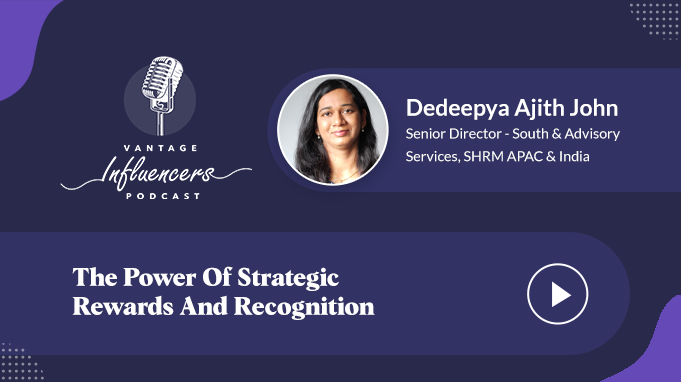
The Power Of Strategic Rewards And Recognition
Episode Overview
Dedeepya Ajith John opens the conversation with a simple but often overlooked idea: people work harder when they feel valued, and that feeling has to be built into a program by design rather than assumed to exist on its own. She connects recognition directly to retention, productivity, absenteeism, and trust, arguing that positive reinforcement for specific, desirable behaviors consistently outperforms negative reinforcement when it comes to motivating employees. Rather than treating rewards and recognition as a one-off perk, she frames it as an intervention that, when deployed correctly, lifts engagement and motivation across an entire organization.
The conversation then moves into what actually makes a rewards and recognition program durable. Dedeepya walks through the elements she considers non-negotiable: alignment with organizational values, a balance between compensation and non-monetary recognition, personalization to different employee personas, and a mix of instant and scheduled recognition moments. She also addresses two questions that trip up most programs: how to reward individuals without discouraging teamwork, and how to measure whether a program is actually working, from tracking adoption rates to running pulse surveys and one-on-one check-ins rather than forcing a hard ROI number onto a fundamentally human intervention.
Episode Highlights
- Recognition works because people perform better when they feel genuinely valued, not because of any specific perk or platform.
- A rewards and recognition program needs to align with organizational values and objectives first, then flex around compensation, growth opportunities, and personalization.
- Personalizing recognition to different employee personas, rather than applying one standard company-wide policy, is what makes a program sustainable over time.
- Balancing individual and team recognition comes down to three things: quantifying what earns a reward, aligning it to organizational goals, and making sure everyone understands how to earn it.
- The most common pitfalls in R&R programs are unclear alignment to company goals, subjective evaluation criteria, one-size-fits-all policies, and treating the program as a set-it-and-forget-it initiative.
- Measuring R&R impact rarely comes down to a single ROI figure. Program adoption rates, before-and-after productivity and retention metrics, and pulse surveys all work better than chasing a definitive dollar return.
About the Guest
Dedeepya Ajith John, Senior Director - South & Advisory Services, SHRM APAC & India
Dedeepya is a dynamic business professional with over 14 years of experience across Advisory, Research, and Academic Partnerships, with a focus on the India, APAC, and MENA regions for SHRM. Her expertise lies in Human Capital Management, where she leads business development and consulting efforts. She holds a background in Mechanical Engineering from Jawaharlal Technological University (Kakinada, Andhra Pradesh) and an MBA from the Indian Institute of Science (IISc, Bangalore), along with certifications as a SHRM Senior Certified Professional (SHRM-SCP), Level-1 Hogan Assessor, SHRM PMQ, DISC, and Job Evaluation by Korn Ferry Hay.
Connect with Dedeepya on LinkedIn
Host
Sanjeevani Saikia, Vantage Influencers Podcast Host
What You Will Learn
- How to design a rewards and recognition program that stays aligned with organizational values and objectives
- What separates programs with long-term sustainability from those that fizzle out after launch
- How to strike the right balance between individual recognition and team-based rewards
- The most common pitfalls organizations run into when rolling out R&R programs, and how to avoid them
- Practical ways to measure whether a rewards and recognition program is actually working
Key Topics & Timestamps
| Timestamp | Topic |
|---|---|
| 01:29 | Dedeepya's corporate journey, from HR consulting to Senior Director at SHRM |
| 02:36 | How strategic rewards and recognition enhance employee motivation and engagement |
| 04:56 | Key elements to consider when designing an effective, sustainable R&R program |
| 07:51 | Balancing individual recognition with team-based rewards |
| 10:40 | Common challenges and pitfalls in implementing R&R programs |
| 13:36 | Metrics and methods to measure R&R program effectiveness |
| 15:39 | Closing thoughts and how to connect with Dedeepya |
Full Transcript
Click to read the full episode transcript
Welcome to the Vantage HR Influencers Podcast. This podcast is sponsored by Vantage Circle, the simple and AI-powered rewards and recognition platform for employee engagement. Engaging in a thoughtful and comprehensive discussion about the power of strategic rewards and recognition is of paramount importance. This topic holds immense significance because it unveils the key to unlocking individual and organizational potential, by shedding light on the strategic use of rewards and recognition, gaining insights into how they can serve as catalysts for motivation, engagement, and exceptional performance.
Sanjeevani Saikia: Hello listeners, welcome to another thought-provoking episode of the Vantage Influencers Podcast, where we will unravel the undeniable power of strategic rewards and recognition. I am your host, Sanjeevani Saikia, and today we will be having a conversation with Dedeepya Ajith John, Senior Director - South & Advisory Services, SHRM APAC and India. Hi Dedeepya.
Dedeepya Ajith John: Hi Sanjeevani. Good morning.
Sanjeevani Saikia: Good morning. First of all, I would like to thank you for giving your invaluable time and joining us in today's episode. Before we dive deeper into today's topic, the power of strategic rewards and recognition, could you kindly walk us through your corporate journey so far?
Dedeepya Ajith John: Dear Sanjeevani, thank you so much for this opportunity as well. So, quickly to talk about my corporate journey, I started off as an HR consultant with Oracle India, back in 2006. I worked there for about two years, after which I joined SHRM, the Society for Human Resource Management, as a Senior Research Analyst. This is my twelfth year with this organization, and I presently work as Senior Director, South and Advisory Services. I handle multiple portfolios here, including consulting, research, academic partnerships, the South Asia business, as well as the Asia Pacific operations. So, this is what I currently do at SHRM.
Sanjeevani Saikia: Wonderful. Thank you for sharing your journey with us. It has truly been remarkable. So, with your permission, can we dive straight into the topic?
Dedeepya Ajith John: Absolutely, please.
Sanjeevani Saikia: The first question that I have is, how can strategic rewards and recognition programs enhance employee motivation and engagement within an organization? Since we are very aware of the fact that strategic rewards and recognition programs can play a very vital role in augmenting or bolstering employee engagement, what do you have to say regarding this?
Dedeepya Ajith John: What you said is absolutely right. It follows a very simple yet powerful realization to me: people will always work harder when they know that they are being valued, and here, valued is the keyword. And that holds true across organizations and across generations, not just for newer employees but for everyone. So, right now, as we speak, I think the biggest challenge that most organizations face is ensuring that their employees are motivated enough, valued enough, to perform to their fullest potential, and sometimes to also strive to go above and beyond. So, while there are a number of enablers to bring in this motivation and engagement, I think there is enough and more research that actually shows a very clear correlation between rewards and recognition strategy and retention metrics, productivity metrics, absenteeism, increased trust, and happiness. So, there is enough research around it. To me, it actually follows a very simple organizational behavior principle: positive reinforcement definitely works much better than negative reinforcement. So, being able to promise rewards and recognition for specific, desirable behaviors or actions definitely triggers positive reinforcement and gives employees a full push to go beyond their boundaries and work, rather than negative reinforcement. So, in short, I think what you said comes back to this: a strategic rewards and recognition intervention, when deployed right, will definitely lead to increased engagement and motivation levels across the organization.
Sanjeevani Saikia: Wonderful. So, it's a fact that a rewards and recognition program involves a lot of elements, so it is not very easy to build a rewards and recognition program without catering to the diverse needs of employees. So, what are some key elements to consider when designing a rewards and recognition program to ensure its effectiveness and long-term sustainability?
Dedeepya Ajith John: So here, the term long-term sustainability is something that we would love to focus on.
Sanjeevani Saikia: Absolutely, since we don't just want a rewards and recognition program in place, but something that has a long-term impact on the organization.
Dedeepya Ajith John: Absolutely. I think the first step, or the most important element, is alignment with the organizational values and objectives that will help achieve the desirable behaviors or actions. It's important for organizations to look at this as an employee value proposition enabler, and not as any ad hoc HR intervention. So, to me, that's the most important element. Along with that, various other elements come into play, like having the right balance between compensation, benefits, and learning and growth opportunities, so we can cater to what actually determines the motivation levels for employees. The third element is a diverse set of expectations, so we need to ensure that our R&R strategy is equitable across the organization. I think it's important for us to create personalization as well, to understand what employee personas exist within the organization, and what motivates them best. If we're able to bring those personalization aspects into our R&R strategy, I think that will help create effectiveness and also build that long-term sustainability. Yet another element that comes to mind is having the right mix of both instant and regular R&R mechanisms in place. And, of course, last but not least, continued communication. So, to me, these are some of the important elements. But if we're talking about sustainability, while it's important to consider all of these elements to create an effective R&R strategy, considering hybrid workplaces and the nature of marketplaces today, it's important for our R&R strategy to also be extremely agile in itself. So, how effectively we're able to understand employees' needs, how those needs are changing for different employee personas, and how well we integrate that into the R&R strategy, will actually help with long-term sustainability as well. So, that's my take on this.
Sanjeevani Saikia: Absolutely. So here again, Dedeepya, you would agree with me that individual recognition and team-based recognition are going to be a little different from each other. What's going to be effective for an individual is not going to be as effective for an entire team, for example. So, I would love to know your take on how organizations can strike a balance between individual recognition and team-based rewards to encourage both personal achievements and collaboration.
Dedeepya Ajith John: I think this is a very tricky job for organizations, managers, and HR leaders, being able to appreciate both individual and team achievements without causing any resentment or unhealthy competition. So, to me, the key is definitely quantification, alignment, and awareness. When I say quantification, I'm talking about how well we're able to quantify the measurement objectives that determine whether an individual or a team gets that reward and recognition. That needs to be clearly defined. And, as I said before, alignment to the organizational objectives, and last but not least, the awareness part of it: how well are your teams and individuals aware of what will help them get the best results, what will help them get the reward and the right recognition for the work they put in. That's very important. Let's say, for example, if the goal is to increase customer satisfaction, you can actually look at rewarding both the team and the individuals. Look at the individuals who have performed exceedingly well and provided excellent service, and you may want to reward and recognize them. Whereas for the team as a whole, you can reward them for achieving a high satisfaction score. So that's one point. The second thing is also about balancing out the R&R to suit the person or the situation at hand. For example, maybe you could look at formal R&R mechanisms like incentives or promotions for outstanding or above-expectations performance. When it comes to team achievements, maybe you could look at more team awards or social recognition, peer-to-peer recognition, celebrations in the workflow. These are some of the things that can help promote collaboration within teams as well. So, to me, all in all, I would say how well you're able to quantify the measurable objectives of rewards and recognition, how well they're aligned, and how well you make them clear across the organization, is key, along with trying to address the best needs of both the individual and the team.
Sanjeevani Saikia: True. Well said. Dedeepya, I think our listeners would want to know about the challenges that come up when introducing rewards and recognition programs in an organization. So, what challenges or pitfalls should organizations be aware of when implementing rewards and recognition programs, and since you're here, it would be wonderful to know from you the ways to mitigate those challenges.
Dedeepya Ajith John: Sure, I can discuss this in our conversation right now. So, at the risk of repeating myself, I think once again, the biggest challenge that organizations face, especially with their employees, is that employees don't really understand how they fit into the overall big picture the organization is driving toward. So, as long as we're able to provide that clarity, and that's tied to alignment with organizational objectives and values, I think that solves that particular challenge. The second one is all about subjectivity versus objective evaluation: how objectively we're able to evaluate the value that a person, an individual, or a team brings to the table, how well we're creating those measures and metrics and making them available across the organization, and providing clarity and consistency in objectively evaluating the KRAs or KPIs. That's key. So that's the second part of it. The third part, which we already discussed, is the entire aspect of personalization. Today, when we talk about R&R, I see a lot of organizations putting in a lot of effort to understand employee personas and bring in that personalization, but I also see a good number of companies, maybe about 50%, who create an R&R strategy and leave it as one standard offering applicable to the entire organization, which doesn't really work. So, personalization is something organizations definitely need to look into. The last part, which I already spoke about, is the entire aspect of continuity. This is one of the biggest pitfalls, where we create an R&R strategy, believe it's going to be sustainable, and then leave it as is for the next two or three years. That doesn't really work. Given today's scenario and the marketplace, we need to be constantly reviewing our R&R strategy, taking feedback from multiple stakeholders to see whether it's working or not, and accordingly integrating that feedback and review to keep refining the R&R strategy as needed. That's something organizations and HR leaders definitely need to work on. So, that's my take on this.
Sanjeevani Saikia: Okay, so as we arrive at the end of today's episode, but before we let you go, there's one last thing that both our listeners and I would love to know your take on. What metrics or methods can organizations use to measure the effectiveness of their rewards and recognition program? And at the same time, for those looking at rewards and recognition platforms, is there any particular suggestion you'd want to give them?
Dedeepya Ajith John: Sure. I guess this is yet another tricky thing that any R&R program faces, especially when we're talking about talent management interventions or HR programs. It's very difficult to actually attribute ROI, to say that a particular impact or shift happened because of this R&R intervention versus any other intervention. But nevertheless, I think something that I see working in a few organizations is the basic simplicity of program adoption. That's number one. Another thing that works, especially in a case like R&R, is where individual managers or individual businesses and teams can measure the impact analysis, whether in terms of productivity, engagement, absenteeism, retention rates, or, just as important, behavioral changes before and after implementing the R&R intervention for their own teams. So that could be a quick way to figure out whether the R&R intervention you've put forth for your team is working or not. The third thing is definitely pulse surveys, eNPS scores, engagement surveys, and as simple as having those over-the-coffee conversations or taking one-on-one feedback, which also helps us understand and get a general pulse of the workplace, to see whether things are working or not. So, these are some of the ways we can measure the effectiveness of R&R programs.
Sanjeevani Saikia: Okay, yes, so Dedeepya, we've reached the end of today's podcast. Do you have any message for our listeners? Our listeners would be delighted to hear it from you. Also, our audience might want to stay in touch with you post this podcast, so it would be great if you could tell them how they can reach out to you.
Dedeepya Ajith John: Absolutely, good to keep in touch. I'm there on LinkedIn. You can Google me, search for my name, Dedeepya Ajith John, that's the best way of keeping in touch. And I would be more than happy to address any further queries or have any other discussions on this topic with any of the listeners.
Sanjeevani Saikia: Wonderful. It's been a pleasure to have you as our guest today. Your insights and expertise have been invaluable, and we're grateful for the time you've taken to share your knowledge with our listeners. So, Dedeepya, thank you so much. Thanks a lot.
Dedeepya Ajith John: Thanks a lot, Sanjeevani. Have a great day, and thank you so much.
FAQ
What is the biggest driver of employee motivation, according to Dedeepya Ajith John?
Feeling genuinely valued. Dedeepya argues that people work harder when they know their contributions are noticed, and that positive reinforcement for specific behaviors consistently motivates employees more effectively than negative reinforcement.
What makes a rewards and recognition program sustainable long term?
Alignment with organizational values, a healthy mix of compensation and non-monetary recognition, personalization to different employee personas, and a program that gets reviewed and adjusted regularly rather than left untouched for years.
How should organizations balance individual and team-based recognition?
By clearly quantifying what earns a reward, aligning those criteria to organizational goals, and making sure employees understand exactly what behaviors get recognized, whether the reward is aimed at an individual or an entire team.
How can HR teams measure whether their R&R program is working?
Rather than chasing a single ROI number, HR teams can track program adoption rates, compare productivity and retention metrics before and after implementation, and run pulse surveys or one-on-one check-ins to gauge sentiment.
Related Reading
Also listen on






You might also like
 Employee Recognition
 Humanizing the Workplace Through Recognition
 Employee Recognition
 Scaling Culture Without Losing Its Soul as Recognition Drives Growth Inside and Out
 Employee Recognition