The Netflix of HR: Creating Hyper-Personalized Employee Experiences
Episode Overview
Andreas opens with a comparison that reframes how HR teams should think about technology. The same forces that make streaming platforms feel personal, quiet layers of data working in the background, are now reshaping how employees experience their own workplace. He argues that hyper-personalization isn't a shiny add-on but a response to a real problem: a single employee handbook, a single learning catalog, and a single career pathway can never fit a workforce made up of people with very different needs and goals. For Andreas, treating personalization as just another software rollout misses the point entirely.
The conversation moves quickly from definition to accountability. Andreas pushes back on the idea that ownership of this shift has to sit in one department, arguing that clear governance, agreement on who decides what and who delivers what, matters far more than whether HR or IT holds the pen. He connects hyper-personalization directly to outcomes like engagement, internal mobility, and how quickly employees can find and consume learning, then closes with a caution many HR teams underestimate: implementing new technology is often the easiest part, while the people side, the change management, the shifting accountabilities for managers and HR alike, is where these efforts actually succeed or fail.
Episode Highlights
- Andreas compares HR's hyper-personalization moment to Netflix and other consumer technology that already uses data to create frictionless, individual experiences.
- He argues personalization isn't about adding more technology, but about giving each employee the specific access, information, and pathways relevant to their role.
- On ownership, Andreas says it matters less whether HR or IT leads the transformation and far more that governance and decision rights are clearly agreed upfront.
- He ties hyper-personalization to measurable outcomes: stronger engagement, more visible career paths, faster learning consumption, and better HR productivity.
- Andreas advises HR leaders to start with the business case, pilot with available vendors, and treat the effort as a full transformation rather than a one-off tool rollout.
- His biggest myth to bust: selecting and implementing a new tool is the easy part, while the people and change management side is where most transformations actually fail.
About the Guest
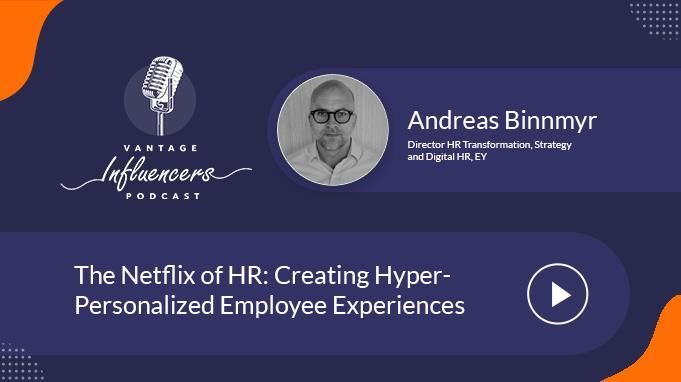
Andreas Binnmyr, Director of HR Transformation, Strategy, and Digital HR, EY
Andreas is an internationally experienced HR leader with expertise spanning HR strategy, transformation, and shared services, having worked across the Middle East, EMEA, the Americas, and APAC in both corporate and consulting roles. He has led complex HR and talent transformation programs, designing operating model enhancements, HR service delivery models, and HR technology solutions for multinational corporations and public sector organizations, with experience spanning HR operations, rewards, talent and performance, learning, payroll, and compliance. A seasoned change management practitioner, he has led large-scale change enablement initiatives from strategy through training and communication, and is a recognized speaker at conferences including SHRM and Informa, as well as a guest lecturer at the American University in Dubai.
Connect with Andreas on LinkedIn
Host
Shabana Shahnaz, Vantage Influencers Podcast Host
What You Will Learn
- Why Netflix-style personalization is becoming a serious framework for modern HR
- The real difference between adding HR technology and building a hyper-personalized experience
- How to think about ownership and governance when personalizing HR at scale
- Which business outcomes to track when justifying a personalization investment
- Where to start if your organization is early in this journey
- The biggest myth holding HR transformations back from succeeding
Key Topics & Timestamps
| Timestamp | Topic |
|---|---|
| 01:48 | Framing "the Netflix of HR" as a growing theme across HR and other corporate functions |
| 02:53 | What hyper-personalization actually means and how HR arrived at this moment |
| 04:09 | The role AI and data play in building hyper-personalized HR experiences |
| 05:24 | Who should own personalized HR: HR, IT, or a new kind of leader |
| 06:53 | The impact of hyper-personalization on internal mobility and career development |
| 10:53 | Where HR leaders should begin when starting a hyper-personalization journey |
| 14:04 | The biggest myth about HR personalization: that a new tool is all it takes |
Full Transcript
Click to read the full episode transcript
Welcome to the Vantage HR Influencers Podcast. This podcast is sponsored by Vantage Circle, the simple and AI-powered rewards and recognition platform for employee engagement.
Imagine opening your company's HR platform and seeing content, opportunities, and career pathways curated just for you, much like how Netflix serves your next binge-worthy shows, right? Sounds futuristic. Well, it isn't, but it's also happening right now.
Before we begin, I'm your host, Shabana Shahnaz, and I will welcome you to yet another episode of Vantage Influencers Podcast, where today we are diving into what many are calling the Netflix of HR. However, this isn't about entertainment. It's about revolutionizing employee experiences through hyper-personalization which is powered by AI, people analytics, and a bold new thinking.
At its core, this trend isn't just about delivering more tech. It's about treating employees not as one-size-fits-all resources, but as individuals having evolving needs, goals, and journeys.
To help us unpack it all, I am thrilled to be joined by Mr. Andreas Binnmyr, who is a globally seasoned HR leader, a transformation architect, and a change strategist with a career that spans every corner of the globe, from the Middle East to APAC, from the Americas to Europe.
So welcome to the show, Andreas. It's a pleasure to have you here.
Andreas Binnmyr: Thank you very much, and really appreciate the opportunity to contribute to your webcast. So, pleasure to be here, and thank you for the very nice introduction.
Shabana Shahnaz: Of course, of course. So shall we start with the topic itself then, the Netflix of HR, right?
Andreas Binnmyr: Yeah, I think it's a great topic to discuss, and it, of course, has a lot of relevance with what's happening in the HR space, but also amongst other corporate functions within many large organizations. And I think, from my perspective and what I see in many organizations, are increased and more complex demands from employees and managers in the HR function itself to create a more frictionless experience enabled by technology, enabled by AI, and delivering those moments that matter in a better way. So I think it's a great topic to discuss, and I think it's an area that many organizations are still grappling with, and how do we move these things forward, and how do we tackle this? So yeah, it's a great topic.
Shabana Shahnaz: Right, correct. So it's catchy, it's for sure, but what do you think it really means, the Netflix of HR? Like, how did we even get to this point in the evolution of HR?
Andreas Binnmyr: Yeah, I think it touches upon the fact that lots of other technology around us is already hyper-personalized or is already using a lot of different data sources to create these improved and seamless experiences where the computing power or various technologies knows more about us, so it can help us to find things faster and get things done faster. And the same thing applies to HR, that if I want to look for a simple policy, or if I'm a typical or a specific worker or employee type, I might have very different needs than another kind of worker or employee. And I think this whole thing about hyper-personalization in HR is about creating that frictionless, simple access to the HR activities that I need to perform my job as easily as possible. That, to me, is what hyper-personalization and Netflix of HR is all about.
Shabana Shahnaz: Right, that makes a lot of sense. So, Andreas, how exactly do you think organizations are making this happen? Like, what kind of role is AI and data playing in creating these hyper-personalized experiences?
Andreas Binnmyr: Yeah, I think I've been working in many different sort of HR transformation or HR technology type programs throughout my career. And data is always one of those cornerstones and pillars of success for this sort of transformation or transition into something new. And by the way, that was true with SAP on-premise implementations 15 years ago, and it's even more true with some of the leading edge and more advanced sort of AI technologies that you could potentially implement today. So I think coming to grips with the likes of data is clearly one of the major cornerstones here. And I think another sort of reflection when I see some of these things is, of course, how do you prepare a workforce in HR to deliver these kinds of services as well? So what impact does it have on HR, should you be successful in your outcomes?
Shabana Shahnaz: Right, right. So with that level of intelligence built into the system with data, don't you think it raises a question like who's actually responsible for delivering this kind of transformation, as in who should own the implementation of personalized HR? Like, should it be HR or IT? Or do you think it's time for a new kind of leader to step in?
Andreas Binnmyr: So I think the question of ownership is always a difficult point in programs and transformations like this. And I've been in areas where there's been perhaps a technology function that's led these kind of transitions. Very often it's been HR leading these kind of transitions. But I think ultimately, there's two things for me. One is that, to me, it really doesn't matter as long as the governance around the program and around the transformation is determined and is agreed by the senior sponsors and the senior stakeholders. So the ethos of governance, and being clear who can ultimately decide on what, and who is responsible for delivering what, be it IT, be it HR, be it finance, whatever it is, that is to me the core of any sort of transition like this. And I think that really needs to be at the core.
Shabana Shahnaz: Right, got your point. That's a brilliant one, actually. Well, let's move on to talk about outcomes, right? So what impact, Andreas, do you think this kind of personalization has on internal mobility or career development, per se?
Andreas Binnmyr: Yeah, well, I think it needs to have an impact. So, in my experience, one of the areas where perhaps HR can continuously improve its ability is to build business cases and benefits cases, and that needs to be at the core of why you're transitioning towards perhaps the Netflix of HR or hyper-personalization. So what are the outcomes you're trying to achieve? In my view, with hyper-personalization you can tackle a lot of key HR metrics and KPIs, whether that's around increasing engagement, because I think as an employee, it's easier to find things, I have more visibility, I have more transparency. Career paths, for example, that's perhaps a good thing to measure if you embark on a journey like this. I think there could be other areas, so let's call it hyper-personalization in terms of talent development and learning, et cetera. And then perhaps another metric is around, well, how is learning consumed in the organization through the help of hyper-personalization? Because I no longer need to spend several hours looking for the right learning or the right content system, and the technology is helping me. But I think the third one, which is, of course, again, a little bit depending on the type of organization you are, hyper-personalization and a better experience through technology should in reality also help to balance the cost or help with productivity in HR. So where are the HR folks spending their time? Is it about providing proactive advice, supporting the leadership agenda, really taking time for face-to-face type, more complex conversations? And that's where I think, again, hyper-personalization and a better digital experience can help with a lot of that. So you can sort of refocus HR's attention more away from the operations into the more strategic and advisory things that Ulrich and others have been talking about for the last 30 or 40 years. So I think that's still very relevant. That's a pretty long-winded answer to your question, but I think the breadth is important, and that you really think about what's the business case, what's the benefits, what's the business going to get out of the investment into something like this.
Shabana Shahnaz: Correct, I completely agree with your point. It actually also shifts the role from career gatekeeper to a career enabler with this hyper-personalization, right? So, yes, that was-
Andreas Binnmyr: Yeah, absolutely. And I think there are still many, at least from my perspective, there's still many HR organizations that are exactly, to your point, more acting as the sort of policy police or the gatekeeper, or being very stuck in some policy or process. And I think, again, with the right technology, set up the right way, with the right HR service delivery model and the right HR operating model.
Shabana Shahnaz: Yes.
Andreas Binnmyr: There's some real opportunities to really progress how HR adds value back to the organization.
Shabana Shahnaz: Correct, absolutely, agree to your point. So then, Andreas, tell us, for HR leaders who are just starting to explore this journey, right, what advice would you have for them? Where do you think they should begin?
Andreas Binnmyr: That's a great question, and maybe I'll start with the answer, which is, well, it depends. But I think I want to tie back to what I said previously: I would always start with what are the business outcomes, what are the benefits you're trying to achieve, how do you measure what it is you're trying to tackle. Because if that is pretty clear, and if that is aligned and agreed with wider decision-makers in the organization, that's always where I personally would start, because it gives you some of those anchor points needed and gives you the direction needed to do something like this. So I think that's one.
Shabana Shahnaz: Yes.
Andreas Binnmyr: I think another area where I would start is, again, a little bit depending on where you are on your journey. What I would say is that technology is more accessible today. There are more vendors, there's more providers in the human capital space than ever before, and that continues to grow. So one of the things I think is important is that HR functions explore, pilot, try, and test their way out in slightly more agile ways to hit some of these use cases or benefits they're trying to achieve through the right technology that can deliver hyper-personalization. So I think continuously exploring, working with your technology function, working with your digital HR function, whatever you have, to really push this agenda forward, because there are many providers that can deliver aspects of this. So I think that's the second point that's important to me, what I would advise on. And the third one is, of course, thinking about these types of programs, because I truly believe they are very transformational if you do them right, is to think about it in terms of a transformation and not just a few use cases or a piece of technology that needs to be implemented and then it's over and done with. I think truly planning out, truly thinking about what the program, the transformation will look like, what's the cost, what are the benefits, tying back to some of the impacts you want to address, that is part of the journey as well. So I think with those two or three things, that's where I would start on a journey like this.
Shabana Shahnaz: Well, I loved all your points. I mean, to reiterate, as you said, you have to start with your people, right, and take a test-and-learn approach, and also not overlook the change management aspect of it. So that was a brilliant answer, I loved your answer. So then, Andreas, I think we can move on to the final question for today's conversation, right? So before we wrap up, would you please tell us, what's one big myth about personalization in HR that you would love to bust?
Andreas Binnmyr: Excellent question. So I think the biggest myth still, and it's not just for hyper-personalization, which is obviously clearly very technology enabled, but I think the biggest myth and the biggest challenge I still see is that many HR teams, many technology teams, seem to consider that selecting and implementing a new tool is kind of all it takes. And I, from my experience, and I think I mentioned at the very start of our conversation, the sort of holistic approach to transformation is extremely important. Because I think the way the technology is moving forward, that is almost your easiest activity that you need to undertake. But as you very nicely said, the people journey and the impact on employees, managers, and HR, if you achieve this hyper-personalization, is very big. So I think the element of change, the element of perhaps business readiness, the element of making sure that you are delivering what you said you would deliver through and with people, is so important and is well known. Seven out of ten, or eight out of ten, transformations are perceived to fail because people aren't bought into what you're trying to do.
Shabana Shahnaz: Correct.
Andreas Binnmyr: So I think, to me, that's kind of a big lesson learned that still keeps on happening today. And I think, finally, I will just say, and just to build on this a little bit further, to me, also the fact that many HR functions seem to think that once technology is implemented, it's sort of a one-off situation, "I do it once and then it's done." But I think if you come back again to the holistic needs of really thinking, well, if I have this new ability to build a hyper-personalized experience, process, and technology, what does it mean for my HR team? What will they do differently in a future state? What does it mean for the managers in a future state? What are their accountabilities, and they might be quite different than in a non-hyper-personalized space or in a more traditional setup. And I think that's why you always also need to tag along the HR service delivery model.
Shabana Shahnaz: Right.
Andreas Binnmyr: The HR operating model, and really think about these things from almost a 360-degree perspective, because chances are you will fail if you fail to hit that sort of breadth of transformation that's needed to deliver something like this.
Shabana Shahnaz: Right, that was insightful, thank you, that really rings a bell. So then, Andreas, I think this was a very rich and insightful conversation with you. So thank you really for helping us break down what personalization in HR means and how we can actually take the practical steps to get there, right?
Andreas Binnmyr: So, yes, of course.
Shabana Shahnaz: So, to our listeners, if today's conversation sparked ideas or challenged your thinking even a bit, that is exactly the point of this conversation. And personalization, you should know, is not a luxury anymore, right? It's becoming the foundation of meaningful and modern HR. So thank you so much, Andreas. If our listeners want to connect with you, would you point them to your LinkedIn, or would you provide your email? How would you help them?
Andreas Binnmyr: I think I'm fairly active on LinkedIn. It's easy to connect with me, and happy to connect there, and more than happy to answer questions or follow-ups, whatever they might be. So LinkedIn, best way to contact me.
Shabana Shahnaz: Great, amazing then. So thank you so much, Andreas. It was a pleasure having you on the show, and thank you everyone for tuning in. We will see you next time.
Andreas Binnmyr: Thank you so much.
Thanks for listening to the Vantage HR Influencers Podcast. Please do subscribe to Vantage HR Influencers Podcast on Apple Podcast, Spotify, and our YouTube channel for new episodes.
FAQ
What does "the Netflix of HR" actually mean?
It refers to applying the same hyper-personalization that consumer platforms use, tailoring content and recommendations based on data, to the HR experience. Instead of one policy or one learning catalog for everyone, employees see the information, opportunities, and career pathways relevant to their specific role and needs.
Who should own hyper-personalization in HR, HR or IT?
According to Andreas, ownership matters less than governance. Whether HR, IT, or another function leads the effort, what matters is that senior sponsors and stakeholders clearly agree on who decides what and who is responsible for delivering it.
How does hyper-personalization affect career growth and internal mobility?
It can shift HR from being a "gatekeeper" enforcing policy to an "enabler" of growth. When employees have more visibility and transparency into career paths and learning opportunities, engagement and internal mobility both tend to improve.
What is the biggest myth about personalizing HR experiences?
That selecting and implementing a new tool is the hard part. Andreas argues the technology is often the easiest piece: the real challenge is the people side, including change management and redefining what HR and managers do differently once the new experience is live.
Related Reading
Also listen on