The Secret To A Great Workplace Experience
Episode Overview
What actually makes a workplace experience great? In this episode, Lionel Paul David breaks the question down into something HR teams can act on, rather than treating it as an abstract, feel-good goal. He argues that workplace experience is not a single initiative or perk. It is a constantly evolving ecosystem that blends culture, technology, operations, and the everyday realities employees face across both physical and digital work environments. For Lionel, the real test of workplace experience is simple: does it consistently deliver a great employee experience, so that a great customer experience naturally follows.
Lionel lays out three ingredients he considers non-negotiable. The first is a human-centered approach: understanding each employee's background, demographic, needs, and aspirations well enough that a program never feels copy-pasted from another organization. The second is staying proactive, since yesterday's best practice can quickly become irrelevant as an employee base evolves. The third, and the one he calls most important, is a holistic view that refuses to treat employee experience and customer experience as separate tracks running in silos. He also walks through how design thinking, starting with empathy for the end user, can turn even an unglamorous HR process into something faster and more human, and why he believes the workplace experience conversation only gets more urgent as automation and hybrid work reshape what employees expect.
Episode Highlights
- Workplace experience isn't a single perk or benefit. It's a constantly evolving mix of culture, technology, operations, and daily experience across physical and digital environments.
- The secret to a great workplace experience comes down to three things: a human-centered approach, staying proactive as needs evolve, and taking a fully holistic view instead of treating employee and customer experience as separate tracks.
- Copy-pasting another company's employee experience playbook doesn't work. HR needs a real grip on employee demographics, needs, and aspirations before designing anything.
- Employee recognition has shifted toward personalization, letting employees choose rewards and experiences that matter to them instead of one-size-fits-all cash bonuses.
- Design thinking starts with empathy. Mapping the actual user journey, rather than guessing at a "blanket" problem statement, uncovers issues a siloed HR process would otherwise miss.
- A hyper-disruptive, post-pandemic world makes workplace experience more urgent, not less, because the workforce that stays behind carries the pressure of keeping the business running.
About the Guest
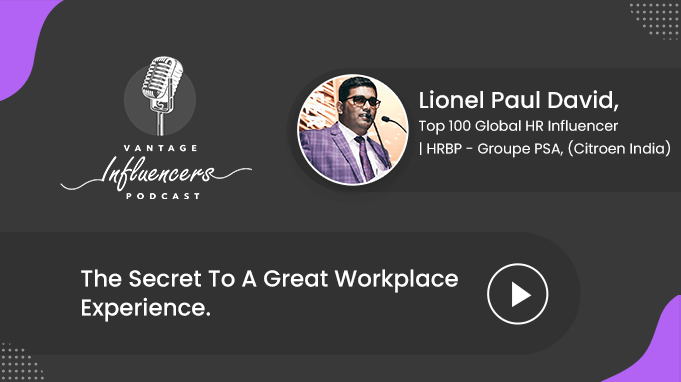
Lionel Paul David, Head of HRBP for Corporate Functions - India Region, Groupe PSA
A creative, proactive, and result-oriented HR professional, Lionel has spent close to a decade and a half working across talent attraction, workplace culture, and employee experience, across industries spanning IT, media, internet, and infrastructure, and now automotive. His association with the National HRD Network (NHRDN) has given him a platform to connect with senior HR leaders across sectors and geographies.
Connect with Lionel on LinkedIn
Host
Susmita Sarma, Vantage Influencers Podcast Host
What You Will Learn
- How to define "workplace experience" as a blend of employee experience and customer experience
- The three-part framework for a great workplace experience: human-centered, proactive, and holistic
- Why copy-pasting another organization's employee experience approach doesn't work
- How employee recognition preferences have shifted toward personalization and instant, digital-first rewards
- How to apply design thinking, starting with empathy, to fix broken HR processes
- Why investing in workplace experience is more urgent, not less, in a post-pandemic world
Key Topics & Timestamps
| Timestamp | Topic |
|---|---|
| 00:00 | Cold open: what makes a workplace a wonderful experience |
| 00:41 | Introducing guest Lionel Paul David |
| 01:06 | Lionel's HR career journey across industries |
| 02:46 | Defining the emerging meaning of "workplace experience" |
| 04:56 | The three-part secret to a great workplace experience |
| 08:13 | How employee recognition preferences are evolving |
| 11:01 | Getting started with design thinking in HR |
| 16:26 | Why the pandemic makes investing in workplace experience urgent |
| 21:04 | The future of workplace experience |
| 23:16 | Closing advice for HR leaders |
Full Transcript
Click to read the full episode transcript
Welcome to the Vantage HR Influencers Podcast. This podcast is sponsored by Vantage Circle, the leading employee benefits and engagement platform.
What makes a workplace a wonderful experience? Well, that's not an easy question to answer. Today, companies are constantly searching for new ways of engaging employees and building an atmosphere in which employees love to work for decades. Businesses need to look beyond just benefits and expand their interfaces to include technologies, physical environments, and corporate culture.
So let's get started.
Susmita Sarma: Hi, everyone. This is Susmita, Vantage HR Influencers Podcast. And today we are going to talk about the secret to a great workplace experience. And to join me today in the conversation, I'm so excited to welcome Lionel Paul David, a creative, proactive, result-oriented professional. Lionel is Head of HRBP for Corporate Functions, India Region, at Groupe PSA, a multinational automotive OEM. Welcome to the show, Lionel.
Lionel Paul David: Hi, good day, Susmita. Thanks for having me here.
Susmita Sarma: OK, so before we jump into the topic, Lionel, I would like to know a little more about your journey in the corporate field.
Lionel Paul David: OK, so I've been blessed with a very exciting career so far, where I had the opportunity to work along with some incredible people for close to a decade and a half in the corporate world. And during this journey, what I enjoyed the most is the ability to make a positive impact on the lives of the workforce that we serve and the community at large. I've been privileged to be part of organizations that allowed me to architect cutting-edge and award-winning practices across different facets of HR, as a specialist first, then as a generalist, and as an HR leader, in spaces like talent attraction, workplace culture, and employee experience. So that's something close to my heart, and I'm glad that we're going to be talking about that today. Organization change and transformation, with leading organizations across IT, ITES, media, internet, infrastructure, and now in the auto sector, that's been the gratifying part in terms of touching the full spectrum of HR across different industries. And in that period of a decade and a half, I picked up some good skills to my repertoire. In addition to this, my association with NHRDN has also provided me a platform to connect with senior leaders across sectors and locations, and my roles have also allowed me to contribute to the profession and the fraternity in whatever small way I can. So that's a bit of an introduction from my side.
Susmita Sarma: OK, so quite a diverse, very experienced panel. So in basic terms, workplace experience is the cumulative total of all experience in an organization that an employee goes through. So in your view, what would be the emerging definition of the term workplace experience?
Lionel Paul David: OK, so for me, workplace experience is a holistic approach that combines customer experience and employee experience to create a sustainable business result. Because today, customers are being spoiled for choice. Companies have to do their best to compete in the marketplace by creating a memorable customer experience to gain customer loyalty. And on the other side, social media has ensured that a bad customer experience is out in public in the form of reviews. So this means consistent customer delight is key for a business to succeed, and customers are more informed than ever. So that's one side. The secret to delivering a great customer experience consistently is only through creating a delightful employee experience. There are plenty of examples of this idea in the literature. Many people would have read about companies where an employee-first, customer-second philosophy drives the business. Another personal favorite of mine is Zappos. The founder, in his book Delivering Happiness, talks about how their organization delivers a great customer experience consistently by creating a delightful employee experience. So the bottom line, for me, in terms of the definition, is: if you can take care of your employee experience, you take care of your customer experience. A human-centered and proactive approach to creating what I would call a constantly evolving ecosystem, one that combines culture, technology, operations, and experience to get the best out of each individual employee, in both physical and digital work environments, that is workplace experience for me.
Susmita Sarma: So what does it take to build a successful workplace experience? What is the key ingredient, or the secret ingredient, to a great workplace experience?
Lionel Paul David: OK, so like I mentioned in my earlier answer, the first thing is the human-centered approach. Designing the experience for your employees should not be a copy-paste approach, which many people do. It's easy to copy-paste a design, but mindless copying cannot deliver an authentic experience. You can read about a great human-centered approach somewhere and think it will fit your organization, and try to copy it or replicate it. It doesn't work that way. The HR team should have a grip on what the employee profile looks like: what backgrounds they come from, what their demographic is, their needs, wants, and aspirations, so that they can deliver an authentic experience that makes each employee feel like this has been designed for them. So that's the first ingredient: a human-centered approach.
The second ingredient, for me, is having a proactive approach, because we live in an agile world where the experience is constantly evolving. As your employee base evolves, the experience needs to continue to evolve with it. The best practice of yesterday may not be relevant today, and that's something we have to take stock of, looking at the four components of the ecosystem we discussed earlier: culture, technology, operations, and experience. The organization's culture and the employee experience journey need to keep pace and evolve at the same rate as the operations and technology in the business. That's the proactive approach.
The third thing, which is the most important, is a holistic approach. I'm glad that you've titled this discussion "workplace experience" and not just "employee experience," because a few years ago, in the early 2000s, people were largely talking about employee engagement, and at the same time, business was talking about customer experience, or CX. Then people realized that you cannot have customer experience in silos, so engagement evolved to make way for experience. Today, the third ingredient I'm talking about is the holistic approach. One thing that's consistent across business history is that a siloed approach to transformation fails. Can a company deliver a great customer experience in silos, without a matching employee experience? Maybe in the short term, but not in the long term. So the idea should be to balance all levers of transformation together, holistically, if the organization wants this to be a sustainable, competitive edge. So to summarize, the secret to a great workplace experience is, I would say, three things: being human-centered, being proactive, and taking a holistic view.
Susmita Sarma: Great. So workplaces are undergoing a complex transformation. The only way for companies to thrive, sustain, and prosper is to adapt themselves to the changing norms of the working culture. One such major transformation is seen for most organizations in the employee recognition space. So how do employees prefer to receive recognition at work today? What are your views on it?
Lionel Paul David: OK, so is there anyone who doesn't love a pat on the back, or a good shout-out for a job well done? I don't think, in human history, that anyone doesn't fit into that. Those acts of extrinsic motivation boost morale and create a positive vibe within the team. In HR, this is something we've had theoretical grounding for, through motivational theories, and companies have been advocating different ways to try to motivate employees through extrinsic rewards, while also trying to tap into intrinsic motivation. So employee recognition, like every other concept, has evolved massively over time, and we live in curious times of instant gratification. To meet this need, companies are now applying concepts like gamification, so that ongoing, small recognitions can serve as instant recognition provided to employees. Many organizations are increasingly using digital platforms to do this. Earlier, when companies gave cash rewards without any cheer around them, it didn't serve as a lasting memory. So a key reason I see is the personalization of rewards, especially allowing employees to choose experiences that matter most to them. This can take the form of, say, dining, health, picnic, or travel vouchers that today several organizations let employees pick and choose from. The key with most of these experiences is that they're shared with the people who matter most to the receiver, which acts like a force multiplier. On the other side, these changes haven't taken away from the value of regular monthly, quarterly, or annual rewards presented in team meetings, town halls, and annual days. You can also add to this list peer-to-peer recognition and social media recognition. So every organization seems to have most of these mechanisms in place, but the key is execution, especially when you take care of the minute details, because that's what moves the employee.
Susmita Sarma: So many corporate leaders are now looking at design thinking as a way to enhance the experience of workers in the workplace. So, before we get into how to get started with design thinking, could you explain the concept to us?
Lionel Paul David: OK, so first thing first for an HR person, before we get into the theory of design thinking: it's very simple, everything starts with empathy. Even in design thinking, it starts with empathy, keeping the user experience intact without adding our own definition to the problem. This helps us avoid generalizing, and helps create a solution that's sustainable. So the key is to become user-centric, to focus on humans first and foremost, seeking to understand people's needs and coming up with effective solutions to meet those needs. When you get this part right, you get the rest of design thinking right.
Let me share one of my experiences, a fairly simple one, so it's easy to understand. With one of my earlier employers, we had an issue with employees being unhappy about the exit process. In the entire employee journey, this was our biggest weak link, I'd say. When we discussed this issue with the HR operations team and the finance team, who were responsible for the process, we got a bunch of reasons, most of them valid, and it kept coming back to the process being done manually. That was the problem statement, but every time I took the problem statement to them, they gave me another problem statement back. There was no solution. So we said, this isn't going to work, let's come together, brainstorm, and apply some design thinking principles.
What did we do? We mapped the current user experience. There are different kinds of people exiting the system. Someone who's less tenured, someone who's spent a lot of time with the company. A less-tenured person won't get certain components in the full and final settlement, and some people who are less tenured might have recoverables. So there were a lot of these scenarios. We profiled these users and mapped their experience, so that the problem space across different user groups could be precisely identified, rather than having a blanket problem statement defined entirely from our own side of things.
Then we automated the process, but alongside that, we did several other things. First, we had the opportunity to change the touchpoints and eliminate redundant steps that weren't necessary, and we split the process into two smaller loops. These changes helped us achieve some good results. We ensured the employee got a predictable and consistent exit process, eliminating steps the employee previously had to follow up on, like a physical relieving letter on the last day. Employees now had clear visibility into their full and final settlement at least a day before their last working day. And what used to take about 45 days as the cycle time to process the full and final settlement, we brought under seven days. But we didn't stop there, because in design thinking, you don't solve a user problem once and move on. You constantly keep reviewing the process to see how you can improve efficiency, using different metrics, and also combine the input from post-exit interviews. That's the human side of it. As I said, the starting point is empathy: keep the human at the center of the problem, and define it from their perspective. This is how we kept improving the process further.
Susmita Sarma: OK, so when we say "how to get started with design thinking," as you said, you gave an example with the exit process. So we can apply design thinking to many other things in the workplace, right?
Lionel Paul David: True, in every process within HR, you have an opportunity to apply design thinking. As I said, the starting point is empathy. Once you empathize with your user, you create a user profile and define the problem from their standpoint. Then you ideate for solutions. You shouldn't sit in a silo thinking, "I'm the HR person, I'm the process owner, so this is how I'll define the solution." No, you ideate, preferably with a cross-functional team, and bring the user into the picture to validate whether the proposed solution works for them. Because at the end of the day, no matter how much you try to empathize, define, and ideate with a cross-functional team, if it doesn't work for the user, it doesn't work for the user. Then you prototype and test the solution. That's what you need to do.
Susmita Sarma: Very nicely explained, Lionel. So my next question is, considering COVID-19 and how it has changed the entire workplace landscape, employers are now trying to take back their investments in employees. Given the number of people laid off or put on furlough since March, various positions are filled by the remaining workers, and they're possibly the most vital to business survival now. The pressure on them is more than ever, to support their employers in withstanding this crisis. So how would you describe why now is the time to invest in workplace experience?
Lionel Paul David: OK, that's a very interesting question. On one side you have the pandemic, but even without the pandemic, this was more than ever the time to invest in workplace experience, because we live in an era of hyper-disruption. Everything around us is constantly evolving. There are two aspects to consider, and I'll come to the COVID part next.
The first, in the general scenario, removing COVID from the equation for a moment: we live in a world of finite resources, shorter product cycles, increasing competition, and shrinking margins. The success of an organization's transformation efforts to cope with these hyper-disruptions, and to deliver a customer experience that translates into business opportunities, depends on the workforce. Now add COVID to this. If a production line had ten people, and today, because of a cash crunch, cost optimization efforts, and previous automation efforts that happened to get implemented around the same time, you may now have about six or seven people. But if they aren't efficient, if they aren't aligned to the purpose and mission of what you want to achieve, you're not going to win, whether from a product perspective, a competition perspective, a margin perspective, or a customer perspective. That's one side.
On the other side, consider that a prospective candidate already knows your brand through their own interactions as a customer, especially for organizations that are product-facing. They may also know someone who already works there, or has worked for the company, if it's a services business. So they carry certain perceptions and expectations before they sign the dotted line and become an employee. The quality of the workforce you're able to attract, retain, and drive top performance from is shaped by the workplace experience that the workforce desires. So, for a moment, ask yourself: what has the workplace experience of our employees actually been? If each of us can honestly reflect on how the workplace experience of our employees looked pre-COVID, during COVID, and what we aspire it to be post-COVID, is it at least consistent? Or have we used this as an opportunity to take it up a notch?
So how do we know? There are three key factors. From HR, look at the leadership style, because that's the messaging: leadership is what delivers the message that people believe in, and what actually gets executed on the ground. Look at the leadership style during this period, the workplace environment we've been able to provide, and the policies and procedures that govern the organization. If we take stock of these three, we'll know whether we've been consistent, whether we've dropped the ball, or whether we've taken workplace experience up a notch. If an organization has already taken it up a notch, in my view, it's already showing up on social media as an organic testimonial from employees, not just from potential candidates, but from current clients and other employees within the organization too. That gives a huge sense of pride and reassurance to these stakeholders, and deepens their commitment to the organization's purpose. So I don't know if there's ever been a better business case to invest in workplace experience than right now.
Susmita Sarma: So how does the future of workplace experience look to you?
Lionel Paul David: OK, so today we're at a crossroads, where the rise of knowledge workers is on one side, and the rise of intelligent automation and machines is on the other. These crossroads bring us to a need for man-machine co-working, which increases the need to humanize the workplace. In a knowledge-working environment, people are looking for something beyond titles, beyond paychecks, beyond perks. That's what people are looking for. So the future of workplace experience starts with crafting a mission and purpose that gives a sense of belonging, giving people challenges that help them progress, providing them with space to engage and bond with co-workers, and designing flexible working arrangements that let them balance their professional aspirations with their life priorities.
Most importantly, what people are looking for today is an environment that is fail-safe. Because in an industry where everything is constantly churning, you're expecting people to challenge the status quo and to be innovative. Unless you provide a fail-safe environment, where people can challenge the status quo and innovation is celebrated as a way of life, they can't thrive, they can't give their best. None of what I've said is new, but a lot of it hasn't become mainstream yet. You see this in pockets, in startups that are disrupting the market, and you're also seeing it in some of the leading players. Over the next few years, I see the future of workplace experience evolving along these lines and becoming mainstream. Most importantly, businesses across the spectrum are now realizing the importance of workplace experience more than ever before, which makes the space more exciting and active.
Susmita Sarma: So is there anything else you'd like to add, or any suggestions for our listeners?
Lionel Paul David: OK, so what's happened with COVID is that the momentum of the HR transformation agenda has picked up pace. Many of us now work alongside conversational AI bots and other digital systems in our HR teams. With this rising digital wave, it's important to retain the human side of HR. When I read about smart machines learning to become more empathetic than real people, it makes me uneasy. So let's work toward preparing for a post-COVID workplace where four things are critical for workplace success. The first is increasing our focus on employees' financial, physical, and psychological needs. The second is separating critical tasks and roles from the rest, and focusing on automating the rest, if we haven't done so already. The third is focusing on skill-building through continuous learning, in order to future-proof our organizations. And the last is making the physical workspace, which is increasingly blurring the lines between physical and digital, work for everyone, because more and more organizations will be embracing remote work. So, as a one-liner, I'd say we should look forward to nothing more than human-centered HR.
Susmita Sarma: That's right. So how can our listeners reach out to you, Lionel?
Lionel Paul David: I have an active Twitter and LinkedIn profile, so feel free to connect or drop me a line. I'm more than happy to stay connected with each of you.
Susmita Sarma: So that was a great conversation with you, Lionel. Thanks for joining me.
Lionel Paul David: I enjoyed it. Thank you so much.
Thanks for listening to the Vantage HR Influencers Podcast, where we engage with HR influencers about human resources. Please subscribe to the Vantage HR Influencers Podcast on Apple Podcasts and Spotify for new episodes.
FAQ
What is workplace experience?
Workplace experience is a holistic approach that combines employee experience and customer experience into a single, constantly evolving ecosystem of culture, technology, operations, and experience across both physical and digital work environments.
What are the three secrets to a great workplace experience?
According to Lionel Paul David, they are a human-centered approach, a proactive approach that keeps pace with an evolving workforce, and a holistic approach that refuses to treat employee experience and customer experience as separate initiatives.
How has employee recognition changed in recent years?
Recognition has shifted toward personalization, letting employees pick rewards and experiences that matter most to them, alongside more instant, gamified, digital-first recognition, without pushing out the value of regular team, town hall, and peer-to-peer recognition.
How can HR teams use design thinking to improve the workplace?
By starting with empathy, mapping the real user journey instead of guessing at a generic problem statement, ideating with a cross-functional team, and then prototyping and testing solutions before rolling them out organization-wide.
Related Reading
Also listen on