The Transformative Power of Creative Problem-Solving in HR
Episode Overview
Adam Calli opens with a simple reframe: HR does not have to choose between enforcing rules and encouraging creativity. He walks through how understanding the full context of a situation, the scope of its impact, the experience level of the people involved, and the business circumstances of the moment, gives HR room to respond with judgment instead of a reflexive no. He describes the difference between running a "department of no" and a "department of know," where employees come to HR expecting a collaborative search for the right answer rather than a flat refusal, and explains why the same precedent does not always have to apply twice once the context has changed.
Adam also pushes HR to look outward for ideas rather than only inward. He points to employee resource groups as an underused source of insight, arguing that if these groups already exist inside an organization, HR should be asking them what to do instead of only supporting them from the sidelines. He warns against what he calls an echo chamber, where leaders only hear from people who think and look like them and lose the range of perspective that genuinely different voices provide. The conversation closes with his advice for people new to HR: learn the laws and policies first, ask questions relentlessly, and find a mentor before trying to get creative.
Episode Highlights
- Adam Calli compares breaking a company policy to breaking the law: understanding the full scope of a situation, financial impact, reputational risk, or safety concerns, tells HR how much room it has to respond creatively rather than reflexively.
- He explains that expectations should scale with compensation and experience, a highly paid, experienced employee is held to a higher standard than someone who is still learning the role.
- Adam reframes HR's job as being the "department of know" instead of the "department of no," opening a collaborative conversation with managers rather than shutting requests down outright.
- He points out that the same precedent does not always apply twice, seasonal business pressure can justify saying no to a request today and yes to the identical request a few months later.
- Adam argues that employee resource groups are an underused source of guidance and encourages HR to ask these groups directly what the organization should do, rather than only supporting them from the outside.
- He warns against the "echo chamber" effect, where leaders who only hear from people who look and think like them end up missing perspectives that could make their decisions stronger.
About the Guest
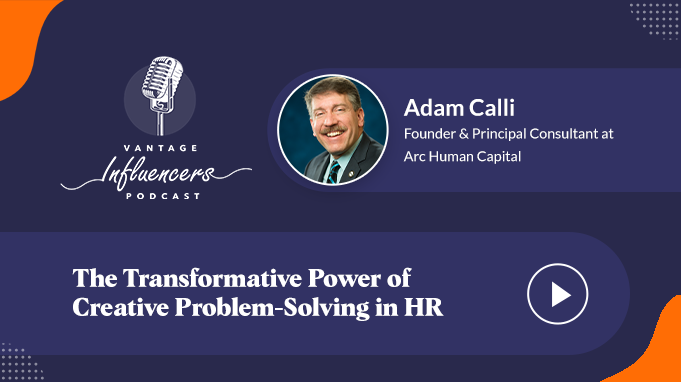
Adam Calli, Founder and Principal Consultant, Arc Human Capital
Adam Calli leads Arc Human Capital, an HR consulting firm built around experienced HR professionals who help organizations meet compliance requirements while applying modern, business-minded HR practices. His career spans hospitality, television production, banking, and government contracting, work that shaped his belief that HR earns credibility by understanding the industry it serves rather than applying policy from a distance.
Host
Susmita Sarma, Vantage Influencers Podcast Host
What You Will Learn
- Why understanding the scope and context of a situation helps HR calibrate between strict rule enforcement and creative flexibility.
- How pay and experience level should shape the expectations HR sets for different employees.
- Why being seen as a "department of know" builds more trust than functioning as a rule-only "department of no."
- How business context, not blanket consistency, should guide whether the same precedent applies twice.
- Why lunch conversations and genuine relationship-building matter long before a problem ever reaches HR's desk.
- How employee resource groups can become a direct source of strategic guidance instead of just a support function.
- What an echo chamber looks like inside HR decision-making and how to avoid one.
- What newcomers to HR should prioritize learning first: laws, policies, mentors, and the habit of asking questions.
Key Topics & Timestamps
| Timestamp | Topic |
|---|---|
| 01:11 | Adam's path from hospitality management into HR consulting |
| 03:15 | What motivated a more progressive, business-engaged approach to HR |
| 06:10 | Balancing rule enforcement with creative problem-solving in HR policy |
| 17:11 | Environmental scanning and staying ahead of workplace change |
| 22:24 | Using employee resource groups and avoiding echo chambers in decision-making |
| 25:48 | Essential skills and mindset for HR newcomers |
Full Transcript
Click to read the full episode transcript
Welcome to the Vantage HR Influencers Podcast. This podcast is sponsored by Vantage Circle, the simple and AI-powered rewards and recognition platform for employee engagement. Creative problem-solving is shaking up HR, and it's a big deal at work nowadays. Join us as we talk about how HR folks handle the tricky balance of following the rules, sparking new ideas, building connections with co-workers and leaders, and navigating the ever-changing workplace.
Susmita Sarma: Hello, listeners. I'm your host for the show, Susmita, and in this episode we'll dive deep into the exciting world where creativity meets human resources. Joining me is our special guest for the show, Adam Calli, the founder and principal consultant at Arc Human Capital. Hi Adam, welcome to the Vantage Influencers Podcast.
Adam Calli: Thank you very much. I'm very excited to be here. I've been looking forward to it.
Susmita Sarma: Brilliant. So before we begin with our real conversation on the topic today, would you like to share some key milestones in your field that have led you to your current role in HR consulting?
Adam Calli: Sure. I actually studied hotel management in college. My vision was to be the general manager of a big, beautiful Florida resort. As you can see, life doesn't always go the way we think it will when we're eighteen years old and picking our major in college. Still, I got my degree and went to work for a hotel and resorts company. As I worked with my employees in my departments, I realized I was more excited about working with the employees I saw every day than the guests, even our most frequent guests were only there for a couple of days, or a week if they were in for a meeting, and some of them I'd never see again. Whereas the relationships with our staff members, you build them, and they go on for years in many cases.
So I began to get interested in HR and started doing some training. I shared my interest with the leaders at the hotel. They kept that in mind and gradually gave me opportunities to contribute to what was going on there and exposed me to different aspects of human resources. Eventually I got a job in payroll because that had some HR aspects to it. Then I was fortunate, thanks to the magic of networking. I know this session isn't about networking, but it matters. The controller I worked for was good friends with the HR director at another hotel in our area, and he got me an interview with her when she had a job open. As they say, the rest is history. Twenty-five years later, here I am talking with you.
Susmita Sarma: Brilliant. So how has your perspective on HR evolved over the years, twenty-five years now, and what actually motivated you to take a progressive approach with Arc Human Capital?
Adam Calli: The thing that attracted me to HR originally still holds true today. I felt like so many people in HR know the policy, they know the law, and that's all they tell you. They stick to the standard operating procedures, the company policy, and that's it. I felt like I wanted to go into HR because there had to be a way to still follow procedures and laws but be more engaged with my colleagues, more engaged with the business, and say, okay, how can I bring some logic and reasoning to this instead of just giving a knee-jerk reaction and saying, no, we can't do that.
Because then you become the department of no, N-O. I wanted to be the department of "know," K-N-O-W. Come to me because I know things. Let me share with you what I know about the laws, federal, state, and local, and about the policies of our company, and then let's collaborate together and figure out a better way to approach the situation instead of just saying, nope, can't do that.
Susmita Sarma: So, coming together and solving whatever problem comes up, right? I think you'd define that as creative problem-solving in HR.
Adam Calli: Indeed. And once you demonstrate to the managers, leaders, departments, and divisions in your organization that you're an approachable person, that you're not going to just shut them down, people start saying, I could work with this person. I'm not going to go to HR only at the last possible minute, when everything's about to blow up and things are far more difficult, because I know they'll be interested in talking with me and we'll work together. When you invite and reinforce that kind of relationship, it gains momentum. Those managers talk. People have an experience with you and share it with others, and then someone else will say, oh, my friend had a good experience when they went to talk to Adam. Maybe I shouldn't be afraid of going to HR.
Susmita Sarma: Let's move on, Adam. Striking a balance between enforcing rules and encouraging creativity can be very challenging, isn't it? How do you actually navigate that delicate balance in your HR policies?
Adam Calli: For one thing, I think of it like the law. There are misdemeanors when you break a minor law, and there are felonies when you break a more major one. If you understand the full scope of what happened, the full impact, whether it's financial, or it affects the company's reputation, the customer, maybe damaged property, maybe there were injuries, that gives me some leeway to be more or less creative.
Understanding the context of a situation also helps me understand something about the people involved. If I have a more experienced, trained, highly compensated person, to be blunt, I expect more from that person. Sometimes people think, I'm highly trained, I'm highly experienced, you need to respect me, you need to treat me special. Yes, that's true, but with that comes higher expectations. If I pay you a hundred thousand dollars, I expect more from you than someone I spend fifty thousand dollars a year on. Higher expectations go with higher compensation. Whereas when someone is more entry-level and still learning, I don't expect as much. I know they need guidance, and I know there's maybe even a higher likelihood of failure. Understanding that difference tells me my approach needs to be a little different.
The other thing about striking a balance is that I need to be like a liaison to the managers and the folks in the operation. I need to make sure they're informed. I talked a minute ago about being the department of "know" instead of the department of "no." So I need to tell them, listen, just because we can't do a thing one way doesn't mean we can't do anything. You bring me your problem and I might say we can't do it that way because the Fair Labor Standards Act, or the Americans with Disabilities Act, or whatever law applies, says we can't. But I'm opening the door to you. I'm working collaboratively with you. You don't just come to HR and expect me to hand you the answer. You come to me expecting that we'll work together to find the right answer, and the right answer for one division or department doesn't necessarily apply to another.
I don't want anyone listening to this to think, well, what about consistency? What about the precedent we set when we do one thing, for how we handle the next situation? That's absolutely a fair point. We need to understand the precedent, but we also need to understand the context and the details behind it.
Let me give you an example. We're recording this on the fifth of December, and here in the United States we're approaching the holiday season, a huge time for retail, when everyone is shopping and spending money. If I'm in the retail industry right now, this is the busiest time of year, bar none. All the customers are coming in, they all need something, the money is being spent. If an employee came to me right now and said, I need to take a leave of absence, I might have to say no, I can't do that right now. That doesn't mean I won't do it, it just means I can't do it now. Of course, it depends on the circumstances, if it's a medical issue, that's different, but setting those aside, I may need to say no because of the business circumstances. That same person requesting an identical leave of absence in January, after the busy season is over, I might have no problem saying yes to.
The point is, understand the context. If I have a precedent that says no in December, that doesn't necessarily mean it's a precedent to say no in July. Business circumstances are different, staffing levels could be different, your location could be different. What one division or office can't do, a different one might be able to.
Susmita Sarma: Equally, it's the responsibility of employees and colleagues to foster a positive relationship too, not just the leaders or HR. It's a two-way street.
Adam Calli: It definitely is, a two-way street. I read a book a while ago called Your First 100 Days in an executive position. It was written for someone stepping into an executive role, but I'd argue it's just as valuable for anyone wanting to move into a senior leadership role, because it maps out a roadmap. I'm not here to sell the book, it's not mine, but one line in it always stuck with me. It said, never miss a lunch. And I don't mean that literally about eating a lot. The point was to have lunch with other people, with your colleagues. If you're new to the company, new to the industry, new to a particular site, get out of your office and go to lunch with your colleagues, and get to know them on both a personal and a professional level.
It takes time to build relationships, and you have to be genuine about it, you're not a politician. I can't speak for how politicians behave everywhere, but here in America they sometimes get a bad reputation for not being genuine. My point is, be genuine. Take the time. Engage with people over lunch. You're not in a rush, you're away from the office, you can be more relaxed. You're learning about them and they're learning about you, and you're laying the groundwork for dealing with issues that haven't even happened yet.
Think of it like this: if you have a problem with a friend you've known for years, you'll approach solving it very differently than you would with a stranger, because you know one another, you know each other's motivations and the context you operate in. With a stranger, it's totally different, because nothing is established.
So the relationships you build today only help you tomorrow. If you're early in your career, people probably aren't approaching you as much yet, because they know you don't know as much, and you're not yet in a position where people seek your input. But someday you will be, and if you get promoted from within your own organization while your colleagues in the operation are also getting promoted, eventually you'll all reach the top of your respective ladders, and you'll find yourself working with these same colleagues in senior roles, when you once worked together at a junior level. So today's efforts are just planting the seeds for good relationships tomorrow.
Susmita Sarma: And specifically for HR, the goal is to be viewed as a collaborative partner rather than just a rule enforcer within the company.
Adam Calli: That is the goal, absolutely, you hit it right on the head. And I'd argue it's important for us to know HR, that's what we're paid for, that's what my title says, that's where my office is. But we can only really be successful if we understand the business. Especially if I'm new to an industry. One of the beautiful things about HR is that it exists everywhere. I can go into practically any industry and there are HR roles. It can be exciting. I've worked in television production, in banking, in defense contracting, and the list could go on. Those are very different worlds, but I did HR in all of them. When you move into a new industry, you need to learn it, because if you're going to collaborate with your colleagues and earn their respect, you have to understand what their world is like, because it's now your world too.
You also have to speak their language, which goes hand in hand with understanding the industry. But the language of business, everywhere, is numbers. It's data, it's money, whatever your currency is, wherever you're listening from, dollars, rupees, euros, it doesn't matter. If you're in business, it comes down to money. Understanding how a company spends money and how it makes money will inform your HR approach and help you build the relationships we've been talking about.
Susmita Sarma: If we talk about proactively future-proofing organizations, how do you think HR can creatively navigate the evolving work landscape? Adam, can you talk about introducing innovative solutions for the challenges posed by such rapid change?
Adam Calli: Sure. I mentioned before that I worked at a hotel company, and we used to do something called the In Touch Day. If you've ever seen the TV show Undercover Boss, you'll understand this: you take leaders and put them out in the field so they can see what people are actually doing. If you're in HR, especially if you're new to an industry or a site, you have to get out in the field, because how can I help people adapt, how can I future-proof anything, if I don't understand their current reality? I'll only understand that by getting out there.
When you go to business school, they talk about a concept called environmental scanning, something we should always be doing in strategic planning. I'm completely on board with that. How does it come to life in the real world? Whether you're in HR or not, but especially if you are, you need to be reading all the time. It could be something online, or it could be old-fashioned, a book made of paper. Find reputable sources, both within HR, like HR-focused publications and industry resources, and outside of HR too, Forbes, Business Insider, publications like Fast Company that focus on what's new and different and how organizations are breaking the mold.
These activities, this environmental scanning, keep you current and aware of what's coming. If someone is listening to a podcast episode today, think about how many dozens of episodes have been recorded before covering all kinds of topics, and podcasts are great because you can listen on the go, whether you're commuting or exercising. It's also important, if you're trying to scan the environment, to be exposed to other organizations and people doing similar work, and one way to do that is going to conferences. A one-day or one-week session brings you back not only engaged and excited about your career again, but also more aware, because you've had the chance to step away from your day-to-day and just think. Stop and think about that for a moment. Just go and think, just go and listen, digest what the speakers are telling you, and think about how it affects your workplace.
Another way to stay aware and proactive is to recognize that change in the workforce often comes from new generations. When the baby boomers came into the workforce, then Gen X, then millennials, and now Gen Z, every group forced the workforce to change and adapt to them. I'm a member of Gen X, and I remember the baby boomers trying to figure out how to integrate us into their world, and how they had to change to deal with us. That happened again with millennials, and it's happening now with Gen Z. So many books, articles, and podcasts have been written about the generations in the workforce. The Gen Zers I know, I can learn from them and think, whoa, this is totally different from how we used to do things, how do we need to adapt?
Larger organizations can do very practical things, like creating an advisory board or group, whatever you want to call it, the name doesn't matter. Get a group of Gen Zers together once a month or once a quarter, whatever makes sense for your business, and be intentional about asking them, hey, I want to talk about this, how do you view this issue? The company is doing this, or thinking about doing this, how do you think it will work? What will make us successful? What pitfalls do we need to watch for? The things you can learn from asking and listening are amazing.
A lot of organizations already have employee resource groups, ERGs. You've probably done an episode about this before. They're great, they're meant to help those groups acclimate and succeed within the company. But let's turn that around for a minute: if these groups already exist in your organization and you want them to succeed, what's stopping you from going to these already established groups and asking them to tell you what you should do? If you already have these groups, you're probably already doing some of this, I'm just calling it out. If you have an ERG for working parents, for military veterans, for members of a minority group, or for people early in their careers, the list could go on, but the point is, use them. They already exist, and they'll be thrilled and honored to give you insight.
That brings me back to your question, what's coming down the road, how can I be proactive, how can I be innovative about a challenge based on the input these groups give me? Do you know what an echo chamber is?
Susmita Sarma: Not much.
Adam Calli: An echo chamber is literally a chamber, a room, a box, however you want to picture it, where all you hear is your own voice. You yell, and you hear it bounce back to you.
Susmita Sarma: Yeah.
Adam Calli: An echo chamber in business is where you only hang around people who think like you do, so when you say something, they say the same thing back to you. What you're missing is other points of view, the insights of other groups that could help you be more successful.
Susmita Sarma: Interesting.
Adam Calli: So don't just listen to a bunch of senior-level people who are all the same race, age, and gender, because regardless of how smart, educated, experienced, or deep in the industry their roots are, they're going to miss things, because they're hanging out in an echo chamber and not opening themselves up to hear from other groups.
Susmita Sarma: It's like coming out of your comfort zone, away from a group of like-minded people, toward a completely different group whose mindset you think is different from yours.
Adam Calli: Exactly. I don't need to say another thing, you said it perfectly.
Susmita Sarma: Yeah, but if we talk about newcomers to the field, Adam, do you think there are specific skills and mindsets that are essential for success in HR, especially for those who are new to the HR family?
Adam Calli: Yes. First of all, you have to learn, you don't know what you don't know yet, and it's hard to be creative when you don't even know the foundation you're working on. For example, you have to learn the laws, because sometimes that's the basis for what we can and cannot do. If you don't understand the law, your creativity is going to do nothing but get you in trouble.
Every organization has policies, some more than others, some well defined, some not, but they exist. So learn the reasoning behind our policies, and then question everything. My first HR director, the one who hired me, was named Elaine. She was a wonderful woman, and I learned so much from her. Twenty-five years later, I'm still thanking her. I was asking her, why do we do that, how do you do that, why didn't we do this, and I probably drove her crazy, but I'm still thanking her today. So if you're new to the field, ask. There are respectful ways to ask, and if you're smart, you understand there are right times and right places to ask. In a quiet room, when we're not in the middle of a crisis, just a few of us in the department, that might be the right time. But still, ask. Be like a sponge, just soak up the knowledge.
Get yourself a mentor, someone you can ask, someone who can share different points of view, who can say, oh yeah, I tried this, here's what happened, and then you can say, well, what do you think would've happened if we'd tried it this way? And they might say, oh yeah, that would have worked, I wish I'd thought of that. Sometimes you don't have the right idea at the right time, but a mentor can help you learn a lot and get exposed to a lot, so that when you're dealing with whatever comes your way, you'll be prepared.
I mentioned that book earlier about stepping into an executive role, start thinking of yourself in a leadership role before you even get there, and you'll start to conduct yourself that way, whether it's through the material you're reading, the podcasts you're listening to, or the TED talks you're watching. You want to do the same things the leaders around you are doing, and that gives you the chance to go to those leaders and say, hey, I listened to this podcast, it raised some interesting points, what do you think about this or that? First, your leaders will be impressed that you're staying alert, doing this environmental scanning, tuning into your industry, that's good for your career. But second, and more importantly, they'll engage with you in a dialogue around the topic, which lets you learn from people further down the career road than you are.
Leadership isn't about being in charge, it's about taking care of those in your charge. That's a quote I picked up somewhere.
Susmita Sarma: I think that's really well put, what you just said.
Adam Calli: I've heard it before, stated in different ways, but I like the way you put it, and I'd agree a hundred percent. In HR, we can't act alone, we get things done with and through other people, that's why the relationships I mentioned earlier matter so much. But it doesn't matter if you're in HR or a leader of a department, a division, or an entire company, a member of the senior executive team, you can't do it all. One of the most famous leaders of our generation, Jack Welch at General Electric, do you think he was out there doing everything himself? His company had something like a hundred and thirty thousand employees. Of course not. He's the famous name, the person people interview, the person who writes books, whose methods people study. But one person can only achieve so much. We all get work done with and through others. How we treat them, how we engage with them, how we seek their counsel, that lays the foundation for success. It makes me look good if I'm Jack Welch, but it's all my people who did the work.
Susmita Sarma: Adam, so quickly, would you like to tell our listeners how they can reach out to you if they want to get in touch?
Adam Calli: Sure. My company is called Arc Human Capital, that's A-R-C Human Capital, and you'll find us online at archumancapital.com. My name is Adam Calli, last name spelled C-A-L-L-I, so I'm very easy to find on LinkedIn. I'm always happy to connect, just mention that you heard me on the podcast, and I'll know to accept your invitation. And of course, you can email me, I'm Adam, A-D-A-M, at archumancapital.com.
Susmita Sarma: Brilliant, lovely, Adam. I'd like to end with a quick note to thank you for being part of our podcast today. Your insights truly hit the mark and provided exceptional clarity and depth on this topic. So, truly appreciate your time and expertise, Adam. Can't wait to catch up again down the road.
Adam Calli: Well, thank you, it's been an honor. I felt so excited when you invited me to be here, and I hope we're able to do this again someday.
Thanks for listening to the Vantage HR Influencers Podcast. Please subscribe to the Vantage HR Influencers Podcast on Apple Podcasts, Spotify, and our YouTube channel for new episodes.
FAQ
What does Adam Calli mean by being the "department of know" instead of the "department of no"?
Instead of reflexively rejecting requests that seem to conflict with policy, Adam encourages HR to explain the relevant law or policy and then collaborate with the employee or manager to find a workable path forward, rather than shutting the conversation down entirely.
How should HR decide when to apply the same precedent to a similar situation?
Adam argues that precedent needs context. A request that gets a no during a business's busiest season might reasonably get a yes a few months later, because staffing levels, business pressure, and circumstances change even when the request itself doesn't.
What is an echo chamber in HR decision-making, and why is it a problem?
An echo chamber happens when leaders only hear from people who think, look, and reason the way they do. Adam warns that even smart, experienced people miss important blind spots this way, and that leaning on employee resource groups for honest input helps counter it.
What advice does Adam Calli give to people who are new to HR?
He recommends learning the underlying laws and policies first, asking questions relentlessly and at the right moments, and finding a mentor who can share perspective and experience before trying to get creative with solutions.
Related Reading
Also listen on