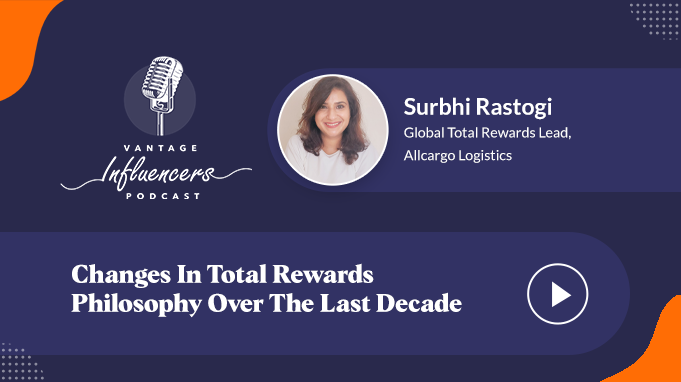
Changes In Total Rewards Philosophy Over The Last Decade
Episode Overview
Surbhi Rastogi opened the conversation by tracing how total rewards has moved away from being a purely monetary exercise. The sharpest turning point, in her view, came after the pandemic: organizations that once measured their offer almost entirely in take-home pay and headline benefits started competing on flexibility, mental health support and overall wellbeing instead. She pointed to Gen Z's expectations as a second catalyst, arguing that employees entering the workforce now weigh remote and hybrid options, inclusive workplaces and a genuine commitment to diversity, equity and inclusion as heavily as the number on their offer letter.
Surbhi argued that the next shift is personalization. Rather than issuing the same fixed benefits basket to an entire pay band, she believes organizations need to let employees choose what actually fits their life stage, whether that is a wellness allowance for a 25 year old or extended family medical cover for someone supporting aging parents. She also described how AI and real-time analytics are compressing the feedback loop for total rewards teams, turning benchmarking exercises that used to take months into something leaders can track week to week, and closed by describing her vision for where the discipline is headed: reward strategies built around wellbeing, equity and continuous learning rather than compensation alone.
Episode Highlights
- Total rewards shifted after the pandemic from a compensation-first model to one built around flexibility, wellness and mental health support.
- Gen Z employees weigh inclusive culture, remote options and a real DEI commitment as heavily as salary.
- Personalized, pick-and-choose benefits are replacing one-size-fits-all packages across pay bands.
- Pay equity audits, adoption leave and family health cover are becoming standard parts of DEI-driven total rewards.
- AI and real-time analytics are speeding up market benchmarking and benefit utilization tracking.
- Retention rates, engagement surveys and cost-benefit analysis are now core metrics for measuring total rewards success.
About the Guest
Surbhi Rastogi, Global Total Rewards Lead, Allcargo Logistics
Surbhi Rastogi built her early career in total rewards at GE Capital in London and Coca-Cola India, before joining Deloitte Consulting to lead compensation strategy for a large workforce. She stepped away from full-time corporate roles twice to care for her two daughters, and used the time to reinvent herself as an award-winning storyteller, picking up honors including the Times Write India Write Award, the Orange Flower Award and a Digital Women Award, while also volunteering as a Community Editor for SheThePeople TV and serving as a WICCI Council Member for the Haryana Arts Leadership Council. After completing an Executive Development Course at XLRI, she returned to the corporate world as Global Total Rewards Lead at Allcargo, and now speaks openly about her journey to help other professionals navigate their own career comebacks.
Connect with Surbhi on LinkedIn
Host
Sanjeevani Saikia, Vantage Influencers Podcast Host
What You Will Learn
- How total rewards philosophy has shifted from compensation-first to wellbeing-first over the past decade
- Why Gen Z expectations and post-pandemic flexibility are reshaping benefits design
- How to build personalized, pick-and-choose rewards packages that work across different employee life stages
- What DEI-driven changes look like inside a modern total rewards package
- Which metrics organizations use today to measure total rewards effectiveness
- Where AI and real-time analytics fit into the future of total rewards
Key Topics & Timestamps
| Timestamp | Topic |
|---|---|
| 00:00 | Cold open: the changing philosophy of total rewards |
| 01:40 | Surbhi Rastogi's corporate journey across GE Capital, Coca-Cola India, Deloitte and Allcargo |
| 04:56 | Key factors driving total rewards changes over the past decade |
| 09:05 | How technology and globalization are reshaping reward system design |
| 11:06 | Strategies proving effective for attracting and retaining top talent |
| 13:50 | Specific DEI-driven modifications companies are making to their rewards packages |
| 22:57 | Impact of personalized rewards on employee satisfaction and retention |
| 26:01 | Metrics used to measure the success of total rewards programs |
| 30:50 | Why upskilling, reskilling and holistic wellbeing are becoming core to total rewards |
| 36:07 | The future trajectory of total rewards philosophy |
| 38:03 | Closing thoughts and how to connect with Surbhi |
Full Transcript
Click to read the full episode transcript
Welcome to the Vantage HR Influencers Podcast. This podcast is sponsored by Vantage Circle, the simple and AI-powered rewards and recognition platform for employee engagement.
Sanjeevani Saikia: Welcome listeners to another enlightening episode of the Vantage Influencers Podcast. I'm your host Sanjeevani Saikia. Together, we'll explore the complexities within the vibrant landscape of HR. We'll delve into intriguing subjects crafted to spark your interests and ignite inspiration.
The evolution of Total Rewards philosophy has been a transformative journey over the past decade. It has reshaped the very fabric of how organizations engage and retain their talent. This shift underscores the pivotal need to reassess our approaches, aligning them with the diverse expectations of a modern workforce. As we navigate this era of change, unraveling the nuances of this evolutionary trajectory becomes essential.
So today, join us for an engaging discussion with Surbhi Rastogi, Global Total Rewards Lead, Allcargo Logistics. We will explore how Total Rewards have evolved over the past decade.
Hi Surbhi.
Surbhi Rastogi: Hi Sanjeevani.
Sanjeevani Saikia: First of all, I'm thrilled to have you here today to talk about changes in Total Rewards philosophy over the last decade. But before we dive in, I'd love to hear a bit about your journey. So could you walk us through your corporate journey so far?
Surbhi Rastogi: Yeah, definitely. So all through my career, I have been in Total Rewards. I started my career with Infosys, post my MBA. And the very first project was a compensation planning project with Bank of America. With this project, as the project lead I traveled to London. In London, I decided to make a career shift, and joined GE Capital as their European compensation analyst.
In this role, I was handling around 6,000 employees across Europe, so around 12 countries: France, UK, Germany, the Nordics, Benelux, and others. We were mainly concentrating on compensation practices, market benchmarking, and wage planning.
Three years into the role, I decided to move back to India. And I joined Coca-Cola India as their India and South Asia lead for Total Rewards. Here again, I was handling the compensation as well as the benefits part. But a year or so into the role, I had a toddler at that time, and she wasn't doing too well health-wise. She did not like the move from Europe to India, and she was falling sick very often, so I had to take a break.
In the break, I had my second daughter. And when she was around eight months old, I joined Deloitte Consulting as lead for their entire consulting practice. I handled the compensation strategy for around three to five years for them. But then again, I had to take a break because there were a lot of late nights and a lot of traveling, and with two young children it was really difficult. I took a longer break because I decided that I needed to be with my children till they were a little older and a little more independent.
During this break, I completed a certified rewards professional course, and I also did a Strategic HRM programme from XLRI. Then in 2022, I joined Allcargo as their Global Total Rewards Lead. Here, I'm handling total rewards for Allcargo Logistics and its group companies, and I'm also overseeing the performance management practices. So that's been my journey so far.
Sanjeevani Saikia: Wonderful. Thank you for sharing your journey with us, really appreciated. So with your permission, I'd like to begin today's conversation. So let's go ahead.
Surbhi Rastogi: Yeah, perfect.
Sanjeevani Saikia: As the workforce evolves, so do the strategies that organizations use to attract and retain talent. Over the last decade we've observed significant shifts in how companies structure their total rewards systems. These changes haven't just been about offering more benefits, I think they reflect a deeper understanding of what motivates employees and what keeps them engaged. Given this backdrop, we can explore the fundamental shifts in total rewards over the last decade. What key factors do you believe have been instrumental in driving these changes?
Surbhi Rastogi: So I believe there has been a lot of change post-COVID. If you look at the pre-COVID era and the post-COVID era, pre-COVID, the concentration on the sheer compensation, the salary in hand, and the benefits that you get, was much larger. But during COVID, people got used to flexible working benefits, and also realized the importance of maintaining their health and wellbeing.
So with Gen Z coming in, I think the entire concentration has moved a little bit. Of course, money is important, but there are various other benefits which the newer generation is looking for in their total rewards package. They are looking for wellbeing policies, they want mental health support, they want flexible working benefits, they want wellness programs, and they prefer employers who give all of this. They also prefer organizations that understand why they need flexibility in their working.
So organizations which give you the flexibility to work from anywhere at any time are preferred over the traditional organizations that are about the typical 9 to 5, and which require employees to be in the office all the time. There is also an increased focus on diversity, equity and inclusion. Organizations that are creating more diverse and inclusive workplaces are definitely more preferred by Gen Z.
Then, one thing employees are looking for now is, previously the rewards packages used to be very similar for the entire pay band or the entire company. But now people want customization and personalization in their packages. So employees want to pick and choose which benefits work best for them. For example, a 20 year old may not be looking at medical insurance for their parents and in-laws, whereas for a 40 year old, a benefit where they get medical insurance coverage for their parents, in-laws or extended family members might be very important. So they want that flexibility to pick and choose which benefit they want.
And also, total rewards leaders now need to make the best use of AI and data analytics, and understand the pulse of the organization, so that they can implement real time changes to the rewards and make the best out of whatever they are offering, the best return for the money being spent. So I think these are the changes which have mainly happened over the last decade.
Sanjeevani Saikia: So according to you, it is not just the compensation but what comes along with it, the other benefits.
Surbhi Rastogi: Yes.
Sanjeevani Saikia: And the customization along with it, right?
Surbhi Rastogi: Absolutely. If you look at the LinkedIn surveys over the past two, three years, from monetary compensation being at the top of the ladder, let's move down the ladder. Now people are looking at flexible benefits, people are looking at wellness programs, people are looking at managers who are supporting the growth of employees. So of course the hygiene factor is money, but that's not the only thing which is needed.
Sanjeevani Saikia: Interesting. Again, I think the role of technology and globalization has been transformative in reshaping how companies approach their reward systems, from remote work capabilities to access to global talent pools. These advancements have altered the way businesses view, and most importantly implement, rewards. Have these shifts influenced your perspective on how organizations should structure or implement their reward systems?
Surbhi Rastogi: Yes. The first thing which is very important is that when it comes to rewards, you have to incorporate the global changes as well as the local laws that are there. Technology really helps with that, where you can localize your benefits even when you have global vendors offering them.
The second thing is staying agile and embracing innovation in the total rewards design system, so we need to create more flexible and tailored approaches to meet the diverse needs of the workforce. This is something technology can enable.
The third thing is understanding what effective rewards will help in attracting and retaining top talent. There are tools and surveys designed to understand what employee motivators are, what is keeping them engaged, and what can be offered more. All of this needs to be leveraged further so that the effectiveness of the reward systems keeps improving.
And of course, AI is now coming into play, so I'm hoping that when it comes to market benchmarking figures, the kind of changes in the industry that used to come from annual or biannual surveys, where we would get the pulse of the market within six to eight months, that will be much faster to receive with AI tools and technological advancements.
Sanjeevani Saikia: Yes. Surbhi, as someone deeply rooted in the HR domain, you have likely witnessed how attracting and retaining top talent has become fiercely competitive. I'm sure total rewards strategies have adapted to meet the evolving expectations of employees. So what strategies have emerged as particularly effective in attracting and retaining top talent amidst this shifting landscape?
Surbhi Rastogi: I think the needs of the current generation have changed. If you look at millennials, the way we grew up, or even the generation before that, we somehow grew up with the mindset that we need a salary coming in every month, and we need that financial stability. We needed long term, ten years in one organization. The current generation's needs are very different. People are not looking to stick with one organization or be loyal to one organization for the rest of their lives, they're not looking at 10, 12, 15 years in one organization.
People are not looking at financial stability as the basic need, because most of the people coming into this workforce already have the basics. They might have a stable home, a car, a good phone, they already have these things. So now organizations have to look at what more they can offer this generation. Overall wellbeing becomes a priority when they come into the workplace, they're not just looking at coming into the office, working and going back. They want their employers to look at their overall wellbeing, they want mental health support to be there, they want managers to be involved in their overall growth and development and to care for employees.
They're looking at organizations that take care of diversity, equity and inclusion. There are surveys which prove that organizations taking active steps towards DEI initiatives are more preferred as employers. Employers who are taking care of sustainability initiatives and their carbon footprint are also more preferred.
You also need to take care of learning and development opportunities for this generation, so you need to take care of reskilling and upskilling, you have to provide avenues for skill enhancement and career growth. This entire package helps in retaining top talent, not just the monetary return that you're offering employees. This is what I feel.
Sanjeevani Saikia: Okay. I think you must have observed that the increasing emphasis on diversity, equity and inclusion has catalyzed a deeper introspection within organizations. In a way, companies are recognizing that their total rewards packages aren't just about monetary compensation or benefits, as you've already mentioned.
Surbhi Rastogi: Absolutely.
Sanjeevani Saikia: But potent tools to foster an inclusive culture. So I believe it is the need of the hour to understand some of the specific modifications or adaptations that companies have made in their total rewards packages to ensure they embody and promote DEI principles. So what's your take on that?
Surbhi Rastogi: So I think, personally, as a rewards professional, I myself am pretty invested when it comes to DEI practices. I've seen the changes, and as a working mother, I understand the kind of emphasis needed to support half of our population.
So I believe one thing that has traditionally existed has been pay inequity in the market. Now organizations are conducting pay equity audits to identify and rectify these disparities in compensation. This disparity could be based on gender, ethnicity or other demographic factors, so proactive approaches are needed to ensure fairness in total rewards.
The second thing is that we need more inclusive benefits packages, so total rewards packages need to be restructured to cater to diverse needs. You might need to offer family-friendly policies, child benefit policies, health coverage that includes women's health needs, and support for various lifestyle choices. There could be adoption leave, there could be creche facilities being provided. All of this needs to be included in the benefits package.
Also, especially post-COVID, you need to offer more flexible work benefits. I think the best thing about COVID, despite the pandemic having many negative effects, is that it opened the mindset of organizations and managers to the idea that work can be done from home too, which opened up a completely different demographic that could not previously come into offices to work. So there are women who can work from home and contribute positively while taking care of their households. You need to incorporate that flexible working arrangement, and design roles around it.
Then there should be diverse representation in leadership. Companies are placing strong emphasis on achieving this diverse representation. Here, what you need to do is not go in for a fixed reservation that you need, say, 33% representation on the board, but while women are in lower and middle management, give them the mentorship and the opportunities that will make them better leaders going forward. Help them fulfil their professional responsibilities while taking care of their families, so that they can evolve into leadership positions.
You also need to take care of training and development programs. These programs need to specifically target underrepresented groups, bridge skill gaps, foster career growth, and empower employees from diverse backgrounds so that they can advance within the organization. If someone has a new baby and needs flexible working arrangements, how can the organization alter the role so that can be enabled? If someone needs creche facilities and you don't have one on site, can you offer tie-ups and discounts with childcare facilities? Things like that need to be taken into account.
Also, organizations need to look at hiring from different, diverse populations. For our women employees, there's an extra referral bonus given, because we saw that especially in logistics, there was very little representation of women. If you refer a woman for a certain position and she gets selected, you get an additional referral bonus compared to referring a man, for example. We also have women-only ships where only women are employed for those locations.
We were also looking at hiring war refugees in Europe when the Ukraine crisis was there, so as an organization we decided that certain positions could be given to war refugees, who could be trained and helped into employment. So you need to look at diverse populations, look at people with disabilities, look at veterans, look at different populations being hired into your organization, which also opens up the mindset and brings different perspectives. I believe every organization that has a more diverse population working for it has more innovation in its products and wider markets open to it. This is something organizations need to take very seriously.
And lastly, you need to have very transparent communication about total rewards. Employees need to understand the components of their total rewards packages and how compensation decisions are being made. For every diverse population, you probably need to customize packages to their needs, have employee resource groups that help them with specific issues, and communicate how you're offering these benefits to that group. I think these are certain things we can do to promote the focus on diversity, equity and inclusion in organizations.
Sanjeevani Saikia: You have mentioned some really thoughtful initiatives, I must say, really wonderful. Do you think post-COVID, companies have started talking about DEI more, or was it there but less discussed and now considered more in the total rewards package? What has made them shift? I don't mean there wasn't a particular reason, I'm sure it must have been there earlier too, but it was less discussed. So why do you think that is?
Surbhi Rastogi: Yeah, so it was always there, but I think post-COVID, I must admit, the mindset around employing women changed. For example, I was a mother, and I had to take a break from my career because I had to concentrate on caregiving responsibilities at home. But post-COVID, once work from home was enabled and there were more flexible working arrangements, more and more women started coming in. There are people with disabilities who can work from home, there are people from diverse populations who can work from their own hometowns or wherever they are most comfortable.
With all of this in place, now that employers are more open to these options, obviously the dialogue around diversity, equity and inclusion has increased. There is more dialogue around it, there are more organizations taking active initiatives around it, and there are employees who want to work for employers that are more open-minded and offering more family-friendly policies. So overall, I believe in a few years we will see a much more diverse and inclusive workforce, one that is representative of the society we live in.
Sanjeevani Saikia: So the move towards personalized rewards isn't just a response to the evolving workforce, but a strategic acknowledgement of the diverse motivations and preferences that employees bring to the table. So could you elaborate on how organizations have operationalized this trend towards personalized or customizable rewards? Additionally, have there been notable impacts or observations regarding employee satisfaction and retention rates stemming from this tailored rewards strategy?
Surbhi Rastogi: Absolutely. So now organizations are increasingly shifting towards personalized and customizable rewards. The reason for this, as I said, is that there are diverse populations in the workforce and the needs of these employees are very different, so organizations have to aim towards creating more tailored and flexible total rewards packages.
The impact on employee satisfaction and retention rates has been pretty notable, because personalized rewards allow employees to choose benefits that align with their individual circumstances and priorities. This fosters a sense of empowerment and value. For example, if I'm a 25 year old, medical insurance for parents or in-laws may not be as relevant, but I might want a wellness benefit, a gym membership, or hobby classes like guitar or drumming for my time away from the office. Whereas if I'm someone who is 50-plus, are they offering annual health check-ups, special benefits where a doctor comes in, specialised health camps, dental camps, and so on? All of this helps meet the unique needs of employees based on what they're looking for.
Even on the compensation side, people now want to pick and choose the specific allowances that work for them, rather than a fixed set for everyone. So even within the basket of allowances, they want to choose what they'd want to avail. These personalized rewards can significantly enhance employee retention. When employees feel their contributions are recognized and rewarded in ways that matter to them personally, they are more likely to stay with the organization. This approach not only attracts top talent but also fosters a positive and engaging work environment that encourages long term commitment to the organization.
Sanjeevani Saikia: Okay. So measuring the success of total rewards programs has evolved significantly over time, I'm sure of that. Today's organizations seek more nuanced and comprehensive ways to assess the effectiveness of their programs compared to a decade ago. So how do you think organizations measure the success or effectiveness of total rewards programs today, and have there been notable shifts in the metrics or methodologies used? What do you have to say about that?
Surbhi Rastogi: So I think there's a mix of the traditional approach and the new approach here. We always had employee engagement surveys, but with AI coming in, these have become more customized to how employees really feel, because every question can be based on the previous question and the employee's response. So now employee engagement surveys assess the overall satisfaction and motivation of the workforce, what they're looking for in a total rewards program, and what the inherent or hidden need is that the total rewards package might need to address.
Also, retention rates and turnover rates help in analyzing the success of the total rewards package. If retention rates are high, employees are happy with the total rewards package and are more likely to stay with the organization. Even now, total rewards is one of the reasons employees give when they leave. So having an effective total rewards package is a hygiene factor, that's a given, certain boxes need to be ticked. Besides that, of course, there's the relationship with the manager and leadership, mentorship, and other reasons why a person might be leaving, but the rewards package is the basic need that has to be fulfilled for employees to stay with the organization.
Then there are performance metrics and productivity: how are employees performing, are they motivated by the bonuses being offered, do you need to offer retention plans over and above your rewards and bonuses? That's something that can be analyzed.
Then you need to do a cost-benefit analysis, evaluate the return on investment the organization is getting on the total rewards package. This involves assessing the costs associated with providing various benefits and comparing them with positive outcomes like increased productivity, reduced turnover and improved morale. All of this needs to be measured.
We also need to look at the attraction and retention of top talent, your high-potential talent. What are they looking for, what are their key motivators, is your total rewards package designed to attract more talent from the industry and retain the talent you already have? A successful program should position the company as an employer of choice and contribute to building a competitive advantage in the talent market. There are organizations known for their reward packages, where employees want to join because they know they and their families will be well taken care of.
And then, with the growing emphasis on diversity, equity and inclusion, organizations are also incorporating specific metrics related to these principles. This includes tracking the representation of diverse groups in middle management or leadership positions, and assessing the impact of total rewards on closing pay gaps, and how any pay inequities are being addressed. Those metrics are also charted now.
And of course, there's the integration of technology and analytics, gathering real time data on employee preferences and benefit utilization. For example, I track a wellness benefit I introduced three months back in the organization. Every week I track how many people are on the app, how many are availing it, and which specific services they're using. This helps get feedback from employees, and you can incorporate this to make further changes to the benefits offered. So I think these are some of the metrics now being used to track total rewards performance and to further enhance the benefits offered to employees.
Sanjeevani Saikia: Now that employers know all too well that employees may not commit years and years to their organizations, apart from keeping compensation as the hygiene factor, what is that one other factor they should consider while designing the total rewards package? Do organizations really invest a lot in reskilling and upskilling employees?
Surbhi Rastogi: Yes. So continuous learning, upskilling and reskilling have become very important, especially given how fast technological change is happening in the market. If we look back just a year, we hadn't even heard much about AI, and now we're talking about jobs being affected because of AI. We're talking about work that used to take hours or days now being finished in minutes, creating presentations, videos, spreadsheets, you name it. So all the administrative parts of work have been taken over and can now be completed by AI.
So you have to look at how you'll upskill that segment of the organization to make sure they're able to do their jobs better. What can you reskill them in, now that part of the job has been taken over by technology, what else can they do? So total rewards increasingly need to incorporate opportunities for continuous learning and upskilling, and investing in employees' professional development will contribute to their career growth, as well as help modernize the workforce across the organization. That's definitely an emphasis for organizations today.
Also, employees now want organizations to take care of their wellbeing. The era of employees working 10, 12, 16 hours, being burnt out and stressed, is gone. This generation is looking for organizations that offer holistic wellbeing: they want mental health support, they want physical health benefits, gym memberships, yoga sessions, annual health check-ups, and financial wellbeing to be taken care of, with financial experts who can help them invest and plan for retirement and other goals.
So apart from traditional benefits, the total rewards package needs to offer all of this, various platforms and experts who can support your physical, mental, emotional, spiritual and financial wellbeing overall. You're not coming into work just for the money, but for the whole person, and that includes career growth through upskilling and reskilling as well. And of course, you need to take care of personalization, what generation and what person needs which benefit, that needs to be taken care of.
So these are the main things, but as I talked about earlier, you also have to focus on inclusive leadership and diversity metrics, and adopt innovative benefits, doing something different compared to other employers. For example, one of the things we offer is leadership programs at Ivy League colleges for our leadership. So someone moving from middle management to higher management, what kind of leadership courses do they want, what individual development plan do they need specific to their personality? You'd have an individual assessment: do you need more business knowledge, more leadership skills, communication skills for working with an intergenerational workforce? Whatever the specific need is, that can be worked on. So all of these are total rewards strategies that need to be kept in mind as we move further into the future.
Sanjeevani Saikia: Okay, you've answered that very thoughtfully, thank you so much. So we're arriving at the end of today's episode, but before we let you go, there's one last thing both our listeners and I would love to know your take on. Looking ahead, what do you foresee as the future trajectory of total rewards philosophy? This is the part our listeners really love to hear, so what do you have to say about that?
Surbhi Rastogi: I think as total rewards specialists, or talent professionals more broadly, we should all envision our role as stewards of employee wellbeing, equity and engagement. We have to embrace the evolving expectations of the workforce by prioritizing personalized and inclusive total rewards strategies. We have to cultivate a workplace culture that values diversity, and fosters an environment where every employee feels seen, heard and appreciated.
We have to stay at the forefront of innovation, leverage technology and real time analytics, which will help tailor benefits and compensation packages to individual needs. And we also have to emphasize continuous learning and upskilling opportunities, to make sure our teams are well prepared for success in an ever-changing work environment. We have to understand that the future of total rewards lies in our hands, and that we have a part to play in crafting an experience that extends beyond financial rewards, one that encompasses holistic wellbeing, career growth and a sense of purpose, which will attract and retain top talent, and contribute to building a resilient and thriving organization. That's my take.
Sanjeevani Saikia: True. So as we wrap up today's podcast, is there a message or insight you'd like to share with our listeners? Your perspective has been invaluable, and they would love to hear any parting thoughts directly from you. Additionally, for those who might want to connect with you after today's episode, could you share how our audience can reach out to you? Go ahead, Surbhi.
Surbhi Rastogi: So you can reach out to me through LinkedIn, I'm very active there and I do check my messages. You can also reach me by email through Allcargo Logistics. I'd be happy to answer any queries you have on total rewards or otherwise. And I'd also be happy to help anyone who wants to return to the workforce after a career break. I've done that multiple times myself, and I know there are women out there struggling to return to their careers after a break, so please feel free to reach out and I'd be happy to help in any way I can. Thank you.
Sanjeevani Saikia: Very, very thoughtful of you. Surbhi, it's been a pleasure to have you as our guest today. Your insights and expertise have been invaluable, and we're grateful for the time you've taken to share your knowledge with our listeners. So Surbhi, once again, thank you so much.
Surbhi Rastogi: Thanks a lot. Thank you, Sanjeevani. This was really an interesting conversation, and I hope our listeners can benefit from it. Thank you. Thank you so much for inviting me.
Thanks for listening to the Vantage HR Influencers Podcast. Please do subscribe to Vantage HR Influencers Podcast on Apple Podcasts, Spotify and our YouTube channel for new episodes.
FAQ
How has total rewards philosophy changed since the pandemic?
Pre-pandemic, total rewards conversations centered mostly on salary and headline benefits. Surbhi Rastogi explains that the pandemic pushed flexible work, mental health support and overall wellbeing to the center of the conversation, and that Gen Z entering the workforce has reinforced that shift by expecting inclusive, purpose-driven employers rather than just a paycheck.
What does personalized or customizable total rewards mean in practice?
Instead of offering the same fixed benefits basket to an entire pay band, organizations let employees choose the mix that fits their life stage, for example a wellness allowance or gym membership for a younger employee versus extended family medical cover for someone supporting aging parents. Surbhi Rastogi notes this approach has a measurable effect on satisfaction and retention because employees feel their specific needs are being addressed.
How are companies building DEI into their total rewards packages?
Surbhi Rastogi points to several concrete steps: running pay equity audits to catch gender or demographic pay gaps, adding family-friendly benefits like adoption leave and creche facilities, offering flexible and remote work options that widen who can participate in the workforce, building mentorship pipelines for women in leadership, and hiring from underrepresented groups such as people with disabilities, veterans and displaced populations.
How do organizations measure the success of a total rewards program today?
Beyond retention and turnover rates, Surbhi Rastogi says companies now track employee engagement survey data, performance and productivity metrics, cost-benefit and ROI analysis on benefits spend, DEI-specific metrics like representation in leadership, and real-time utilization data on individual benefits enabled by technology and analytics.
Related Reading
Also listen on