Uncovering the Top Drivers of Employee Engagement
Episode Overview
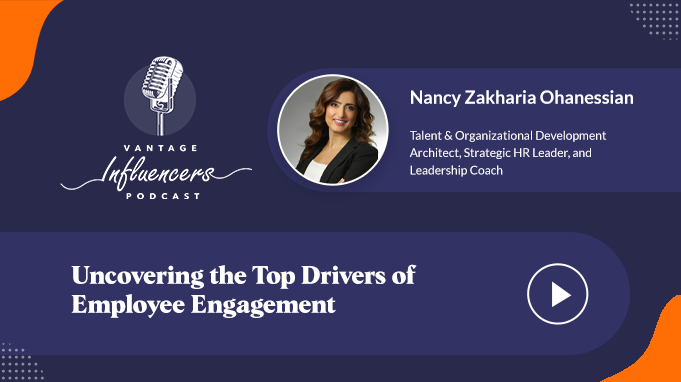
In this episode of the Vantage Influencers Podcast, Nancy Zakharia Ohanessian joins host Susmita Sarma to unpack what actually keeps employees engaged, and why a paycheck alone was never enough to hold anyone's attention. Nancy breaks engagement down into five connected drivers: culture, purpose, inspiration through leadership, ongoing communication, and recognition, arguing that when any one of these is missing, the rest struggle to compensate. She pushes back on the idea that flexibility is a perk, framing it instead as a baseline expectation tied directly to how supported and trusted employees feel day to day.
The conversation moves into leadership style, where Nancy draws a sharp line between transactional approaches that produce compliance and transformational ones that produce commitment, using an example from equine-assisted leadership training to make the point that moving fast alone can leave people behind. She also challenges organizations to rethink recognition as something highly personal rather than a one-size-fits-all program, and closes by weighing where technology genuinely helps engagement measurement against where it can become a substitute for real conversation.
Episode Highlights
- Employee retention comes down to five connected drivers: culture, purpose, inspiring leadership, open communication, and recognition, not compensation alone.
- Workplace flexibility isn't a perk anymore; it's tied to how supported, trusted, and cared for employees feel, and it directly affects resilience and stress levels.
- Transactional leadership buys compliance, but transformational leadership, built on trust, purpose, and autonomy, is what earns real commitment.
- A leadership lesson from equine-assisted training: moving too fast without bringing people along stalls progress, in the barn and in the boardroom.
- Recognition works best when it's tailored to the individual; some employees want public praise, others prefer a quiet thank-you note, and platforms should support both.
- Career development and technology, like pulse surveys and peer recognition tools, matter, but only when paired with real, ongoing conversations between managers and employees.
About the Guest
Nancy Zakharia Ohanessian, Talent & Organizational Development Architect and Leadership Coach
Nancy Zakharia Ohanessian is a global HR and Talent Development leader with over 17 years of experience across government and multinational organizations. A Professional Certified Coach (PCC) and assessor, she specializes in career management, succession planning, and leadership development, and has designed high-potential talent programs and female leadership initiatives throughout her career. She is known for her visionary approach to employee engagement, diversity, and performance management, and for coaching individuals to build self-awareness and make impactful career decisions.
Connect with Nancy on LinkedIn
Host
Susmita Sarma, Vantage Influencers Podcast Host
What You Will Learn
- The five core drivers of employee engagement and retention, and how they connect to each other.
- Why workplace flexibility and well-being are now baseline expectations, not perks.
- How transactional and transformational leadership styles differently affect trust and motivation.
- Practical ways to design recognition programs that reflect a multi-generational workforce.
- Where technology and pulse surveys genuinely help engagement, and where they fall short.
- Why career development conversations are one of the strongest levers for retention.
Key Topics & Timestamps
| Timestamp | Topic |
|---|---|
| 01:20 | Nancy's HR journey and career path |
| 03:00 | Key factors behind employee retention beyond pay |
| 04:50 | Building workplace flexibility and well-being into culture |
| 09:10 | Transactional vs. transformational leadership and their impact on engagement |
| 15:35 | Designing inclusive, personalized recognition programs |
| 18:00 | Career development as a driver of retention and growth |
| 20:00 | The role of technology and pulse surveys in measuring engagement |
Full Transcript
Click to read the full episode transcript
Welcome to the Vantage HR Influencers Podcast. This podcast is sponsored by Vantage Circle, the simple and AI-powered rewards and recognition platform for employee engagement. Employee engagement is all about how deeply employees connect mentally and emotionally with their jobs, teams, and the workplace. For a deep dive into what engagement really means and what it isn't, listen to this exclusive episode of the Vantage Influencers Podcast.
Susmita Sarma: Hello listeners, I'm your host, Susmita, and I'm thrilled to welcome our guest today, Nancy Zakharia Ohanessian. Nancy is a talent and organizational development architect, a strategic HR leader, and a leadership coach. In this episode, we're diving into drivers of employee engagement. We'll start by defining what these drivers are, then explore the top factors that truly boost employee engagement. Stay tuned for some valuable insights. Hi Nancy, welcome to the show.
Nancy Zakharia Ohanessian: Hi, thank you for having me.
Susmita Sarma: How are you doing, Nancy?
Nancy Zakharia Ohanessian: I'm doing great, what about you?
Susmita Sarma: I'm doing fantastic, and for this conversation I'm really excited to take it forward.
Nancy Zakharia Ohanessian: I'm so excited too and looking forward to our discussion today.
Susmita Sarma: Brilliant, Nancy. So as we begin, would you like to share a bit about your background and the corporate journey that has shaped your career?
Nancy Zakharia Ohanessian: Yes, sure. It's been an exciting journey, challenging indeed, and exciting because every challenge brought an opportunity with it. I've been working in the HR space for over 15 years, and each day was a new day, a new opportunity, a new learning, and new knowledge. And that's what I liked about it. I'm a lifelong learner, so this is something that fuels me up, that keeps me going, learning new things, and this is how I can support others, by filling my tank first and then giving back to others from the knowledge and experience I've gained over the years. I've worked in corporate and very big multinational organizations, I've moved around, and I've continued and completed my coaching studies as well. So each one complements the other, along with the experience, and that helps me bring the knowledge I have to others and be that trusted voice to others.
Susmita Sarma: Fascinating, Nancy. Thank you for sharing. So are we good to dive into the main topic today, Nancy?
Nancy Zakharia Ohanessian: Yes.
Susmita Sarma: Yeah, so when it comes to employees deciding whether to stay with a company, it's often more than just a paycheck that keeps them around. I'm sure you would agree to that.
Nancy Zakharia Ohanessian: Of course.
Susmita Sarma: So what do you say are the key factors that really make employees want to stick with their current employer? Do you think things like culture, job satisfaction, and career development play a major role in this decision?
Nancy Zakharia Ohanessian: Definitely. There are many factors that can impact that decision, and we hear about a lot of them, but the ones you mentioned are really key. If I focus on five main factors, I would say the first one would be culture. Then, employees really want to connect to a sense of purpose and have meaning in what they do. Having that purpose, and connecting them to something bigger than themselves, to see the meaning they are creating and the impact they're having, is essential. Inspiration and leadership play a very key role in how connected employees feel and in deciding whether they stay. Ongoing discussions and open communication between employees and their managers are very essential to create that sense of belonging and for employees to feel cared for and valued. And the last one would be recognition. So if I look at the five, it's culture, purpose, inspiration and leadership, communication and ongoing conversations, and recognition.
Susmita Sarma: Almost everything we have in store to discuss today. Excellent point, Nancy. If we talk about workplace flexibility, it's becoming a norm and a very top priority in organizations today. How do you think organizations can find the right balance of flexibility in the workplace for employees?
Nancy Zakharia Ohanessian: This falls under creating that culture. Because when we talk about culture, if we look at the main things, culture is first of all the set of values and behaviors displayed by the leaders. So when we have the right leaders who are inspiring, when we develop and invest in upskilling our leaders, they will be able to create that culture. Organizations that create a strong culture, and this is also based on research, if we look at Gallup research, one of the main things they found is the emphasis on well-being. Today things have changed. We're living in a very complex world, and there are a lot of nuances to how things are done, and there are different things needed by the new generation entering the workplace, and even by the older generations already in the workplace. So it's now a necessity, no longer a nice-to-have. Employees need to feel that they are supported, that the organization cares about their well-being, and that they have flexibility and empowerment. As you said at the beginning, it's not just about a paycheck anymore. A paycheck is the basic thing, the given that has to be there, the launch pad or starting point. What we need to tap into is self-actualization, and what's going to inspire employees. They will be inspired when they feel empowered, trusted, and cared for. This is also where they start going beyond just staying with the organization, and excelling. This type of culture brings out the best in them. What I've seen is that when organizations talk about well-being, it's definitely physical well-being, but also psychological, mental, and financial well-being. Many organizations have financial literacy courses for employees, and mental health awareness programs. And not only from the information or education side, but they've actually embedded these into their behaviors and the way they deal with employees, through the flexibility they offer. Because they realize this goes far beyond well-being on the job. Employees who feel their well-being is taken care of are more resilient, they experience less stress and fewer health problems. So it goes beyond the boundaries of work and impacts the quality of life for employees, giving them flexible time to spend with family and to do the activities or hobbies they like. This, all in all, affects the employee as a whole and brings a lot of value to the organization.
Susmita Sarma: So wrapping up this point, while competitive pay is of course very important, what companies can do is bring a more holistic approach to improve the overall, 360-degree view of employee satisfaction, including effective onboarding and ongoing support throughout, isn't it?
Nancy Zakharia Ohanessian: Definitely.
Susmita Sarma: Absolutely, some really crucial considerations, Nancy. Let's talk about leadership styles. You mentioned it as one of the five pointers, right, when we're talking about factors for employees to stay with a company: inspirational leadership.
Nancy Zakharia Ohanessian: Yes.
Susmita Sarma: We know there are different leadership styles, transformational, transactional, servant leadership, and all of them in some way or the other affect employee engagement. So what specific practices do you think leaders should implement to foster an environment that promotes a high level of motivation and trust?
Nancy Zakharia Ohanessian: You mentioned a couple of those styles, let me start with a couple of them. If I look at the transactional style, the word is transactional in itself, it's about finishing the job, maybe stopping an undesirable behavior, and addressing things fast. It has that notion of efficiency, it's more of a control-based style, a give-and-take style of leadership. At best, this will give you compliance, not commitment, from employees. It's more about managing people, whereas what's needed now is actually inspiring people. We need to go to the next level of how we can inspire people, not just manage them. Leaders manage things but lead and inspire people. People don't want to be managed, they have their passion, their skills, their strengths, they just want a leader to help bring those talents out. They wouldn't want to stay in a job where they're being controlled, it's very disempowering and it kills initiative. So transactional is just about efficiency, it was probably a good style, or still works in places with more industrial-age thinking. If we look at transformational leadership, on the other hand, it's inspiring because it's based on trust. It's about driving toward the vision and direction, connecting employees to that sense of purpose and meaning we spoke about. Transformational leadership is also based on flexibility and autonomy, and it focuses on building relationships, developing capabilities, and empowering and growing people. This is the more efficient way of getting things done. With people, fast is slow, and slow is fast. I recently did leadership training assisted by horses, and there were some great lessons there. Sometimes when we're just driving to achieve something, focused on results, we can't move the people with us. When we're trying to move along with the horse, if we go fast without considering it, the horse won't move. Only when we go side by side, when we're clear on what we want and our intention is to take the horse along with us, will the horse move with us. If we take that lesson back to organizations and leaders, sometimes leaders focus on tasks and results and want to drive toward them fast, but it doesn't work that way. We have to slow down to bring people along with us, because that's when we achieve long-term results. If I take the metaphor of a gardener, it's important that leaders approach leadership as a gardener would, because in coaching we believe every person is naturally creative, resourceful, and whole. There's greatness inside each individual, inside each employee. The seed is always there, and it's important that leaders recognize the power in that seed and create conditions and an environment in which people can flourish. So I'd say a blend of different styles is sometimes needed, but the essence of all styles should always be trust, leading with inspiration, and having ongoing career conversations with individuals to tap into their talents and strengths, and understand what inspires them, so leaders can connect with them at a different level. This puts emphasis on the emotional connection in the workplace, which is becoming more and more important.
Susmita Sarma: So to put it together, Nancy, transformational leadership is the way forward, right? It's truly inspirational and has the potential to be a game changer.
Nancy Zakharia Ohanessian: Yes, it's about inspiring people, not controlling people.
Susmita Sarma: Really great insights on leadership, Nancy. Moving on, we all agree that recognition is highly impactful. So how do you think recognizing employees impacts their engagement and performance? And it would be great if you could share some effective ways to create recognition programs that cater to the diverse needs and preferences in today's multi-generational workforce.
Nancy Zakharia Ohanessian: As we were talking about the differences between individuals, different people have different preferences and can be motivated and inspired by different things. So understanding people is really key to providing recognition that makes a difference to them. That diversity of preferences has to be taken into account, it's not about having one recognition program applied to everyone anymore. Some people might like to be recognized on social media, some might want their achievements out there, a lot might just want a thank you, some might appreciate lunch with the leader, others just want to hear continuous positive feedback. Some prefer public recognition, some prefer it only in front of their team or even in private. As I said, it could be as simple as a thank-you note for some. This goes back to those ongoing discussions to understand what matters to employees and tailor recognition to them. Peer-to-peer recognition is important too, and there are lots of platforms organizations can use to tailor these initiatives. It's important to have a variety of ways to recognize individuals, positive feedback is always important. There are many other things that take motivation to the next level, like when employees feel inspired and empowered, but they also need to feel valued and recognized. These things are still important, but they come in different shapes and forms.
Susmita Sarma: Do you think people today look forward to career development and growth opportunities from their organizations, or do you think they take it all upon themselves?
Nancy Zakharia Ohanessian: Well, they would definitely look for that. It's important for organizations to invest in development, and that's why one of the key factors to engage employees is having ongoing career discussions and development. Organizations need to focus on developing managers, because they play a key role in creating that inspirational environment for employees. However, a focus on continuous development for all employees is key. Many employees have intrinsic motivation and drive within themselves, and it's important for them to own the development they want. However, the organization also needs to support that development and create the environment, the fresh soil, where employees can implement the knowledge they gain. Career development is definitely one of the top factors that attracts and retains employees in an organization, because if employees feel stagnant, if they feel the organization isn't giving them the progression or development they want to see, that's going to impact their motivation.
Susmita Sarma: And people are using different kinds of technologies and platforms to boost employee engagement today, Nancy, which definitely has a lot of advantages, instant recognition being one of them. So what are your views on using technology, and could you share any challenges organizations might encounter with these tools?
Nancy Zakharia Ohanessian: There are many platforms that organizations use, some for recognition or rewards for employees, others to measure employee engagement through surveys. There are probably several challenges here. First, if we only rely on this, it's not the only way to inspire and help employees grow and develop, it's perhaps one way, because those platforms, the rewards, are an extrinsic motivation. They offer short-term success, but in a world with new generations entering the workplace, they care about passion more than possessions. So we need to focus on authentic inspiration and connection with them. That would add to the factors that engage them, but organizations shouldn't only focus on that. The good part of these platforms is that they can be used to provide peer recognition, and employees can choose their own rewards, different types of recognition or rewards that relate to them. This makes things easy and feels inclusive of the different preferences of employees. It's important that rewards are tailored, they could be family experiences or many other things employees can pick and choose from. When we look at using technology to measure employee engagement, the employee engagement surveys organizations conduct once a year are important to give data at that point in time, and it's important to act on it in a timely manner. It's important to leverage technology to do more regular pulse surveys, and technology should also be complemented by focus groups with employees, to understand their pain points, what's working for them so you can do more of it, and what might need change or improvement. So technology, coupled with connection points and other things, helps organizations accelerate what they want to achieve in terms of creating an inspirational culture and an environment that cultivates innovation, and drives passion and a sense of connection for employees.
Susmita Sarma: Right, another important thing that comes to mind about using technology or a platform for employee recognition or engagement is that it can be a source of eliminating biases. For example, in a platform like Vantage Circle, you can actually see how often a person has been recognized, what the trend is for a team being recognized, if someone is being left behind, or if someone is getting recognition more often than required. So that's one of the important advantages of using a systematic approach to it, right?
Nancy Zakharia Ohanessian: Yeah, it helps because it allows for peer-to-peer recognition as well, so the person gets holistic, well-rounded feedback from everyone, not only from one source, which is sometimes just the manager or feedback from one person. This allows people to contribute and recognize someone for things they see when they work with them. That's the beauty of it.
Susmita Sarma: Thank you for the fantastic discussion and podcast, Nancy. Any final piece of advice for the audience?
Nancy Zakharia Ohanessian: Thank you so much for having me, it's exciting, and this is a vast topic, we just briefly touched on some of the important things. What I'd like to leave the audience with is that leadership is a choice, it's not about a position. If someone says, "I'm an individual contributor, I'm not a leader," everyone is a leader regardless of position, because leadership is about how you approach things and conduct yourself, the behaviors you bring. So adopt these leadership behaviors, inspire yourself and others, and help foster engagement in the right way, for you and for everyone else.
Susmita Sarma: Great insights, Nancy, and I appreciate the clarity and depth you brought to the conversation. I'm so eager to apply what we learned today. Thank you so much for your time and energy, Nancy.
Nancy Zakharia Ohanessian: Thank you for having me. Have a great day.
Thanks for listening to the Vantage HR Influencers Podcast. Please subscribe to the Vantage HR Influencers Podcast on Apple Podcasts, Spotify, and our YouTube channel for new episodes. Thank you.
FAQ
What are the top drivers of employee engagement, according to Nancy Zakharia Ohanessian?
Nancy identifies five connected drivers: culture, a sense of purpose, inspiring leadership, ongoing communication between employees and managers, and recognition. She argues that a paycheck alone rarely explains why employees choose to stay.
What's the difference between transactional and transformational leadership?
Transactional leadership focuses on efficiency and control and, at best, earns compliance from employees. Transformational leadership is built on trust, purpose, and autonomy, and is what earns genuine commitment and long-term engagement.
How should organizations approach employee recognition?
Rather than running one recognition program for everyone, organizations should tailor recognition to individual preferences. Some employees want public praise, others prefer a private thank-you, and peer-to-peer recognition should be part of the mix.
Can technology alone improve employee engagement?
No. Technology such as pulse surveys and recognition platforms can support engagement efforts, but Nancy stresses they work best alongside regular manager conversations and focus groups, not as a replacement for them.
Related Reading
Also listen on