What To Do About Employee Moonlighting?
Episode Overview
Atma opens by naming the two forces that quietly push people toward a second stream of work: unmet potential and unmet income. He argues that most jobs cannot absorb the full range of a person's curiosity and drive, so when that hunger goes unsatisfied at the primary job, people look for outlets after hours. He then draws a second, sharper line: the concern isn't really about employees doing something extra in the evenings. It's about what happens when that extra work touches the same customers, the same code, or the same intellectual property the primary employer owns. A developer picking up freelance design work is a different conversation from a developer reusing an employer's codebase for a side client, and Atma insists both employers and employees need to be honest about which situation they're actually in.
From there, the conversation moves to what HR should do about it. Atma pushes back on the instinct to hunt for moonlighters by monitoring laptops or after-hours activity, arguing that energy is better spent building a culture where people are trusted to own their outcomes and are recognized for delivering them. He also addresses the legal grey zone, noting that no broad law governs moonlighting and that clarity has to come from the employment contract itself, spelling out what would count as a conflict of interest. He closes by connecting the topic to generational change, distinguishing moonlighting from the broader gig economy and predicting that as younger employees push for more ownership over how they spend their time, employers who lead with clear terms and trust will handle the shift better than those who lead with suspicion.
Episode Highlights
- Moonlighting means taking on work beyond your primary job, typically outside regular working hours.
- Two forces drive it: talent that isn't fully tapped at work, and the need for extra income to support passions or expenses.
- The real risk isn't the extra work itself, it's when that work touches the primary employer's intellectual property, code, or customers.
- Employers are better off focusing on outcomes and empowerment than trying to police what employees do after hours.
- No broad law currently governs moonlighting, so clear conflict-of-interest language in the employment contract matters more than ever.
- Moonlighting and the gig economy are different concepts. A gig worker has no single primary employer, while a moonlighter does.
About the Guest
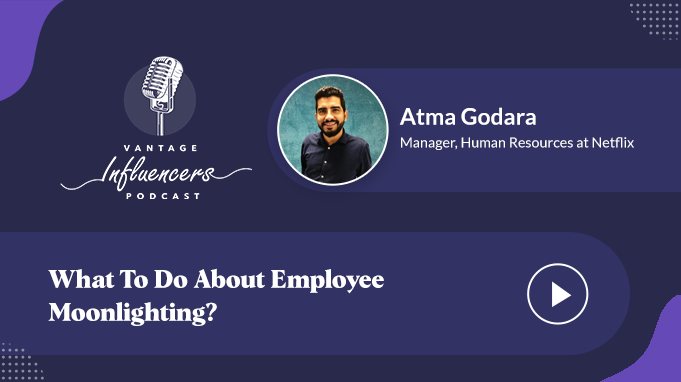
Atma Godara, Human Resources Manager, Netflix
Atma is an engineer turned HR professional who has worked across startups and large conglomerates, building experience in HR technology, digital transformation, HR analytics, business partnering, and talent management. He is currently a compensation-focused HR business partner and brings a strong interest in solving complex people problems and coaching individuals through career development and performance.
Host
Susmita Sarma, Vantage Influencers Podcast Host
What You Will Learn
- How to define employee moonlighting and the two most common reasons employees take it up
- Why chasing down moonlighters is the wrong focus for HR and what to prioritize instead
- Where moonlighting crosses into a genuine conflict of interest with the primary employer
- What the current legal landscape around moonlighting looks like
- How to write employment contracts that set clear expectations without shutting down employee autonomy
- How moonlighting differs from gig work and what that means for the future of work
Key Topics & Timestamps
| Timestamp | Topic |
|---|---|
| 01:40 | Atma's background and corporate journey |
| 02:30 | Defining employee moonlighting and its most common causes |
| 04:42 | Why chasing down moonlighters misses the point |
| 05:50 | Where Atma actually stands on moonlighting |
| 08:10 | The legal grey area around moonlighting |
| 09:22 | How employers and HR should handle it with care |
Full Transcript
Click to read the full episode transcript
Welcome to the Vantage HR Influencers podcast. This podcast is sponsored by Vantage Circle, the simple and AI-powered rewards and recognition platform for employee engagement.
Moonlighting, it is a very open secret in the corporate world today and has been recently in the news too, with many top organizations raising concerns about it, and some have even terminated their employees who engaged in this practice.
Susmita Sarma: Hi everyone, I'm Susmita, your host, and I'd like to welcome you to the Vantage HR Influencers podcast today. In this episode, we'll be joined by Atma Godara to discuss the challenges around moonlighting. We'll answer some of the tough questions that have been raised by different employers, and about the future of work. So let's begin. Welcome to the show, Atma.
Atma Godara: Thank you very much, Susmita. Happy to be here and thanks for having me.
Susmita Sarma: Yes, thank you for sparing your time for this podcast today. By the introduction, I'm sure you know that we will be discussing moonlighting today. A lot has been spoken about the topic in different podcasts and webinars. We recently had, last week only, a webinar on moonlighting. So a lot has been discussed already, but there are still so many tough questions that employers have been raising about this topic that it's never enough to discuss something which is such a trend nowadays. So let's begin, and before that, Atma, I would like to know a brief about yourself and your corporate background.
Atma Godara: Absolutely, and as you said, this is one of the hot topics these days, and we have been synced for the last few months. Everybody is talking about moonlighting. So to start with, as you mentioned, my name is Atma Godara, and my pronouns are he, him, and his. I currently work with Netflix as the manager of human resources. I am a business partner in the compensation role here, and prior to Netflix I have worked with startups. I have worked in conglomerates also, and I have worked across industries and have had experience in the space of HR technology, digital transformation, HR analytics, business partnering, and talent management.
Susmita Sarma: Great, thank you for the introduction, Atma. So I think we can start with a discussion now. In the very beginning, it would be great if you can tell us how you describe the term employee moonlighting, and what according to you are the most common reasons for it.
Atma Godara: Absolutely. See, when we talk about moonlighting, the definition is that whenever a person or an individual is doing something apart from their primary job, and typically during the day you have your employer, and you end up doing the extra work or the second job during the night. That's why it's called moonlighting. That's the definition we have. And there are two primary reasons which I could think of right now. One is, of course, tapping human potential. I mean, you talk about any job, any profession, it is nearly impossible, I would say, to tap the entire human potential, to manage their curiosity and passion for their work. So that's one thing, when people have a hunger that isn't satiated at work, they try to look for more work outside their working hours. And second, and this is a hot topic in the tech sector, especially on the West Coast, from what I've heard from some of my friends, people are paid at a certain level, and the employer can't pay more than that, because if they do, these people won't be viable in future given what they're expected to deliver at that cost. But at the same time, these individuals need to earn more to run their families and to fuel their passions or hobbies. So these are the two primary reasons, tapping the potential and the source of extra income, that come together when we talk about moonlighting.
Susmita Sarma: So is it easy to identify moonlighters, like in any organization, if people don't talk about it, if they don't use official laptops or other technologies from the office, then how can we identify moonlighters?
Atma Godara: See, I have a little different take on this. I would say, why would you, as an employer, have your focus on identifying a moonlighter? Rather, why don't you empower your employees or your talent in a way that gives them that sort of ownership, so that when they come to work, they are the owner of their work and what they're supposed to deliver. The focus should be on the outcome, as an employer, as a manager, as a leader, what one demands from the team, rather than what they're doing outside their working hours, or over the weekends, or on their personal devices. The focus should primarily be on empowering them, so when they come to work they are energized, giving their 100%, and delivering what's desired from them.
Susmita Sarma: Yeah, so undoubtedly the trend is inviting and stirring huge debates across corporate corridors. We can hear different perspectives from different leaders and managers, both online and offline. Some employers are seeing it constructively, but again some are seeing the opposite and are completely against it. So personally, Atma, from what I could understand from your last answer, you are in favor of moonlighting, am I right?
Atma Godara: See, let's try to understand where everybody's coming from, and to be honest, nobody's wrong in this space. When you talk about people who are raising a concern about moonlighting, their primary concern is very clear, that if a person is moonlighting and it is impacting the customers, or the product, or the technology of the primary employer, if it's taking away from those, then it's definitely a matter of concern. Or if the moonlighter is using the technology or the code they're writing for that employer, if they're using the same code, the same methodology, to moonlight, then that's definitely a matter of concern, because what's happening there, technically, is you're taking away, or I'd use a stronger word, you're stealing the intellectual property of the employer. So this becomes more of an ethical question, and that's where employers are very concerned about it. So as an employer, one has to ensure nothing of this sort is happening. Also, employees need to be made aware that while moonlighting, it could be something totally different from what they do at work. For example, if there's a techie writing code in their day-to-day job, they can be a painter, they can be a singer, going to a concert or doing an open gig over the weekends, and fueling their passion and earning money from that, that should be definitely fine in my opinion. So these are two different viewpoints, opposite to each other, but both of them are right in their spaces.
Susmita Sarma: Yeah, so as long as it doesn't affect your work in the office, you think it's quite ethical. So are there any legalities that have been framed about moonlighting recently?
Atma Godara: To the best of my knowledge, there is no federal law which governs moonlighting. Having said that, what has been happening for a while is that the employment contract, while you're working with an employer, mentions that you won't be doing anything where there might be a conflict of interest. So some employers mention it, some don't, but as an employee, if you're willing to do something you're passionate about and you're not really clear whether it might create a conflict or not, it's always advisable to go and talk to your manager, and try to understand whether it would be hurting the company, its intellectual property, its customers, its product, or the code. It's always good to talk to the manager before getting into something that might be a case of conflict.
Susmita Sarma: Yeah, so do you think employers and HRs who know that they have employees who are moonlighting need to give some special attention or care in the workplace?
Atma Godara: See, I think irrespective of whether a person is moonlighting or not, the focus, as I was mentioning previously, should be on the culture, which should be developed in a way where people feel more empowered. What is culture, basically? Culture is when you're doing something even when nobody's watching you. So having that kind of culture in place, where people are coming to the workplace and delivering a hundred percent, owning their output, being made accountable and also being rewarded for the same, and even after that if people are going out and doing something out of their passion, let them go and do it. I believe they would come back more energized, more discharged, and more productive at work. Having said that, of course, it can't be something that arises a conflict of interest with the primary employer, so that has to be kept in mind for sure.
Susmita Sarma: Yeah, and having said that, no legalities have come up or are going to come up very soon, is it? Like, you're moving forward with employee moonlighters in the future of work?
Atma Godara: See, the future of work is shaping in a very different way, I would say, because what's happened historically, if we see over the last few years or decades, earlier it used to be the employer who used to lay down those terms and conditions. And with millennials, and especially Gen Z in the workplace now, people want to work on their own terms, they want to do multiple things. I remember, and this is one of the most common things we hear when we millennials have these conversations in the office, that hey, my father or my mother joined this job and retired from the same place after 30 or 40 years. And when we talk about Gen Z or millennials, they want to do many things, and that's why we've been hearing a lot about the gig economy for quite some time now. So somewhere, what I think at this point in time is, how do we marry these two, because moonlighting and the gig economy are very different things. In moonlighting there is a primary employer, but when somebody is a gig worker, there's no primary employer, the person is doing different things at different points in time.
Susmita Sarma: Great, Atma, so as we reach the last minutes of this episode, would love to know your final take on the topic.
Atma Godara: Absolutely, I think as an employer, if you're worried, it's better to state clear terms and conditions in the employment contract about what is permissible and what is not permissible when it comes to moonlighting. And as an employee, whenever you want to pursue something out of your passion after work hours or over the weekends, ensure that it doesn't affect your productivity at work, and that you don't take away any intellectual property from your employer, or their customers, product, or code. There's no conflict of interest, as we were talking about earlier, that you're a coder but you're moonlighting as a painter, or you're trying to do it as a comedian, or you're doing an open gig, that's absolutely fine, it's super clear. But at any point of time, if you have any doubt, go back to your manager, have a chat, have that conversation, and when you come to work, give your 100%.
Susmita Sarma: Great, so lastly, would you like to tell us how our listeners can reach out to you and learn more about moonlighting and other HR trends?
Atma Godara: Absolutely, Susmita, I'm super approachable and super active on Twitter, my Twitter handle has my name on it. I'm also approachable on LinkedIn, and of course I'm real fast on Twitter, a bit slower on LinkedIn DMs, because I take time to reply to those. So yeah, Twitter first and then LinkedIn for sure.
Susmita Sarma: Okay, so the topic today, moonlighting, has been splitting perspectives and generating challenging questions, which I'm sure we've addressed at least a few of in this very brief discussion today. Thank you for your time and for sharing your knowledge with our audience today, Atma, it was great talking to you, thanks for joining the conversation.
Atma Godara: Thank you for having me, Susmita, it was a great conversation, and have a great day and a great week ahead.
Welcome to the Vantage HR Influencers podcast. This podcast is sponsored by Vantage Circle, the simple and AI-powered rewards and recognition platform for employee engagement.
FAQ
What is employee moonlighting?
Employee moonlighting refers to taking on additional work beyond your primary job, typically outside of regular working hours. It's driven by two main factors: wanting to use skills and potential that aren't fully tapped at the primary job, and needing extra income to support financial needs or personal passions.
Is moonlighting actually a problem for employers?
It depends on what's involved. If the additional work doesn't touch the primary employer's customers, product, code, or intellectual property, it's generally not a concern. It becomes a genuine issue when the moonlighting work overlaps with or draws on the same intellectual property, technology, or customer relationships the employee's primary job involves.
How should HR respond to moonlighting instead of trying to catch it?
Rather than monitoring employees for signs of moonlighting, HR and managers should focus on building a culture of empowerment and outcome-based accountability. When employees own their outcomes, feel trusted, and are recognized for their work, what they do in their own time outside of work becomes far less of a concern.
Is moonlighting the same as gig work?
No. Moonlighting assumes a primary employer alongside additional work, while gig work involves no single primary employer at all, with the person moving between different engagements over time. The two trends are related to changing employee expectations but are structurally different.
Related Reading
Also listen on