Why Some Teams Perform Better Than Others
Episode Overview
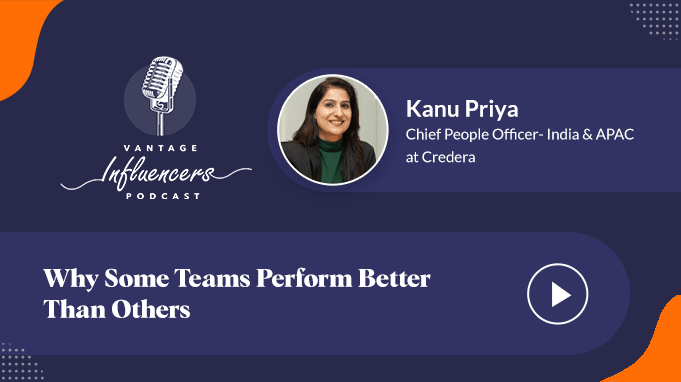
Kanu Priya opens this episode by rejecting the idea that performance is where the real conversation should start. In her view, what happens before performance, whether people feel safe enough to speak up, push back, or admit a problem, decides almost everything that follows. She points to Google's Project Aristotle research on team effectiveness, where psychological safety, not talent, emerged as the strongest predictor of a high-performing team. Kanu Priya argues that when leaders skip this groundwork and jump straight to KPIs and strategy decks, a team may hit a peak once, but the pattern rarely holds.
The conversation then turns to why so many teams stall between intent and action, and Kanu Priya traces the gap to the middle layer of an organization, where vision gets diluted before it reaches the people doing the work. From there, she makes her sharpest argument: micromanagement is not a personality flaw but a symptom of broken trust or ownership that was never fully handed over. Fix those two things, she says, and the urge to micromanage dissolves on its own. She closes by describing what separates teams that peak once from those that sustain performance: an ongoing appetite for honest self-examination, even after success, rather than the comfort that quietly breeds blind spots.
Episode Highlights
- Psychological safety, not talent, is the single biggest differentiator behind high-performing teams, according to Google's Project Aristotle research
- Underperformance is rarely a skill gap; more often it is a "safety gap" where people don't feel safe to push back or flag problems
- Alignment breaks down most often at the middle layer, where vision gets diluted before it reaches the people executing the work
- Micromanagement is a symptom, not a personality trait; it shows up when trust was never extended or ownership was never fully transferred
- Sustainable performance runs on three R's: reinforcement of vision, recognition beyond a certificate, and built-in recovery time
- Teams that peak once optimize for performance; teams that sustain it optimize for learning and stay willing to examine their own blind spots
About the Guest
Kanu Priya, Chief People Officer - India & APAC, Credera
Kanu Priya is a transformational HR leader with over 18 years of experience across consulting, manufacturing, and technology-led industries. As Chief People Officer - India & APAC at Credera/Areteans, she leads HR strategy with a "business-first, people-always" philosophy. Known for driving M&A integration, hyper-growth scaling, digital HR modernisation, and leadership development across global markets, her career includes key roles at Atotech (MKS Instruments), Canon India, Gartner, and Pioneer Urban. She is certified in PROSCI Change Management and Hogan Assessments, and is a graduate of the Future CHRO Program at ISB.
Connect with Kanu Priya on LinkedIn
Host
Sanjeevani Saikia, Vantage Influencers Podcast Host
What You Will Learn
- Why psychological safety, not skill or talent, is the real foundation of high-performing teams
- How to notice when your team's vision is getting diluted as it cascades through middle management
- Why micromanagement is a symptom of trust and ownership gaps, not a character flaw
- How to build recovery into a performance system instead of treating it as a special exception
- What separates teams that peak once from teams that sustain performance across multiple cycles
- Why modeling vulnerability as a leader gives the rest of the organization permission to do the same
Key Topics & Timestamps
| Timestamp | Topic |
|---|---|
| 01:12 | Kanu Priya's career journey across talent management, M&A integration, and people strategy |
| 06:26 | The foundational conditions, especially psychological safety, that must exist before performance is possible |
| 12:32 | Why teams look aligned on paper but struggle to execute, and where that gap really starts |
| 18:18 | How trust and ownership determine whether a leader needs to micromanage |
| 24:05 | The three R's framework for sustaining performance without burning teams out |
| 31:05 | What separates teams that perform well once from those that sustain it over time |
Full Transcript
Click to read the full episode transcript
Welcome to the Vantage Influencers Podcast. This podcast is sponsored by Vantage Circle, the simple and effective recognition platform for employee engagement.
Sanjeevani Saikia: You know, when we talk about performance at work, we often jump straight to outcomes, be it targets, KPIs, or results. But the more I have been thinking about it, the more it feels like performance is really an outcome of a lot of invisible things working, or somewhat not working, in the background. And maybe that's where the real conversation actually begins, not with performance itself, but with what makes it possible in the very first place.
To explore this further, I'm really glad to be joined by someone who has been closely shaping people and performance strategies at scale. Today we have with us Kanu Priya, Chief People Officer, India and APAC at Credera. Hi, Kanu Priya. Thank you so much for joining us today.
Kanu Priya: Thank you so much for having me, Sanjeevani.
Sanjeevani Saikia: It's a pleasure to have you on the show. Thank you so much once again. Prior to getting into the heart of the topic, could you kindly walk us through your corporate journey so far?
Kanu Priya: Yeah, absolutely. It's been more than 17 or 18 years of experience working in the stream of human resources and organization development. I thoroughly enjoy the journey of working closely with leaders and with humans.
My journey started with an organization named CEB, which is now Gartner, where my role was more into talent management, understanding talent, and helping them grow in the space of performance. Because every time we hire people, we always assume they'll do well on their own, but this is a system that helps them grow. And that's where the talent management team was integral, a key shaping architect of this entire talent space, or people space. I'm very passionate about people.
My journey also includes working closely with organizations like Canon, and with organizations like Atotech, which had seen pre-acquisition elements where we worked very fast-paced around systems, making them more agile and ready for a big shift, especially in the chemical industry, moving from manual processes to becoming more people, process, and systems driven.
My current role is with Credera, which is a consulting firm. I have been part of acquisitions again, and post-acquisition integration goes much deeper than just the strategy deck, because the strategy deck is just one slide. When you actually integrate people and work closely with them to build a better strategy and get them ready for the future, that's where the real art of human resources comes in. And I'm very happy to be part of today's topic, Sanjeevani. I do see there is a lot I can contribute from my experience, and thank you so much for having me.
Sanjeevani Saikia: Wonderful. Thank you so much for sharing your journey with us. It's a pleasure to have you on the show once again. Thank you so much. With your permission, I'd like to begin our discussion on today's topic.
Great. So before we even get to outcomes, first of all, there's this question of readiness, which I think we have to address first. Are people clear on what they are doing? Do employees feel supported? Do they even have the environment to do meaningful work? And if these pieces aren't in place, expecting performance can almost feel very premature in nature. So if we strip it back to basics, in your experience, what's the real starting point? What needs to be in place before performance even becomes possible?
Kanu Priya: Yeah. Thank you so much. It's a great question because, you know, most often when you work with big organizations, you always feel it's a system, an institution that you're getting into. But what comes first is far more human. So the question is, do I belong here? Do I know what winning looks like for me?
Let me be direct. The starting point has nothing to do with strategy, tech, or your KPI framework. Those come, but they come later. I've sat across from brilliant people, people with stellar track records, who were underperforming. Every single time I dug in, it wasn't a skill gap. It was a safety gap. They didn't know if it was okay to push back. They didn't know if raising a problem would be seen as competence or as a complaint. So they played it safe. And playing it safe is the enemy of high performance.
I'm a huge fan of Google's research paper, Project Aristotle. The project asked, what makes a team effective? And while everybody was expecting talent to be the answer, I think what came up was that one of the single biggest differentiators was psychological safety. And that's the core. Even when you look at Maslow's hierarchy, safety comes first, whether people feel they can take a risk without being humiliated. And the results are phenomenal. When a team feels safe, feels themselves, and feels like they belong, it shows up in your dashboards. It shows up in your attrition. It shows up in your outcomes. It shows up in everything, the synergy, the numbers, the revenues.
So for everyone listening, go back and think about a high performer you once had, and if they've gone quiet, ask why. What has changed for them? Because the skill, they have acquired. The capability continues to be there. But what changes is the conditions around them. It could be a change in leadership, a change in environment, a change in a new system. And that shows up in the outcome, as a team and as an individual.
That's where I think it matters how leaders create an environment that's safe, how they make their team members feel they belong. These are the honest conversations that really make an organization successful, because silence has a cost. You pay for it in attrition, in rework, in rebuilding. So process definitely holds performance together, but it's psychological safety that makes performance possible in the first place. And unlike a process, you cannot install safety through a policy rollout or a town hall. It requires far more genuine effort, consistency, and visible intent from the leader every single day, not just once. It's a continuous effort. So, yeah, for me, it's safety, psychological safety.
Sanjeevani Saikia: Yeah, I would definitely agree with you that psychological safety is one of the most important things. According to you, what do you think really makes someone feel psychologically safe? There are a lot of things people talk about, is it recognition? For a particular group, say Gen Z, maybe their psychological safety really comes from recognition, pay later. For millennials, maybe pay would come first, recognition second, something like that. So according to you, what is that one thing that really makes psychological safety be there in the first place?
Kanu Priya: Yeah, I think the conversations on the floor are certainly very important. Our leaders coming and going and holding a discussion in a forum is a good starting point. But safety is a continuous effort that a leader puts in. This is where it matters, how am I available on the floor for you? How do I appreciate?
Appreciation is a second phase. It's acknowledging that you have something to contribute, acknowledging your presence. Sometimes the quietest team member may be the one who is delivering the most. They may not be the extrovert who is chatting with you and raising their hand, but you walking up to them and being available for them matters. And I don't mean that every C-suite member has to be available all the time, because they have a thousand things to take care of. But how available their champions, their layer, are, matters. How many skip-level discussions are happening?
Because I've seen, Sanjeevani, a town hall has gone by, we've published our vision, everything is sorted, and then I've lived this firsthand. When we're having our skip level, and minus one, minus two, minus three, talking about what they're doing, what's happening, what their priority is, we're amazed and humbled at the same time. They understand, but they're not able to fully comprehend it. Sometimes you need to go that level deep to really comprehend the vision, ask them questions, and build that connection. And in this world of AI, when everything can be easily pulled from AI, you still need those human conversations on the floor to really chat, connect, and help them understand further. What's in it for you? What's in it for them? Why are we doing what we're doing? What is this vision reinforcing, time and again? And when you hold these conversations, when you acknowledge and appreciate these little moments on the floor, even the chats on a team, safety is built. Safety nets are built in the organization.
Sanjeevani Saikia: Now, let's say the basics are in place. There's clarity, there's direction, and maybe even the right intent at the leadership level. But what's interesting is that even with all the intent in place, things don't always translate into action the way we expect. Teams can look very aligned on paper, but when you observe the day-to-day efforts, it feels quite scattered or slightly off track, which makes me wonder, is alignment more about having a shared vision, or is it about how that vision actually shows up in everyday decisions? And most importantly, where do you see teams most commonly losing alignment between intent and action?
Kanu Priya: Yeah, you know what, you go for an offsite, you work with your leaders, go to the whiteboard, and set that one statement, double click it. We always do that. And then when you double-click it, you put it in your values, in your sheet, in your strategy deck. January is mostly like that, when you get all your paperwork done. And that's when you start asking your next layer to cascade it down, and you realize how human nature is, information gets diluted and filtered. And back to my earlier point, first there's communication, then there's comprehension of that entire vision. And that's where alignment goes.
I want to be very direct. Most of the time it's the middle layer, because it's the bottom that does the action, and it's the leaders who put things down on the sheet with the strategy and the vision. But it's the middle layer where we need to get deeper, educate, train, and work closely, time and again, so there are no translation issues, no gaps.
Now, how do you do that? Like I said, I have firsthand experience. Big organizations have their own skip-level discussions. We do that too, not to question our middle layer, but to help them achieve their tasks, because half the time these middle layers are also understaffed, under-resourced. They have their own pressure, their own identity to protect, they also want to do a phenomenal job, but in the translation, things go off track. So it's also leadership's responsibility to do double-checking, to go level by level.
What is your people-connect strategy? Very important. Is it just once a quarter, or do you have a yearly plan with your high potentials, your next layer, your important delivery leaders and delivery people? Because they're the ones who bring the change, they're the ones who get the reactions of work from clients, they're the ones who work very closely with clients. That's important. Multi-layer discussions are imperative, and this is where I think misalignment happens. So you can nip it at the bottom by having these people-connect conversations. That's very, very important.
And this is where you build a system, because a hierarchy is a system that you build, not just an org chart, and that system needs reinforced connection and communication. I would also call it a circle where everybody contributes and is aligned to one united vision. There are still gaps, still places where I know who's doing what, but I don't have the ownership. So can we define the ownership?
This is what we, as an organization, have also learned over time. Why do we have big teams? Can we not have a small team? What's the RACI matrix? Very clearly defined, end to end. If it's successful, who's the owner? If it's not successful, who's the owner? And that's where accountability comes up.
The second piece is checking if the comprehension of the vision has been taken up. Very important. And the third, very integral segment, is feedback loops. I'm managing things on my own, I'm under pressure to show my delivery, but I won't raise my voice that there's a gap. And by the time the person is done with their project, we find out there was a gap and we didn't know how to address it. That's also misalignment. That's also when you're in the third quarter and you can clearly see you've missed your target for the year, because nobody spoke up, nobody raised their voice. And this is where I think a ritual of meeting at regular intervals is very important, where you reinforce the vision, help people prioritize, because it's a very agile world we're in, everything is changing. Look at the current geopolitical scenario, it's changing. My client requirements are changing. AI is disrupting. So how am I helping my team keep reprioritizing while keeping the bigger vision and the values intact? So, yeah, these are some misses, but it's the role we as leaders have to play, continuously, genuinely, deliberately, all the time, and with patience.
Sanjeevani Saikia: Now, shifting gears a little, once alignment begins to settle, the next challenge is how teams are managed. Constant supervision can only go so far, and many people don't even like it. At some point, performance starts depending on whether people feel seen and whether they feel a sense of ownership over their work. So in many ways, it becomes less about managing tasks and more about building trust. So according to you, Kanu Priya, what role do trust and ownership really play in enabling teams to perform consistently, without that whole micromanagement thing going on behind it?
Kanu Priya: Yeah, you know why I'm smiling? Because half the time my team, or as HR, we keep hearing from team members that a manager is a micromanager, they can't work like this. And when I speak to the leaders, and I've worked with them, they'd say, I'm watching too closely because I can't let this go, because I'm afraid things won't turn out right, and then I'll be the one held accountable. And this is real. It happens, I understand it.
But where I want to come in is, most people treat micromanagement as a personality flaw, as if it's a character trait you're born with. It's not. Micromanagement is almost always a symptom. And you rightly mentioned it, it's trust and ownership. I see trust and ownership as the root cause of it. Because either trust was never extended, or ownership was never truly transferred. Fix those two, and I can completely say the need to micromanage dissolves on its own.
Trust is what a leader extends, the signal that says, I believe you have what it takes to figure things out. Ownership is absolutely an accountability, a commitment, it's beyond the task, and it definitely leads to a high-performing, self-directing team.
But I also understand there are scenarios where either of these can go off track, not because a manager doesn't want to extend it, but because the organization is going through a lot of changes. Let me take an example. As an organization, we've been working on a post-acquisition integration exercise, and when we're going through this change, we know all eyes are on us as leaders, because we have to integrate people, a mass number of people. It's not that delegation of authority isn't there, it is, but if you're under scrutiny, taking care of so many people, bringing people together, then trust may be there, but ownership might not be 100% transferred or cascaded down. And in that case, it doesn't mean you have to micromanage.
There are always situations like this. It's always important to hold open and transparent conversations with your team, share why you're behaving the way you're behaving, why you need to be on top of it, and for how long. And help the team understand it's only for this particular time, when integration is under scrutiny, that I'd like to be on top of things. And then, once it's done, bring that back, ownership is there, you do what you do.
I've seen big organizations, like Amazon, consulting firms, who have institutionalized this. Sometimes they do single-sided ownership, you do that. But there are also times they'll say, okay, for this time, we need you to update us on what's happening. But it's also important for leaders and managers to share the purpose or the why behind their behavior. The pod structure I was talking about is on similar lines. When you explain to people, you're the owner of it, you're accountable for it, but at the same time, there's a dashboard, ensure this dashboard is updated. But yes, to your question, trust and ownership are an integral part. Micromanagement is just a symptom, very important, but it's also leadership's responsibility to understand the current scenario of the organization, understand why trust is grounded or ownership is transferred, and under what circumstances they can't grant or transfer it, because these circumstances would be great.
With AI coming in, there are also places where ownership still sits with leadership, hasn't cascaded down. There are certain functions that aren't completely operating under AI yet, so people ask why their function or team doesn't have the same AI exposure as another function. So as a leader, you have to explain and hold that conversation. And at the end of the day, it's a decentralized decision but centralized visibility. My understanding is autonomy isn't a reward you give high performers after they've proven themselves, it's a condition that makes high performance possible in the first place. So you have to give that autonomy, you have to create that condition for people to perform with trust and ownership.
Sanjeevani Saikia: Now, moving on to the next layer, everything feels more complex once teams start scaling, or when pressure builds. What worked earlier can begin to feel very stretched, and performance can quickly turn into pressure if the right systems aren't in place. So in those moments, what actually holds things together, according to you? As teams scale or face pressure, what systems or rituals really help maintain performance without tipping into burnout? Because burnout is an issue our generation, the workforce at large, is really facing. So how would you tackle that?
Kanu Priya: Yeah, see, sustainable performance and building a high-performing team are two different disciplines, first of all. So I'm happy you're asking, it's about sustainability. Sustainable performance is a design choice for me. When I say design choice, you build a system for sustainable performance, and that system calls for you building recurring efforts, be it through systems, processes, people-connect, recognition, and also recovery, very important.
So what does that mean? First, our systems are built for outcomes, they're not built for sustainable performance or even recovery. True, we have our systems built only for outcomes. We reach our peak performance, we get accolades, thumbs up, double thumbs up. But at the same time, when it's at scale, the first thing that drops is recognition, because we're so much in fast-paced hiring, fast-paced delivery, fast-paced AI adoption, and the pat on the back just goes off the grid, you're just not there yet. And that's where I think the system plays an integral role. Is my system on autopilot mode, taking care of people and performance, not once, but continuously? That's sustainable performance.
So the framework that's very close to me, and that we completely follow in our organization, comes down to three R's. The first R is very much, am I able to reinforce my vision? The second is recognition, and the third is recovery. And the rhythm, when I say reinforcement, is the rhythm of going back and forth on our vision, going back to the slides, going back to the N-1, N-2, the skip levels, helping them understand. And then the rhythm of understanding if there's a gap in this quarter, because we have quarterly check-ins. So, okay, what am I carrying forward to quarter two? How much am I able to achieve against the vision, against the goal I've set for the year? What's the methodology? Where were the obstacles? What am I doing? So those are the rhythms that help you keep your outcome intact, and you stay on track, keeping the bigger vision you've set. So there's no pressure building up over the last quarter, and you're right on track. That's part one.
And as you do that, recognition is an integral part. You have to recognize, you have to be on top of it, and it's not something that's only a leadership job, it's a systems job. And when I say system, it has to be on autopilot, it has to be something that triggers you. Who did a great job? Why hasn't this been captured on the system? Who is that individual? Who is your high performer? What's the next role? And then your great career progressions come in, your skill matrix comes in. What's the next layer, the next growth path for that individual? That's the recognition I'm referring to. Some are definitely tangible, but others are intangible, things you can't even see. It's not just a certificate and a town hall award function, it's the complete progression of an individual, because that individual has signed up with you, and you need to recognize their growth, which is as much an employer's responsibility as growing revenue. So that's the recognition I'm referring to.
Now, the third and very integral part, and this is the entire burnout piece, big organizations still haven't cracked the code because they're built for outcomes, not yet, it's recovery. Today I performed at my peak, do I have space for myself? What do I mean by that? Especially in India, I've noticed with GCCs and IT, we appreciate somebody who works late into the night, somebody who responds to emails at midnight, somebody who's always available. And one day, that person silently goes, because maybe we valued them, but we didn't recognize their performance or career growth. And once they're not available, because they set that high standard of performance, we see the other person's lack of commitment by comparison. So it's a very tricky mix we're in. So recovery is equally important. Do I have that in my framework, built into my system? Do I have shutdown periods? Do I have that one day off after I've stretched through a whole day? It shouldn't just be a shift allowance for working over a weekend or stretching through. It's a very small thing, on Monday, take a chill pill, take a low start, you don't have to be dot on nine, just take it slow, take rest, and you don't have to apply for leave. These are very small recovery periods.
And we must learn from elite sports. Look at their schedule, it's impressive, high-intensity work combined with recovery periods too. So I think business leaders also need a calendar, a schedule built in with the three R's, including recovery, very, very important, because that's how you sustain performance, not just build it once and then not be ready for the next round, because the body isn't ready for that next level of peak performance. So if you know there's a delivery this quarter, this month, or this week, what do the next three or four weeks look like for you? That's also a leader's job, to build that calendar. And that's where peak performance, if it's only once, isn't sustained.
Sanjeevani Saikia: Yeah, you've mentioned some really critical points, and out of which, you mentioned recovery, which I feel is very important, going to the fact that, as you rightly said, our systems are really built for outcomes and not sustainability. So in the longer run, to really make it sustainable, recovery is, I think, very, very important, because high-performing schedules can really take a person so far, but that person really needs to recover at the same time. So I think this was very critical, thank you for underscoring that.
Now, Kanu Priya, we've almost reached the end of today's episode. So now, zooming out a bit, there's a clear difference between performing well once and, most importantly, doing it consistently over time, because at the end of the day, we know consistency matters the most in the long run. One is often driven by momentum or circumstances, while the other reflects something deeper. Consistency really reflects habits, culture, and resilience. So to close this out, I'm really curious, what distinguishes teams that perform well once from those that sustain high performance over time?
Kanu Priya: Yeah, absolutely. You know what, my answer may challenge something we deeply want to believe. I've spoken to so many leaders, and sometimes consultants, and we want to believe that if you hire the right people, build the right strategy, and execute well, performance will follow. And it might, like you mentioned, once. But sustaining it, that's an entirely different discipline. And most organizations never invest in it because they're too busy celebrating the peak to prepare for what comes after.
So teams that perform well once usually have three things going for them: the right moment, the right clarity, a shared urgency, maybe a product launch, a turnaround, a delivery, a crisis, and everything was in shape and settled for them, because it was very situational. The performance was situational, maybe not structural. So to sustain high performance, we have to build something different, and what do we build? We build the capacity to learn faster than the environment changes. And that's not a talent statement, it's a cultural one.
I have organizations where, once they do something great, they'll sit back and enjoy it. My understanding is, if you were to not just believe the inputs coming from clients, but do your own debrief, can we also think of doing better, always think of doing better? There are organizations that don't believe in their own press. Pixar is one of them, they run their "brain trust" after every single film, regardless of how successful it was, a candid debrief. Because the greatest threat to sustained performance isn't failure, it's success. Success creates comfort, comfort creates blind spots, and blind spots are where the next failure is already forming.
Bringing this back home, in terms of the IT and GCC landscape, we were doing phenomenally in 2010, our execution excellence was the most talked about, we had cost competitiveness, and many thought it was beautiful. Now look at it, the environment has shifted: AI, automation, product thinking. There's a significant number of changes we're not ready to adapt to, not because there's a lack of talent, but because we built infrastructure for yesterday, and we never did our honest self-examination. We knew AI was coming, and now we're doing rationalization in terms of headcount.
So the organizations that navigated that shift, the leaders who did something specific, what I've learned is they modeled vulnerability. They said out loud, in meetings, in all-hands, town halls, one-on-ones, "I was wrong about that, here's what I learned." And that single act gave the entire organization permission to do the same. And going back to the first question, what builds a high-performance team is psychological safety, because safety at the team level starts with intellectual honesty at the leadership level. Teams that peak once optimize for performance. Teams that sustain it optimize for learning, and that difference shows up quarter by quarter.
So the only sustainable competitive advantage a team can have, in a world changing faster than any strategy cycle, is the ability to foresee and adapt. And this ability is never accidental, it's a choice, always a choice. So how fast am I making myself ready, and how fast have I built an agile team, made them learn for the future, and made them ready for the future?
Sanjeevani Saikia: That was a really good response. As you rightly mentioned, the capacity to move faster than how the environment is functioning is really wonderful. Other than that, success itself could be the major hurdle in being a sustained high-performing team, and the ability to foresee. So these were some really critical takeaways from this response.
Kanu Priya, you've wonderfully answered all our questions, thank you so much for that. So we've reached the end of today's episode. Before we go, is there any message you'd like to share with our listeners? Anything you'd like to say? I'm sure they'd love to hear it from you.
Kanu Priya: Yeah, thank you so much for having me. There's one critical message I'd like to share with all my listeners. With AI disruption, things are very fragile, so especially for leaders, you can't wear one hat all the time. As a leader, I'm a huge fan of situational leadership, a book by Ken Blanchard, where you coach continuously, be it for performance or for making people ready for the future. It's not just one hat that fits all.
So as an individual, you have to assess your team members all the time, what stage of learning are they at? Are they at a very decent stage? Then you need to be very direct. Are they at a learning phase-one stage? Then you need to really support them. But there are times you don't have to do it all, because they've already reached their peak, so you just coach them and give them a free hand, which is where we're talking about ownership and trust.
So I'm a huge fan of situational leadership as a whole, because it helps you understand your current state, helps you understand where your team members are, because when you're building a team, not everybody is at the same space or the same page. It's a leader's responsibility to learn what stage of learning, what stage of career they're in, and when you're building that team, you understand where they are, and then wear the hat the situation calls for to coach them and build them for high performance. Because at the end of the day, your success is proportionate to your team's success. So, yeah, that's the whole message. And thank you so much for having me, it was wonderful to be part of this podcast, thank you so much.
Sanjeevani Saikia: It's a pleasure to have you on the show. Thanks a lot, take care.
Thanks for listening to Vantage Influencers Podcast. Be sure to subscribe on Apple Podcasts, Spotify, and our Vantage Circle YouTube channel for the latest episodes.
FAQ
What makes a team high-performing, according to Kanu Priya?
Kanu Priya points to psychological safety as the biggest differentiator, citing Google's Project Aristotle research on team effectiveness. She argues most underperformance is a "safety gap," not a skill gap: people staying quiet because they are unsure if pushing back or raising a problem will be held against them.
Is micromanagement a personality trait?
No. Kanu Priya argues micromanagement is a symptom, not a character flaw. It shows up when trust was never extended to a team or when ownership of a task was never fully transferred, often during periods of organizational change such as a post-acquisition integration.
Why do teams struggle to execute even when everyone seems aligned?
According to Kanu Priya, alignment most often breaks down at the middle layer of an organization, where vision gets diluted as it cascades down. She also points to missing feedback loops, where problems surface only after the damage is already done.
How can teams sustain high performance without burning out?
Kanu Priya recommends building a system around three R's: reinforcement of the vision through regular check-ins, recognition that goes beyond a one-time award, and built-in recovery periods so peak performance doesn't come at the cost of long-term capacity.
Related Reading
Also listen on