
When budgets get tight, recognition is usually the first thing to go.
Not because it does not work. Because it is easy to cut. Nobody walks into the CFO meeting with a clean ROI number for recognition. The program runs quietly in the background, so when it disappears, nobody notices until the attrition data arrives two or three quarters later and everyone wonders what changed.
This is the pattern playing out across organizations in 2026. Hiring freezes, RIFs, and a "do more with less" mandate have put every discretionary line item under the microscope. And recognition, being one of the hardest programs to defend with hard numbers, is often the first to go.
So the instinct is to cut across the board: pause the spot bonuses, scale back the anniversary gifts, freeze the swag. It feels fair. It is also the most expensive mistake you can make with a recognition program, because not all recognition spend is equal. Some of it is the foundation. Some of it is decoration.
This guide is not about building a recognition budget from scratch. It is about defending one. Specifically, knowing what to protect, what to trim, and what to pause when the number needs to come down.
Key Takeaways
- What Recognition Budget Optimization Actually Means in 2026
- The Recognition Budget Benchmark, Reconciled
- The Protect / Trim / Pause Framework: What to Cut First, What to Cut Last
- The Recognition 70/20/10 Rule: A Smarter Allocation Framework
- How to Defend Your Recognition Budget Upward: 5 Tactics
- Five Mistakes That Make Recognition Budgets Easy to Cut
- Frequently Asked Questions
What Recognition Budget Optimization Actually Means in 2026
Recognition budget optimization in 2026 is not about building a budget from scratch. It is about defending one that already exists and making every remaining dollar work harder than it did before.
The economic context matters. Organizations in 2026 are asking HR to justify every major spend category, and recognition is one of the first to face scrutiny. But the math cuts both ways. Gallup's State of the Global Workplace found that low employee engagement costs organizations $8.9 trillion in lost productivity annually. Cutting recognition to save budget while disengagement quietly grows is not a saving. It is a trade-off most organizations do not realize they are making until it shows up in attrition and performance data.
The people dynamic has also shifted. Reduction-in-force (RIF) events, hiring freezes, and flattened headcount growth mean that remaining employees are carrying more. Recognition becomes a retention tool first and a reward tool second in that environment. According to SHRM research, replacing a mid-level employee costs between 50 and 200 percent of their annual salary. A $300 per year per employee recognition budget that prevents even a handful of voluntary departures during a headcount freeze pays for itself many times over.
There is also a perception gap to close. When budgets are cut and no one communicates what is being protected and why, the silence reads as indifference. One senior total rewards leader at a mid-size financial services firm described the dynamic directly: "We chose not to cut recognition when the rest of the discretionary budget was frozen. We communicated that decision clearly to managers and employees. The voluntary attrition data in the following quarter was the clearest program correlation we had ever seen."
This is also where the layering principle matters for comprehensive employee recognition programs. When monetary recognition shrinks, perks layers, including global discounts and lifestyle benefits available at near-zero marginal cost to the company, maintain the perception of employee value without adding meaningful budget pressure.
The Recognition Budget Benchmark, Reconciled
The honest answer to "how much should we spend on employee recognition?" is: between $70 and $350 per employee per year, depending on your company size and program maturity, with 1 to 2 percent of payroll as the guiding ceiling.
If you have seen different numbers elsewhere, you are not misreading them. Three figures are circulated widely in recognition budget conversations: $70–$125, $200–$350, and 1–2% of payroll, and each one is accurate. They just come from different program contexts. The problem is not the data. It is that most budget conversations pick a number without understanding which context produced it.
| Company Size | Program Maturity | $ Per Employee Per Year | % of Payroll |
|---|---|---|---|
| Small (under 250 employees) | New or informal | $70–$125 | 0.5–1% |
| Mid-size (250–2,500 employees) | Structured | $125–$200 | 1–1.5% |
| Large (2,500+ employees) | Mature, multi-tier | $200–$350 | 1.5–2% |
| Enterprise with global programs | Strategic, platform-based | $300–$400+ | Up to 2% |
The Incentive Research Foundation (IRF) Landmark Incentive Study sets 1 to 2 percent of payroll as the recognized ceiling for programs expected to move engagement and retention metrics meaningfully. The per-employee dollar ranges in the table reflect how that percentage plays out across different salary bands and program structures.
None of these figures are wrong. They are measuring different programs at different stages of maturity. The reconciliation principle is simple: use the dollar figure that matches your program's current stage, not the one that confirms the budget you already have.
Why the numbers disagree: Vendor benchmarks reflect their own client base. Enterprise-focused vendors primarily serve large organizations with mature programs, so their $200–$350 figure is accurate for that segment. Mid-market vendors serve a broader small and mid-size base, so their $70–$125 is accurate for that segment. The 1–2% of payroll figure from the IRF applies universally as a percentage ceiling, but it produces very different dollar outcomes depending on average salary. Use the per-employee dollar figure that matches your program maturity, and use the payroll percentage as a ceiling check, not a spending target.
The Protect / Trim / Pause Framework: What to Cut First, What to Cut Last
The Protect / Trim / Pause framework is a three-tier decision matrix that tells HR directors exactly which recognition program components to defend at full budget, which to reduce in frequency without eliminating, and which to pause temporarily until the budget recovers.
Every recognition budget guide tells you how to build a budget. None tells you how to defend one when cuts arrive. This framework is the defense-side equivalent.
| Tier | Components | Principle | Why |
|---|---|---|---|
| Protect | Peer-to-peer recognition, manager spot awards, long service awards | These drive daily engagement and anchor long-term retention. | Highest ROI per dollar. Most expensive to rebuild after cutting. |
| Trim | Company-wide events, themed campaigns, swag and physical gifts, leadership shout-outs | Visible and valued, but do not drive the daily recognition habit. | 30–50% frequency reductions save budget without signaling program collapse. |
| Pause | Experimental programs, non-anniversary milestone gifts, premium catalog tiers, offsite celebration events | Expansions built on top of a functioning base. | Safe to suspend. No harm pausing additions; significant harm pausing foundations. |
Tier 1: Protect (Untouchable)
The three components you must protect at all costs are peer-to-peer recognition, manager-initiated spot awards, and long service awards. These three are not untouchable because they are popular. They are untouchable because each one serves a distinct, measurable function that cannot be replicated by a cheaper substitute.
Peer-to-peer recognition creates the daily volume of recognition that any programmatic system depends on. It scales without per-event budget approval because each recognition moment costs only the points assigned to it. Remove it, and recognition does not slow down. It can break down completely. Managers catch the wins that surface to them, not the ones that happen between peers. They cannot fill that recognition gap alone.
Manager spot awards often deliver some of the biggest impact in a recognition program because they allow managers to appreciate employees immediately for specific behaviors and contributions. And that matters more than many companies realize. Gallup found that employees who receive meaningful recognition are 65% less likely to be searching for another job. Yet only 22% of employees say they receive the right amount of recognition from their manager.
Long service awards are the non-negotiable retention anchor at the 5, 10, and 15-year milestones. Removing them sends a clear signal that tenure does not matter, which is precisely the opposite message a budget-pressured company can afford to send to its most experienced people.
Tier 2: Trim (Reduce Frequency, Not Existence)
Trim components are the visible, event-based recognition moments that can absorb frequency reductions without triggering meaningful disengagement. Company-wide recognition events, themed monthly campaigns, swag allocations, and leadership shout-outs in town halls all belong here.
The principle is compression, not elimination. If you run four themed recognition campaigns a year, run two. If you allocate $40 per person for branded merchandise, allocate $25. The program still exists and employees know it still exists. Here's what you need to avoid: trimming events without communicating the reason. Employees who see a program go quiet with no explanation fill that silence with their own interpretation, which is rarely flattering.
Tier 3: Pause (Cut Until Budget Restored)
Programs in the pause tier are experimental or expansion-phase initiatives built on top of a functioning recognition base, making them the safest cuts available.
Examples include non-anniversary milestone gifts, premium catalog tiers in the rewards store, and offsite celebration events. None of these replace the daily recognition habit. Pausing them signals financial discipline, not program abandonment, as long as Tier 1 and Tier 2 programs remain intact.
The Recognition 70/20/10 Rule: A Smarter Allocation Framework
The Recognition 70/20/10 Rule divides a recognition budget into three buckets: 70 percent on programmatic day-to-day recognition, 20 percent on milestone and tenure awards, and 10 percent on experimental and spot-based programs.
The 70/20/10 construct is well-known in marketing and personal finance. Applied to recognition spending, it creates a defensible structure that tells a CFO not just how much you are spending, but why that distribution makes sense. It also makes clear which bucket to reduce first when the budget tightens.
| Tier | % of Budget | What It Funds | Cut-Last Test |
|---|---|---|---|
| Programmatic (70%) | Peer-to-peer points, manager spot awards, core values recognition, social recognition feed | The engine of daily recognition frequency. | Cut last. This is the base of everything. |
| Milestones (20%) | Long service awards, work anniversaries, onboarding recognition, project completions | Anchors retention at key tenure points. | Cut second. High impact, lower frequency. |
| Experimental (10%) | Pilot campaigns, premium catalog tiers, new recognition formats, offsite celebrations | The innovation budget for recognition. | Cut first. These are additions, not essentials. |
The 70 percent allocation to programmatic recognition captures the peer-to-peer model specifically: points-based, manager-visible, value-tagged, and always on. This is the bucket that employee rewards and recognition research consistently shows drives retention and engagement the most. Gallup research on recognition frequency found that employees who don't feel adequately recognized at work are three times more likely to say they'll quit in the next year. This is why always-on, peer-to-peer programs consistently outperform annual or milestone-only recognition.
The 10 percent experimental bucket is also the most important one to preserve, even at a reduced size. Organizations that eliminate their recognition innovation budget entirely tend to run the same program for five years with steadily declining participation rates. Keeping even 5 percent for experimentation signals that the program is a living system, not a static policy.
How to Defend Your Recognition Budget Upward: 5 Tactics
The single most important thing to do before a budget conversation with the CFO is to build your per-dollar ROI story before the meeting, not during it.
Recognition programs without outcome tracking are the easiest to cut. Recognition programs with clear, quantified data are the hardest. Here is how to build that data story in the 90 days before it is needed.
Tactic 1: Track Recognition-to-Retention Correlation
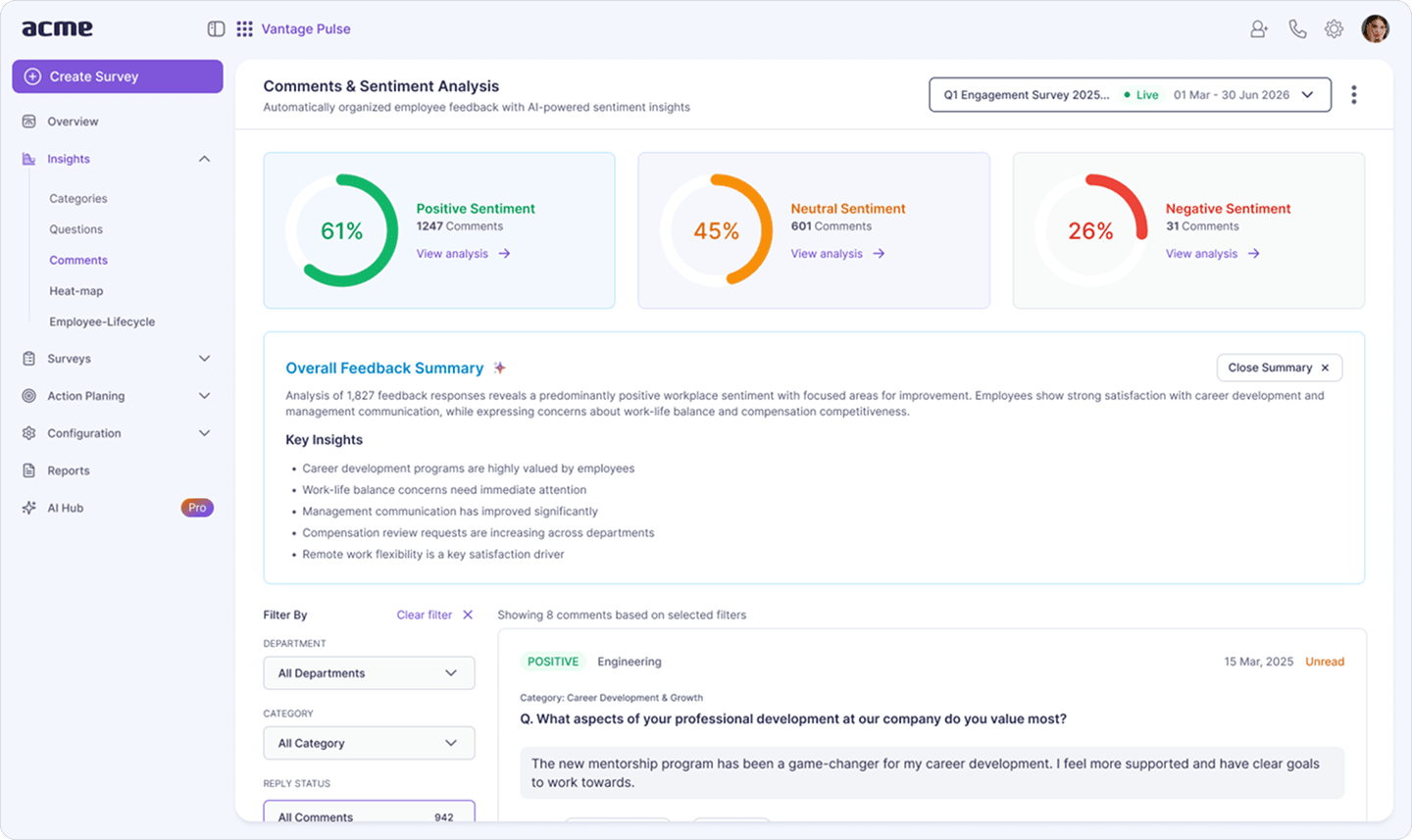
Pull your recognition participation data and your voluntary attrition data by team and by quarter. Match them. In most organizations, teams with higher recognition frequency show lower voluntary turnover. One correlation point is coincidence. Four consecutive quarters of the same pattern is a defensible business argument. Adding employee engagement survey scores as a second layer strengthens the story further and gives you three variables: recognition, engagement, and retention, all pointing in the same direction.
Tactic 2: Convert Soft Wins Into Dollar Figures
The most powerful move in recognition budget defense is translation. SHRM estimates the cost of replacing an employee at 50 to 200 percent of their annual salary. If your average salary is $65,000 and you use a conservative 75 percent replacement cost, retaining just two employees who might otherwise have left saves $97,500. If your annual recognition spend for a 200-person company at $150 per employee is $30,000, the math is straightforward. Building this argument around specific employee turnover costs turns an abstract program into a tangible financial case.
Tactic 3: Tie Every Award to a Company Value
Recognition that is tagged to a company value is not just an acknowledgment. It is a data point showing which behaviors the organization is actively reinforcing. Walking into a budget meeting with a report showing that 80 percent of peer recognitions last quarter were tagged to "customer focus" or "ownership" converts a soft program into a culture measurement system. This reframe, from recognition as a morale tool to recognition as a values tracking mechanism, changes the entire framing of the budget conversation.
Tactic 4: Show the Vendor Consolidation Math
Most companies run three to five separate tools for recognition, perks, wellness, and engagement surveys. Each carries per-seat fees, implementation costs, and integration overhead. Consolidating into a single platform like Vantage Circle regularly reduces recognition-adjacent SaaS spend, without removing a single feature employees actually use. A CFO who is reluctant to protect a recognition budget line may be very receptive to a vendor consolidation story that reduces total SaaS spend while improving the employee experience.
Tactic 5: Pre-Wire the CFO With Data, Not Anecdotes
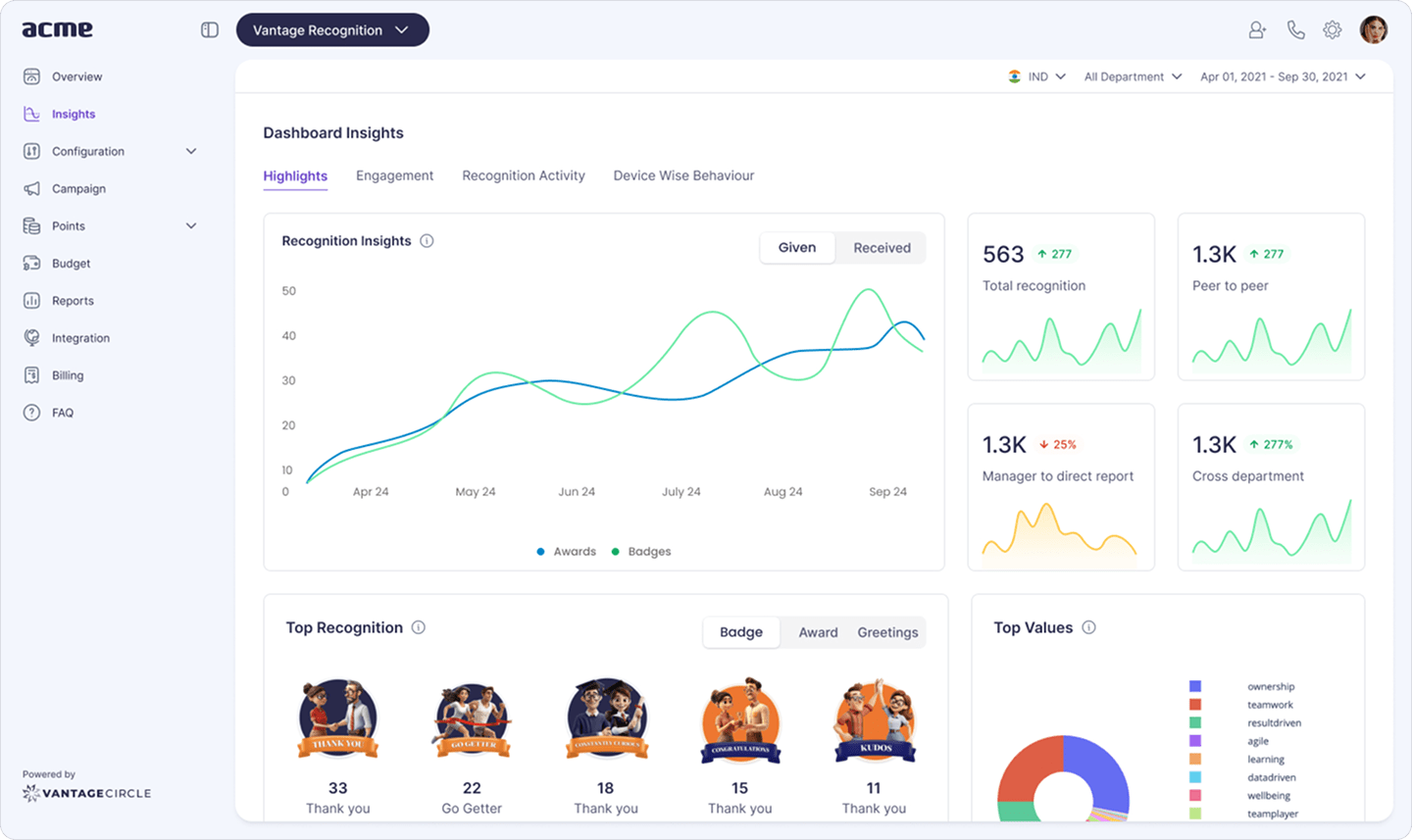
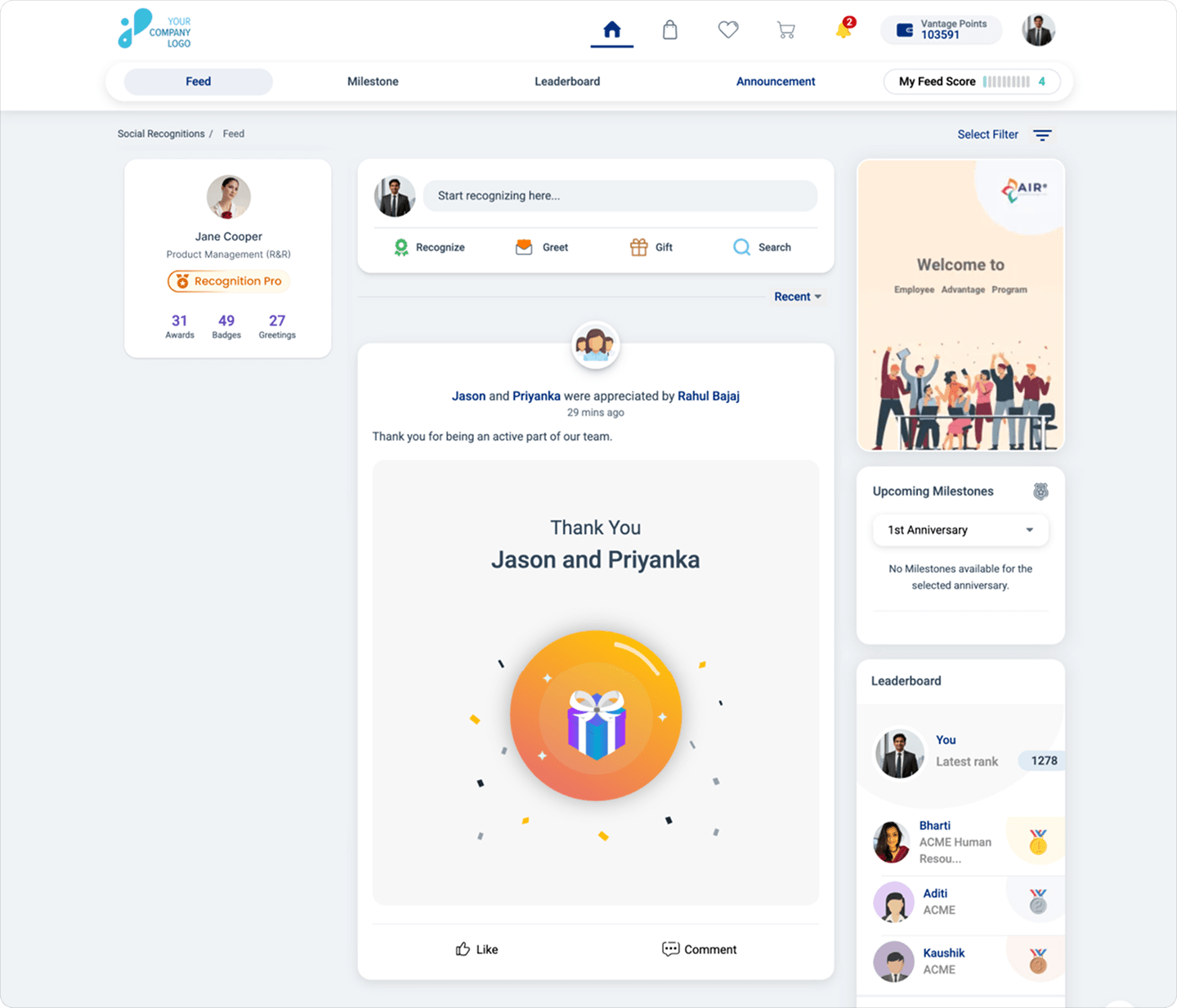
The CFO question that ends recognition budget conversations is: "What return are we getting per dollar of recognition spend?" If you cannot answer it within thirty seconds using a dashboard screenshot, the budget gets cut. Recognition analytics dashboards that show per-team participation rates, value-tag breakdowns, recognition frequency trends, and correlation with engagement scores give you that answer immediately. Build the habit of pulling a monthly recognition summary and sharing it with finance proactively, even in quarters when the budget is not under discussion. Pre-wiring the conversation means the CFO becomes a defender of the program, not a skeptic.
The CFO question that ends the conversation: "What return are we getting per dollar of recognition spend?"
Answer it in three parts before you walk in:
- Participation: What percentage of employees were recognized in the last 90 days?
- Retention correlation: How does recognition frequency map against voluntary attrition by team?
- Cost avoided: If recognition contributed to retaining X employees this year, what replacement cost did that prevent?
Have all three on a single slide before you walk in.
Five Mistakes That Make Recognition Budgets Easy to Cut
The five most common mistakes that make recognition budgets vulnerable are: no participation tracking, no outcome reporting, overinvesting in swag and underinvesting in programmatic recognition, over-relying on top-down recognition, and paying for the same employee across multiple disconnected vendor platforms.
Each mistake produces the same result: a program that looks like a cost center rather than an investment.
1. No participation tracking. If you cannot answer "what percentage of employees received recognition at least once in the last ninety days?" in under five minutes, your program has a visibility problem. Budget defenders need data. Programs without data are programs without defenders.
2. No outcome reporting. Tracking recognition activity is necessary. Tracking what it produces is sufficient. If your recognition reports show event counts but not engagement trends or attrition patterns, you are showing inputs rather than outcomes. Finance teams respond to outcomes.
3. Spending too much on swag, too little on programmatic recognition. A recognition budget that allocates 40 percent to branded merchandise and 20 percent to peer-to-peer points has its priorities inverted. Swag belongs in Tier 2 or Tier 3 of the Protect / Trim / Pause framework. Programmatic recognition belongs in Tier 1. When the allocation does not reflect that, the program has a structural vulnerability in the next budget cycle.
4. Over-relying on top-down recognition. When recognition flows only from managers to employees, two problems emerge. First, employees go unrecognized for work that managers do not directly observe. Second, the program depends entirely on managers being consistent recognizers by habit, which most are not by default. Employee recognition programs that include peer-to-peer recognition eliminate both problems by distributing the recognition responsibility across the entire team.
5. Not consolidating recognition tools. If recognition lives in one platform, perks in another, pulse surveys in a third, and wellness in a fourth, you are paying per-seat fees across multiple vendors for the same employee. That math creates budget pressure that looks like a recognition problem but is actually a vendor strategy problem. One integrated platform resolves it cleanly.
Frequently Asked Questions
How much should you budget for employee recognition?
The widely accepted benchmark is 1 to 2 percent of payroll, with the Incentive Research Foundation recommending 1.5 to 2 percent to cover platform, administration, and rewards costs. Use the figure that matches your program's current stage. Newer programs typically run toward the lower end, mature enterprise programs with milestone awards and global rewards catalogs toward the upper end, and treat the 1 to 2 percent of payroll range as a ceiling check rather than a floor target.
What is the 70/20/10 rule for recognition spending?
The Recognition 70/20/10 Rule allocates 70 percent of the recognition budget to programmatic day-to-day recognition, 20 percent to milestone and tenure awards, and 10 percent to experimental or spot-based programs. This distribution ensures that the highest-ROI components receive the largest share of the budget. During budget cuts, the 10 percent experimental tier is the first to reduce. The 70 percent programmatic base is the last.
What recognition costs should be cut first during a budget freeze?
Cut experimental and event-based recognition first, trim milestone frequency second, and protect programmatic recognition in full. The Protect / Trim / Pause framework gives the complete decision matrix. In brief: pause non-anniversary milestone gifts, offsite celebration events, and premium reward catalog tiers first. Trim the frequency of themed campaigns and swag allocations second. Do not cut peer-to-peer recognition, manager spot awards, or long service awards under any budget scenario.
What are the 5 C's of employee engagement?
The 5 C's of employee engagement are connection, contribution, communication, congratulation, and care. Recognition directly supports the "congratulation" dimension and reinforces all the others. When employees feel seen for their contributions, they connect more deeply to their team, understand how their work matters, communicate more openly, and believe the organization cares about them. Recognition programs that tag awards to company values and make recognition visible across the team address all five dimensions simultaneously.
How do you calculate recognition program ROI?
Recognition program ROI is calculated by dividing the value of prevented turnover by the total recognition spend for the same period. A simplified formula: multiply the number of retained employees attributable to recognition by the average replacement cost, then divide by total recognition spend. If your program retained five employees who might otherwise have left, and your average replacement cost is $65,000, that is $325,000 in prevented replacement spend. If your annual recognition spend for a 300-person company at $150 per employee is $45,000, the ROI is more than 600 percent. This is the calculation that ends the "recognition is a cost center" conversation.
The Bottom Line: Cut Smart, Not Across the Board
Recognition budgets are cut bluntly and rebuilt slowly. The organizations that hold on to engagement and retain their best people through budget pressure are the ones that knew what to protect before the conversation happened. They had the data ready, the framework built, and the story structured before the CFO asked the question.
The three frameworks in this guide give you that preparation: the Protect / Trim / Pause matrix, the Recognition 70/20/10 Rule, and the benchmark reconciliation table. Use the Protect / Trim / Pause matrix to walk into any cut conversation with a clear, reasoned position instead of a reactive one.
If you are also evaluating whether your current recognition stack is creating unnecessary vendor costs, the Vantage Circle platform consolidation model merges recognition, perks, and pulse surveys into one platform and typically reduces recognition-adjacent SaaS spend meaningfully, without removing a single employee-facing feature.

Shaoni Gupta is a content marketing specialist at Vantage Circle, with expertise in scriptwriting and copywriting in the field of employee rewards and recognition.
Connect with Shaoni on LinkedIn.