I used to think resilient organizations were just lucky.
They'd hit something bad, shake it off, and the CEO would give some speech about grit and culture and coming together. I believed it for longer than I'd like to admit. But the longer I've spent watching companies go through real disruption, not the "our Q3 was disappointing" kind, but the genuine structural kind, the more that story falls apart. The lucky ones weren't lucky. They'd been quietly building something for years without calling it anything.
What they were building, mostly without knowing it, was a resilient workforce. A workforce that absorbed disruption instead of breaking under it.
Economic whiplash. A technology that makes your core competency half as valuable overnight. A leadership vacuum nobody saw coming. None of these are outlier events anymore, they're just Tuesday, eventually. And when they arrive, most organizations go into reaction mode. Firefighting. Triage. The ones that don't are the ones whose people already knew how to navigate without a map.
That's the whole game, really.
Key Takeaways
- Resilience is built during stable times, not manufactured during emergencies.
- Toughness and resilience are different. One depletes the workforce, the other builds absorption capacity.
- Manager behaviour under pressure shapes culture more than any policy or values document.
- Recognition is one of the most underused tools for signaling resilient behaviours.
- Pick one strategy and execute it consistently before reaching for the next.
What Is a Resilient Workforce?
The most common mistake I see: leaders conflate resilience with toughness.
Push harder. Lean in. Rise to the moment. It sounds right. It's actually backwards. When you respond to disruption by squeezing more out of a workforce that's already strained, you don't get resilience, you get a faster collapse. A workforce running on fumes going into a crisis has nothing left when the crisis actually bites.
Resilience, the real kind, is about absorption capacity. How much can this organization take before people stop functioning well? That capacity is built during normal times, not manufactured during emergencies. It comes from people who can hold ambiguity without freezing, who can lose a plan and find a different route without needing someone above them to hand it to them. That's not a personality trait you hire for. It's a capability you cultivate, or don't, and it depends heavily on whether your teams have the psychological safety to speak up when something feels wrong.
McKinsey's research shows organizations with high resilience are 1.5 times more likely to achieve above-average financial performance over the long term. I'd push back slightly on framing it purely as a financial argument, the real case is that without it, the other investments don't hold. But the number is real, and it's the kind your CFO will actually listen to.

VANTAGE INFLUENCERS PODCAST
"This is about building for the future. This isn't a quick fix and you need to recognize you may not always get it right and be ready to pivot and get back on track."
— Mark Edgar, People-First Culture Leader
Listen to the Episode7 Strategies to Build a Resilient Workforce
None of the seven below is novel on its own. Most leaders have seen each of them in some form. The reason organizations still end up with brittle workforces isn't that the strategies are unknown, it's that they're treated as discrete initiatives instead of a connected system. The compounding effect only shows up when several are running at once and reinforcing each other.
1. Prepare Employees for the Future
Preparation and prediction are not the same thing. Organizations confuse them constantly.
Nobody can tell you what the workforce needs to look like in 2029. Anyone who claims otherwise is selling something. But the inability to predict doesn't mean you can't prepare, and the organizations that treat "we can't know" as an excuse to do nothing are the ones who end up blindsided.
I've sat in rooms where leadership knew a technology shift was coming, watched the signals for 18 months, and did nothing because "we don't want to alarm people." What happened instead was that the disruption arrived, people felt blindsided, and the alarm was 10x worse than it would have been with early, honest preparation. Protecting employees from the truth of what's coming is not kindness. It's a slow-building liability.
The World Economic Forum's Future of Jobs Report (2023) found that 44% of workers' core skills are expected to be disrupted within five years. Nearly half. That's not a fringe estimate, it's based on employer surveys across industries. The organizations responding to that figure with genuine urgency now will look very different from their peers in three years.
Practical preparation looks like this: regular skills gap work, not a one-time audit. Cross-functional exposure, so your people understand more of the business than just their lane. And, this one gets skipped constantly, actually bringing frontline employees into scenario conversations. Not to panic them. Because people who've talked through "what if this changed" are categorically less rattled when it does. (For the broader framing on how to lead these transitions without losing trust, our change management deep-dive walks through it.)

VANTAGE INFLUENCERS PODCAST
"Humans are unpredictable. We all have our own way of responding to change. So when leaders just push back on the culture wave, in my experience, they create more chaos than predicted order. Let's ride the wave with the culture shock."
— Adam Massman, Chief People Officer at Netchex
Listen to the Episode2. Build a Culture of Continuous Learning
I'll say something that might be unpopular: most L&D programs are elaborate placebos.
Completion rates go up. The LMS dashboard looks healthy. And almost nothing changes about how people actually work. I've seen organizations spend significant money on training infrastructure while their actual learning culture, the informal, day-to-day kind, was completely inert. The dashboard is not the culture. It's a measurement of something that often has very little to do with the culture.
Real learning environments are scrappier than that. They're the team where someone says "I tried something this week that completely didn't work, here's what I learned." The manager who responds to a mistake with "what would you do differently" instead of disappointment. The culture where people feel safe enough to say "I don't know how to do this yet" without it reading as incompetence. We've written more on what makes continuous learning actually stick at the team level.
That environment is hard to create and harder to sustain. Which is probably why most organizations skip to the dashboard.
The LinkedIn 2023 Workplace Learning Report found that 93% of organizations are concerned about employee retention, and the single top strategy for addressing it is learning opportunities. Not pay. Not benefits. Learning. Employees who feel like they're becoming more capable stay. The ones who feel like they've plateaued start quietly browsing, usually at exactly the moment you most need stability.
3. Give Employees Meaningful Work
Here's something I've argued about with colleagues: meaning is not a nice-to-have. It's structural.
The counterargument I usually hear is that meaning is soft, subjective, hard to operationalize. "People should just be professional." Which, fine, people can be professional and completely hollowed out at the same time. I've watched it happen. Someone does the work, does it well, and has zero investment in whether any of it actually matters. When something goes wrong and real commitment is needed, it isn't there. Professionalism without meaning is fragile in a way that doesn't show up until pressure arrives.
Gallup's research is consistent on this: employees who find their work meaningful show higher engagement, lower absenteeism, better performance outcomes over time. But the stat I find more useful is the inverse, how quickly disengagement sets in when people can't answer the question "why does this matter." It moves faster than most leaders realize. The signs of engaged employees are well documented, but the early signs of disengagement are what HR leaders should actually be watching for.
The fix is genuinely not complicated, which is what makes the widespread neglect of it strange. Most employees don't see the connection between their daily work and organizational outcomes because nobody drew the line. That's a managerial failure, not an employee one. "The analysis you run every Monday is what informs where we open the next office", one sentence like that changes what Monday feels like. Ownership over outcomes deepens it further. And asking, occasionally and seriously, whether someone's role still connects to what they actually care about surfaces more than most HR processes ever will.
4. Address Workplace Stress Head-On
Some stress is fine. It's the productive kind, the kind that comes from caring about something and trying to do it well.
What I'm talking about is the other kind. The slow, grinding, nobody-actually-has-time-to-do-this-properly kind. The kind where your inbox is the last thing you look at before sleep and the first thing you look at when you wake up and somewhere around month six you stop feeling it because it's just the baseline now. That kind of stress doesn't show up in a survey as "I am extremely stressed." It shows up as flat affect, declining quality, a workforce that's technically present and functionally depleted, the kind of pattern we've explored in depth in our piece on employee burnout.
The American Institute of Stress puts the cost of workplace stress on U.S. employers at over $300 billion annually. Absenteeism, healthcare, lost productivity. It's a familiar figure at this point, which is almost the problem, it's been cited so many times that it's stopped landing.
Here's what I keep coming back to: stress management is mostly treated as an individual problem with individual solutions. Breathe. Meditate. Use the EAP. But chronic workplace stress isn't primarily a self-regulation failure, it's a systems failure. Unrealistic workloads. Unclear priorities. Managers who respond badly when someone says they're struggling. Those are organizational problems, not personal ones. And until organizations treat them that way, the wellness spend is mostly decorative.
✓ Treat stress as a system
- Audit workloads quarterly, not just at year-end
- Train managers to absorb "this is too much" without flinching
- Make priorities explicit, then enforce the cut list
- Track sustained overtime as a leading risk metric
✗ Treat stress as personal
- Sending breathing-app subscriptions and calling it wellness
- Promoting "self-care Fridays" while deadlines stay unchanged
- Asking employees to "manage their energy better"
- Putting EAP posters in the kitchen as a checkbox exercise
The leverage point is the manager. Not HR. The person who assigns the work, sets the timeline, and decides what happens when someone raises their hand and says it's too much. Train that person well and the baseline changes. Skip that and it doesn't matter what else you offer. Practical stress management at the team level starts there.
5. Develop Problem-Solving as an Organizational Muscle
Most organizations don't realize they've trained their employees not to think.
That's a sharp way to put it, but I think it's accurate. Tightly scripted processes, top-down decision flows, an environment where taking initiative outside your defined scope is quietly discouraged, these are efficient in stable conditions. They're devastating when something novel happens. You end up with a workforce that's excellent at executing what they've been told and uncomfortable doing anything else. And the first time the situation deviates from the script, they freeze and wait.
I've watched it. Capable people, genuinely smart, sitting on their hands during a crisis waiting for direction that wasn't coming quickly enough. Not because they were passive or disengaged. Because nothing in their organizational environment had ever asked them to move without a clear instruction set.
The rebuild is slow and somewhat uncomfortable for everyone. Real problems, not case studies, actual business challenges with actual stakes, given to teams with the genuine expectation that their thinking will inform a decision. Failures debriefed openly, as data, without the organizational instinct to soften or minimize. Recognition for quality reasoning even on things that didn't pan out, because without that signal people rationally avoid the hardest problems.
It doesn't happen fast. And for a while it feels messier than the scripted alternative. That's how you know it's working. If you're starting from zero on this, our breakdown of problem-solving skills is a useful primer for what good looks like at the individual level.
6. Make Mental Health a Priority, Not a Perk
The average corporate mental health program is a phone number, a portal nobody visits, and a manager who'd rather not get involved.
I've said before that most programs are inadequate, and I'll stand by it. But I want to be more specific about where they fail, because it's not always obvious. The failure isn't in the resources offered. It's in the environment that determines whether anyone uses them. A counseling benefit that employees are afraid to use because they don't know if it's truly confidential, or because using it signals something they don't want to signal to their manager, is not actually a mental health resource. It's a checkbox.
The World Health Organization estimates that depression and anxiety cost the global economy $1 trillion per year in lost productivity. That figure predates the large-scale changes remote and hybrid work have made to how people experience their jobs.
Managers are the intervention that actually works, and almost no one trains them adequately. They're the first to notice. They're almost never equipped. Training managers to have real conversations, not HR-scripted check-ins, actual human conversations about how someone is doing, is foundational in a way that no EAP can replicate. Worth pausing on this one: manager burnout is the silent breaker. A burned-out manager can't carry their team's weight on top of their own, and most organizations are running them past that line without noticing.
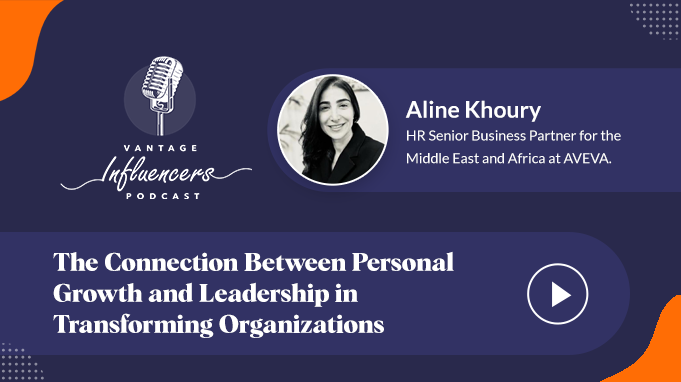
VANTAGE INFLUENCERS PODCAST
"It taught me how important it is to listen deeply to people and to ask powerful questions, which can transform relationships. That shift from managing to partnering has impacted me a lot."
— Aline Khoury, HR Senior Business Partner (MEA), Aviva
Listen to the Episode"You don't have to give me an answer right now, but I've noticed you've been a bit quieter the last couple of weeks. I'm not asking as your manager. I'm asking because I'd want to know if it were the other way around. What's going on?"
And then there's workload. Which is a mental health issue, full stop, even when it's not labeled that way.
7. Run Surveys That Drive Real Change
Somewhere along the way, "we run an engagement survey" became a complete sentence.
It isn't. The survey is just the data collection step. What matters is what happens after, and in most organizations, what happens after is a slide deck, a town hall, and then approximately nothing. The next survey goes out six months later and employees fill it in with slightly less candor than before, because the last one didn't seem to go anywhere.
Gallup research found that only 26% of employees strongly agree that the feedback they give actually improves how they work. The majority have essentially concluded that the loop doesn't close. That's not a survey problem. It's a credibility problem. And a workforce that doesn't believe its concerns get heard is not going to surface the early signals leadership most needs during disruption.
89% of companies now use recognition and rewards programs to reinforce behaviours and shape culture, not just to reward output. That's the headline from Vantage Circle's State of Recognition and Rewards 2025. When recognition is wired to behaviours like adapting under uncertainty or solving novel problems, it becomes one of the strongest signals an organisation has for what resilience actually looks like.
The fix isn't complicated but it requires discipline. Results shared at the team level, not just the organizational level, because org-wide data is too abstract to feel real to the person doing the actual job. Specific commitments made and visibly followed through on, not vague assurances. And managers who treat the debrief conversation as the real work, not a formality.
The organizations that do this well aren't doing something elaborate. They're just closing the loop. It's rarer than it should be.
Vantage Pulse gives managers the real-time visibility to have those conversations grounded in actual data, not impressions. Which turns out to matter a lot when the impressions and the data don't match.
Build resilience as a daily practice, not a one-off
Resilience compounds when feedback closes and recognition reinforces what you actually want to see more of. Vantage Circle gives HR leaders both signals on one platform, pulse data that catches the early signs, and recognition that makes the right behaviours repeat.
FAQ
Summing It Up
There's a version of all this that's easy and doesn't work.
Run a survey. Add a wellness benefit. Mention resilience in the values document. It satisfies a requirement. It doesn't build anything. And when something actually goes wrong, not a bad quarter, something genuinely destabilizing, the gap between what organizations think they've built and what they've actually built becomes visible fast.
The version that works is slower. Less comfortable. Harder to put in a board update. It's managers trained to have real conversations. Feedback that visibly changes something. Work that people can actually connect to a reason. A culture where thinking through novel problems is practiced, not improvised in a moment of crisis.
Pick one thing from this piece. Not all seven. One, done properly, with enough consistency to become real. Then the next.
That's the actual path. It's not dramatic. It compounds.

This article is written by Mrinmoy Rabha. He has worked in the human resources environment and has elevated recognition and rewards through his insightful and detailed writing. He aims to enhance the practice of Recognition in the workplace with new ideas and innovation that will help shape the work culture. For any related queries, contact editor@vantagecircle.com