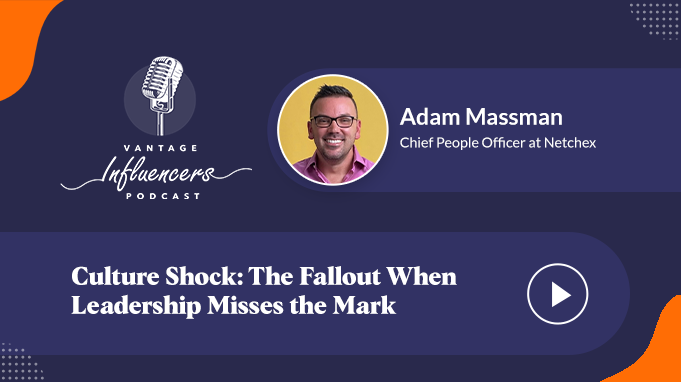
Culture Shock: The Fallout When Leadership Misses the Mark
Episode Overview
Adam Massman argues that culture is not a mission statement on the wall. It is the lived outcome of an organization's systems, beliefs, attitudes, and policies: the feeling employees carry the moment they walk through the door. Culture shock, in his framing, is what happens when something disrupts that feeling, whether it is a shift in leadership structure, a new strategy, or a change nobody saw coming. Contrary to the episode's title, he pushes back on the idea that leadership missing the mark is always the cause. Sometimes it is an intentional strategic pivot. Sometimes it is an external shock like a pandemic. Leadership is a major factor, but far from the only one.
The conversation moves through two real examples: the ongoing standoff between return to office mandates and employees who have already decided that flexibility is not up for debate, and a strategy overhaul that quietly broke a relationship driven culture by installing a process heavy operating model. Adam also makes the case for paying closer attention to what he calls the mighty middle, the managers who translate vision from the top into daily reality, and shares his method for rebuilding trust when a new leader inherits a team that has stalled. The discussion closes on vulnerability: why leaders who let themselves be seen as imperfect, rather than performing composure, tend to build stronger, more resilient teams.
Episode Highlights
- Culture is the lived outcome of an organization's systems, beliefs, and policies, not a slogan on the wall, and culture shock happens when something disrupts that lived experience.
- Leadership missing the mark is one cause of culture shock, but intentional strategy shifts and external events like a pandemic can trigger it just as often.
- Employees are increasingly driving culture change themselves, forcing leaders to rethink resistance to flexible work arrangements and other traditional expectations.
- The mighty middle, the layer of managers who translate vision from the top down to the frontline, plays an underappreciated role in whether a culture shift lands well.
- New leaders who inherit a team but skip building trust first often stall out, and simple, personal connection exercises can rebuild that trust quickly.
- Vulnerability and authenticity, not a polished and unshakeable persona, are what help leaders earn genuine buy-in from their teams.
About the Guest
Adam Massman, Chief People Officer at Netchex
Adam Massman is an industrial-organizational psychologist with a wealth of experience in organizational development and talent management. Early in his career he considered clinical psychology before choosing to focus on the business side of helping people reach their potential, a path that has taken him through roles at Kellogg's, P&G, Rockwell Collins, and JLL, working directly with C-suite leaders and HR business partners. His expertise spans crafting impactful talent management, diversity and inclusion, recruiting, and learning and development strategies designed to boost employee engagement, foster digital agility, and cultivate inclusive workplaces where employees can thrive while driving the business forward. He joined Netchex as Chief People Officer a few months before this conversation was recorded.
Host
Susmita Sarma, Vantage Influencers Podcast Host
What You Will Learn
- How to define culture as the lived outcome of an organization's systems and policies, not just a slogan.
- Why leadership missing the mark is only one of several forces that can trigger culture shock.
- How to read employee driven shifts, like resistance to return to office mandates, as a culture signal rather than a discipline problem.
- Why the mighty middle management layer deserves as much attention as the C-suite when driving culture change.
- A practical way for new leaders to build trust with an inherited team before pushing a new vision.
- Why vulnerability and authenticity build more credibility with employees than a polished, unshakeable leadership persona.
Key Topics & Timestamps
| Timestamp | Topic |
|---|---|
| 00:00 | Cold open: what happens when leadership creates culture shock |
| 00:44 | Introducing guest Adam Massman, Chief People Officer at Netchex |
| 01:22 | Adam's path to becoming Chief People Officer at Netchex |
| 03:02 | Defining culture and what "culture shock" really means |
| 05:46 | Real-life examples: return-to-office resistance and a strategy-driven regime change |
| 11:07 | How employees drive culture from the bottom up, and the "mighty middle" |
| 13:23 | A recent leadership challenge and the role of trust |
| 17:07 | Surprising discoveries about change in the HR landscape |
| 18:42 | Vulnerability and authenticity in leadership |
| 24:15 | Final advice for leaders and closing thoughts |
Full Transcript
Click to read the full episode transcript
Welcome to the Vantage HR Influencers Podcast. This podcast is sponsored by Vantage Circle, the simple and AI-powered rewards and recognition platform for employee engagement.
Culture Shock: The Fallout When Leadership Misses the Mark is about the problems that happen when leaders don't understand or support the people they're in charge of. It's almost like feeling lost in a new place, but in this case, it's because the leaders aren't guiding or taking care of their team properly. This can lead to frustration, conflict, and a lack of trust, making it hard for everyone to work together effectively.
Susmita Sarma: Hello listeners, you're tuned in to the Vantage Influencers Podcast. I'm your host, Susmita, and today we are diving into a fascinating topic: Culture Shock, the Fallout When Leadership Misses the Mark. Joining me is our guest of the show, Adam Massman, the Chief People Officer at Netchex. Welcome to the show, Adam.
Adam Massman: Thank you for having me.
Susmita Sarma: It's great to have you here. How are you?
Adam Massman: I am doing quite well. Thank you for asking.
Susmita Sarma: Adam, before we delve into our discussion today, would you like to share a bit about yourself with our audience? Maybe about your personal and professional journey that has led to your current role as Chief People Officer at Netchex?
Adam Massman: Yeah, I'd be happy to. Early in my career, I actually thought I wanted to be a clinical psychologist, someone who would help people evolve and become better versions of themselves. I quickly realized it's a very emotionally draining job, and I have a ton of appreciation for people who have chosen that career. But there was a part of me that still wanted to help people unleash their potential. I found that organizational psychology was a really interesting way to blend the personal aspect of helping people achieve their potential with the business aspect that I really enjoyed as well.
My career has spent most of its time in organizational psychology, really with the intention of helping employees and businesses find the connection between employee motivation, employee strengths, employee insights, employee psychology, and the business side of growth, helping businesses understand the human side of their organization and unlock its potential. So I got my degree in organizational psychology. Most of my career has been in talent management and learning within HR. More recently I started taking on larger roles within HR, as chief HR officer and chief people officer, and I joined Netchex about three or four months ago as their Chief People Officer.
Susmita Sarma: Brilliant. Thank you for sharing, Adam. It's inspiring to hear about your journey and the valuable insights you've gained along the way. Let's jump into the topic for today: Culture Shock, the Fallout When Leadership Misses the Mark. Can you explain to our audience what culture shock actually means in the context of organizational leadership?
Adam Massman: Yeah, absolutely, I think it's a great question. I just want to start with, what is culture? There's a lot of debate about what culture in an organization actually is. For me, when I talk about culture in organizations, I talk about it as the outcome of what happens in an organization based on its systems, beliefs, attitudes, programs, and policies. That's the outcome you feel. When you walk into an organization, you feel the culture, you feel the outcome, you feel the experience. So when we talk about culture shock, it's something that disrupts that feeling. There's some kind of shock to the value system, to the process, to the leadership structure, that creates a ripple effect downstream, so employees start saying it feels different to work here. And culture shock doesn't always have to be a negative thing. It can be positive too. It's a change in the system and in the way you feel when you experience your day to day work.
Susmita Sarma: So do you think it's always about leadership missing the mark?
Adam Massman: No, I actually don't. I mean, there are many times when leadership misses the mark and creates culture shock, but it can happen in a variety of ways. It can happen through an intentional change in strategy. You might say, we're going to bring in more tech focused talent because of a change in strategy, and that tech focused employee profile actually changes the culture of the organization. Or it could be an external force. Not to relive the 2020s, but COVID was an external phenomenon that affected organizational culture as well. So there are a lot of things that can drive culture shock, and leadership is a huge part of that, a huge factor. That's why we're going to discuss leadership's role in shaping company culture and ensuring the well-being of employees.
Susmita Sarma: So let's explore some examples or scenarios where we can see the effects of leadership, particularly leadership missing the mark, in real life situations.
Adam Massman: Yeah, absolutely. There are at least two examples I'd like to tap into from my experience. I'll go back to COVID because I think it's one everyone can relate to. There's been a lot of discussion about return to work, return to office, return to the traditional work environment. And leadership has really struggled with the ability to embrace what the culture had already started to embrace, which is, I want to work from home, I want flexibility, I've re-evaluated what's really important to me, and I'm going to demand flexibility from my employer in how I work. So what we've seen from a lot of large organizations in the leadership space is this resistance, this pullback of, no, let's go back to the way things were, let's go back to the traditional Monday through Friday office schedule. And then you see almost a revolt from employees saying that's not going to work for me, I'm going to choose a different employer, or I'm going to take a pay cut because I want a job that allows flexibility in my work.
So when it comes to this leadership shock, what's really key, and this example matters to me as a Chief People Officer, is that when these culture waves start happening in organizations, leaders have a couple of options. One, they can try to push the wave back and say, at the top of the house, we're going to try to push the wave back and stop it from going too far. But you have to do that knowing there's risk involved, because you don't know what the unintended consequence will be. Culture isn't something you can plot on a spreadsheet and have magically happen. Humans are unpredictable. We all respond to change in our own way. So when leaders just push back on a culture wave, that culture shock can, in my experience, create more chaos than the order they were hoping for. In the COVID example, my approach was, let's ride the wave with the culture shock. Let's figure out how to meet our employees in the middle. Maybe it's not, let's go completely back to everybody working from home every day, but are there ways for us to embrace some of those ways of working and still find ways to retain our top talent, get productivity from our employees, and still be an employer that drives a top performing culture? So that's one example I thought about in preparing for this conversation.
The other one is around regime change. Earlier in my career, there was an instance where we had a pretty significant shift in organizational strategy. The intention was to help disrupt some of the industry trends happening in the space I was in, and we installed a new business strategy intended to create change and hopefully win back shareholder value. What we didn't anticipate was how much embedded cultural nuance that organizational shift actually meant for employees. It was an organization that was very relationship oriented, very familial. What we were doing was installing a much more process driven approach to everything we did, in order to become more competitive in the industry. And as a result, what we found was a lot of resistance to what we'd call culture shock in that context. Reflecting on that instance, what I didn't fully appreciate is that when you think about any of these big changes at the top, whether it's strategy or leadership changes, anything that's going to create change, you have to ask what the impacts to culture are. What are the three or four steps down the road that you may not think about? It may not be the process map that changes, but how does it feel for employees every day once that process changes? Is it going to feel like the same place they worked and loved before? If the answer is no, then you need to help them along that change journey.
Susmita Sarma: And clearly, as you mentioned with the previous example about employees craving flexibility now, we often talk about the impact of leadership on employees, but this is something reversed, isn't it? It's a case where an employee's perspective and their collective actions have started significantly influencing leadership decisions and organizational culture in a very unexpected way.
Adam Massman: Yes, absolutely. I think it's an interesting phenomenon too. What I think we, as heads of HR, spend a lot of time talking about is the direction in which decision making and culture influence actually happens. I've spent a lot of my career talking, at an executive or C-suite level, about how we drive culture, what culture we want to define as an organization. But in reality, culture comes from all directions. It comes from the bottom, from our employees every day. It also comes from what I call the mighty middle, the group of people who have to take the vision from the top and translate it down to the rest of the organization. I actually find, in my experience, that this is the layer we shouldn't forget when it comes to culture change and culture shock, because they're the ones who are going to either reinforce, celebrate, and encourage the moments that matter in the culture we're trying to drive, positively or negatively, on a day to day basis, and also be the voice to the top that says, hey, the changes you're trying to create are going to land well with our people for this reason, or they're not going to land well for this reason. So when we're thinking about culture change and culture shock, that's the group we should probably be paying more attention to: what is that group in between the top and the bottom that needs to be invested in helping us drive that change?
Susmita Sarma: Absolutely, Adam. Your examples really shed light on the importance of leadership in shaping workplace culture. But Adam, in your current role as Chief People Officer, I'm sure you encounter various challenges every day. Can you share an example of a particularly tough leadership situation you've faced and how you navigated it to ensure a positive outcome?
Adam Massman: Yeah, I feel like every day is a leadership challenge.
Susmita Sarma: You're right.
Adam Massman: I think what all of these situations typically boil down to is trust, driving trust between people. I think about an example from last week, where Netchex is growing, we're growing quite quickly as an organization, which is great. So we have a lot of new managers and new leaders coming on board. We typically hire exceptionally smart, brilliant people with a lot of industry experience who we hope will come in and help us execute our strategy well. What we find, and this isn't unique to Netchex, but any organization I've been in, is that a new leader comes in and says, let's hit the ground running, let's create our strategy, let's go, let's get this done, team, let's rock and roll. And the team that was already there, whether under a pre-existing leader or a leader who had left, looks up and thinks, who is this person? Where do they get these ideas from? I don't understand the vision, I don't understand what they're trying to march toward. And they end up a little bit stalled, not moving as fast as that new team leader wants them to.
So when I get involved, I get a phone call like, hey, I'm finding that my team, I've been here a few weeks or a few months, isn't being as productive as I was hoping they'd be. My first question is always, how much trust have you built with that team? And I always get an immediate pause, and they usually say, I don't think I've done that yet. I never take that as a negative. I just say, that's the problem, let's do the work. So typically we'll do some kind of exercise that builds trust. Trust can actually be built pretty quickly if you find creative ways to have fun together and get to know the people on your team in a way that makes them feel comfortable. So we've had people find playful exercises, having fun in a room, playing a game, or using something like a two truths and a lie game, finding ways to build personal connections so a new leader gets to know their team members. That's the foundation of trust, that personal connection between two people. Once you have that, you have something familiar to move forward together and do the work. So my tried and true method has always been: once you build that trust, then bring the vision back in, bring the roadmap back in, let's get to work, let's build. That's exactly what I did a few weeks ago with a leader, and they're now back at it and driving incredible results.
Susmita Sarma: And it's not just about trust, we have to understand the whole people dynamics that work for us. Is there any surprising insight or discovery about human behavior in the workplace that you've come across in your career?
Adam Massman: At this point in my career, I've kind of stopped being surprised by human behavior, because that's what makes us human, being unpredictable. But here's what I'll say about that question: what I am surprised about is that there's no shortage of change happening in the world that we haven't yet predicted. When I think about everything I learned in grad school, the first five or ten years of my career in really large, mature organizations, where I saw all the different sides of dealing with various aspects of HR, nothing predicted the last three or four years in the HR space when it comes to disrupting the talent landscape. So what I always tell people I mentor in the HR space is: think about how the article you read in the New York Times, or see on CNN, or whatever news article you're reading, is going to impact your day as an HR professional today. Because I guarantee you, at some point in the next three to four months, it's going to show up in a way you didn't expect. But if you start thinking about it today, you'll get ahead of it.
Susmita Sarma: Yeah, and if we talk about the importance of vulnerability in leadership, Adam, can you share a time when you've seen a leader show vulnerability, or when you yourself have been in a vulnerable situation?
Adam Massman: Absolutely. I think vulnerability is so, so important. I talk about this a lot in my one on one executive coaching with leaders. I think we, as leaders, feel, especially in roles like CEO or CRO, that we have to put on these incredibly brave faces and be almost like Oscar winning actors at all times. And of course you don't want your CEO or whoever to be off the rails and creating chaos with emotions, but the amount of time and effort that goes into that, even I think about myself, when I go on stage and start giving a speech, you're aware of how you show up, how you're posturing your hands, all of that. Whereas if you could just spend that energy being authentic, listening to how your employees are communicating, and reflecting on what they're saying, that relationship changes. So being more you, all the time, I think really matters. It comes back to the topic we started with, culture. I think now more than ever, people are really watching how leaders show up every day. They're watching: does someone at the top look like me? Do they have experiences like me? Do they relate to me?
I think about an example of a female leader I was coaching a few years ago, who was talking about how she was preparing her presentation for the board. It was very stressful for her because she'd never done this before, and there were a lot of demands on her personal life at the time, and her team didn't quite understand why everything felt so chaotic while they were putting this board presentation together. She actually came into my office and was about to cry, and I said, hey, what's going on? And she said, I just need to be honest, I have a lot going on at home, my husband is really sick right now, and I'm taking care of the kids, and there were a lot of things going on in her personal life. I said, understood, take a break, take a moment, take a beat. How have you been able to process what's going on in your personal life alongside your professional life, and how have you been able to share this with your team in a way that makes sense? And she looked at me like, I can't share this with my team, I'm a leader, I have to be the calm in the room. And I said, no, you don't. You have to be the person who shows up to lead them. Leading doesn't mean you're impenetrable, it doesn't mean you're perfect, it means you're actually imperfect, but you show up in a way that helps them navigate those situations.
So she went back to her team the next day, and of course she didn't disclose everything we'd talked about, but she basically said, hey, I've been a bit chaotic lately, here's a bit of what's been going on. And the team just rallied around her and helped get the board presentation done. It created a completely different dynamic on the team. Everyone started sharing their own personal stories later, their own ways of dealing with work-life conflict. I think it's a small example that shows authenticity matters. There's always a fine line around what you share and don't share, but I'd always err on the side of finding a way to relate to your people. People connect to that, people resonate with that. And there's always that saying, people don't leave organizations, they leave people, they leave bad managers.
Susmita Sarma: Exactly. And in those ways, you can create those bonds through being authentic. It's also a way of spreading empathy among your team members, isn't it?
Adam Massman: Absolutely. Yeah, and I think empathy is something everyone has a new perspective on, coming out of COVID. We all have these lives outside of work that we don't always talk about. But there are a lot of things going on that we need to appreciate, that we need to understand. Just because someone smiles during the day doesn't mean they aren't having something hard going on. So I'd always assume positive intent, always try to attribute kindness. It's easier said than done, because work is hard and things get stressful and deadlines pile up. But it's those basic human behaviors that I think really matter most at the end of the day.
Susmita Sarma: Yeah, great insights and great examples, Adam. Our final question: what's your one piece of advice for leaders looking to improve their connection with their teams?
Adam Massman: Yeah, I think we've covered it, but it's: be you, authentically. It's amazing, I have that written down on my own personal laptop too, for myself. I remind myself of that every day when I get up to work, and I remind every leader I talk to of that as well.
Susmita Sarma: And before we wrap up today's episode, Adam, I want to extend a huge thank you to you for joining us. Your knowledge and insights have been incredibly valuable, and we are so grateful for your time, Adam. It's been a pleasure having you on the show.
Adam Massman: Absolutely. Thanks for having me.
Thanks for listening to the Vantage HR Influencers podcast. Please do subscribe to the Vantage HR Influencers podcast on Apple Podcasts, Spotify, and our YouTube channel for new episodes.
FAQ
What does "culture shock" mean in the context of leadership?
Adam Massman defines culture as the lived outcome of an organization's systems, beliefs, attitudes, and policies, the feeling employees experience day to day. Culture shock happens when something disrupts that feeling, whether it is a shift in leadership structure, a change in strategy, or an external event. It is not inherently negative; it simply signals that something in the system has changed.
Does culture shock always happen because leadership missed the mark?
No. Adam pushes back on that assumption directly. While leadership missteps can trigger culture shock, so can an intentional strategic pivot, a shift toward a different kind of talent profile, or an external shock like a pandemic. Leadership is a major factor, but far from the only one.
How can a new leader build trust with a team they just inherited?
Adam's approach is to address trust before pushing a new vision. When a new leader reports that their team is not performing, his first question is always how much trust they have built. Simple, low pressure connection exercises, like games that help people get to know each other, can build that foundation quickly before reintroducing strategy and roadmaps.
Why does vulnerability matter in leadership?
Adam argues that leaders who try to project a flawless, unshakeable image often work harder at performing composure than at genuinely connecting with their teams. Leaders who allow themselves to be seen as imperfect, and who communicate honestly about what they are navigating, tend to build deeper trust and more resilient, engaged teams.
Related Reading
Also listen on