
Most return-to-office announcements arrive with a date and a number of days. They rarely account for what those days cost the people expected to show up: a longer commute, a reshuffled school run, a desk that may or may not be free.
HR usually finds out later, through attrition numbers or a tense town hall. A survey is the cheaper way to find out. Sent early enough, it shows which parts of the policy will hold and which will quietly break, while there is still time to fix them.
Below are 40 questions you can lift as they are, the ones to leave out, and what to do once the answers come in. If you need questions for someone coming back from parental or medical leave, that is a different conversation, and it has its own section further down.
Key Takeaways
- A return-to-work survey should be sent 4–6 weeks before a policy change, kept to 10–15 questions and under 10 minutes, and run anonymously so HR cannot see who answered.
- The 40 questions cover 7 categories: work model, in-office experience, commute, workspace, collaboration, well-being, and retention.
- Several common survey questions create legal risk. Remove health status, disability, family status, and living-arrangement questions.
- A 30/60/90-day follow-up pulse tracks whether the transition is working after the policy takes effect.
Why Run a Return-to-Work Survey?
CBRE's 2026 Americas Office Occupier Sentiment Survey: From Retreat to Rebalance found that 89% of employers now require at least three days of office attendance a week, up from 78% in 2025. But setting an attendance target doesn't guarantee employees will show up. An inconvenient location (62%) and a lack of amenities (53%) remain among the factors limiting attendance.
As John Morris, CBRE's Group President of Advisory Leasing for the Americas, put it: "The market has shifted from whether the office matters to whether it delivers."
The survey tends to arrive after the announcement. It goes out to show employees were consulted, not because there was still room to change something. Employees can tell. Response rates are the first sign.
Some HR leaders are saying as much. Srilak Jayathma, Lead of Employee Relations and Compensation at Al Fahad Exchange LLC, put it this way on the Vantage Influencers Podcast:

Vantage Influencers Podcast
"All the organizations should rethink about their culture and rethink about their work policies."
Srilak Jayathma · Lead, Employee Relations and Compensation, Al Fahad Exchange LLC, UAE
Listen to the EpisodeAsking employees directly is how organizations surface practical barriers early enough to fix them: whether teams can collaborate on the same office days, whether the workspace meets their needs, whether commuting arrangements are creating avoidable strain. For survey design principles that apply to any policy change, see change management survey questions.
Also read: Impact of Hybrid Working on Employee Engagement
40 Return to Work Survey Questions by Category
Treat the 40 questions as a bank. Pick the 10 to 15 that bear directly on the change you're making. A new three-day requirement calls for the schedule, commute, workspace and collaboration questions first; retention can wait for the follow-up pulse. Skip anything that doesn't apply to a role. Asking a field engineer about desk availability tells them nobody checked who was on the list.
1. Work model and schedule preferences (7 questions)
Most employees will accept some office time. The disagreement is over how much, and on which days. Get those numbers before the policy fixes them.
Scroll to explore →
| # | Question | Answer format |
|---|---|---|
| 1 | How many days per week in the office would work best for your role? | Multiple choice: 0 / 1 / 2 / 3 / 4 / 5 |
| 2 | Which days of the week would you prefer to be in the office? | Multi-select: Mon / Tue / Wed / Thu / Fri / Other |
| 3 | Which of your tasks are more effective when done in the office versus at home? | Open text |
| 4 | How important is schedule flexibility to you under the new attendance policy? | 5-point scale: Not at all important → Extremely important |
| 5 | How clearly has the new attendance policy been communicated to you? | 5-point scale: Not at all clearly → Very clearly |
| 6 | Do you have concerns about how the policy change will affect your work? | Yes / No + open text if yes |
| 7 | What would make it easier to follow the new attendance requirements? | Open text |
2. The in-office experience (6 questions)
An employee who commutes an hour to sit on video calls with colleagues in another city will draw their own conclusions about the policy. This section asks what office days are being used for.
Scroll to explore →
| # | Question | Answer format |
|---|---|---|
| 8 | What do you value most about working from the office? | Multi-select: Team collaboration / Fewer home distractions / Separation of work and home / Access to equipment / Social connection / Other |
| 9 | What do you find most difficult about working from the office? | Multi-select: Commute time / Commute cost / Noise and interruptions / Commitments outside work you can't easily move / Reduced focus time / Other |
| 10 | What would make office days worth the commute for you? | Open text |
| 11 | How would you rate the balance of focus time versus collaboration time on a typical office day? | Far too much focus time / Slightly too much focus time / About right / Slightly too much collaboration time / Far too much collaboration time |
| 12 | How productive do you feel working from the office compared to working from home? | 5-point scale: Much less productive → Much more productive |
| 13 | What would improve your experience on office days? | Open text |
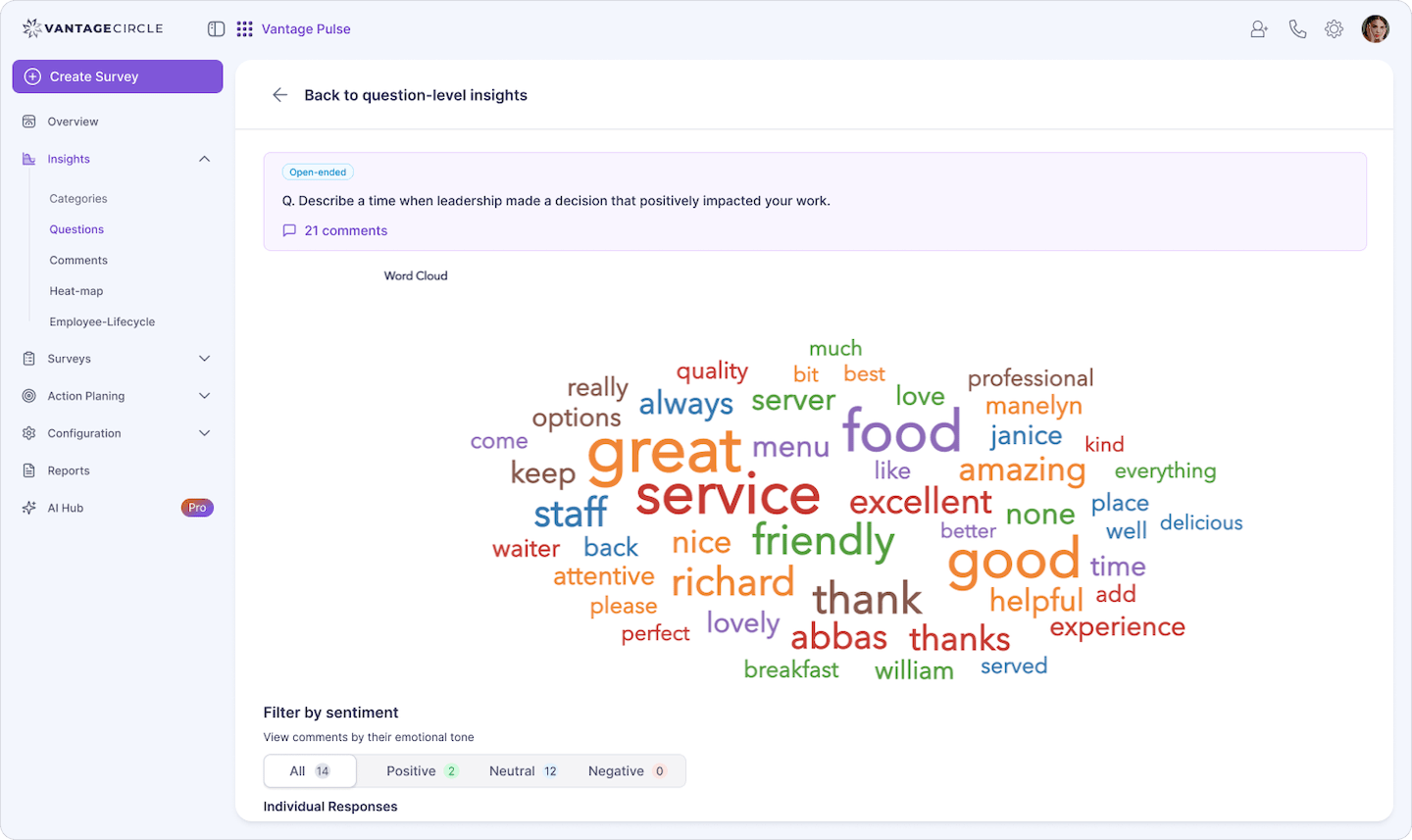
Read the open-text answers before the scores. Two teams can give the office the same low rating for opposite reasons: one can't find a quiet room, the other comes in to find nobody from their team there. Once responses run into the hundreds, the word-cloud and sentiment views in Vantage Pulse show which complaints recur, so you know which ones to read in full.
3. Commute and logistics (5 questions)
For someone with a 75-minute commute, a three-day mandate adds seven and a half hours a week before any work happens. Ask about the journey in specifics. "Commute concerns" in the abstract gives you nothing to act on.
Scroll to explore →
| # | Question | Answer format |
|---|---|---|
| 14 | How long is your one-way commute to the office? | Multiple choice: Under 15 min / 15–30 min / 30–60 min / 60–90 min / Over 90 min |
| 15 | How will the new attendance requirements change your monthly commute cost? | Multiple choice: No change / Increase by $1–$100 / Increase by $101–$300 / Increase by more than $300 / Decrease (adapt amounts to local currency) |
| 16 | Does the new schedule conflict with commitments outside work that you can't easily move? (optional) | Yes / No / Prefer not to say |
| 17 | What is your primary mode of commute? | Multiple choice: Public transport / Car / Bike or cycle / Walk / Other |
| 18 | Are there any logistics not covered above that would affect your ability to follow the new attendance schedule? | Open text (optional; avoid sharing identifying or sensitive details) |
Commute cost is the complaint HR can address fastest. Fuel, transit and meal discounts through Vantage Perks won't erase the increase, but they reach an employee's month sooner than a policy revision will.
4. Workspace and tools (5 questions)
Desk plans are usually built on average attendance, and midweek is rarely average. The constraint tends to surface midweek, when most teams prefer to be in together.
Scroll to explore →
| # | Question | Answer format |
|---|---|---|
| 19 | Is desk availability in the office adequate for your required days? | 5-point scale: Never adequate → Always adequate |
| 20 | Is quiet space (for focused work or calls) available when you need it in the office? | 5-point scale: Never → Always |
| 21 | Is your office equipment (monitor, keyboard, peripherals) equivalent to your home setup? | Yes / No / Partly |
| 22 | Do the technology tools you use work as reliably in the office as at home? | 5-point scale: Much less reliable → Much more reliable |
| 23 | What workspace or equipment change would most improve your office days? | Open text |
For a broader set of questions about how the physical environment affects employee experience, see work environment survey questions.
5. Collaboration and management support (6 questions)
Office days pay off only if the people you work with are in on the same ones, and that is largely down to managers. These questions check whether they are coordinating it or leaving teams to work it out.
Scroll to explore →
| # | Question | Answer format |
|---|---|---|
| 24 | Has your manager explained the reasons behind the new attendance requirements? | Yes / No / Somewhat |
| 25 | Are your team's office days coordinated so that you overlap with the colleagues you work with most? | Yes / No / Partly |
| 26 | How supported do you feel by your manager during this transition? | 5-point scale: Not at all supported → Very well supported |
| 27 | How effective has the communication from leadership been about the return-to-office change? | 5-point scale: Not at all effective → Very effective |
| 28 | What additional support from your manager or team would make the transition easier? | Open text |
| 29 | Is your work recognized consistently, whether you do it from the office or from home? | 5-point scale: Never → Always |
If remote days score lower on Q29, the likely cause is visibility. Managers praise what they see. Peer-to-peer recognition helps here, since colleagues see the work a manager misses.
6. Well-being and support (5 questions)
Keep this section optional. It asks how the change is landing and what support would help, and it stops short of anything about health, disability or family circumstances.
Scroll to explore →
| # | Question | Answer format |
|---|---|---|
| 30 | On a scale of 1–5, how stressed do you feel about the return-to-office change? | 5-point scale: 1 (no stress) to 5 (very stressed) |
| 31 | Do you feel the organization has taken your personal circumstances into account in planning this change? | 5-point scale: Not at all → Very much so |
| 32 | Would you find it helpful to have access to mental health or well-being resources during this transition? | Yes / No / Already using them |
| 33 | Would information about requesting a workplace accommodation or adjustment be useful to you? | Yes / No / Prefer not to say |
| 34 | What would help you feel more supported during this transition? | Open text |
If you need an individual workplace accommodation or adjustment, contact HR directly at [your HR channel]. Please don't include medical or other sensitive personal details in this survey.
7. Engagement and retention (6 questions)
Ask about intent to stay directly, in Q36. The eNPS question measures something adjacent: whether employees would recommend you as an employer. It earns its place because you can track it from one survey to the next.
Scroll to explore →
| # | Question | Answer format |
|---|---|---|
| 35 | On a scale of 0–10, how likely are you to recommend this organization as a place to work? (eNPS) | 0–10 scale |
| 36 | Has the new attendance policy affected your intent to stay at this organization? | Much less likely to stay / Slightly less likely to stay / No change / Slightly more likely to stay / Much more likely to stay |
| 37 | What would make you more likely to stay at this organization through this change? | Open text |
| 38 | How fairly do you feel employees across different roles and locations are being treated under the new policy? | 5-point scale: Very unfairly → Very fairly |
| 39 | Do you feel your overall engagement at work has changed since the return-to-office change was announced? | Multiple choice: Increased / Stayed the same / Decreased |
| 40 | Is there anything else you want leadership to know about your experience of this change? | Open text |
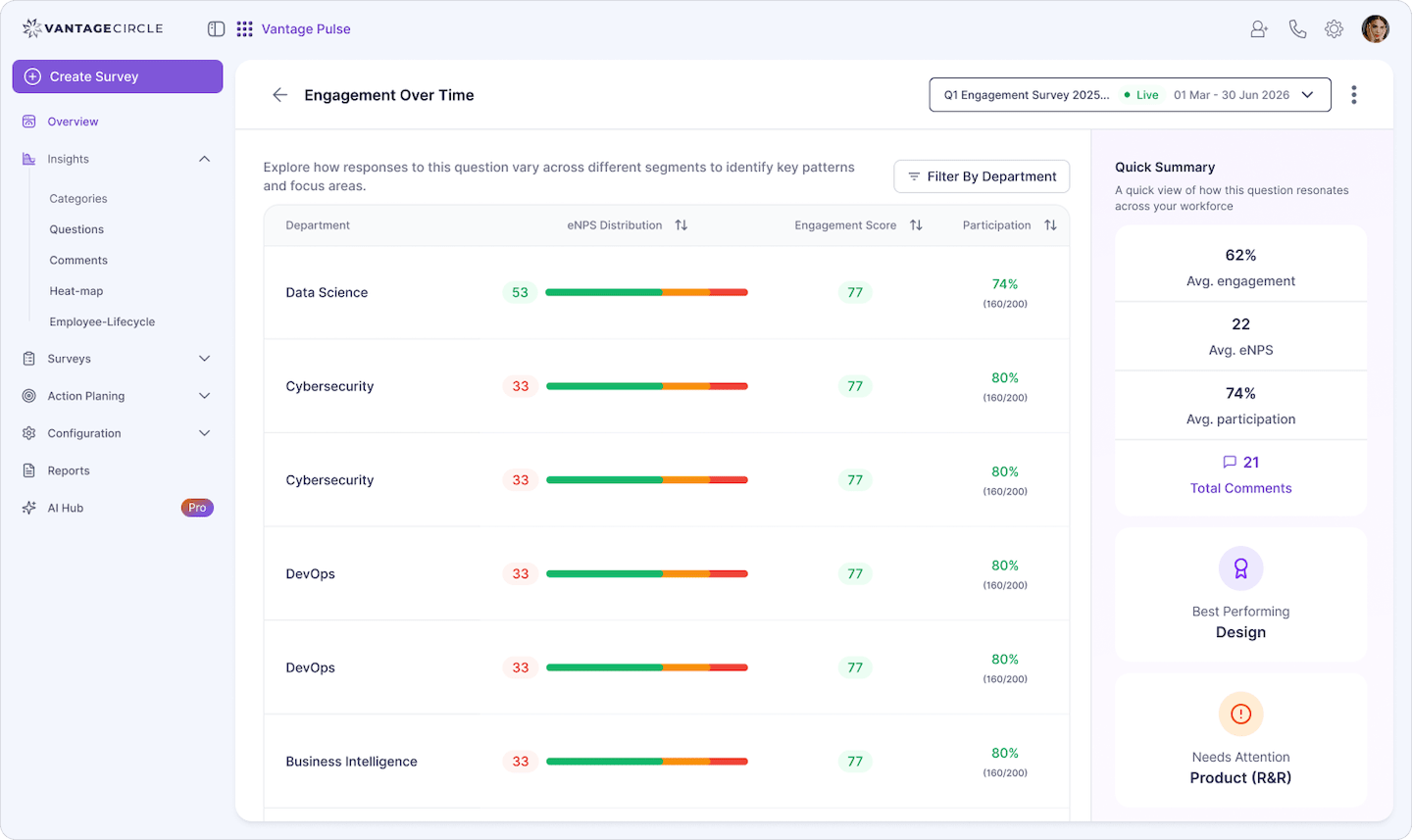
Company-wide averages hide a great deal. A 3.8 on office-day productivity can be sales at 4.5 and engineering at 2.9. Cut the results by department and location in Vantage Pulse before you decide what to fix, and for whom.
Questions to Avoid in a Return-to-Work Survey
Some questions can invite employees to disclose sensitive personal or medical information that HR doesn't need to collect through a general workplace survey. Depending on the jurisdiction and context, questions about disability, pregnancy, medical conditions and family responsibilities may also raise discrimination, privacy or employment-law concerns.
The safer approach is to ask what workplace support employees need, rather than asking them to explain the personal circumstances behind that need.
This is not legal advice. Have your legal or HR compliance team review the final survey before distributing it.
Scroll to explore →
| Question to avoid | Why it's risky | Ask instead |
|---|---|---|
| "Are you healthy enough to return to work?" | Solicits health or disability status; ADA risk in the US | Refer employees to your HR channel for accommodations. Accommodation requests should go through HR directly, not through an anonymous survey. |
| "Have you experienced any mental health challenges during remote work?" | Solicits protected health information; risk of discrimination claims | "Would you find it helpful to have access to mental health resources during this transition?" |
| "Do you have any dependents?" | Solicits family status; pregnancy and parental status protections | "Does the new schedule conflict with commitments outside work that you can't easily move?" (optional) |
| "What is your living condition?" (alone / with family / with friends) | Personal and irrelevant; marital and family status implications | Remove. Logistics questions cover the actual barriers (commute time, cost, schedule conflicts). |
| "How did you commute before the pandemic?" | Dated; irrelevant to a 2025–26 policy change | "What is your primary mode of commute?" (Q17 above) |
Return-to-Work Questions After Extended Leave
Employees returning from parental, medical or long leave need a short check-in about workload, updates missed, schedule needs and support. Office-attendance surveys are the wrong tool for this conversation.
A return-to-work meeting is a 1:1 manager check-in. The purpose is reintegration: getting the employee up to speed, flagging workload concerns early, and agreeing on support for the first 30 days. Use these six questions as a guide for that meeting:
- What do you need to get up to speed quickly (project updates, team changes, tool changes)?
- Is your current workload realistic for your first two weeks back?
- Does your schedule need any adjustment for the first 30 days?
- What support would make the most difference in your first month back?
- Are there any changes to your role or responsibilities you'd like to discuss?
- Is there anything we should know to support you during this reintegration?
How to Run a Return-to-Work Survey
These five steps are where most survey efforts succeed or fall apart.
1. Time it 4–6 weeks before the policy starts
Results that arrive the week before a mandate takes effect leave no time to act. Four to six weeks gives HR time to identify the most common barriers and brief managers before the change takes effect.
2. Keep it anonymous and under 10 minutes
Configure the survey so individual responses cannot be linked to employee identities. Tell employees upfront who can see results and how they will be reported. Keep the core survey to 10 to 15 questions. For teams of five or fewer, treat results as qualitative only: small groups can be identifiable from their answers. Use an anonymous pulse survey tool. For ready-to-use formats, see pulse survey questions.
3. Share results and decisions within 2 weeks
Publish a summary of the top findings and what HR plans to do about each. Employees who complete a survey and hear nothing back are less likely to respond to the next one.
4. Act on the top 3 issues by team
Department-wise results show which teams are most affected and where the biggest practical barriers are. Address the top 3 issues at the team level, not just company-wide. For how to act on hybrid survey results more broadly, see hybrid workforce best practices.
5. Re-pulse at 30, 60 and 90 days
One survey before the change is not enough. A short pulse at each of those milestones shows whether concerns are easing and whether the actions HR took are landing.
Scroll to explore →
| Question | Scale |
|---|---|
| How well is the new attendance schedule working for you? | 5-point: Not at all well → Very well |
| How has your stress level about the new schedule changed since you returned? | 5-point: Much higher → Much lower |
| Has your team been able to coordinate office days effectively? | 5-point: Not at all → Very effectively |
| How has your intent to stay at this organization changed since the policy took effect? | 5-point: Much less likely to stay → Much more likely to stay |
| What one thing would most improve your experience of the new schedule? | Open text |
Run your return-to-work survey anonymously. Vantage Pulse lets you send the pre-change survey, track department-wise results, and schedule the 30/60/90-day follow-up pulses in one place. See how it works.
Conclusion
The survey is the easy part. The harder part is being willing to change something because of it. If the results come back and the policy stays exactly as drafted, employees will notice, and the next survey will tell you less.
Frequently Asked Questions
What questions are asked in a return-to-work meeting?
A 1:1 manager check-in covering workload, missed updates, schedule adjustments and support needs for the first 30 days. The extended-leave section above has the full six-question guide.
What are 5 good survey questions examples?
(1) How many days per week in the office would work best for your role? (2) Does the new schedule conflict with commitments outside work that you can't easily move? (3) Has the new attendance policy affected your intent to stay? (4) How clearly has the new policy been communicated to you? (5) What would make office days worth the commute for you?
What is a good office poll question?
Keep poll questions specific and immediately actionable, with a single decision in mind. For example: "Which day of the week works best for your team to be in the office together?" or "What is the single biggest barrier to your office days right now?" Single-question polls work best when you need a fast read on one decision, not a full sentiment picture.
Should a return-to-work survey be anonymous?
Yes. Set it up so responses cannot be traced to individuals, and tell employees upfront who can access results. For teams of five or fewer, report qualitatively only.
When should you send a return-to-work survey?
4–6 weeks before the new policy takes effect. Follow up with a short pulse at 30, 60 and 90 days to track whether concerns are easing.
How many questions should a return-to-work survey have?
10–15 questions and under 10 minutes. The 40 questions here are a full bank. Pick the categories that apply to your specific change.
Where can I get free return to work survey questions?
The 40 questions in this post are free to copy. Select the categories that apply to your policy change, add your organization's logo, and distribute via any survey tool. For a broader survey question template and additional question formats, see the linked guide.
Written by