
The recognition you typed in thirty seconds last March is still pinned in someone's Slack. So is the criticism. Written feedback at work is any performance or behavior feedback delivered in a durable format: an email, a chat message, a review comment, or a recognition post. It works best when it names the specific behavior, its impact, and a next step, because the reader cannot hear your tone; the words carry everything. Below are copy-adaptable examples for every channel, and when to write at all.
Here is what this guide covers:
Key Takeaways
- When to Put Feedback in Writing (and When Not To)
- How to Write Feedback That Lands
- Feedback Email Examples
- Short-Form Written Feedback: Chat and Recognition Posts
- Written Feedback in Reviews and Formal Documents
When to Put Feedback in Writing (and When Not To)
Put feedback in writing when you need a record, when your team works across time zones, or when the wording deserves a second draft. Say it live when the issue is serious, sensitive, or being raised for the first time.
The channel decision matters more than most managers give it credit for. Written feedback is permanent by design. That permanence is an asset when you are documenting a pattern, recognizing work publicly, or reaching a colleague who works nine hours ahead of you. It becomes a liability when the topic carries emotional weight, because a sentence that reads as neutral to you can read as cold to someone bracing for bad news.
| Put It in Writing When | Say It Live When |
|---|---|
| You need a record you can reference later | The issue is serious enough to affect someone's role or standing |
| The team works remotely or asynchronously | The topic is personal or emotionally sensitive |
| Praise deserves permanence and visibility | You are raising a concern for the first time |
| The phrasing needs care and a second read | Your tone carries most of the message |
Recommended Read: 7 Impactful Ways to Deliver Meaningful Employee Feedback
A social recognition feed is written feedback operating at company scale: every post is durable, public, and readable in the recipient's own time. That is why written praise compounds in a way a hallway comment cannot; the recipient rereads it, their peers see it, and their manager finds it at review time.
Only 55% of employees feel truly recognized.
Source: The Recognition Effect — Vantage Circle × Great Place to Work India, 2025, 5.7 million employees across 2,000 organizations
The gap between the 45% who do not feel recognized and the 55% who do often comes down to how specific the written message is.
How to Write Feedback That Lands
Effective written feedback does three things in order: it names the specific behavior, states the impact of that behavior, and proposes a next step. Everything else, including tone, warmth, and length, comes after you have the structure right.
The structure exists because writing strips out every cue a conversation provides. In person, "we should talk about the report" arrives with a facial expression attached. In an email, the reader supplies the expression themselves, and anxious readers supply the worst one.
Here is the difference in practice:
Before: "Great job on the client presentation. Keep it up!"
After: "Your competitive pricing slide in the Brightline presentation answered the objection their CFO raised in discovery before he could raise it again. That preparation is what moved the deal forward. I would love to see you brief the rest of the team on how you built it."
The first version is pleasant and forgettable. The second names the behavior, the impact, and the next step, and the recipient can act on it.
The hardest part of written feedback is the blank box, and structure solves it. This is why tagging a company value works so well as a starting prompt: name the value, name the behavior that demonstrated it, and the sentence writes itself. If your team struggles to write specific feedback, give them a scaffold before you give them training. For a deeper bank of examples on the improvement side, see our guide to constructive feedback examples.
Feedback Email Examples
These five copy-adaptable feedback email examples cover the workplace scenarios managers and peers write about most: recognition, a missed deadline, a shared project, upward feedback, and the written follow-up to a live conversation. Each includes a subject line, because the subject line sets the reader's expectation before they open the message. For more templates on the recognition side, see our bank of positive feedback examples.
1. Recognizing Strong Work (Email to a Direct Report)
Subject: Your work on the Meridian launch
Hi Priya,
I want to put this in writing so it is on the record. The migration checklist you built for the Meridian launch caught the data mapping error two days before go-live, which saved us a rollback and a very uncomfortable client call. That level of anticipation is exactly what I want this team known for. I have shared the checklist with the other project leads as the template going forward.
Thank you, Rahul
2. Constructive Feedback After a Missed Deadline
Subject: Following up on the Q3 vendor report timeline
Hi Daniel,
The Q3 vendor report landed three days after the finance close, which meant the team worked from estimates in the leadership review. I know the data pull from the new system was harder than expected. Going forward, flag a slipping deadline as soon as you see it rather than at the deadline itself; an early warning gives us options a late report does not. Can we set a mid-point check-in for the Q4 report?
Best, Maria
3. Feedback to a Peer on a Shared Project
Subject: Quick thought on our onboarding revamp
Hi Tomas,
Working through the onboarding revamp with you, one thing stands out: your habit of writing decision summaries after each working session has kept both our teams aligned without a single extra meeting. One suggestion from my side: could we agree on final copy before assets go to design? We reworked two graphics last sprint because the wording changed after handoff.
Thanks, Aisha
4. Upward Feedback to Your Manager
Subject: A suggestion on sprint planning
Hi Elena,
You asked for candid input, so here it is in writing where I can be precise. Sprint planning runs long because estimation and prioritization happen in the same meeting. When you split them for the March sprint, we finished forty minutes early and the estimates held. I would like to propose making that split permanent. Happy to draft the new agenda if useful.
Regards, Marcus
5. Following Up in Writing After a Verbal Conversation
Subject: Recap of our conversation today
Hi Jordan,
Thanks for the open conversation this afternoon. Putting the key points in writing so we share the same record: we agreed the client escalation stemmed from a handoff gap, not an effort gap; you will own the new handoff checklist by Friday the 17th; and we will review how it is working in our one-on-one on the 31st. If I have captured anything differently than you remember it, reply and correct me.
Best, Sam
Short-Form Written Feedback: Chat and Recognition Posts
Chat feedback trades formality for speed, and it works because the format forces specificity: one behavior, one impact, one line. A Slack message or a recognition post has no room for throat-clearing, which makes it the easiest written feedback format to get right and the easiest to waste on a generic "nice work."
Here are seven scenario-named short-form examples:
- After a tough support escalation (Slack DM): "The way you de-escalated the Fairview call today, acknowledging the delay before they raised it, turned a cancellation risk into a renewal conversation. Textbook."
- Public recognition post (feed): "Shoutout to Lin for rebuilding the demo environment overnight before the Hexa walkthrough. Sales walked into that meeting with zero glitches because of you. #CustomerObsession"
- Peer feedback in a project channel: "Nikhil, your comment thread on the pricing doc saved us a full alignment meeting. More async decisions like that, please."
- Quick course-correct (Teams DM): "Small flag on today's standup: the update ran long and we lost the two blockers at the end. Lead with blockers tomorrow and it lands better."
- Recognition post tagging a value (feed): "Tagging this one #OwnIt: Sana noticed the invoice mismatch in the Delta account and chased it to resolution without being asked. That is what ownership looks like in practice."
- Manager to report after a presentation (Slack DM): "Your answer to the CFO's integration question was the strongest moment of the deck. Write that answer down; it belongs in our standard objection doc."
- Cross-team thank-you (channel): "Design turned around three revisions on the webinar assets in one day so marketing could hit the launch window. That sprint did not go unnoticed."
Structure is what keeps short-form feedback concrete, and it is worth building in rather than hoping for. Peer-to-peer recognition tools do exactly this: a recipient, a reason, and a value tag replace the blank message box, so a two-line post carries the same behavior-and-impact core as a full email. See how peer-to-peer recognition builds that structure in.
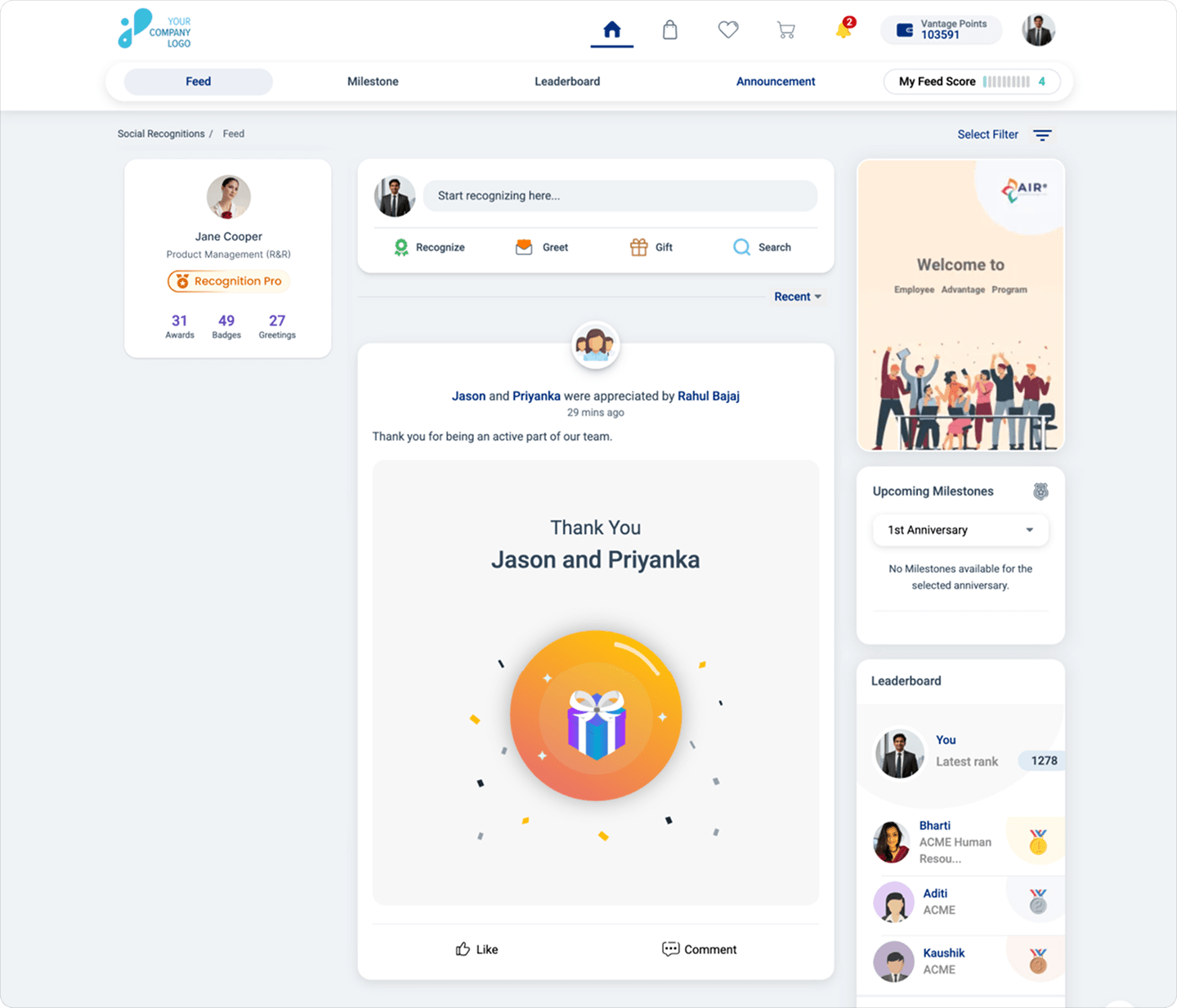
Short-form feedback works because the format is small enough to send without friction. The same specificity, applied at the other end of the scale, is what makes review comments credible.
Written Feedback in Reviews and Formal Documents
Review comments are the highest-stakes written feedback most managers produce, because they are read in a formal context and reread out of one. The same three-part structure applies, with one addition: anchor every claim to the review period, not to the last two weeks.
Three examples of written review comments:
- On collaboration: "Ana resolved the two cross-team conflicts on the platform migration by documenting each team's constraints before proposing a solution, and both teams adopted her proposal without escalation."
- On a growth area: "Dev's technical analysis is consistently strong; the growth area this cycle is packaging it. In Q3, two of his recommendations stalled because stakeholders outside engineering could not act on the write-up. A one-paragraph executive summary on each doc is the agreed next step."
- On consistency: "Across all four product releases this year, Farah's release notes shipped on time and required zero corrections, which support now cites as their most reliable internal resource."
Recommended Read: Self-Appraisal Comments by Employee: 120+ Examples for Your Next Performance Review
Written recognition is also measurable. Analytics show which feedback actually got read and reacted to, which is something a verbal comment can never give you.
Frequently Asked Questions
How to give written feedback examples?
Give written feedback at work in three steps: name the specific behavior, state its impact, and propose a next step. For example: "Your migration checklist caught the mapping error before go-live (behavior), which saved us a rollback (impact); I have shared it as the team template (next step)." Match the channel to the stakes: email for formal feedback, chat for quick reinforcement, and a live conversation for serious or first-time concerns.
How do you give feedback to a colleague in an email?
Open with the shared context, name one specific behavior, state its impact on the work, and close with a request or suggestion rather than a verdict. Peer email feedback works best when it stays narrow: one project, one behavior, one ask, as in template 3 above.
When should feedback be in writing instead of in person?
Feedback belongs in writing when you need documentation, when the team works asynchronously, or when praise deserves permanence and visibility. It belongs in person when the issue is serious, sensitive, or new. The same rule runs upward: open-text responses in an employee feedback survey are employees' written feedback to the company, and they deserve the same specificity this article asks of managers.
Conclusion
Name the behavior, state the impact, propose the next step, and put it in writing when permanence helps rather than hurts. The five email templates and seven short-form examples above are built to be copied, adapted, and sent today. If you want written recognition to become a habit across your company rather than a skill a few managers have, see how Vantage Rewards builds the structure in.
People rarely remember every conversation they have with a manager. They do remember the feedback they return to months later before a review, a promotion, or a difficult week. That's the power of writing it well.
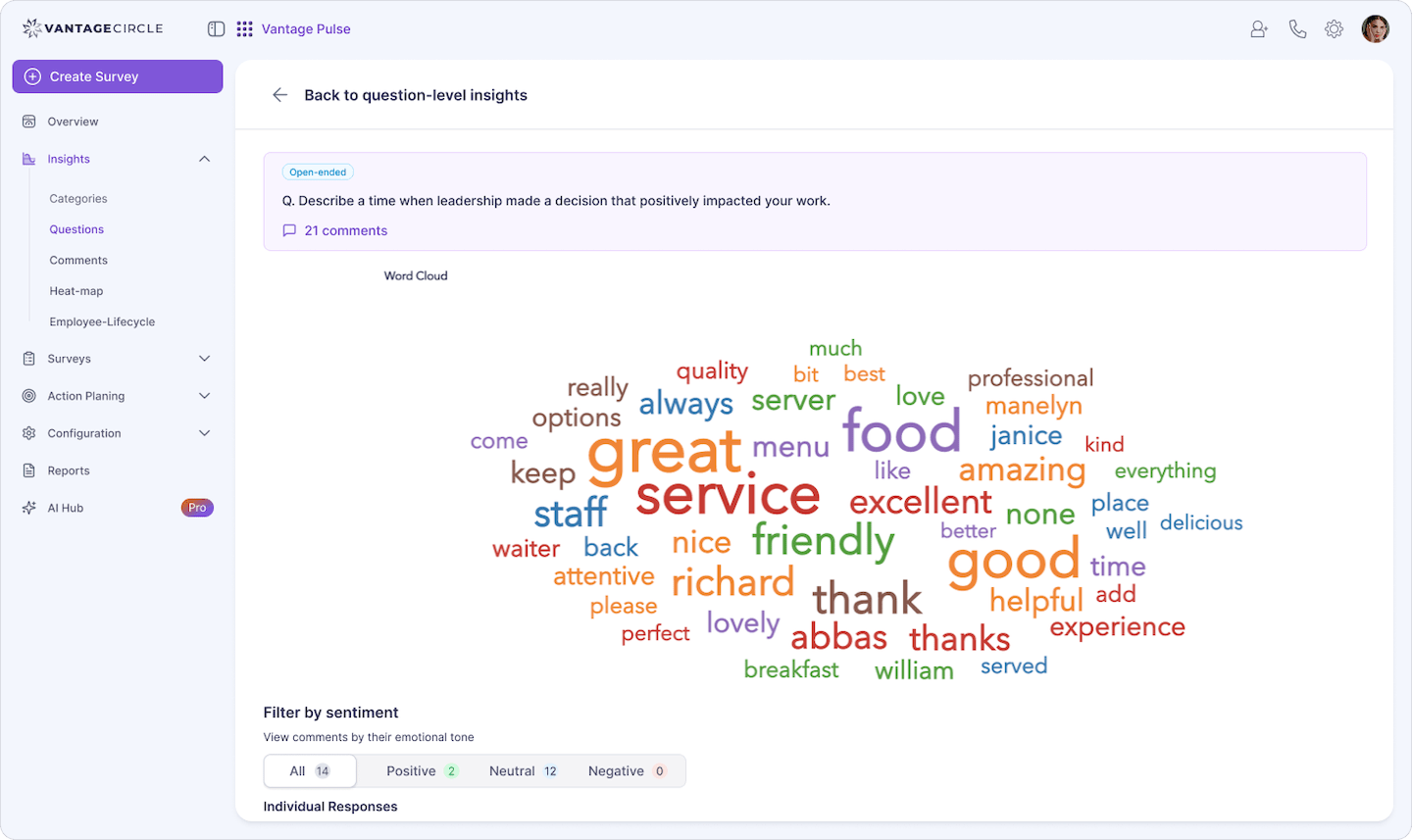
When written feedback becomes employee survey data at company scale, Vantage Pulse surfaces the patterns in aggregate, so HR leaders can see what managers are missing individually.

Supriya is a Content Marketing Lead at Vantage Circle, where she writes on employee engagement, recognition, workplace communication, and culture. She spent the earlier part of her career in corporate communications at Burson, ESPN Star Sports, and CBRE, advising organizations on the messages employees actually hear.
Connect with Supriya on LinkedIn.