
Fewer than 1 in 4 employees have ever formally rated their manager's performance (Gallup, 2024). Most feedback still flows one way, and when organizations try to fix that with a 360 degree feedback review, the questions are usually copied from a template that measures personality instead of behavior. This guide gives you 75 ready-to-use 360 feedback questions organized by competency and by rater relationship, the 5 actionable rules that separate usable questions from noise, and 10 commonly copied questions to repair or retire. Use it to assemble a 15 to 25 question survey people answer honestly.
360 feedback questions are the survey items used to collect performance feedback about one employee from multiple raters: their manager, peers, direct reports, and the employee themselves. Effective questions target one observable behavior each, use a consistent rating scale, and close with open-ended prompts for context.
What Are 360 Feedback Questions?
360 feedback questions are structured survey items that gather performance feedback about one employee from every direction they work in: their manager, their peers, their direct reports, and themselves. The name refers to that full circle of perspectives. The colleague who shares their projects, the direct report who experiences their delegation style, and the person themselves each see behavior the manager cannot.
The questions come in 2 standard formats. Rating-scale questions ask raters to score a specific behavior, usually on a 1 to 5 agreement scale, and produce comparable data across raters and cycles. Open-ended questions ask for written examples and context. A well-built questionnaire uses both. The ratings surface where the gaps are; the open-ended responses explain what is driving them. Together they turn scattered employee feedback into a development plan a person can act on.
What Makes a Good 360 Feedback Question?
A good 360 feedback question asks about one observable behavior, names the situation it occurs in, and can be answered by someone who has worked with the person. It never asks raters to judge traits, intent, or personality, because raters cannot observe any of those things. They can only observe what a person does.
That single principle expands into 5 actionable rules:
- One behavior per question. "Does this person communicate well and meet deadlines?" is 2 questions wearing one rating scale. A rater who answers "agree" for communication and "disagree" for deadlines has nowhere to put the truth.
- Observable, not inferred. Ask about what raters have seen or heard. "Is this person strategic?" demands mind-reading. "Does this person connect the team's daily work to a stated goal?" demands only memory.
- Situation-specific. Behavior changes with context. "Handles disagreement without becoming defensive" produces sharper data than "is a good colleague," because it tells the rater exactly which moments to recall.
- Scale-consistent. Keep one rating scale across the whole survey. Raters who must switch between frequency scales, agreement scales, and quality scales start answering the format instead of the question.
- Answerable by the rater group receiving it. Peers cannot evaluate budget management. Direct reports cannot evaluate peer collaboration. Route each question only to the people positioned to answer it.
The fastest test. Could two colleagues who worked with this person answer the question with evidence, not opinion? If the honest answer is no, rewrite the question before it collects a single response.
How Many Questions Should a 360 Feedback Survey Have?
Fifteen to 25 rating-scale questions, plus 3 to 5 open-ended prompts. Longer surveys do not produce more insight; they produce straight-lining, where fatigued raters click the same score down the page and the last third of your data quietly turns to noise. Count the load per rater, not only per survey: a peer asked to review 4 colleagues in one cycle is answering 100 questions, and the fourth survey gets whatever attention is left over.
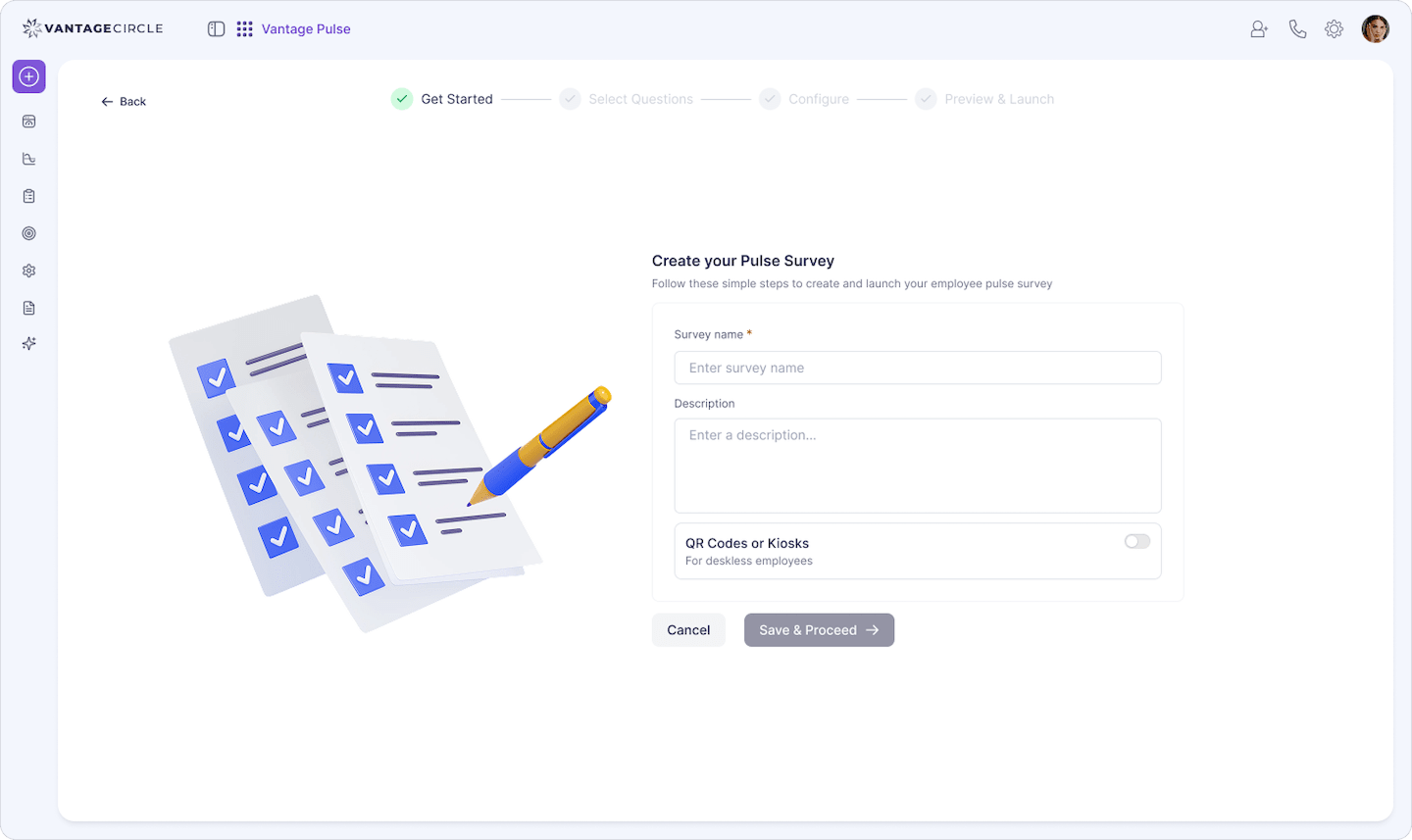
Survey length is a completion-rate decision, and it should be made on evidence. Pulse Analytics in Vantage Pulse tracks response patterns across survey cycles, so you can see where rater attention drops in your own organization and trim the questionnaire accordingly instead of guessing.
75 360 Feedback Questions by Competency
Below are 75 ready-to-use 360 feedback questions: 63 rating-scale statements organized across 7 competencies, plus 12 open-ended prompts. Do not use all 75. Pick 15 to 25 rating-scale items that match the role and the review's purpose, add 3 to 5 open-ended prompts, and stop. Rating-scale statements below are scored on a 1 to 5 Likert scale, from "strongly disagree" to "strongly agree."
Communication and Collaboration Questions
These 10 questions measure how information moves through this person, in both directions.
- Explains complex information in terms the audience can act on.
- Shares project updates before they are requested.
- Listens without interrupting when others present opposing views.
- Confirms what was agreed before a meeting ends.
- Adjusts communication style when working across teams or functions.
- Responds to messages and requests within an agreed timeframe.
- Raises problems early, while there is still time to fix them.
- Gives credit publicly when building on someone else's idea or work.
- Keeps stakeholders informed when a deliverable is at risk.
- Documents decisions so people who were absent can follow them.
Leadership and Vision Questions
These 10 questions apply to anyone who sets direction for others, whether or not they hold a formal title. They are the core of any 360 feedback questionnaire for leadership development.
- Connects the team's daily work to a clear, stated goal.
- Makes priorities explicit when the team faces competing demands.
- Explains the reasoning behind decisions, not only the decision itself.
- Delegates meaningful work rather than only routine tasks.
- Protects the team's time and focus against scope creep.
- Acts on difficult decisions instead of postponing them.
- Communicates changes in direction as soon as they are confirmed.
- Develops people through stretch assignments matched to their goals.
- Holds high performers and low performers to the same standards.
- Represents the team's interests accurately in leadership discussions.
Interpersonal Skills and Teamwork Questions
These 10 questions capture how this person treats the people they work beside.
- Treats colleagues with the same respect regardless of seniority.
- Offers help when a teammate is visibly overloaded.
- Handles disagreement without becoming defensive or dismissive.
- Follows through on commitments made to teammates.
- Includes quieter colleagues in discussions and decisions.
- Accepts constructive feedback without withdrawing or retaliating.
- Manages frustration professionally under deadline pressure.
- Builds working relationships beyond their immediate team.
- Corrects course and acknowledges it when they get something wrong.
- Recognizes teammates' wins as visibly as their own.
Problem-Solving and Decision-Making Questions
These 10 questions measure judgment: how this person moves from problem to decision to result.
- Gathers relevant input before committing to a decision.
- Distinguishes urgent problems from important ones.
- Proposes a solution when raising a problem.
- Considers downstream effects on other teams before acting.
- Changes position when presented with better evidence.
- Makes timely decisions with incomplete information when waiting has a cost.
- Breaks large, ambiguous problems into workable steps.
- Escalates issues at the right time, neither too early nor too late.
- Uses data over anecdote when both are available.
- Reviews what went wrong after a failure before assigning blame.
Motivation and Engagement Questions
These 8 questions look for discretionary effort: the work nobody would notice was missing.
- Volunteers for work outside their formal responsibilities.
- Maintains quality standards on low-visibility tasks.
- Persists on difficult problems instead of passing them on.
- Shows genuine interest in improving how the team works.
- Recognizes colleagues' contributions without being prompted.
- Approaches new tools and processes with willingness rather than resistance.
- Stays constructive when plans change at short notice.
- Invests visibly and regularly in their own skill development.
Efficiency and Time Management Questions
These 8 questions measure whether this person's output arrives when others need it.
- Meets agreed deadlines without last-minute quality tradeoffs.
- Runs meetings that start on time and end with clear next steps.
- Prioritizes high-impact work over easy wins.
- Negotiates scope or timeline honestly when their plate is full.
- Turns around reviews and approvals fast enough that others are not blocked.
- Estimates work realistically rather than optimistically.
- Simplifies or automates repeat tasks instead of redoing them manually.
- Protects focus time for deep work while staying reachable for urgent issues.
Alignment with Core Values Questions
These 7 questions test whether the company's values survive contact with real decisions. Values questions only work when raters have seen the values in action. When recognition posts are tagged to specific company values year-round on a rewards and recognition platform, raters answer from a visible record instead of straining their memory.
- Applies company values when making decisions under pressure.
- Speaks up when a proposed action conflicts with a stated value.
- Treats customer interests as a real constraint, not a slogan.
- Models the behavior described in the company's values in daily work.
- Recognizes colleagues specifically for values-aligned behavior.
- Represents the company's values consistently with external partners.
- Holds themselves to the standards they expect from others.
Open-Ended 360 Feedback Questions
These 12 open-ended prompts supply the context that rating scales cannot: examples, situations, and advice in the rater's own words. The first 3 form the classic start-stop-continue frame.
- What should this person start doing to be more effective?
- What should this person stop doing?
- What should this person continue doing?
- Describe a specific situation where this person's work made your work easier.
- Describe a situation where working with this person was difficult, and what they could have done differently.
- What is this person's single most valuable contribution to the team?
- What one skill, if developed, would most improve this person's impact?
- Share an example of this person living one of our company values.
- What does this person do well that they may not realize others notice?
- If you could give this person one piece of advice, what would it be?
- What kind of work brings out this person's best performance?
- Is there anything else you want this person to know?
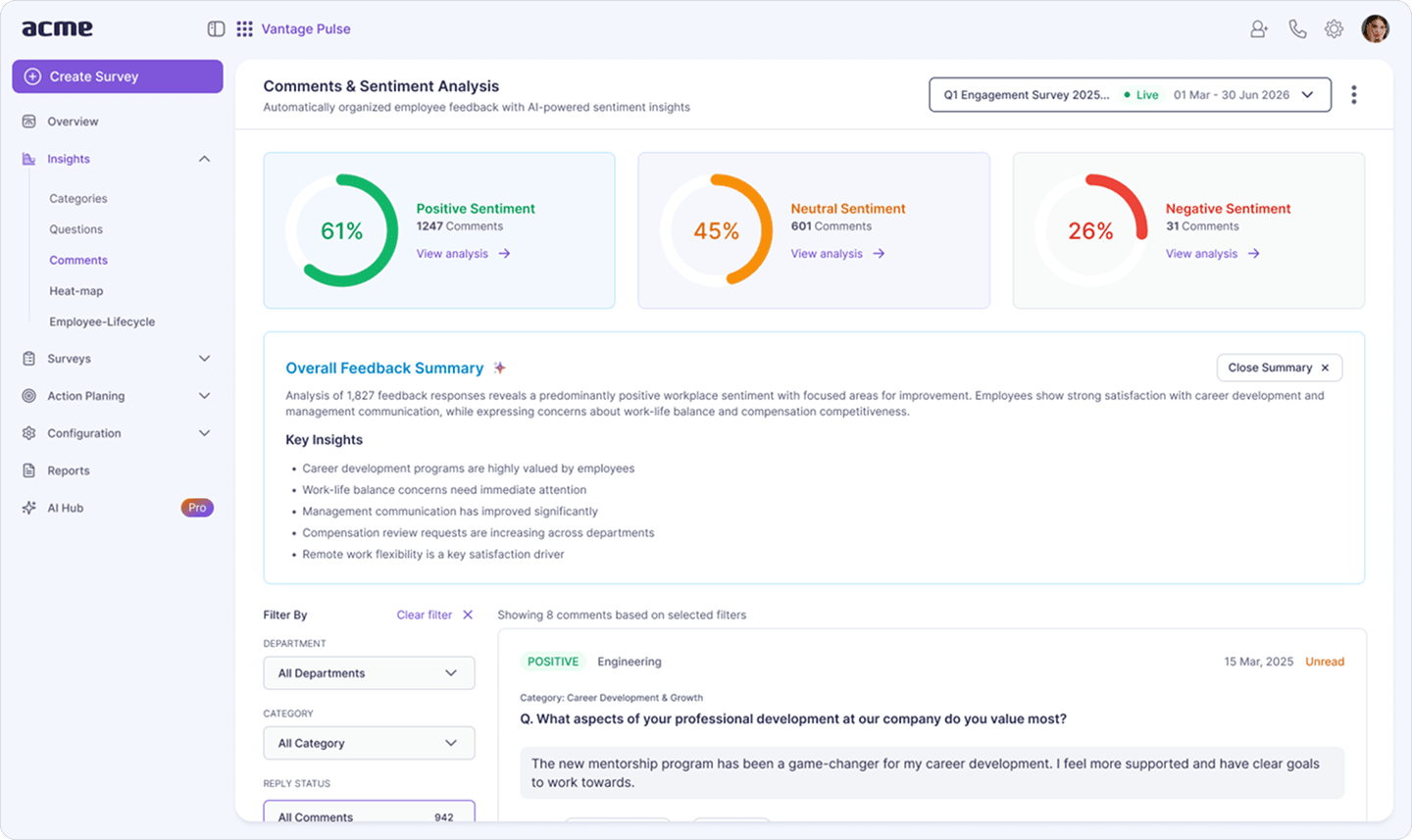
Twelve open-ended answers per employee, multiplied across a department, is unreadable by hand. Sentiment Analysis and Word Cloud Analysis in Vantage Pulse classify free-text comments as positive, neutral, or negative and surface recurring themes automatically, so a manager can act on patterns in one review pass instead of reading 300 paragraphs.
360 Feedback Questions by Rater Relationship
The same competency reads differently from above, beside, and below, so strong questionnaires vary the question by who is answering it. A peer sees collaboration. A direct report experiences delegation. A manager observes outcomes. The person themselves knows intent. The matrix below shows 5 competencies phrased for each of the 4 rater groups; pick the variant that matches the rater, not a single generic version sent to everyone.
| Competency | Self | Peers | Direct Reports | Manager |
|---|---|---|---|---|
| Communication | I explain my reasoning clearly enough that others rarely need to ask twice. | Explains complex information in terms I can act on. | Explains what is expected of me and why. | Communicates project status accurately, including bad news. |
| Leadership | I make my priorities clear when demands compete. | Sets a direction the team visibly follows. | Makes it clear how my work connects to team goals. | Takes ownership of team outcomes, good and bad. |
| Teamwork | I offer help before being asked when a teammate is overloaded. | Follows through on commitments made to me. | Treats every member of the team with equal respect. | Builds productive relationships across functions. |
| Decision-Making | I change my position when the evidence changes. | Involves the right people before deciding. | Explains the reasoning behind decisions that affect me. | Makes sound decisions with incomplete information. |
| Time Management | I meet the deadlines I commit to. | Turns around requests fast enough that I am not blocked. | Respects my time in meetings and requests. | Delivers agreed work on schedule without quality tradeoffs. |
Self-Review Questions
Self-review questions ask the employee to rate themselves on the same behaviors their raters score, which makes the gaps visible and builds self-awareness. The most useful development conversations start where self-scores and rater scores disagree by 2 points or more. Phrase self items in the first person, as in the matrix above, and pair them with reflective prompts. For written self-assessment language, see these self-appraisal comments. When a gap surprises you, the survey alone will not explain it. Asking directly for feedback on that specific behavior, rather than waiting for the next cycle, is what turns the number into something you can act on.
Questions for Peers
Peer questions should stay inside what peers actually witness: collaboration, communication, reliability, and teamwork. Peers hold the most honest view of day-to-day behavior and the least visibility into strategy or budgets, so never route them planning or resource questions. Peer feedback is also where anonymity matters most, because peers keep working side by side after the survey closes.
Upward Feedback Questions (Direct Reports on Managers)
Upward questions are the highest-value and lowest-volume feedback in most organizations, which is exactly why a 360 exists. Fewer than half of employees say they have been able to give feedback on their manager (Gallup, 2024). Focus upward items on delegation, clarity of expectations, fairness, and support, the behaviors only a direct report experiences directly.
Manager-on-Employee Questions
Manager questions should focus on outcomes, growth, and standards, the dimensions a manager is positioned to judge. Rate delivery against expectations, response to feedback, and progress since the last cycle. Because managers already assess these areas in formal reviews, align the 360 items with your existing employee performance survey questions so the 2 instruments reinforce rather than contradict each other.
10 Flawed 360 Feedback Questions and How to Fix Them
Three patterns account for most bad 360 data: double-barreled questions, trait questions, and leading questions. The 10 below are the most commonly copied, each shown with the reason it fails and a repaired version you can use instead.
| Flawed question | Why it fails | Repaired version |
|---|---|---|
| Is this person a good leader? | Trait-based and undefined; raters score likability, not leadership | Makes priorities explicit when the team faces competing demands. |
| Does this person communicate well and meet deadlines? | Double-barreled; one scale cannot hold 2 answers | Split into 2 items: one on communication, one on deadlines. |
| Don't you agree this person has improved this year? | Leading; the phrasing pre-loads the answer | How has the quality of this person's work changed over the past 12 months? |
| Is this person intelligent? | Asks raters to infer a trait they cannot observe | Breaks large, ambiguous problems into workable steps. |
| Rate this person's attitude. | "Attitude" is undefined; every rater scores a different thing | Stays constructive when plans change at short notice. |
| Would you enjoy spending time with this person outside work? | Measures affinity, not performance; invites bias | Would you choose to work with this person on a high-stakes project? |
| Does this person always deliver perfect work? | Absolute wording ("always," "perfect") forces a no from honest raters | Delivers work that requires little rework or correction. |
| How does this person compare to their teammates? | Forces ranking; produces resentment, not development data | Meets the standards expected of someone in their role. |
| Why do you think this person missed their targets? | Presumes failure and asks raters to speculate about intent | What obstacles, if any, have you seen affect this person's delivery? |
| Is this person a culture fit? | Undefined; the most bias-prone phrase in feedback | Share an example of this person demonstrating one of our company values. |
The 3 failure patterns. Double-barreled questions hide 2 behaviors under one scale. Trait questions ask raters to guess at character instead of reporting behavior. Leading questions tell the rater which answer you want. Nearly every unusable 360 response traces back to one of these 3.
How to Run a 360 Feedback Survey People Answer Honestly
Honesty is a survey-design outcome: anonymity, rater count, and cadence decide it before the first question is read. The best question bank in the world produces polite fiction if raters believe their manager can trace an answer back to them.
Start with enforced anonymity. Candor tracks directly with perceived safety, and perceived safety requires more than a promise in the invitation email. Anonymous Responses in Vantage Pulse hides rater identity at the platform level and aggregates results so no individual answer can be singled out by elimination. That protection matters most for upward feedback, where a team of 2 offers no real anonymity regardless of what the software promises.
Select raters deliberately. Aim for a mix the employee has genuinely worked with in the review period: their manager, 3 to 5 peers, and all direct reports where they exist. Hand-picked rater lists made of allies produce flattering, useless data.
Survey fatigue shows up in response patterns before it shows up in completion rates. In multi-colleague review cycles, the last peer survey in a rater's queue tends to cluster near the midpoint of the scale at a noticeably higher rate than the first, not because raters ran out of opinions, but because they ran out of attention. Keeping per-rater load to 15 to 25 items is what stops the final colleague on the list from inheriting everyone else's fatigue.
Brief raters on how to answer before the survey opens. Good answers describe behavior from the review period, name specific situations, and skip speculation about intent. Tell raters that "agree" with one sentence of context is worth more than "agree" alone, and that leaving a question blank beats guessing. Five minutes of rater instruction raises the quality of every response that follows.
Set a sustainable cadence. A 360 cycle is a deep read taken once or twice a year, not a monthly event. Between cycles, a one-question eNPS pulse tells you whether the development actions from the last 360 are landing, without adding survey fatigue. Shorter pulse surveys carry the signal between the deep reads, and a dedicated employee survey tool keeps all of it in one system instead of scattered spreadsheets.
FAQ
What questions should I ask in a 360 review?
Ask 15 to 25 rating-scale questions that each target one observable behavior, plus 3 to 5 open-ended prompts. Cover communication, teamwork, decision-making, and time management for every role, add leadership questions for anyone who directs others, and route each question only to raters positioned to answer it.
What are some 360 feedback examples?
Strong examples include "Follows through on commitments made to teammates" as a rating-scale item and "What should this person start, stop, and continue doing?" as an open-ended prompt. Both describe observable behavior, which is what separates usable 360 feedback questions from personality judgments.
What are some good feedback questions to ask?
Good feedback questions name one specific behavior and the situation it appears in. Three ready-to-use examples: "Raises problems early, while there is still time to fix them" (communication); "Handles disagreement without becoming defensive or dismissive" (teamwork); "Describes a specific situation where this person's work made your work easier" (open-ended). Each targets one observable moment a rater can recall from memory, not a character trait they have to infer.
What are 5 good survey questions?
A defensible 5-question minimum, drawn from the bank above:
- Raises problems early, while there is still time to fix them.
- Handles disagreement without becoming defensive or dismissive.
- Follows through on commitments made to teammates.
- Meets agreed deadlines without last-minute quality tradeoffs.
- What should this person start, stop, and continue doing?
The first four are rating-scale items that every rater group can answer with evidence. The fifth is the open-ended prompt that puts the scores in context.
What are some good feedback questions?
Good feedback questions avoid the 3 failure patterns: double-barreled, trait-based, and leading. "Does this person communicate well and meet deadlines?" is double-barreled; split it into two items. "Is this person a good leader?" is trait-based; rewrite it around a specific observable behavior. "Don't you agree this person has improved?" is leading; the phrasing tells raters which answer you want. Strip those three patterns and the remaining questions are almost always worth asking.
Turn the Question Bank Into a Working 360
A 360 review is only as good as its questions, and its questions are only as good as the conditions around them. Pick 15 to 25 behavioral items from the 75 above, repair anything that resembles the 10 flawed patterns, enforce real anonymity, and keep the cadence humane. When results land, debrief them with each employee and agree on 1 or 2 development actions, because a 360 that ends at the report is a survey, not a review. Then fix the biggest complaint about 360s, that feedback arrives months after the behavior, by keeping peer-to-peer recognition flowing between cycles, so the annual 360 confirms patterns instead of revealing them.
Ready to run it
Build your first honest 360 with Vantage Pulse.
Anonymous responses, sentiment analysis on open text, and pulse check-ins between cycles. Everything in one platform, without the spreadsheet debt.

Supriya is a Content Marketing Lead at Vantage Circle, where she writes on employee engagement, recognition, workplace communication, and culture. She spent the earlier part of her career in corporate communications at Burson, ESPN Star Sports, and CBRE, advising organizations on the messages employees actually hear.
Connect with Supriya on LinkedIn.