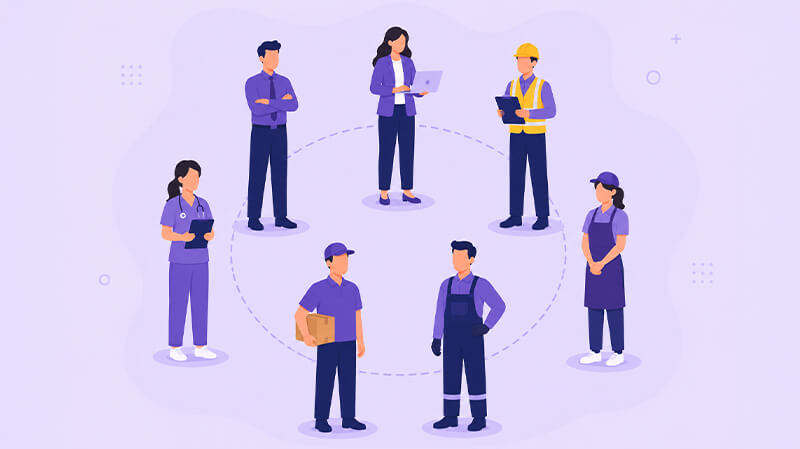
Most recognition programs are built for people who sit at a desk with a company email address, which quietly excludes the majority of the workforce, including factory floor, retail, healthcare, field service, and warehouse employees, from participating at all. Including your entire workforce means designing recognition around how deskless employees actually work, not retrofitting a corporate tool and hoping it reaches the floor.
Why Recognition Programs Leave Non-Desk Workers Out
Three design assumptions baked into most recognition platforms systematically exclude blue-collar and hourly workers before a single recognition moment is attempted.
The first is that login requires a corporate email address. A machinist on a factory floor, a nurse on a ward, an associate at a fulfillment center, or a field technician covering a multi-state service territory does not have one. These workers often operate on personal phones, have never been issued company credentials, and have no access to a corporate intranet during their shift or after it ends.
The second assumption is that recognition workflows fit a standard workday. In US manufacturing, logistics, healthcare, and retail, three-shift and rotating-schedule operations are the norm. A recognition program that runs on office hours misses the night shift every time, without anyone in the office noticing, because no one on the night shift is there to see what they missed.
The third is that employees already know how to find and use the platform. A social recognition feed behind a dashboard is not accessible to a worker who has never been prompted to log in, does not know the platform exists, and has no daily workflow that would naturally bring them there.
The result is consistent across most organizations: recognition analytics cluster around salaried, office-based employees. The floor, the warehouse, and the field team are absent, not because their managers do not value them, but because the platform was never designed to reach them.
The scale of the gap matters. Bureau of Labor Statistics (BLS) data from 2024 shows that 55.6 percent of all US wage and salary workers, more than 80 million people, are paid hourly rates. The majority of those workers, factory floor employees, warehouse associates, retail staff, and field technicians, perform their jobs without a fixed desk or company computer. A recognition program designed for the desk population is not missing a small segment. It is missing the majority.
How Deskless Workers Actually Access Recognition
A deskless worker without a corporate email, a desktop, or any prior experience on a recognition platform faces a specific, addressable barrier: there is no starting point in the standard digital flow that was designed for them. That is a mechanism problem, and it has a mechanism solution.
Phygital Recognition Cards are Vantage Circle's confirmed, named answer to this access problem. Phygital means physical plus digital: a printed card carrying a QR code and a PIN that a manager or HR team hands directly to an employee on the factory floor, in the warehouse, or at the job site. The card gives the employee a tangible starting point that requires no prior familiarity with a recognition platform.
The redemption flow works as follows:
-
1
Manager hands the card
HR or a line manager hands a physical Phygital Recognition Card directly to the employee, whether on the floor, at the job site, or in the warehouse.
-
2
Employee scans or enters PIN
The employee scans the QR code with any smartphone camera. If scanning isn't possible (no-phone policy, poor lighting), they manually enter the printed PIN instead.
-
3
Account login or first-time setup
The employee logs into their Vantage Circle account. First-time users can create one on the spot, with no corporate email or prior enrollment required.
-
4
PIN confirmed → points deposited
The employee confirms the PIN, and recognition points land immediately in their digital wallet.
-
5
Recognition goes public
A social recognition feed post is generated automatically, making the moment visible to the rest of the organization, regardless of which shift the employee works.
The card does not remove the need for a Vantage Circle account. What it removes is the requirement that the employee independently navigate to a platform they have never opened, find where recognition happens inside it, and know what to do from there.
"Meaningful recognition should know no boundaries and Vantage Circle is making it easier with its Phygital Recognition Cards that celebrate the wins of every employee."
Here is how the card addresses each barrier, specifically:
In practice: DHL
DHL runs its GSC Rewards and Recognition program across 5,000 employees in India, the Philippines, China, Colombia, and Germany. The stated challenge: engaging all employees, especially those in remote or offline roles, was difficult to manage under a standard digital recognition flow. DHL leveraged Vantage Circle's offline distribution capabilities for employees with limited digital access. Result: 74% of registered employees actively participated, 60% of active platform users received recognition, and 7,100+ recognition and reward moments were recorded in 2023-24.
Designing Recognition Around Shift Work, Not the 9-to-5
A recognition campaign timed to standard office hours misses an entire shift by design. For much of the US hourly workforce, that is not a one-time scheduling oversight; it is the permanent default state of every recognition program their employer has run.
Three-shift manufacturing is standard at automotive plants, food processing facilities, and industrial sites across the Midwest, Southeast, and Gulf Coast. Round-the-clock logistics operations run at fulfillment centers and distribution hubs in every major US metro area. Hospital systems and long-term care facilities staff rotating schedules with no consistent overlap between day teams, night teams, and the HR department trying to reach both. Large retail chains face the same problem at scale: store associates work split shifts across hundreds of locations, and a recognition program administered from a corporate office rarely reaches the sales floor in time to matter.
Campaign Management in Vantage Recognition lets HR schedule recognition moments around actual shift timings instead of defaulting to a standard workday. A campaign built for the night shift launches at the start of that shift, not at 9am when the day team has already moved on and the night crew is still asleep. Long Service Awards and milestone alerts do not silently skip the workers they were built to acknowledge because those workers happened to be off-shift when the system ran.
Peer-to-peer recognition adds a horizontal layer that does not depend on manager availability or schedule alignment at all. When shift colleagues can recognize each other directly, the recognition moment does not require a desk-bound manager to initiate it. A floor supervisor on days cannot recognize a warehouse associate on nights in real time. A fellow night-shift associate can, and does.
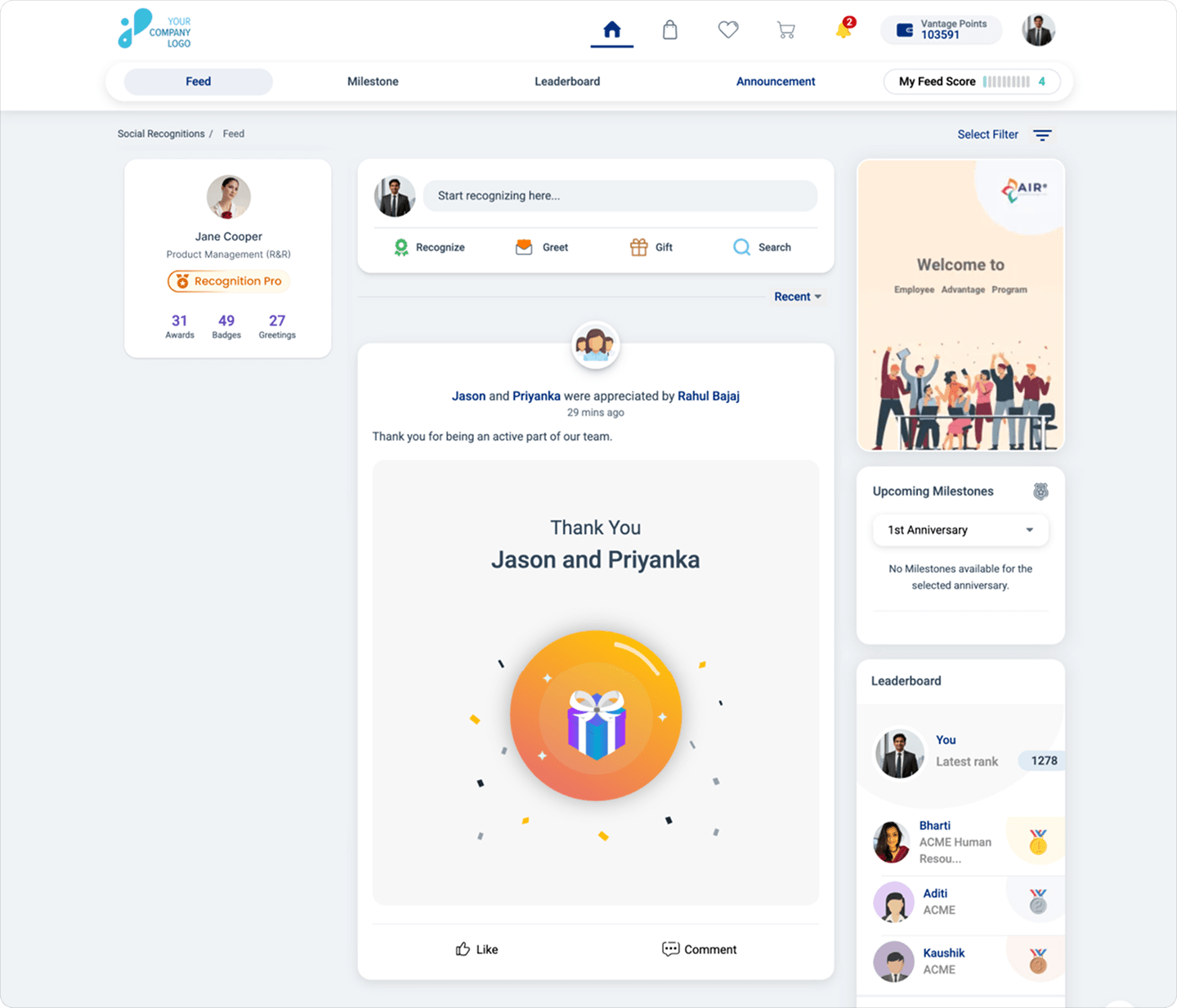
(Source: Vantage Recognition — social recognition feed after a Phygital Recognition Card is redeemed)
The US Frontline Reality: Hourly, Multi-Site, and Always Understaffed
Three US labor market conditions make the recognition gap significantly more expensive than most HR budgets account for.
Voluntary turnover in hourly roles is structurally high. BLS JOLTS data consistently shows that retail trade, transportation and warehousing, and food services record some of the highest voluntary quit rates of any sector in the US economy. Gallup estimates that replacing a frontline worker costs 40 percent of that worker's annual salary when recruiting, onboarding, and lost productivity are factored in. Gallup research found that employees who receive high-quality recognition are 45 percent less likely to leave their organization within two years. That retention advantage only applies if recognition actually reaches the employees most at risk of leaving, and in most US programs, it does not reach the floor at all.
Seasonal and contract labor compounds the access problem. US retail, e-commerce, food production, and hospitality scale significantly during peak periods, often with workers who have been on the payroll for days, not months. A recognition platform requiring HR-system enrollment and account prerequisites cannot keep pace with that kind of workforce movement. A Phygital Recognition Card can reach a first-week seasonal associate through a single conversation between that worker and their manager, with no system prerequisites.
The frustration is well-documented in frontline practitioner communities: token gestures that feel disconnected from actual work, campaigns that visibly run for the office and never reach the floor, recognition moments timed to a schedule the hourly workforce does not work.
A Practical Framework: Recognition That Reaches Everyone
One recognition program, designed around the right access mechanisms, reaches every workforce segment without requiring separate programs for separate groups. As John Land of Vantage Circle wrote in Authority Magazine, recognition can flow in any direction: peer-to-peer, manager-to-employee, or across teams entirely. That directional flexibility matters most when your workforce spans multiple shifts, locations, and employment types.
| Workforce Segment | Typical Barrier | Design Fix |
|---|---|---|
| Factory and manufacturing workers | No corporate email, rotating shifts, shared or personal devices | Phygital Recognition Cards; campaign scheduling by shift |
| Field sales and service teams | Irregular hours, no guaranteed company device, remote locations | Mobile-first access; peer-to-peer recognition between field colleagues |
| Contract and seasonal workers | Not enrolled in HR systems, short engagement window | Account created at card redemption; not dependent on HR system login |
| Retail and warehouse staff | Dispersed locations, high turnover, limited digital onboarding | Physical card entry point; social feed visibility across all sites |
Core Values Alignment keeps recognition consistent across all of these segments. A safety behavior acknowledged on the production floor and a customer-service win at the checkout counter can both map to the same company value. One values framework works the same way whether the recipient is at a desk or on the factory floor.
In manufacturing, this breadth shows in the outcomes. A leading HVAC manufacturer running recognition across 7 plants and more than 3,000 employees saw a 35% increase in active platform users, a 50% rise in unique award givers, a 41% increase in unique award recipients, and 2x the number of Long Service Awards after implementing values-based recognition built to reach workers across shifts and locations.
Long Service Awards are particularly relevant in hourly roles, where tenure is harder to achieve and costlier to lose than in office roles. Automated milestone recognition ensures a five-year anniversary on the warehouse floor receives the same acknowledgment as one in the corporate office, and triggers on time without requiring HR to manually track individual dates across a dispersed workforce.
Recognition analytics close the feedback loop. When a platform shows that recognition activity clusters entirely around salaried, office-based employees and barely registers on the floor or in the field, it is surfacing a program failure that would otherwise stay invisible inside aggregate metrics. Tracking recognition reach by location, shift classification, and workforce type is how an HR team confirms that the program is working as designed, and identifies precisely where it is not.
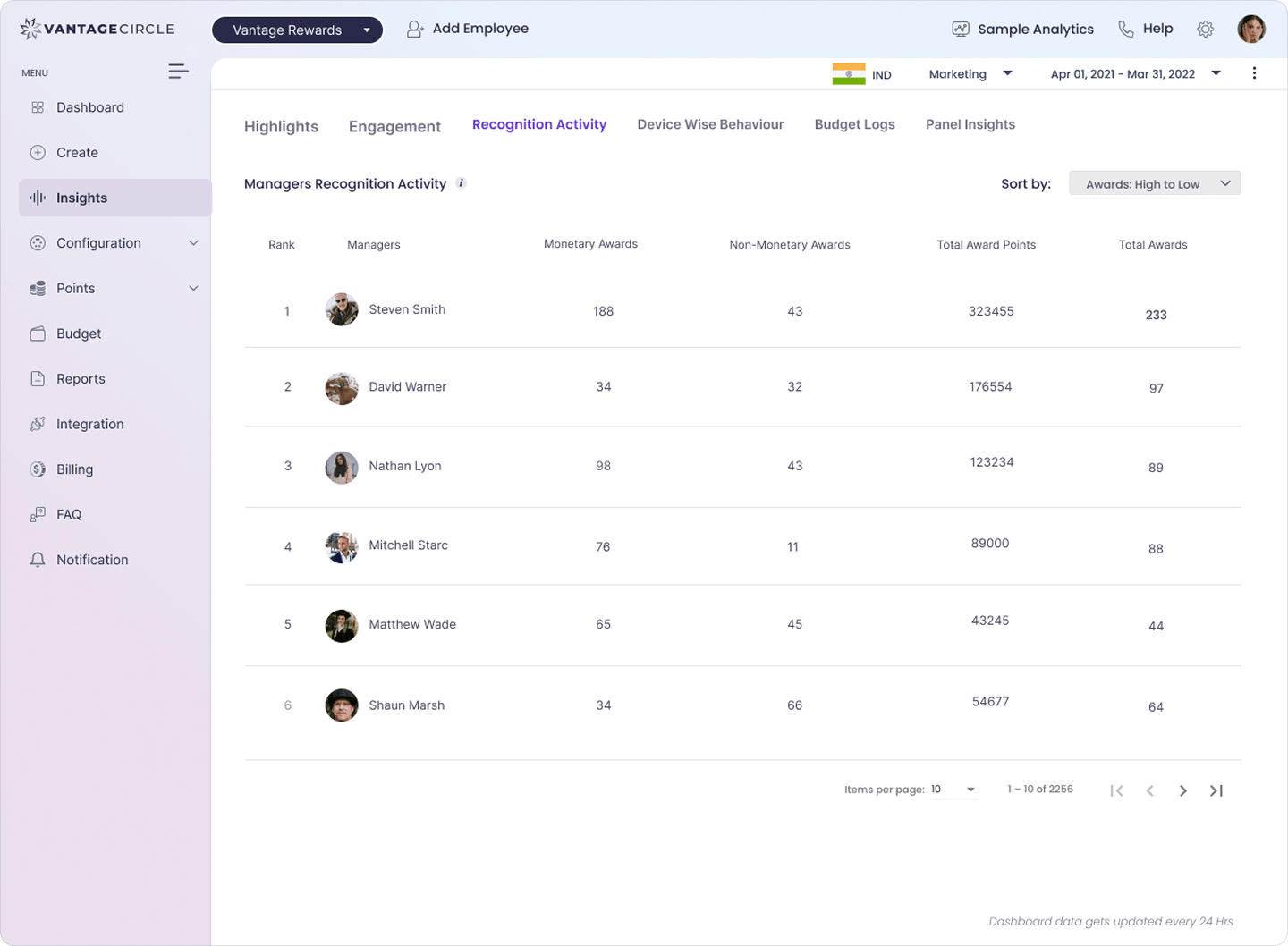
(Source: Vantage Recognition — recognition activity dashboard showing recognition volume, participation rate, and trends across the organization)
Frequently Asked Questions
1. What are good employee recognition ideas for frontline and deskless workers?
The delivery mechanism has to match the work environment. A physical card handed directly to a factory associate, a peer shoutout visible to the whole shift team, or an automatically triggered milestone award. These work because they reach the employee where they are, not where a platform assumes them to be.
2. What motivates frontline employees specifically?
Timely, specific recognition tied to a behavior they just performed. Cash-value rewards through employee discount programs also carry disproportionate weight in hourly roles where compensation flexibility matters day-to-day.
3. Do frontline and deskless workers need a smartphone to use Vantage Recognition?
For Phygital Recognition Cards, a smartphone is needed to scan the QR code, with manual PIN entry always available as a fallback. A Vantage Circle account is required at redemption, but it can be created on the spot with no prior HR system enrollment needed.
4. How is recognizing a frontline worker different from recognizing an office employee?
The recognition itself is the same: timely acknowledgment of a specific behavior. The delivery has to be different. A frontline worker without a corporate email or a desktop needs a physical starting point: a card, a QR code or PIN, and a social feed that makes the moment visible regardless of which shift they work.
Key Takeaway
When a recognition program only reaches desk employees, it is not reaching your workforce. In the US, where hourly and deskless workers span manufacturing, logistics, retail, healthcare, and field services, the gap between a program's stated intent and its actual reach is both wider and more expensive than it appears from a conference room. Closing it starts with the access mechanism: Phygital Recognition Cards for the factory floor and warehouse, shift-timed Campaign Management for teams that do not work 9-to-5, and peer recognition for the field workforce that never comes into the office. When the mechanism works for everyone, the recognition program actually does too.

Susmita Sarma is a Digital Marketer at Vantage Circle, making employee recognition less of a checkbox and more meaningful - helping organizations say we value our people and truly mean it.
Connect with Susmita on LinkedIn.