
Most companies collect plenty of employee feedback. Far fewer do anything visible with it, and that gap is where feedback programs quietly die.
Employee feedback is the exchange of information about performance, behavior, and experience between employees, managers, and the organization, moving in both directions. That last part matters more than the textbook phrasing suggests. When it works, feedback runs as a loop that gets collected, acted on, and measured again. When it doesn't, you get an annual form nobody trusts.
I've spent years watching HR teams nail the collection part and lose the plot right after. So this guide goes past definitions into the six distinct types, what makes feedback actually land, and the part almost everyone skips: closing the loop so people keep telling you the truth.
What Is Employee Feedback?
Employee feedback is any information shared about work, behavior, or experience that helps a person or an organization improve. Read that again and sit with the phrase "or an organization," because it carries more weight than it looks. Ask most managers what feedback means and they'll describe the downward kind, the stuff they hand to direct reports. That's one-third of the picture, and honestly the least interesting third.
Start with direction. Feedback travels three ways, and I've rarely seen an organization run more than one of them well:
From manager to employee. Performance conversations, coaching, praise, course corrections. The direction everyone already recognizes.
From employee to leadership. What is working, what is broken, what people will only say if they trust the channel. The direction most programs quietly fail at.
Between peers. Colleagues telling each other what helped and what got in the way. Underused almost everywhere, despite being the feedback people trust most.
An organization that only runs one of these three directions doesn't have a feedback culture. It has a reporting line.
Anyone building a program needs two more distinctions in their pocket. Formal versus informal, first. Reviews, surveys, and 360 processes sit on the formal side. The hallway conversation, the Slack thread, the two minutes after a meeting ends? Informal, and that channel carries more useful signal than most leaders want to admit. The second split is solicited versus unsolicited. Either you asked, or someone saw something and decided you should know. Healthy organizations run all four combinations. Struggling ones rely almost entirely on formal, solicited feedback, which is the slowest and most filtered kind, and then wonder why every problem reaches them six months late.
Why Employee Feedback Matters
Feedback is the cheapest performance lever most organizations own, and the most poorly operated. Not because leaders doubt its value. Because they confuse collecting it with acting on it.
The engagement math is hard to argue with. Employees who strongly agree they receive valuable feedback are five times as likely to be engaged, per Gallup and Workhuman's 2023 research. Same study: 57% less burnout, 48% less likely to be scanning job boards. Gallup's broader research settles a few ongoing arguments with a single number, too. 80% of employees who got meaningful feedback in the past week report being fully engaged. Remote, hybrid, on site, take your pick; the effect holds everywhere. Feedback quality predicts engagement better than office attendance does. So before mandating three days a week in the name of connection, check whether your managers had one useful conversation last week.
The same Gallup and Workhuman research carries a finding I find more interesting: only 27% of employees actually want feedback from their manager weekly. That looks like a contradiction until you read it properly. People aren't tired of feedback. They are tired of bad feedback, the going-through-the-motions kind that costs them a meeting and teaches them nothing.
I'd push back slightly on treating this as purely an engagement story, though. The sharper business case is informational. Your frontline employees know where the process breaks, which customers are about to churn, and which manager is quietly burning out a team. Without a working feedback channel, that knowledge stays on the floor. The engagement lift is real, but it is the byproduct. The signal is the product.
And the downside scenario now has a price tag attached. Gallup's latest State of the Global Workplace report found engagement fell to 20% in 2025, its lowest level since 2020, at an estimated cost of $10 trillion in lost productivity, roughly 9% of global GDP (Gallup, 2026).
Global engagement fell to 20% in 2025 — an estimated $10 trillion in lost productivity, roughly 9% of global GDP.
Gallup, 2026No single feedback program fixes a macro number like that. But the mechanism runs through every organization the same way: people who are never asked, never heard, and never see anything change do the minimum, and the minimum compounds. Disengagement is rarely a mood. It's a conclusion employees reach from evidence, and an ignored survey is evidence.
The follow-through problem is where this becomes an operating question rather than a philosophy question. Most organizations do not have a feedback problem, they have a follow-through problem. A recurring pulse built on eNPS surveys gives HR a baseline number, and a baseline is what makes "we acted on your feedback" provable instead of asserted. No number, no proof.
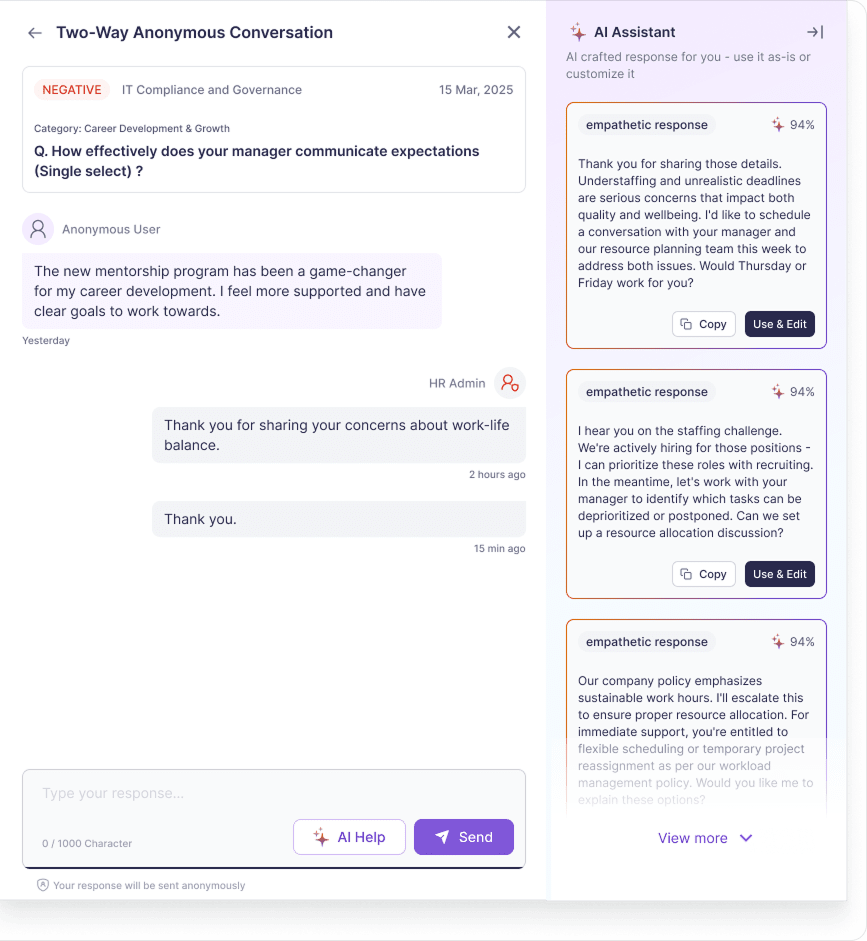
(Source: Vantage Pulse)
The 6 Types of Employee Feedback
There are six distinct types of employee feedback: positive, constructive, upward, peer-to-peer, 360-degree, and self-evaluation. Each one serves a different job, and programs stall when organizations lean on one or two types and call it a culture.
| Type | Direction | Best For | Go Deeper |
|---|---|---|---|
| Positive (reinforcing) | Any direction | Locking in behaviors you want repeated; building trust equity for harder conversations later | Positive feedback examples |
| Constructive (redirecting) | Usually manager to employee | Correcting course on a specific behavior without damaging the relationship | Constructive feedback examples |
| Upward | Employee to leadership | Surfacing process failures, management blind spots, and honest sentiment | Employee survey guide |
| Peer-to-peer | Colleague to colleague | Day-to-day quality signals from the people closest to the work | Coming: peer feedback hub |
| 360-degree | Multi-source | A full-circle view of a person's impact, typically for development, not appraisal | 360 degree feedback |
| Self-evaluation | Employee about themselves | Calibrating self-perception against manager and peer perception before reviews | Coming: self-evaluation hub |
Worth pausing on the first two, because people mix them up constantly. Positive feedback, done right: "The way you restructured the client deck saved that renewal call. Do that framing again." Not "great job." The specific version teaches something; there are more worked versions in our library of positive feedback examples. Now the constructive kind: "The report was late twice this month, and it delayed the finance close both times. What is getting in the way?" Specific behavior, real consequence, and a question at the end instead of a verdict. That closing question does most of the work.
One thing worth flagging about upward feedback, because it's the type most organizations fail at: employees don't critique leadership on the record. They critique leadership anonymously or not at all. Anonymity here isn't a nice-to-have. With anonymous survey responses, it's the difference between honest data and polite data.
No organization builds all six at once, so sequence matters. My rule: start where trust costs the least. Positive and peer-to-peer feedback carry almost no interpersonal risk, which makes them the cheapest way to normalize commenting on each other's work. Structured upward feedback comes next, once people have some evidence that speaking up is safe. And 360s go last. Every time. They're the most powerful type here and the easiest to botch, and I've watched a 360 rollout in a low-trust team curdle into score-settling dressed up as development. That took years to walk back.
How to Give Employee Feedback That Lands
Feedback lands when it is specific, timely, behavioral, two-way, and balanced. Five principles. Miss any one of them and the same message that was meant to help starts to read as an attack, or worse, as noise.
Specific beats general, every time. "Great job" teaches nothing. "Your objection-handling on the pricing question kept that deal alive" teaches exactly what to repeat. Vague praise is decorative. Specific praise is instructional.
Timely beats scheduled. Feedback loses value in transit. Gallup found employees who receive daily feedback from their manager are 3.6 times more likely to be motivated to do outstanding work than those who receive it annually (Gallup, 2024). Daily is unrealistic for most managers. Waiting for the quarterly review is worse.

VANTAGE INFLUENCERS PODCAST
"My performance reviews are the fastest because I share regular feedback with people throughout the year — nobody's surprised. Waiting until year-end to give feedback doesn't work for me."
— Ritika Bhandari, HR Leader
Listen to the EpisodeBehavioral beats personal. Describe what the person did and what it caused, not what you have decided they are. "You interrupted the client three times" is workable. "You're dismissive" is a fight.
Two-way beats broadcast. The most useful feedback conversations end with a question, because the manager rarely has the full context. "What was going on?" surfaces the constraint you didn't know about.
Balanced beats relentless. People who only ever hear corrections stop listening. People who only ever hear praise stop growing.
There is a sixth skill hiding under these five, and almost nobody trains it: receiving. How a person reacts to feedback determines whether they ever get honest feedback again. React defensively once, and colleagues quietly reroute around you. They don't stop having opinions about your work. They stop sharing them, which is worse, because now the information exists and you are the only one without it.
Receiving well is a learnable sequence, and a short one. The pause comes first. Your gut reaction to criticism is almost never the response you want on record, so buy yourself three seconds. A clarifying question helps next, mostly because it signals processing rather than rebuttal-drafting. Then thank them, agree or not. The thank-you isn't payment for this piece of feedback; it buys the next one. And the step everyone skips comes days later: circling back to say what you actually did with it. Skip that and you had a feedback exchange. Do it and you've built a standing channel.
Teams where receiving is trained get more feedback, earlier, at lower stakes. Teams where it is not get their feedback through exit interviews.
Getting the redirecting version of this right is its own craft, and the phrasing matters more than most managers think. Our constructive feedback examples hub breaks down the wording for the hardest scenarios line by line.
This section is the summary version deliberately. We are publishing dedicated deep-dive guides in this cluster on giving constructive feedback, giving positive feedback, and performance review phrasing, each of which goes further than a pillar page should.
How to Collect and Act on Employee Feedback: Closing the Loop
Employee feedback fails at the acting stage, not the collecting stage. Almost every organization above fifty people runs some kind of survey. Far fewer can name one visible thing that changed because of the last one. Gartner's research puts a number on the damage: only one-third of employees believe their organization will act on their feedback (Gartner, 2023).
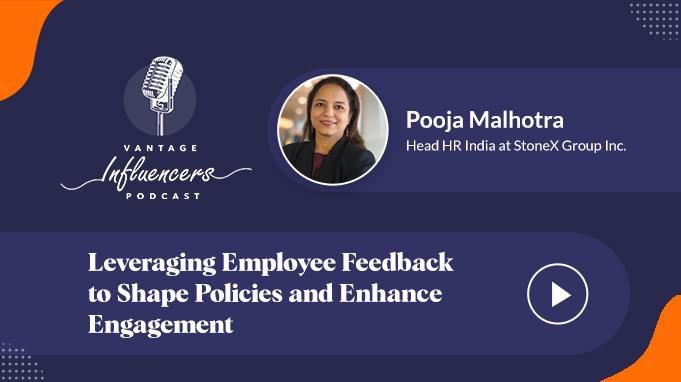
VANTAGE INFLUENCERS PODCAST
"If you take feedback from people but don't do anything about it, there'll be a point when people stop giving feedback. There has to be an action — you have to close the feedback loop."
— Pooja Malhotra, Head HR India at StoneX Group Inc.
Listen to the EpisodeSit with that.
Two out of three people filling in your survey already believe it is theater.
I watched this play out at a mid-sized services firm a few years back. The HR head ran a thorough annual survey three years running. Year one, 78% participation. Year three, 41%, and the open-text answers had turned into one-word entries. Nothing about the survey had changed. What changed was that employees had run the experiment twice and concluded that answering honestly bought them nothing. Participation wasn't declining. Trust was, and participation was just the gauge.
The fix is to treat feedback as a four-stage loop rather than an annual event:
| Loop Stage | What It Requires |
|---|---|
| Collect | A recurring, low-friction channel employees trust, anonymous where honesty demands it, built on well-designed employee feedback survey questions rather than a 90-question annual monolith |
| Analyze | A way to turn open-text volume into themes. Sentiment analysis does in minutes what no HR team does by hand: surface the recurring signals without anyone reading four hundred comments individually |
| Act | Visible changes, communicated with attribution: "You told us X, so we changed Y." Also communicating what you will not change, and why. Silence on rejected feedback reads the same as ignoring it |
| Re-measure | The next pulse, checking whether the action moved the number. The loop only counts as closed when the measurement moves |
The re-measure stage is the one organizations skip, and it is the one employees are quietly scoring you on. Qualtrics analyzed over 27 million employee survey responses and found the single item that most separated high-performing organizations from the rest was agreement with one statement (Qualtrics, 2026):
"I believe that positive change will happen as a result of this survey."
The single item that most separates high-performing organizations — Qualtrics, 2026Not compensation. Not leadership quality. Belief that the loop closes.
A few operating notes on making the loop real, learned mostly from watching it done badly.
On the collect stage, cadence beats coverage. A 10-question pulse every quarter produces better data than a 90-question annual census, for a plain reason: employees answer short surveys honestly and long ones strategically, and a quarterly rhythm means the data is never more than twelve weeks stale. The annual survey still has a place as a deep benchmark. It can't be the only channel.
In practice, a working listening calendar for a mid-sized organization looks something like this. A short pulse each quarter tracking the same core index questions, so trends are comparable. One annual deep survey for the full diagnostic. Lightweight always-on channels between them, whether that is a standing suggestion inbox or a two-question check after major changes. And a rule that no survey ships unless the results of the previous one have already been communicated. That last rule sounds bureaucratic. It's actually the single strongest protection against survey fatigue, because fatigue rarely comes from survey frequency. It comes from answer futility.
Watch your response rate as a metric in its own right, and watch the trend rather than the number. Participation drifting down quarter over quarter isn't a reminder-email problem. That trend is your workforce giving you feedback about your feedback program, in the only language left to people who have stopped believing in the form.
Speed expectations also need splitting. Some feedback is hygiene: the broken process, the meeting nobody needs, the access request stuck for three weeks. Act on hygiene fast, visibly, within days where possible, because these wins are cheap and they buy credibility. Structural feedback about workload, management quality, or compensation deserves the opposite treatment: a slower, honest response that says what will change, what won't, and why. Treating structural feedback with hygiene-speed theater, or hygiene feedback with structural-speed committees, breaks trust from opposite directions.
On the act stage, attribution is the whole game. "You said, we did" only builds trust when the "you said" part is quoted back specifically. "Based on your feedback, we improved communication" convinces no one. "41% of you flagged that project handoffs lose context, so every project now ships with a one-page transition brief" convinces everyone, including the people who disagreed with the change. Precision is what proves you actually read the responses.
And the loop needs a named owner per action item. When survey results are everyone's responsibility, they're no one's. The organizations I have seen close loops consistently assign each theme to one accountable leader with a date, and they publish that assignment. Uncomfortable for the leaders involved. Extremely effective.
Tooling earns its keep right here. Pulse analytics shows whether the action taken after the last survey actually changed anything, which is precisely what keeps employees answering the next one. If you're evaluating employee feedback tools, judge them on how well they support the act and re-measure stages, not on how many question templates they ship. Collection is the commodity. Closure is the differentiator.
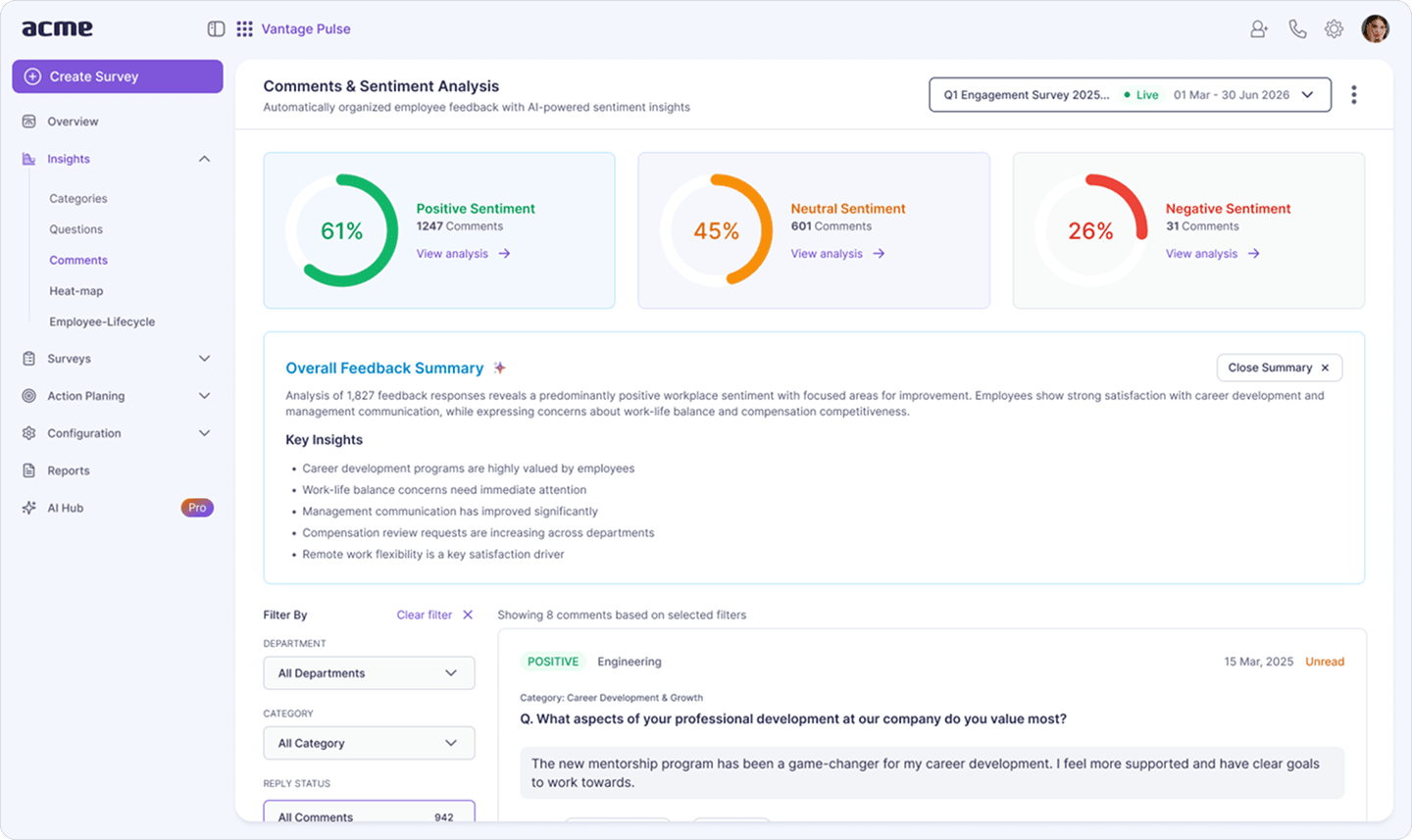
(Source: Vantage Pulse)

Building a Feedback Culture (Not a Feedback Event)
A feedback culture exists when feedback flows without being scheduled. That is the whole test. If every piece of feedback in your organization travels through a form, a review cycle, or an HR-run survey, you have feedback events. Useful, necessary, and not a culture.
The precondition has a name: psychological safety. Google's Project Aristotle studied 180 of its own teams to find what separated the best from the rest, and the answer was not seniority, team composition, or individual talent. It was whether members felt safe taking interpersonal risks, of which speaking honestly is the most common (Google re:Work). Every feedback mechanism you build sits on top of this variable. High safety, and even a clumsy survey program produces honest signal. Low safety, and the most sophisticated listening stack in the industry returns polite fiction.
Distributed teams raise the stakes further. In an office, informal feedback rides for free on proximity: the hallway correction, the overheard praise, the raised eyebrow in a meeting. Remote and hybrid teams lose most of that ambient channel, and the loss is invisible because nothing announces its absence. Gallup's global data shows the isolation cost directly, with fully remote employees reporting more daily loneliness than their on-site peers (Gallup, 2026). The fix isn't more meetings. It's deliberately scheduling the feedback that co-location used to produce accidentally: shorter, more frequent one-on-ones, and written recognition that travels across time zones.
Here's what most leaders miss: the fastest way to normalize feedback is to start with the positive kind, delivered publicly. Corrective feedback is high-stakes and private by nature; nobody builds a daily habit on it. Reinforcing feedback is low-stakes, and when it is visible, it teaches. Every public "this is what great looked like this week" tells the whole team what the organization actually values, faster than any handbook.
Positive feedback delivered at scale already has a name: recognition. A peer-to-peer recognition program turns reinforcing feedback from an occasional management habit into something colleagues do for each other daily, in every direction, without waiting for a cycle. And a social recognition feed makes that feedback public, which is the part that compounds. Visibility is what converts individual moments of appreciation into a shared standard.
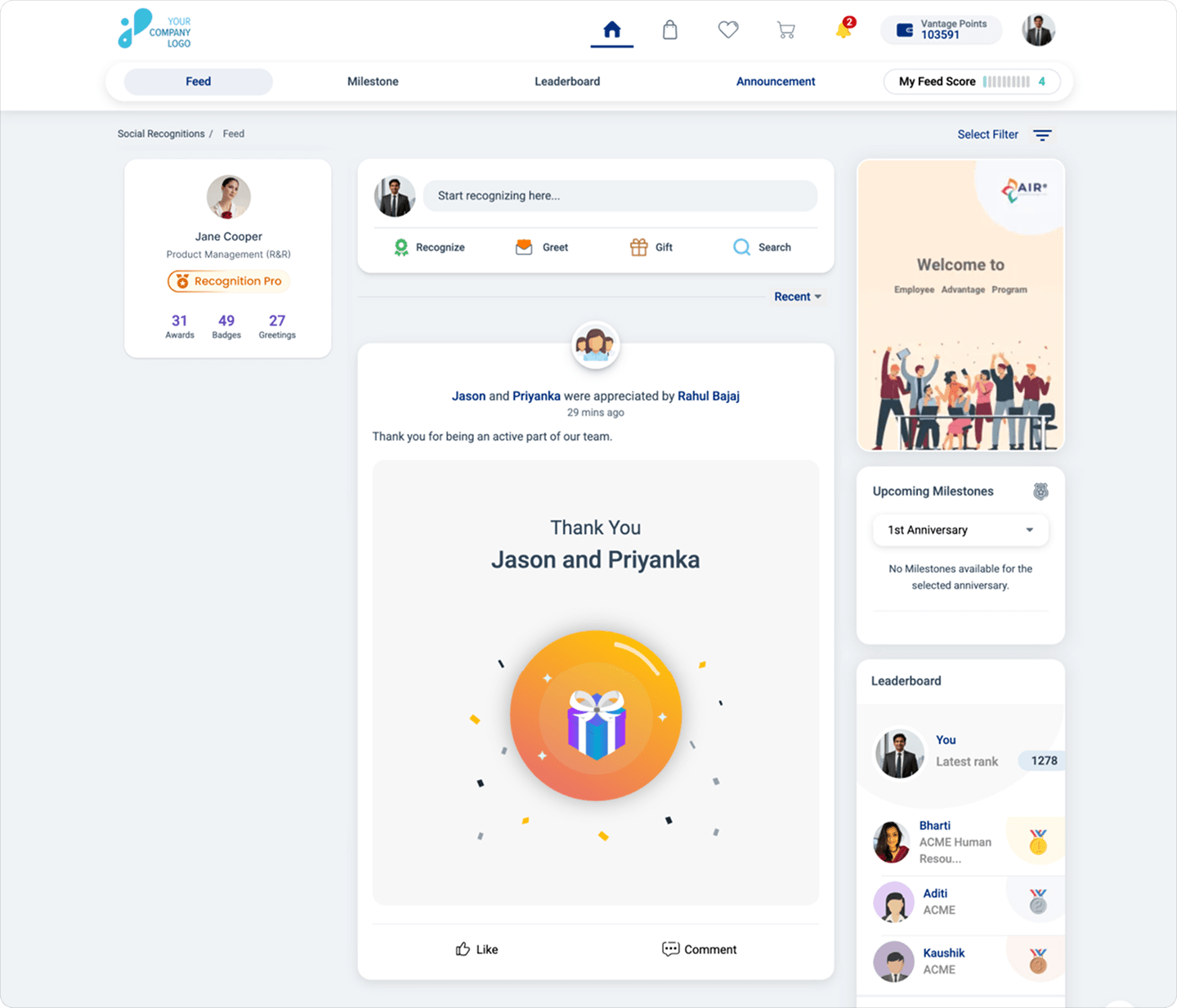
(Source: Vantage Recognition)
The other cultural load-bearing wall is manager behavior when feedback goes up. One defensive reaction to upward feedback, witnessed by a team, undoes a quarter's worth of "we want to hear from you" messaging. Managers who respond to hard input with "tell me more" are doing more for your feedback culture than any platform will. Which means feedback culture is largely a manager training problem in disguise. Train the receiving skill, not just the giving skill: pausing before responding, asking one clarifying question, thanking the person regardless of whether you agree, and reporting back later on what you did with it. Most manager training curricula spend ten hours on delivering feedback and zero on receiving it, and then leaders wonder why the upward channel stays quiet.
Culture is also slower than any of this implies. Expect quarters, not weeks.
Conclusion
Employee feedback only creates value as a loop: collected through channels people trust, analyzed into themes, acted on visibly, and measured again to prove the action worked. Most organizations run the first stage and abandon the rest. That's why employees stop telling them the truth. Build the loop, close it publicly, and pair corrective feedback with recognition so the culture reinforces itself daily. Start with the measurement layer: try Vantage Pulse and give your feedback program a number it has to move.
Frequently Asked Questions
Q1. What is an example of good employee feedback?
A. Good employee feedback names a specific behavior and its impact: "Your summary at the end of the client call locked in the next steps and saved us a follow-up meeting." It is specific, timely, and tied to a real outcome. For full worked libraries, see our positive feedback examples and constructive feedback examples.
Q2. What are the 3 C's and 4 C's of feedback?
A. The 3 C's frame feedback as clear, constructive, and consistent: easy to understand, aimed at improvement, and delivered regularly rather than in one annual burst. The 4 C's model, used more in coaching contexts, stands for context, content, consequence, and change: set the situation, describe the behavior, explain its impact, and agree on what happens next. Both are memory aids for the same underlying rule, which is that feedback works when it is specific, behavioral, and actionable.
Q3. How often should employees get feedback?
A. Meaningful feedback works best as a weekly-to-biweekly rhythm through short check-ins, with formal reviews layered on quarterly or biannually. Frequency matters less than reliability and quality; a five-minute specific conversation every week beats a polished annual review, and employees disengage fastest when feedback is frequent but empty.

He has worked in the human resources environment and has elevated recognition and rewards through his insightful and detailed writing. He aims to enhance the practice of Recognition in the workplace with new ideas and innovation that will help shape the work culture. For any related queries, contact editor@vantagecircle.com