
In every corporate communications role I have held, the same problem kept showing up in different disguises. At Burson it was a client with the right message but the wrong audience. At ESPN Star Sports it was a team that communicated constantly but still kept everyone in the dark. At CBRE it was executives who assumed employees were aligned on strategy because they had sent an all-staff email once.
In each case, the organization had communication tools. What it did not have was a communication strategy: a deliberate plan for who says what, through which channel, to whom, and how you will know if it landed.
That gap is expensive. According to the Grammarly and Harris Poll State of Business Communication report (2024), poor communication costs U.S. businesses an estimated $1.2 trillion a year, roughly $12,506 per employee. One in 5 business leaders said they had lost business because of it. The same study found that 43% said effective communication had helped them win new business.
This guide covers what communication strategies are, the main types, 10 that work in practice, real-world examples, common barriers, and a 6-step process to build your own. For a broader look at the fundamentals, see workplace communication.
What Are Communication Strategies?
A communication strategy is a plan that defines how an organization or individual will share information to achieve a specific goal. It specifies the audience, the message, the channel, the timing, and how success will be measured.
Communication strategies operate at two levels: organizational and individual. Both matter, but they serve different purposes and require different approaches.
| Level | Focus | Examples |
|---|---|---|
| Organizational | How the company communicates across teams, functions, and external stakeholders | All-hands updates, change management messaging, crisis communication, cross-functional briefings |
| Individual | How a person communicates within their role and relationships at work | Active listening, giving feedback, navigating difficult conversations, adapting to different communication styles |
A strong organizational strategy does not automatically produce strong individual communicators, and vice versa. Effective communication requires both layers to work together.
Types of Communication Strategies
Communication strategies are typically organized by channel or mode. Each type fits different situations and has different strengths.
| Type | What It Is | When to Use It |
|---|---|---|
| Verbal | Face-to-face conversations, phone calls, video conferencing, team meetings | Complex discussions, immediate feedback needed, relationship-building |
| Written | Emails, reports, memos, instant messages, documentation | Formal communication, records that need to be referenced later, async updates |
| Nonverbal | Body language, facial expressions, tone of voice, eye contact | Alongside verbal communication; particularly important in high-stakes conversations |
| Visual | Charts, infographics, videos, slide decks, dashboards | Complex data, cross-functional updates, training materials, global teams |
| Digital / Async | Slack, Teams, project management tools, recorded video updates | Remote and distributed teams, updates across time zones, reducing meeting load |
Choosing the right type is the first decision in any communication strategy. A policy change needs written communication for documentation and verbal communication for context. An emergency needs a channel everyone monitors in real time.
Benefits of Communication Strategies in the Workplace
Organizations that build deliberate communication strategies tend to report consistent patterns across these areas.
- Higher employee morale. When communication is predictable and transparent, it reduces the anxiety that comes from ambiguity. Employees who feel consistently informed and heard tend to report higher engagement and job satisfaction.
- Faster problem-solving. Teams with clear communication norms tend to surface issues earlier and fix them before they compound, rather than discovering misalignment once the damage is done.
- Better customer outcomes. Internal communication quality shapes external communication quality. Employees who understand company messaging and have the channels to resolve issues quickly provide better service.
- Fewer conflicts. Many workplace conflicts trace back to miscommunication or an information gap. Defined communication protocols reduce the conditions where conflict grows.
- Stronger decision-making. Decisions improve when the right people have the right information at the right time. A communication strategy makes that more likely and more consistent.
10 Communication Strategies That Work in the Workplace
The ten strategies below split into two groups. The first four are individual skills: what any person can develop regardless of their role or seniority. The remaining six are organizational systems: structures, norms, and tools that determine how information actually moves through a company.
Both matter. Individual skills without organizational systems create islands of good communicators inside a broken environment. Organizational systems without individual skills produce well-designed processes that no one executes well.
Individual communication skills
These four strategies are personal. They can be practiced by anyone on the team, and they are what everything else is built on.
1. Active Listening
Active listening is the foundation of every other communication strategy on this list. It means paying full attention to what someone is saying, processing it before responding, and showing that you have understood their point.
Active listening creates the conditions for better problem-solving, reduces misunderstandings, and builds the kind of trust that makes employee connection possible. It also directly affects how safe people feel sharing ideas or raising concerns.
How to practice it:
- Make eye contact and avoid checking your phone or screen while someone is speaking
- Pause before responding instead of preparing your reply while the other person is still talking
- Summarize what you heard to confirm understanding before adding your own view
- Ask follow-up questions that show you engaged with the content, not just the surface of what was said
2. Non-Defensive Communication
Non-defensive communication means expressing your position clearly without becoming closed off or hostile when challenged. It is especially important in feedback conversations, conflict resolution, and charged discussions where the instinct to protect your position can derail the dialogue.
How to build it as a practice:
- Use "I" statements to describe your experience rather than attributing intent to others ("I noticed the deadline moved" instead of "You changed the deadline without telling me")
- Separate the problem from the person when discussing what went wrong
- Acknowledge the other person's perspective before offering your own, even if you disagree
- Recognize your own communication triggers and take a beat before responding defensively
3. One-on-One Communication
One-on-ones create the space for personalized communication that group settings cannot. They are most effective when they happen consistently, follow an agenda that serves both parties, and include time for the employee to drive the conversation, not just receive updates from the manager.
How to make one-on-ones more effective:
- Schedule them at a consistent cadence (weekly or biweekly for direct reports)
- Share a light agenda beforehand so neither party arrives cold
- Lead with listening, not status updates; use business communication best practices to structure the conversation
- Follow up on actions from the previous meeting before moving to new topics
4. Use Nonverbal Communication Deliberately
Nonverbal communication in the workplace is the layer of every conversation that happens without words: posture, eye contact, facial expression, tone. In high-stakes situations (a difficult feedback conversation, a tense team meeting), these cues can override the words entirely.
Using nonverbal communication deliberately means:
- Aligning your tone and body language with your message, especially in feedback conversations
- Paying attention to nonverbal signals from others to gauge how a message is landing
- Adjusting your approach when signals suggest the message is not registering as intended
- Being aware that on video calls, camera positioning and eye contact still carry significant nonverbal information
Organizational communication systems
The following strategies work at the system level. They are designed and sustained by HR and leadership, and they determine the environment in which individual communication skills either thrive or quietly fail.
5. Empower Managers as Communicators
For most employees, their manager is their most important communication channel. According to Gallup's State of the American Manager (2015), managers account for at least 70% of the variance in team engagement, which means that what the organization announces at the top only lands as well as the person carrying it down.
Empowering managers requires giving them both the tools and the direction to communicate reliably:
- Define the key messages managers need to carry to their teams after major announcements, including how to handle likely questions
- Train managers on how to hold difficult conversations, give specific feedback, and adapt their communication styles in the workplace to different team members
- Give managers structured channels to carry feedback upward, not only downward
- Audit manager communication effectiveness through pulse survey data segmented by team, so gaps are visible before they show up in exit interviews
The goal is for every employee to receive consistent, reliable communication from the person they interact with most, not just from the CEO's town hall.
6. Recognize Achievements as a Communication Practice
Recognition is a communication act. When you publicly acknowledge a specific contribution by a specific person, you signal what the organization values, reinforce the behaviors you want more of, and make the person receiving it feel visible.
According to The Recognition Effect (2025), a Vantage Circle and Great Place To Work study of 5.7 million employees, teams with consistent recognition showed 92% retention compared to 76% on teams where recognition was patchy or absent. That 16-point retention gap is hard to ignore. Whether the mechanism is recognition itself or the culture it reflects, the correlation is strong enough to act on.
Practical formats include public team meeting shoutouts, a dedicated recognition channel in Slack or Teams, peer-to-peer recognition through a platform, and direct notes from senior leaders for significant contributions.
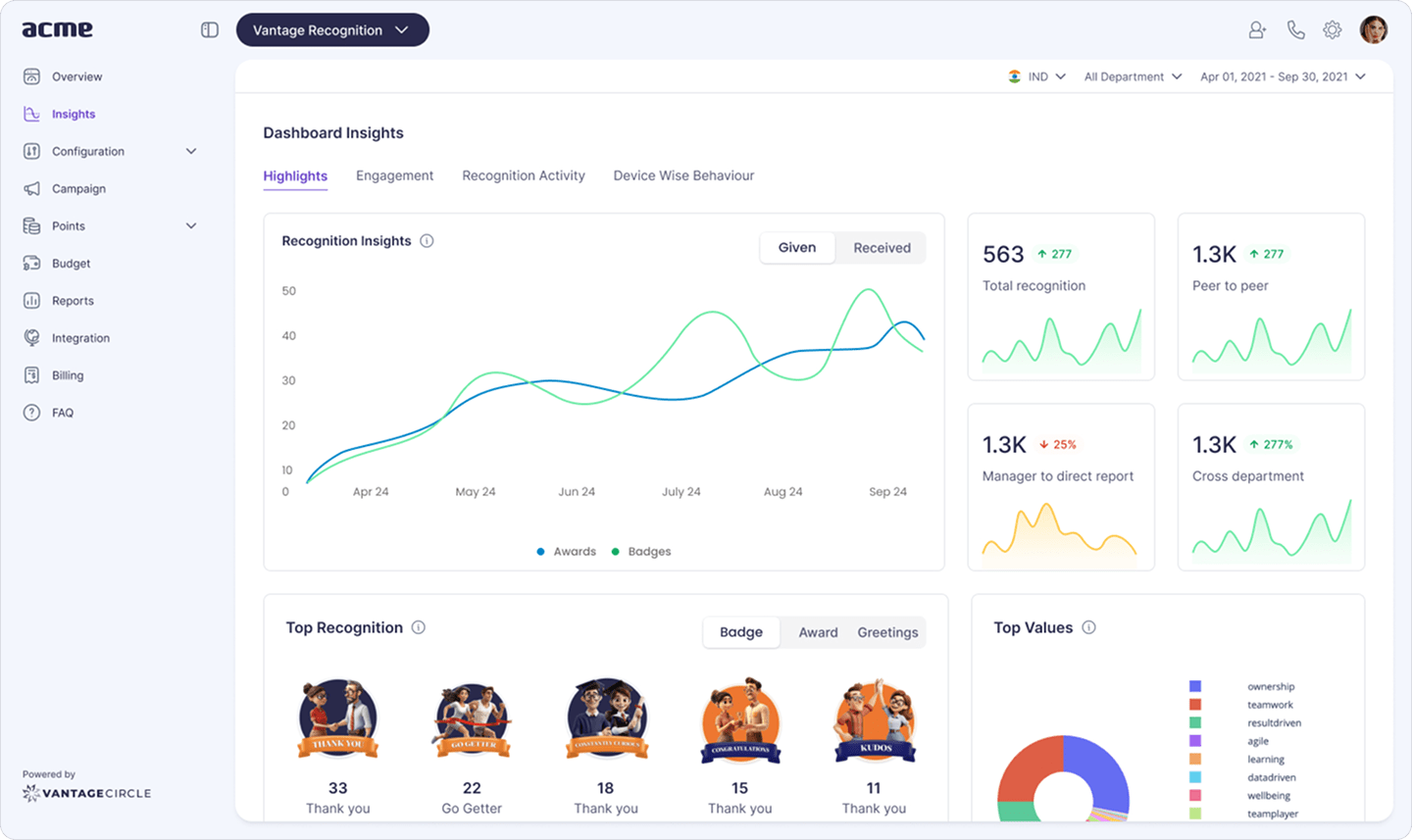
Vantage Recognition makes this trackable at scale: each recognition is tagged to a company value, visible across the organization, and reportable by HR so you can see exactly where recognition is concentrated and where it has gone quiet.
7. Define Your Channel Norms
Most workplaces have multiple active channels but few have explicit norms about what each one is for. The result is that critical information ends up in Slack when it should be in email, decisions get made in chat threads that no one outside the conversation can find later, and people feel permanently on call.
A defined channel strategy answers:
- What belongs in email versus Slack/Teams versus a project management tool
- What requires a synchronous conversation versus an async update
- What response time is expected on each channel
- What the escalation path is for urgent issues
Within those norms, build in format autonomy. Employees process information differently. Offering the same update in multiple formats, such as a written summary alongside a recorded video, means people can engage in the way that actually works for them rather than fighting the system. Set response time expectations by channel rather than requiring instant replies to everything. Team communication becomes more predictable and less exhausting when the structure serves the people inside it, not just the people sending from the top.
8. Invest in Cross-Functional Communication
Cross-functional communication breaks down when each team operates in its own channel ecosystem, uses its own vocabulary, and has no regular touchpoint with adjacent teams. The result is duplicated work, missed dependencies, and the kind of misalignment that surfaces at the worst possible moment.
Strategies that work:
- Establish a shared project space, rather than a sprawling email chain, for cross-team work
- Create regular cross-functional syncs with a rotating facilitator rather than always defaulting to the project lead
- Use shared documentation standards so teams can read each other's work without a translation layer
- Build in structured moments for empathy in the workplace that cross team boundaries, not only reinforce them
9. Choose the Right Collaboration Tools
The Microsoft Work Trend Index Special Report (2025) found that the average employee now receives 117 emails and 153 Teams messages daily, with 48% reporting their work feels increasingly chaotic. Adding more tools without a communication strategy around them makes the problem worse, not better.
The right collaboration tools match the communication needs of your team:
- Synchronous tools (video conferencing, live chat) for real-time collaboration
- Asynchronous tools (shared docs, recorded video, threaded discussion) for distributed or flexible-schedule teams
- Recognition and engagement tools for sustaining morale and visibility in remote team collaboration
Vantage Recognition integrates with Slack and Microsoft Teams, so recognition happens inside the tools your team already uses, without requiring a separate workflow.
10. Measure and Act on Communication Gaps
Most communication problems in organizations are invisible until they are serious. No one announces that they stopped trusting their manager's updates, or that the channel noise has become so overwhelming they have started ignoring it. They quietly disengage.
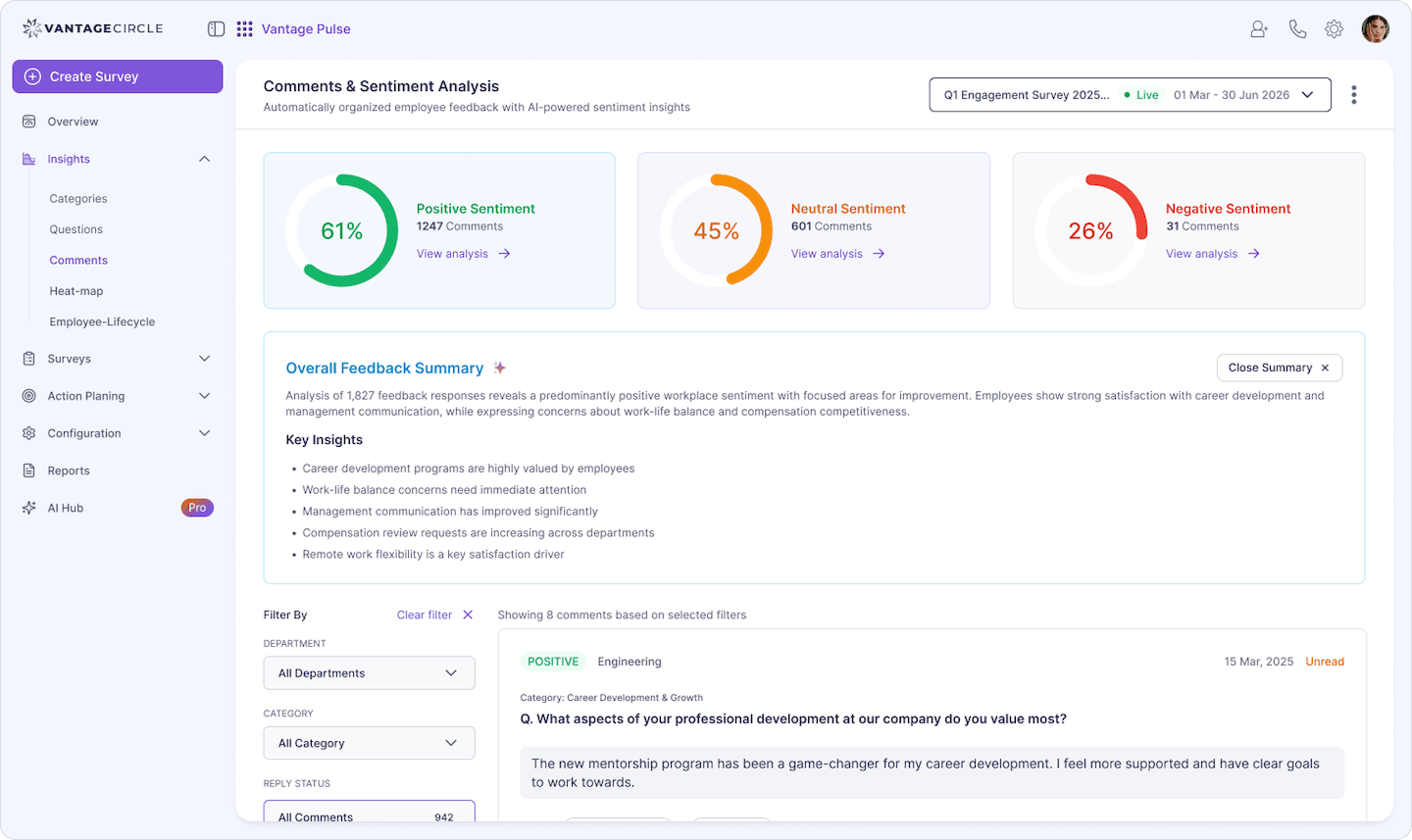
Measuring communication effectiveness means building in signals that catch these shifts early: eNPS scores segmented by team, open-text sentiment from pulse surveys, response rate trends, and how frequently communication-related themes appear in exit interviews.
Vantage Pulse runs recurring eNPS surveys and AI sentiment analysis on open-text responses, giving HR the data to see where communication is breaking down by team and manager, before it shows up as attrition.
Communication Strategy Examples
Real-world communication strategies differ by goal and context. Here are examples across common workplace scenarios.
| Scenario | Communication Goal | Strategy Used |
|---|---|---|
| Announcing a reorg | Minimize confusion and prevent rumor cycles | Cascade messaging: brief managers 48 hours before the company-wide announcement; provide a manager Q&A deck; hold an open AMA session within 72 hours |
| Remote onboarding | New hire feels connected and informed from day one | Structured first-week communication plan: daily check-ins with manager, async intro video from the team, peer buddy assigned for informal questions |
| Cross-team project alignment | All teams working from the same information | Shared project space, weekly written status update to all stakeholders, single decision log accessible to everyone on the project |
| Low engagement signals | Surface and respond to disengagement before it becomes attrition | Anonymous pulse surveys on a recurring cadence, results shared with managers, team-level action plan within 30 days of each survey |
| Performance feedback | Employee receives clear and actionable feedback | Structured 1:1 framework: specific behavior, observed impact, requested change, agreed next step |
Common Barriers to Communication in the Workplace
Communication barriers are the conditions that prevent messages from being received as intended. Most are addressable once they are identified.
| Barrier | What It Looks Like | How to Address It |
|---|---|---|
| Language | Misunderstandings due to different native languages or vocabulary levels | Plain language guidelines, translation support for critical documents, shared glossaries for technical terms |
| Cultural | Different communication norms across cultures (directness, hierarchy, formality) | Cross-cultural communication training, diverse review panels for key communications, explicit team norms about how decisions are made and shared |
| Physical | Noise, poor acoustics, remote locations, unreliable technology | Designated quiet areas, upgraded conferencing equipment, defined async-first norms for distributed teams |
| Emotional | Anxiety, unresolved conflict, or past negative interactions creating defensiveness | Psychological safety practices, manager training on difficult conversations, structured feedback frameworks |
| Perceptual | Different assumptions or biases shaping how the same message is interpreted | Confirmation checks after key messages, diverse feedback on communications before they are sent |
| Hierarchical | Employees hesitant to share upward; executives far removed from ground-level reality | Skip-level conversations, anonymous feedback channels, manager accountability for team sentiment scores |
| Technological | Tool overload, incompatible systems, lack of digital fluency | Channel governance (one tool per use case), onboarding for new tools, IT support focused on adoption not just access |
Anonymous feedback is one of the most reliable ways to surface communication barriers at scale. Employees will rarely flag these issues directly. Strategy 10 above covers how to build the measurement layer that catches these problems early.
How to Build a Communication Strategy in 6 Steps
A communication strategy does not need to be a 50-page document. It needs to answer six questions clearly.
Step 1: Define your communication goal. What outcome are you trying to achieve? Alignment on a change, stronger manager-employee relationships, faster cross-team decisions? A strategy without a specific goal tends to become a list of activities that does not change anything.
Step 2: Identify your audience. Different audiences need different messages, channels, and frequencies. A strategy aimed at all employees simultaneously usually serves none of them precisely. Segment by role, level, location, or the specific outcome you are working toward.
Step 3: Choose your channels. Map which channels each audience segment uses and trusts. Email works for formal updates; Slack works for quick questions; a town hall works for culture moments. Match the channel to the message and the audience, not to what is easiest to send.
Step 4: Craft the core message. Write the message once, then adapt the format for each channel. A clear message is brief, specific, and answers the question the audience will immediately ask: what does this mean for me?
Step 5: Establish the cadence. Communication is only a strategy when it is consistent. One-time announcements are not strategies. Decide how often each type of communication will happen and who is responsible for delivering it.
Step 6: Measure and adjust. Use data to evaluate whether the strategy is working. Metrics include email open rates, response rates on pulse surveys, engagement scores segmented by team, and the frequency of communication-related issues surfacing in manager feedback. Run a 90-day check after any significant change to see whether the gap is closing. For a deeper look at how to build the measurement layer, see Strategy 10 above.
Not sure which step to start with for your organization?
Frequently Asked Questions
What is a communication strategy?
A communication strategy is a plan that defines what an organization or individual will communicate, to whom, through which channel, and how success will be measured. It is not a list of tools or channels; it is the framework for making deliberate decisions about how information moves through an organization.
What are the main types of communication strategies?
The main types are verbal (conversations, meetings, calls), written (email, reports, documentation), nonverbal (body language, tone, eye contact), visual (charts, videos, infographics), and digital or asynchronous (Slack, Teams, project tools). Most effective workplace communication combines several types depending on the audience and the goal.
What are examples of communication strategies at work?
Examples include cascade messaging for major announcements (briefing managers before the company-wide message), anonymous pulse surveys to surface what employees will not say directly, structured 1:1 frameworks for feedback conversations, and a channel governance policy that defines what belongs in email versus chat versus a project management tool.
How do you build a communication strategy?
Define your communication goal, identify your audience, choose the right channels, craft a clear core message, establish a consistent cadence, and measure results. Each step feeds the next: without a goal you cannot define the audience; without a clear audience, the channel choice is a guess.
What is the biggest communication barrier in most workplaces?
Hierarchical barriers are among the most damaging and the least visible. When employees do not feel safe sharing honest feedback upward, problems persist longer than they should. Anonymous feedback channels and manager accountability for team sentiment scores are the most direct way to address this.
Communication strategies do not fix themselves. They require a deliberate decision about what information matters, who needs it, how they should receive it, and how you will know if it landed. Organizations that get this right tend to show lower attrition, faster decisions, and employees who feel informed and invested rather than simply managed.
The tools to support this exist. The data to identify gaps exists. What most organizations need is the structure to act on both consistently.

Supriya is a Content Marketing Lead at Vantage Circle, where she writes on employee engagement, recognition, workplace communication, and culture. She spent the earlier part of her career in corporate communications at Burson, ESPN Star Sports, and CBRE, advising organizations on the messages employees actually hear.
Connect with Supriya on LinkedIn.