
Employee disengagement rarely begins with a resignation. It begins months earlier, when employees stop volunteering ideas, managers stop noticing small wins, and teams quietly settle for "good enough." Long before turnover appears on an HR dashboard, the organization has already paid for it through slower execution, lower productivity, inconsistent customer experiences, and the gradual loss of discretionary effort that drives business performance.
Starbucks' turnaround under CEO Brian Niccol is a reminder of that reality. When he took over in September 2024, the company wasn't just battling falling same-store sales. It was rebuilding a workforce that had lost momentum. Instead of leading with a new menu or aggressive promotions, the "Back to Starbucks" strategy put employee experience first. By September 2025, Starbucks had committed a $500 million investment in labor through a new staffing model. Within the following year, the company's internal performance scorecard had improved by more than 30 percentage points, it reported its first quarter of revenue and earnings growth in over two years, and its stock reached its highest level in more than a year.
The lesson extends far beyond Starbucks. Organizations rarely lose performance overnight. They lose it gradually, as disengagement quietly erodes productivity, collaboration, innovation, and customer experience long before employees decide to leave. What eventually shows up as an attrition problem almost always begins as an engagement problem.
CFOs rarely see a line item labeled "disengagement." Instead, it appears as missed deadlines, slower product launches, customer complaints, higher hiring costs, and managers spending more time fixing preventable problems. Viewed separately, these seem like operational issues. Together, they are the financial footprint of disengagement.
McKinsey's 2023 employee-archetype research estimates that a median-size S&P 500 company loses between $228 million and $355 million annually to disengagement and attrition. This guide breaks down where that cost comes from, explains why it spreads faster than most organizations realize, and provides a calculation framework to estimate what disengagement may already be costing your business.
What Is Employee Disengagement?
Employee disengagement is the condition in which a person fulfills the basic requirements of their role but withholds the discretionary effort that drives performance, innovation, and retention.
It is not the same as job dissatisfaction or burnout, though both can lead to it. A disengaged employee shows up, completes assigned tasks, and avoids overt conflict, while contributing a fraction of their actual capacity. Mercer's 2026 Global Talent Trends report found that only 44% of employees globally are currently thriving at work, the lowest figure in the study's history, down from 66% in 2024. The majority are present without meaningful investment in their work, and for US employers, that gap shows up directly in productivity, retention, and customer outcomes.
The same pattern shows up in every function. A marketing director who once pitched 15 campaign ideas a month submits three. A customer success manager who owned client relationships now routes everything through templates. The capability hasn't changed. The engagement has.
How Much Does Disengagement Cost? (With Data)
McKinsey's 2023 research offers the clearest company-level estimate of what that footprint actually costs. The table below rounds out the picture with the figures most worth knowing.
| Stat | Source and Year | What It Means |
|---|---|---|
| $228M–$355M annual cost for a median S&P 500 company | McKinsey, 2023 | Concentrated in 6 of 12 identified engagement drivers |
| 44% of employees globally are thriving at work, the lowest on record | Mercer, Global Talent Trends 2026 | Down from 66% in 2024; US organizations face the lowest worker investment level in the study's history |
| 91% job satisfaction when organizations address workplace needs effectively, vs. 44% when they don't; 51% retention risk in the "ineffective" group | SHRM, 2026 State of the Workplace (n=2,079 US workers, n=1,856 HR professionals) | Direct, dated evidence tying leadership effectiveness to satisfaction and flight risk |
| 50%–200% of annual salary to replace a departing employee | SHRM | Entry-level (50%), mid-level (100–150%), senior or specialized roles (up to 200%) |
| Global disengagement costs approximately $10 trillion annually | Gallup, State of the Global Workplace 2026 | Widely cited macro baseline; treat as directional rather than an organizational calculation input |
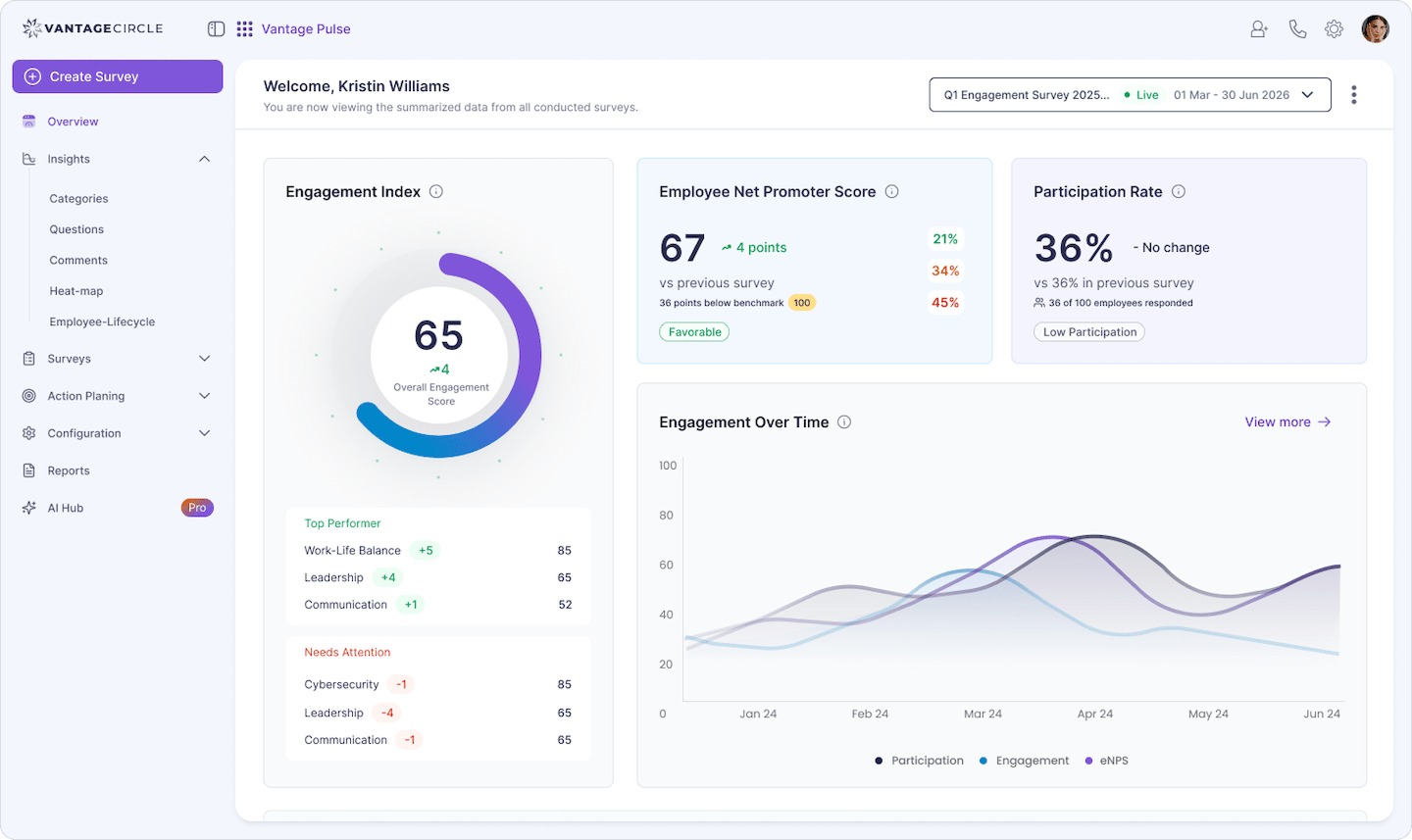
An ongoing eNPS measurement gives HR the actual disengagement rate the table above requires, rather than relying on industry averages. Vantage Pulse tracks engagement signals continuously rather than through a once-a-year survey, so the input number stays current.
Recommended Read: How Can Low Employee Engagement Hurt Your Workplace?
Calculate Your Own Cost of Disengagement
Multiply your headcount by your estimated disengagement rate, then apply an estimated productivity loss percentage, to get your organization's annual output gap from disengagement.
The formula:
Number of disengaged employees × average salary × estimated productivity loss % = annual disengagement cost
Example: a 500-person organization, $65,000 average salary, 60% disengagement rate:
- 500 × 0.60 = 300 disengaged employees
- Conservative estimate (18%): 300 × $65,000 × 0.18 = $3.51M/year
- Higher estimate (34%): 300 × $65,000 × 0.34 = $6.63M/year
Most organizations underestimate this number because they only account for visible productivity losses. The figure above does not include turnover replacement costs, absenteeism, presenteeism, or the cost of errors. Each of those adds a separate layer.
Quick reference ranges by organization size (productivity loss methodology, 60% disengagement rate):
- 100 employees, $60K avg salary: ~$702K–$1.32M/year
- 500 employees, $65K avg salary: ~$3.51M–$6.63M/year
- 1,000 employees, $70K avg salary: ~$7.56M–$14.28M/year
The calculation gives you a floor, not a ceiling. Turnover and hidden costs (covered below) push the real figure higher. Engagement Analytics from Vantage Circle turns this one-time estimate into a running number tracked with the same rigor as any other cost center.
The Domino Effect: Productivity, Innovation and Team Culture
One disengaged employee rarely contains the damage to their own output. The effects spread through teams, timelines, and customer relationships.

SHRM's 2026 State of the Workplace report found that 91% of workers who feel their organization effectively addresses workplace needs report job satisfaction, compared to just 44% among those who view their organization as ineffective. And 51% of the "ineffective" group say they are at least somewhat likely to leave within a year. Since employers in the same research overwhelmingly named effective leadership and management as their top workplace priority, that satisfaction gap traces back to the manager relationship more than any other single factor. A disengaged manager does not simply underperform individually. They compress the engagement of every direct report, and the effect is measurable at the team level, not just the individual one.
The knock-on effects extend further. McKinsey's archetype research identified "disrupters," roughly 11% of the workforce, as highly disengaged employees whose behavior actively degrades the output of people around them. This is distinct from the "mildly disengaged" 32% who simply do enough to get by. The gap between these two groups is not incremental. It is structural, and it scales differently depending on which group is growing inside a given team.
Customer-facing functions make the damage visible fastest. Disengaged employees deliver inconsistent service, produce more errors, and escalate complaints. The productivity gap that starts internally becomes a customer experience problem, then a revenue problem.
The Real Cost of Replacing Disengaged Employees
Replacing an employee costs between 50% and 200% of their annual salary. The visible recruiting costs represent less than a third of the total.
When disengaged employees eventually leave (or are managed out), the replacement cost lands as a sudden, concentrated expense that had been accumulating gradually through lost productivity. About one-third of replacement costs are direct: recruiting fees, job advertising, interview time. The remaining two-thirds are indirect: the productivity gap during the open role, onboarding time for the replacement, institutional knowledge lost, and team disruption while someone new gets up to speed.
SHRM's retention research breaks down replacement costs by level:
- Entry-level employees: 50–100% of annual salary
- Mid-level employees: 100–150% of annual salary
- Senior or specialized roles: Up to 200% of annual salary
The highest-cost scenario is losing the employees who have mentally resigned but not yet left: your most skilled people, carrying institutional knowledge, client relationships, and team context that is genuinely difficult to transfer. The visible symptom arrives at offboarding. The cost has already been accumulating for months.
Hidden Costs: Absenteeism, Presenteeism and Mistakes
Beyond direct productivity losses, disengagement creates three hidden cost layers that rarely show up in financial reporting: absenteeism, presenteeism, and error amplification.
- Absenteeism: Unscheduled absences cost US employers approximately $225.8 billion annually, or $1,685 per employee per year in lost productivity, according to a CDC Morbidity and Mortality Weekly Report (2015). For disengaged employees, who are significantly more likely to take unplanned absences than engaged peers, the per-employee figure skews higher.
- Presenteeism: Employees who show up but operate at reduced mental capacity cost more than those who stay home. An HBR analysis (2004) drawing on JAMA research by Stewart et al. (2003) calculated the total cost of presenteeism in the United States at more than $150 billion per year. The underlying methodology is the most widely cited baseline in this area, though a more recent primary figure is worth sourcing for board-level use.
- Error amplification: Disengaged employees make significantly more mistakes, producing quality control failures, customer complaints, and rework. A single significant error can cost tens of thousands of dollars in corrections and reputational recovery.
- Workplace stress: Mercer's 2026 Global Talent Trends report found that employee thriving hit a record low of 44% in 2026, down from 66% in 2024. This signals that chronic workplace stress and disengagement have compounded, with measurable implications for healthcare utilization and output across US organizations.
Presenteeism alone shows up as a stress symptom before it becomes a motivation problem. Vantage Fit addresses the physical and mental load driving these absenteeism numbers through wellness challenges that give employees structured support before disengagement fully sets in.
These hidden costs typically exceed visible productivity losses, making disengagement significantly more expensive than most organizations account for.
Root Causes of Disengagement (And What Actually Helps)
Poor manager support, inconsistent recognition, and unclear growth paths account for most cases of disengagement. As the satisfaction gap discussed earlier shows, disengagement is usually an organizational problem rather than an individual one. That helps explain why leadership and manager development has remained HR's top investment priority for two consecutive years (46% in 2026, SHRM).

Recognizing Disengagement: Three Categories of Signs
Disengagement follows observable behavioral patterns across three categories. Recognizing them early is the difference between a coaching conversation and a resignation.
| Performance Changes | Communication and Withdrawal | Attendance and Attitude |
|---|---|---|
| Output declines without clear cause | Goes silent in team meetings and group discussions | Unplanned absences increase |
| Error rate and missed deadlines rise | Stops offering ideas or volunteering for projects | Visible detachment or low energy in interactions |
| Delivers minimum-requirement work only | Peer relationships become distant and transactional | References to job searching or "waiting it out" |
The Manager Variance Signal Map: The satisfaction and retention gap covered above is not evenly distributed. It concentrates wherever leadership is perceived as ineffective. When an employee's behavior shifts across multiple categories above, the most statistically probable root cause is a breakdown in the manager relationship, not a fundamental motivation problem in the employee.
The Vantage Circle × Mercer AIRe Whitepaper maps the four behavioral science pillars of high-engagement programs (Appreciation, Incentivization, Reinforcement, and Emotional Connect) directly onto what disengaged employees report lacking: recognition, clarity, motivation, and belonging. Organizations that build the Emotional Connect pillar into their programs show 31% lower voluntary turnover (SHRM, 2023). Those that embed the Reinforcement pillar (recognition tied to specific behaviors, not just tenure) see 12% higher productivity versus organizations relying on annual feedback cycles alone (HBR, 2022). Managers who read disengagement signals early and respond with specific recognition and feedback, rather than formal performance procedures, interrupt the pattern before it becomes turnover.
The five most common root causes:
1. Leadership gaps: Managers who fail to provide clear direction, specific feedback, or emotional support create the conditions for disengagement. That is why leadership development consistently ranks as the top HR investment priority. Not as a strategic nicety, but because it is the highest-ROI fix available. Vantage Recognition's Manager Recognition gives managers a structured, low-friction way to close the recognition gap instead of relying on informal praise that gets skipped under deadline pressure.
2. Recognition deficit: WorldatWork's 2026 State of Rewards survey (1,316 responses, January–February 2026) found recognition satisfaction sitting at just 58%, with dissatisfied employees roughly 1.5 times more likely to report low intent to stay. Employees who feel seen for their contributions are far less likely to disengage quietly or start looking elsewhere. Recognition that is timely, specific, and tied to behaviors (not just outcomes) is what sustains engagement between formal review cycles.
3. Growth stagnation: When employees cannot see a development path at their current organization, they begin investing their discretionary effort elsewhere. Research on top employee retention factors consistently ranks growth clarity alongside manager support as the two most actionable levers HR controls directly. The question they are asking, consciously or not, is whether staying is worth it. Organizations that cannot answer that question with visible progression, mentorship, or skill investment are the ones that lose people slowly and then suddenly.
4. Communication debt: The cumulative effect of leadership silence, missed check-ins, and avoided difficult conversations. Deloitte's 2026 Global Human Capital Trends report found that the average worker absorbed 15 major organizational changes in the past year, yet only 27% of leaders believe their organization manages change communication effectively. Like financial debt, communication debt compounds. The relational erosion typically builds for months before the performance gap becomes visible. Effective feedback is what keeps the debt from accumulating.
5. Wellbeing decline: Employees rarely disengage because of a single stressful week. It happens when heavy workloads, uncertainty, and poor recovery become the normal way of working. Over time, people stop investing discretionary effort because they no longer have it to give.
How to Fix It: High-ROI Strategies to Re-Engage
Re-engaging a disengaged workforce requires addressing root causes: manager behavior, recognition frequency, and growth clarity. Adding surface-level perks without fixing these does not move the dial.
Manager development: McKinsey's archetype research found that "uncaring and uninspiring leaders" sits among the top drivers responsible for nearly two-thirds of total disengagement cost at a median S&P 500 company. Investment in leadership capability yields the highest and fastest engagement ROI of any lever available. Organizations with structured manager training programs consistently see meaningful improvement in team engagement within six months. The first target: managers who are themselves disengaged. Manager-level burnout compounds through every team they lead, making leadership re-engagement a prerequisite for team re-engagement.
Peer-to-peer recognition: Re-engagement strategies that rely only on top-down manager recognition are slow to scale.
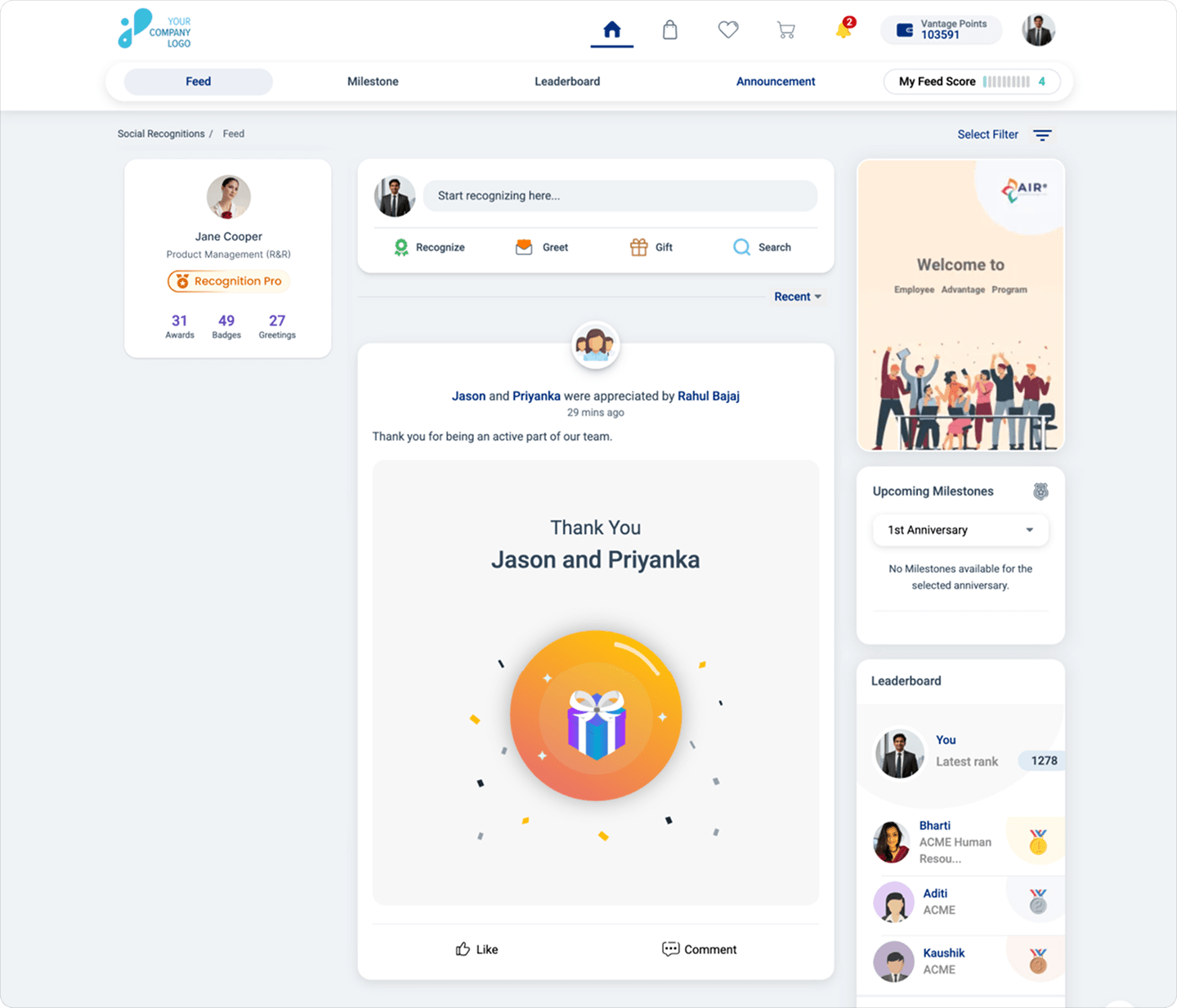
Vantage Recognition's peer-to-peer recognition gives every employee, not just managers, a channel to counteract the withdrawal behaviors described above. The Recognition Effect study (Great Place to Work India × Vantage Circle, 2025, n=5.7 million employees across 2,000 organizations) found that organizations in high-recognition cultures are 4X more likely to achieve workplace excellence than those in emerging recognition cultures. Recognition frequency (how often an employee is seen and acknowledged) is one of the highest-leverage, lowest-cost re-engagement levers available.
Recognition technology: The turnover and productivity outcomes documented in the AIRe Whitepaper above come specifically from organizations that embed recognition into daily workflows rather than reserving it for annual awards. The mechanism is straightforward: frequent, behavior-specific recognition reinforces what produces performance before those habits have a chance to atrophy.
Continuous feedback loops: The change-communication gap covered under "communication debt" above is why cadence matters as much as content. Weekly check-ins, not annual reviews, are the feedback rhythm that prevents communication debt from accumulating in the first place. Research shows that employees who receive regular, structured feedback are significantly more likely to stay and perform.
Career development clarity: Employees who can see a development path at their current organization invest emotional energy in their current role. Structured learning paths, mentorship, and internal mobility signals lower the probability of mental resignation before a formal exit.
Wellbeing support: Tools like Vantage Fit address the physical and mental load that precedes disengagement by managing the stress that drives absenteeism and presenteeism before it compounds into full withdrawal.
Read More: The ROI of Employee Engagement
Turning Disengagement Into Competitive Advantage
Organizations that treat engagement as a business system, not an HR initiative, consistently outperform competitors across retention, productivity, and customer outcomes.
Gallup's Q12 meta-analysis, its 11th edition and the largest study of its kind (3.35 million employees, 347 organizations, 53 industries, 90 countries), found that business units in the top quartile of engagement are 23% more profitable than those in the bottom quartile, with 18% higher productivity, 78% lower absenteeism, and 32% fewer quality defects. This is the appropriate use of this data: the Q12 meta-analysis is one of few engagement studies with methodology and scale sufficient to support company-level investment decisions.
In best-practice workplaces, engagement levels reflect a deliberate investment. The engagement advantage compounds: highly engaged workforces attract top talent, sustain innovation cultures, and deliver customer experiences that build loyalty. A visible recognition feed, where appreciation is public, frequent, and tied to behaviors the organization values, turns individual re-engagement moments into a company-wide signal. That is what separates a one-off engagement fix from a durable cultural shift.
Vantage Recognition's Social Recognition Feed makes this visible at scale: recognition becomes part of the daily work environment rather than an occasional HR event, which is what sustains engagement after the initial program launch.
Organizations that treat engagement as a competitive lever rather than a compliance exercise position themselves for sustainable performance in a talent market where disengagement is the default.
Conclusion
The cost of disengaged employees is real, compounding, and largely preventable. The organizations that close the gap do so by addressing root causes: manager behavior, recognition frequency, and growth clarity. Adding benefits to a disengaged culture does not fix the underlying problem.
Organizations cannot eliminate every resignation, but they can prevent many of the conditions that cause employees to disengage long before they leave. The earlier leaders recognize those signals and act on them, the less they pay in lost productivity, replacement costs, and missed opportunities.
Start with measurement. Know your disengagement rate before estimating the cost. Then close the most expensive gap first: manager behavior, where the satisfaction and retention swing covered above is largest.
See how Vantage Circle helps organizations measure, reduce, and prevent disengagement at scale.
Frequently Asked Questions
What are some signs that an employee is disengaged?
Watch for three patterns: declining output or quality, going quiet in meetings and no longer offering ideas, and rising unplanned absences or visible detachment. One sign alone can be innocent. A pattern across all three is the one worth acting on.
What are the three levels of disengagement?
Engaged, not engaged, and actively disengaged. The middle group, doing just enough to get by, is typically the largest, and the most expensive to ignore since it is the easiest to miss.
How can I tell if I am disengaged at work?
If you are doing only what is required, feel invisible to your manager, or catch yourself browsing job listings more than usual, that is disengagement, not burnout. It is catchable early if the conditions around you change.
What drives employee engagement?
Three things: a manager who gives clear expectations and regular recognition, work that feels meaningful, and a visible path to grow. All three are within an organization's control.
What causes disengagement?
Poor manager support, lack of recognition, unclear growth paths, and communication gaps, usually two or three at once rather than just one. That compounding is why it is hard to catch until it is already turnover.

Supriya is a Content Marketing Lead at Vantage Circle, where she writes on employee engagement, recognition, workplace communication, and culture. Her work on remote team recognition draws on primary research from Vantage Circle's platform data and customer deployments across distributed workforces. She spent the earlier part of her career in corporate communications at Burson, ESPN Star Sports, and CBRE, advising organizations on the messages employees actually hear.
Connect with Supriya on LinkedIn.