
Picture two people who join the same team on the same day. Same role, same qualifications, same starting salary. Five years later, one of them manages a team and the other doesn't. Nobody broke a policy. Nobody made a decision that looked unfair at the time. And yet this is the story the data tells, over and over.
For every 100 men promoted to their first manager role, only 93 women were promoted, and far fewer Black women and Asian women (McKinsey & LeanIn, Women in the Workplace 2025). Add up a career of small gaps like that, and the World Economic Forum puts full gender parity 120 years away (Global Gender Gap Report, 2026).
That's what makes gender equality in the workplace so easy to miss and so hard to fix. The gap rarely sits in a policy. It builds up in ordinary decisions about who gets the stretch assignment, who gets noticed, who gets a sponsor, and who gets the nod. This guide shows where inequality hides, 12 actions you can take across 6 stages of the employee lifecycle, and how to measure whether they're working.
Key takeaways
- Gender equality is measured by outcomes, such as pay, promotion rates, and who gets recognized, not by intentions or policies on paper.
- Women are about 49% of entry-level employees but 29% of the C-suite, and the biggest single drop is the first step into management.
- The gap builds in routine decisions about hiring, pay, assignments, sponsorship, and recognition, so that is where to fix it.
- Act on 6 lifecycle stages, track results by gender every cycle, and use the self-audit near the end of this guide to find your weakest stage.

Image Courtesy- Unsplash
What Is Gender Equality in the Workplace?
Gender equality in the workplace means employees of every gender have equal access to pay, opportunities, promotion, resources, and protection from discrimination and harassment. You can tell it's working by the results, not the policy: equal pay for equal work, comparable promotion rates, and the same standards applied to everyone.
Australia's Workplace Gender Equality Agency (WGEA) frames the aim as broadly equal opportunities and outcomes, not necessarily outcomes that are exactly the same for everyone. In the United States, the legal floor comes from Title VII of the Civil Rights Act of 1964, which prohibits sex-based discrimination in hiring, pay, promotion, training, and benefits, and the Equal Pay Act of 1963, which requires equal pay for equal work. The Equal Employment Opportunity Commission (EEOC) enforces both, and it treats discrimination based on sexual orientation, transgender status, or pregnancy as sex discrimination under Title VII.
Gender equality is one slice of the broader equality in the workplace, and it covers everyone, including women, men, and people of non-binary or other gender identities.
Gender Equality vs Gender Equity
Equality means giving everyone the same opportunities and applying the same standards. Gender equity at work means recognizing that people start from different places and adjusting support so that outcomes, not just access, end up fair. Most organizations need both.
| Aspect | Equality | Equity |
|---|---|---|
| Approach | The same rules, pay scales, and promotion criteria for everyone | Support adjusted to remove barriers that affect some groups more than others |
| Example | One published salary range per role, applied to every candidate | A review of why fewer women reach the first manager promotion, followed by targeted sponsorship |
| Goal | Equal treatment | Equal outcomes |
The two work together. Equality sets the standard, and workplace equity closes the gaps that an equal standard alone leaves behind.
Gender Inequality in the Workplace: Where It Shows Up (2026 Data)
Gender inequality in the workplace shows up most in four places: pay, promotion, leadership representation, and unequal access to sponsorship. The figures below come from the latest editions of each report.
| Gap | Latest figure | Source (year) |
|---|---|---|
| Pay | US women working full time, year-round earned 83.9% of what men earned in 2025, up from 80.6% in 2024 | US Census Bureau (September 2026) |
| Pay (hourly measure) | US women earned 85% of what men earned, based on median hourly earnings of full- and part-time workers | Pew Research Center (2025, using 2024 data) |
| First promotion to manager | For every 100 men promoted, 93 women were promoted: 82 Asian women and Latinas, and 60 Black women | McKinsey & LeanIn, Women in the Workplace (2025) |
| Sponsorship | 31% of entry-level women have a sponsor, compared with 45% of entry-level men | McKinsey & LeanIn, Women in the Workplace (2025) |
| Senior leadership | Women hold 29% of C-suite roles at participating US companies, unchanged from 2024 | McKinsey & LeanIn, Women in the Workplace (2025) |
| Time to parity | 120 years at the current pace, and 129 years for economic participation and opportunity; the global gap is 69.2% closed across 145 economies | World Economic Forum, Global Gender Gap Report (2026) |
Two of these numbers explain most of the others. The first step up to manager is where the pipeline narrows, and the McKinsey & LeanIn report calls it the broken rung. Fewer women promoted into management means fewer women in the pool for every later promotion, so the gap compounds at each level. Here is what that looks like, level by level.
Women's share of employees at each level, 2025
Entry level is close to even. Every step up loses ground, and the first step into management loses the most.
Source: McKinsey & LeanIn, Women in the Workplace 2025, pipeline data as of January 1, 2025. Women's share is the report's white women and women of color figures added together, so it is rounded; the report states 29% for the C-suite. The orange row is the broken rung.
Sponsorship is the second number. Employees with a sponsor were promoted at nearly twice the rate of those without one: 65% of workers with a sponsor received a promotion in the last two years, compared with 35% of those without.
The two pay rows differ because the Census figure compares annual earnings of full-time, year-round workers, while Pew's compares hourly earnings across all workers. Both show a gap that has narrowed but not closed. Pay is where the problem is easiest to see, but promotion and sponsorship gaps usually come first, and the pay gap is what they add up to years later.
Examples of Gender Inequality in the Workplace
Gender inequality usually shows up in routine decisions, not written policies. Most of these examples are gender bias in the workplace at its most ordinary: nobody means any harm, which is why the habits persist and why only a review of decisions catches them.
| Example | Where it happens | What to do instead |
|---|---|---|
| Asking about salary history | Hiring and offers | Set the offer from the role's published range, not from past pay |
| Gendered job ads | Job descriptions | Use neutral wording and focus on skills and outcomes |
| Office housework (taking notes, planning events) always landing on the same people | Day-to-day assignments | Rotate non-promotable tasks on a schedule |
| Uneven stretch assignments | Project allocation | Track who gets high-visibility work and assign by skill and interest |
| Penalties for taking parental leave | Performance reviews and promotions | Apply the same review criteria to people who used leave |
| Contributions interrupted or credited to someone else | Meetings and reviews | Attribute ideas by name and let people finish their points |
| Uneven recognition | Team and company programs | Review who receives recognition, and from whom, at least twice a year |
| Harassment tolerated from high performers | Conduct investigations | Apply the policy the same way at every level of performance |
Some of these cross into workplace discrimination, where a legal line has been crossed. Most sit below that line, in habits and defaults that a fair process can correct.
Why Gender Equality Matters for Business
Gender equality matters for business because it affects retention, the size of your talent pool, and the quality of decisions, not only fairness.
- Retention. In Women in the Workplace 2025, lack of career opportunity was the top reason employees leave their jobs, ahead of pay, benefits, and flexibility. When promotion paths are uneven, the people who see the gap first are the ones who leave.
- Performance. McKinsey's Diversity Matters Even More (2023) analyzed 1,265 companies in 23 countries. It found that companies in the top quartile for gender diversity on executive teams were 39% more likely to outperform financially than companies in the bottom quartile, up from 15% in its 2015 report. That's a correlation, not proof that diversity alone causes the gain, but the link has strengthened over time.
- Talent pool. When hiring and promotion filters screen out people for reasons unrelated to the job, you are choosing from a smaller pool than the market actually offers. Gender diversity in the workplace widens that pool.
For the wider business case, see our guide to diversity and inclusion.
How to Promote Gender Equality in the Workplace: 12 Actions Across 6 Stages
Promoting gender equality in the workplace works best when you fix the system at each stage where decisions get made, not through one-off awareness campaigns. The 12 actions below follow the employee lifecycle.

Image Courtesy- Unsplash
Hiring
Hiring is where a gap can first open, because the candidate pool shapes every later statistic.
- Rewrite job ads in neutral language. Remove gendered pronouns and loaded phrases such as "rockstar," and describe the skills and outcomes the role needs instead of personality traits.
- Use structured interviews. Ask every candidate the same questions, score each answer against the same criteria, and never ask about marriage, pregnancy, or plans for children.
Pay
Pay is the easiest stage to measure, so it is the fastest to audit.
- Run a pay audit at least once a year. Compare pay for the same role, level, and location, and investigate any gap that tenure or performance can't explain.
- Publish salary ranges and stop using salary history. Several US states and cities prohibit asking for it, and past pay carries earlier gaps into the new offer. The gender pay gap guide covers the detail.
Development and Promotion
This is where the broken rung sits, so it deserves the most attention.
- Add sponsorship to your mentoring program. A mentor gives advice, while a sponsor uses their own influence to put someone forward for a stretch assignment or promotion. With only 31% of entry-level women reporting a sponsor, matching sponsors early closes a very measurable gap.
- Review the first manager promotion every cycle: who was considered, who was promoted, and why. Give everyone equal access to learning budgets and high-visibility projects, and check that manager recognition reaches the whole team, not only the people a manager already knows best.
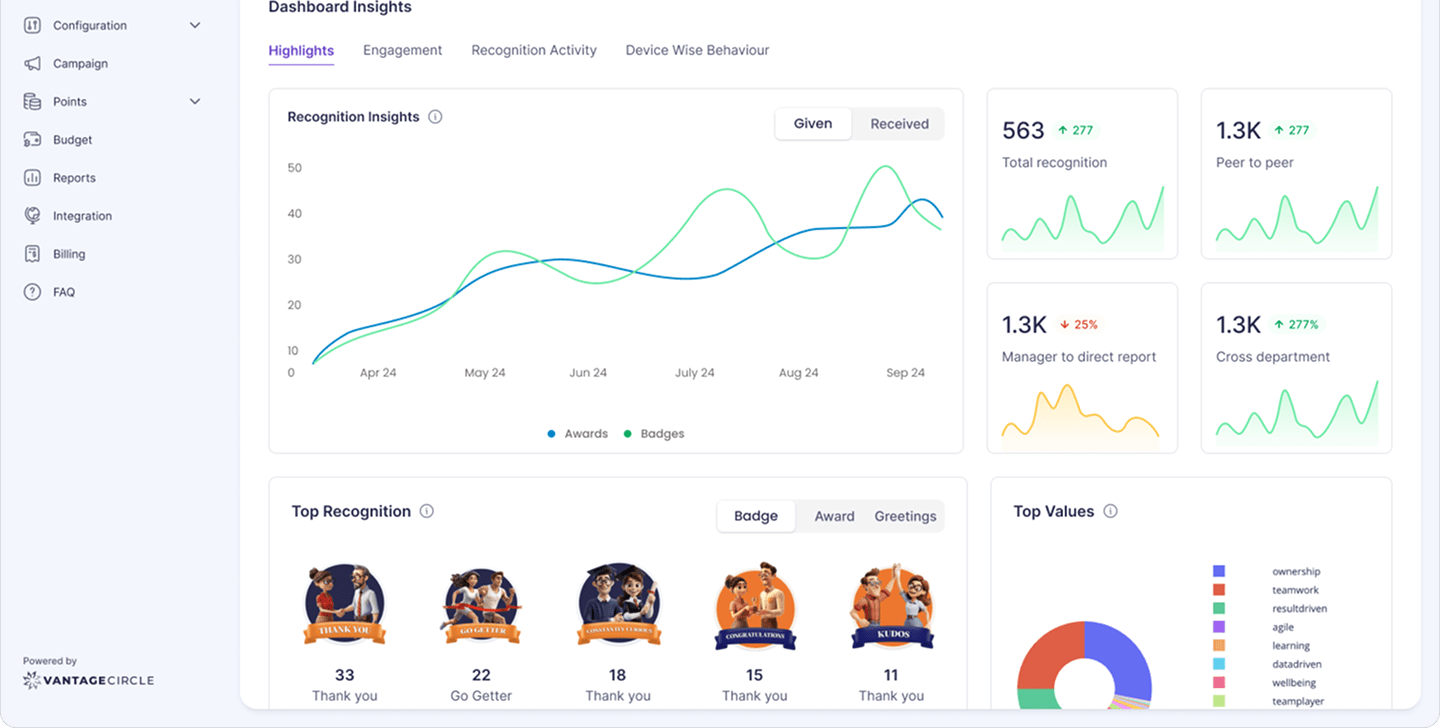
Promotion gaps rarely start at the promotion decision. They start months earlier, in who gets noticed. A manager who recognizes some people more than others shapes who looks promotable, which is why recognition data belongs in a promotion review.
Protection
People who experience bias or harassment often stay silent, so a policy nobody uses tells you nothing.
- Write a harassment policy with real consequences. Define what counts as harassment, name the outcome for each level of severity, and apply it the same way to everyone, including top performers. Our guide to workplace harassment covers what a strong policy includes.
- Give people a safe way to report, including an anonymous one. An anonymous survey channel gives HR an early signal without asking anyone to put their name on the line, and Vantage Pulse supports anonymous responses for exactly this.
Flexibility and Care
Flexibility and care policies work when they are offered to everyone, not framed as a benefit for women.
- Offer flexible work to every employee, and watch for flexibility stigma. Women in the Workplace 2025 found that women who work mostly remotely are less likely to have a sponsor and far less likely to have been promoted in the last two years, while men's rates stay similar wherever they work. Offer flexible working hours to all, and check that using them doesn't cost anyone a promotion.
- Offer parental leave and caregiving support to all parents. Support framed only for mothers reinforces the uneven load. Wellness and care benefits, such as those in Vantage Perks, work best when every employee can use them.
One Standard for Everyone
The same standard for everyone is the simplest way to apply equality in daily management.
- Apply the same performance standards and feedback to everyone. Don't soften hard feedback for some people or hold back stretch assignments from others. Specific, behavior-based constructive criticism is what helps people grow, and everyone deserves it.
- Define what good looks like in writing, then recognize against it. Praise for being a team player or taking charge often lands differently depending on who shows the behavior. Recognition tied to defined company values, which Vantage Recognition supports through values-based recognition, gives everyone the same yardstick.
Diversity training can support all six stages, but training alone doesn't change outcomes. Pair it with the process changes above.
Know More: 6 Types Of Diversity Training For An Inclusive Workplace
How to Measure Gender Equality in Your Organization
To measure gender equality, track outcomes by gender at every lifecycle stage and review them on a fixed schedule. A gap that isn't tracked can't be closed.
| Metric | How to calculate | Red flag |
|---|---|---|
| Representation by level | Share of each gender at every level, from entry to executive | The share of women falls at each step up |
| Promotion rate | Promotions in a period divided by eligible employees, by gender | One group is promoted at a visibly lower rate |
| Pay by role | Average and median pay for the same role, level, and location, by gender | A gap that a documented factor can't explain |
| Attrition | Leavers divided by headcount, by gender and by level | One group leaves at a higher rate, especially after a promotion cycle |
| Exit interview themes | Coded reasons for leaving, by gender | Repeat mentions of bias, blocked growth, or an unsupportive manager |
| Recognition received | Share of recognition received by each gender, compared with its share of headcount | A group gets noticeably less recognition than its headcount would predict |
| eNPS by gender | Employee Net Promoter Score split by gender | A widening gap between groups |
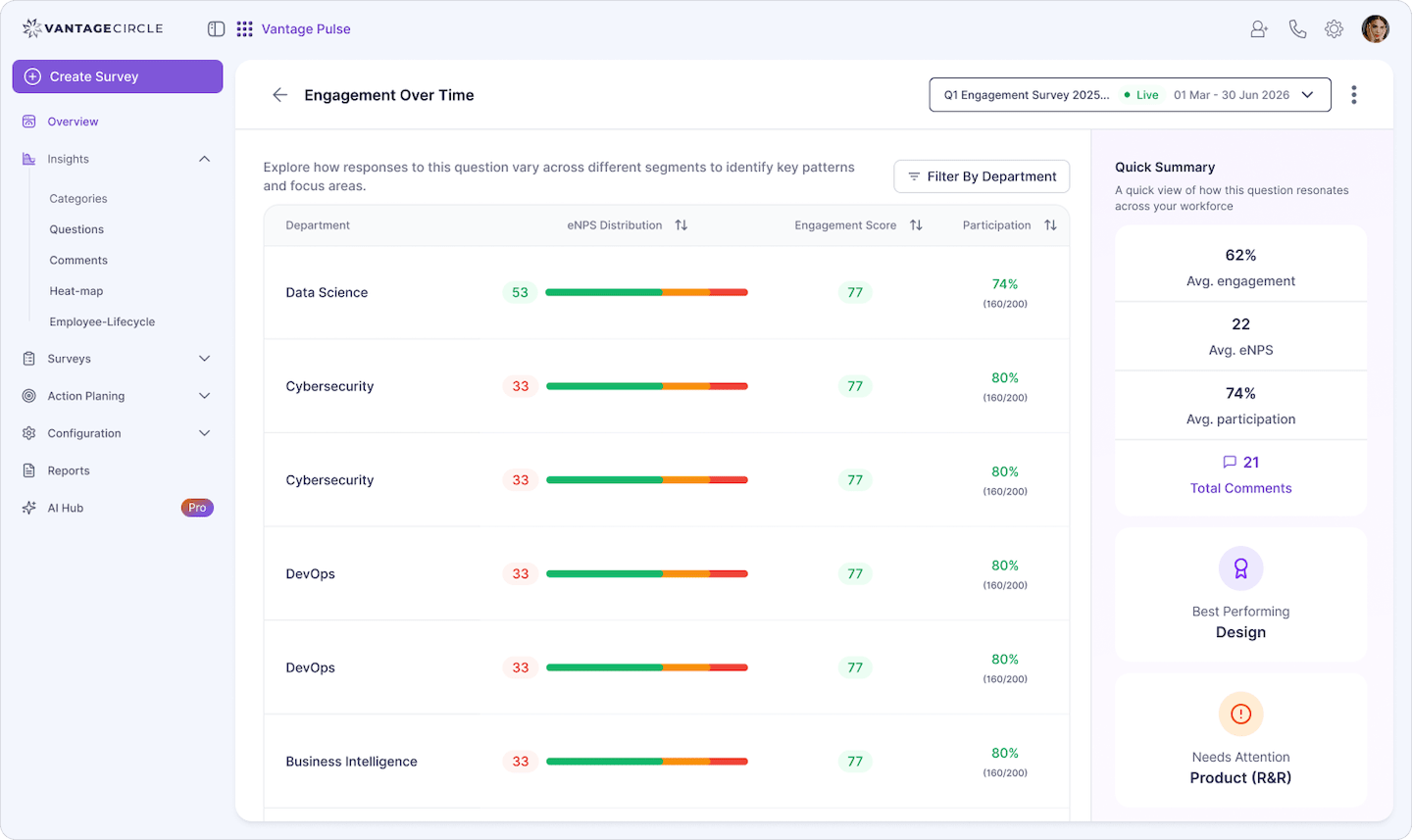
The last three are the ones most teams skip. Exit interviews, coded by theme, show whether the same problems keep pushing people out. Representation numbers show who is in the room, and engagement split by gender shows whether they want to stay, so a widening eNPS gap is an early warning for the attrition that undoes hiring progress. Vantage Pulse eNPS surveys let you compare results across segments, and Vantage Recognition's analytics show recognition given and received, so you can see whether contributions get the same visibility across teams.
A few rules keep this measurement useful and safe:
- Set a minimum group size before you report any split, so no individual can be identified.
- Use the same definitions and the same time window each cycle, so the numbers are comparable.
- Review the results on a fixed schedule, and assign an owner and a deadline to every gap you find.
Quick Self-Audit: How Equal Is Your Workplace?
Score your organization from 1 to 4 on each statement to see which stage needs attention first: 1 for never or not tracked, 2 for sometimes, 3 for usually, and 4 for always and reviewed on a schedule. A 4 should mean you could show someone the evidence.
| Stage | Statement | Score |
|---|---|---|
| Hiring | Job ads are checked for gendered wording, and every candidate gets the same structured interview questions | |
| Pay | We run a pay audit at least once a year and investigate any gap we can't explain | |
| Pay | Salary ranges are shared, and past pay is never used to set an offer | |
| Promotion | We track who is promoted to first manager, by gender, every cycle | |
| Development | Every employee has equal access to a sponsor, learning budgets, and high-visibility projects | |
| Protection | Harassment reports are handled the same way at every performance level, and there is a safe or anonymous way to report | |
| Flexibility | Flexible work and parental leave are open to every employee, and using them doesn't count against promotion | |
| Measurement | We review recognition, engagement, and attrition by gender at least twice a year |
Add up your eight scores for a total between 8 and 32:
- 8-14: Gaps are likely at several stages. Start with the two that are quickest to measure, the pay audit and promotion tracking.
- 15-22: Some practices are in place, but they are uneven. Fix the lowest-scoring stage first, not all of them at once.
- 23-28: Most of the foundations are there. The next step is measurement, so you can see whether the practices are changing outcomes.
- 29-32: You are in strong shape. Keep reviewing the numbers by gender every cycle, because gaps reopen when nobody is watching.
Your lowest score matters more than your total. A single 1 on pay or promotion can undo a lot of good work elsewhere, so start there and score yourself again in 90 days.
Frequently Asked Questions
What is gender equality at the workplace?
Gender equality at the workplace, often called gender equality at work, means employees of every gender have equal access to pay, opportunities, promotion, and resources, plus equal protection from discrimination and harassment. If a company has it, pay, promotion rates, and day-to-day treatment look the same across genders.
What is sexism in the workplace?
Sexism in the workplace is treating people differently, or holding assumptions about them, because of their gender. It can be overt, such as derogatory remarks or unequal pay, or subtle, such as interrupting one group more often. In the United States, Title VII prohibits sex-based employment discrimination.
What are examples of gender inequality in the workplace?
Common examples include unequal pay for the same role, asking about salary history, gendered job ads, uneven stretch assignments, penalties for taking parental leave, and harassment that goes unpunished when the person involved is a high performer. The examples table above pairs each with a fairer alternative.
What are 10 examples of gender equality?
Ten examples of gender equality in practice are:
- Equal pay for equal work.
- Published salary ranges for every role.
- Gender-neutral job ads.
- Structured interviews with the same questions for every candidate.
- Sponsorship available to every employee.
- The same promotion criteria for everyone.
- Flexible work offered to all employees.
- Parental leave for all parents.
- A harassment policy applied the same way at every level.
- Regular reporting of pay, promotion, and attrition by gender.
What are the main gender issues that arise in the workplace?
The main gender issues are the pay gap, unequal promotion into management (the broken rung), unequal access to sponsorship, underrepresentation in senior leadership, an uneven share of caregiving and office housework, and harassment. The statistics table above has the latest figures.
Conclusion
Gender equality in the workplace isn't reached by a single policy or a single campaign. It's reached by fixing the decisions that shape outcomes at each stage, from who gets hired to who gets promoted, and then measuring the result by gender on a fixed schedule.
Start with the stage where your own data shows the widest gap, fix it, and measure again next cycle. The gap compounds over time, and so does the progress.

Lupamudra is a content marketing specialist at Vantage Circle, where she has written 50+ articles on employee recognition, rewards, and workplace culture, alongside employee engagement, diversity and inclusion, and HR compliance topics, including how India's tax rules apply to recognition and rewards programs.
Connect with Lupamudra on LinkedIn.