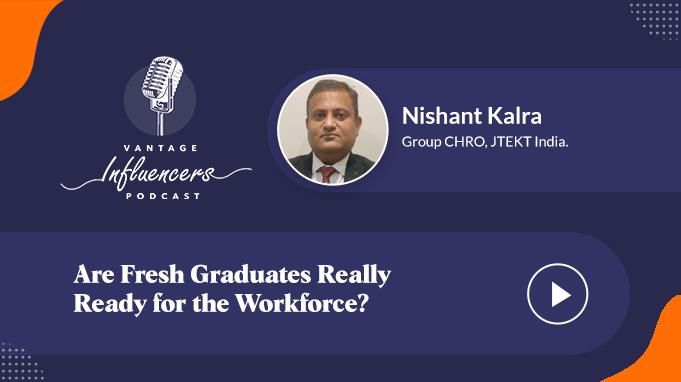
Are Fresh Graduates Really Ready for the Workforce?
Episode Overview
Nishant Kalra's central argument in this episode is that the workforce-readiness debate isn't really about who is at fault. Fresh graduates often expect rapid career growth, creative freedom, and manageable workloads, while workplaces demand adaptability, patience, and problem-solving built over time. He frames the real gap as a mismatch between expecting immediate success and the reality that value has to be proven gradually, and argues that closing it takes a mindset shift toward continuous learning and treating a career as a marathon rather than a sprint.
His most concrete contribution comes when he names the specific soft skills graduates struggle with most: communication, adaptability, and critical thinking, and lays out how to build each one. He recommends active listening, mentorship, and public speaking or writing practice for communication; exposure to new challenges and openness to feedback for adaptability; and questioning assumptions while exploring multiple solutions for critical thinking. He's equally clear that neither internships nor gig work alone make someone workplace-ready, since they tend to build narrow, task-specific experience rather than the broader teamwork and long-term project skills a full-time role demands, and that education and employers share responsibility for the gap: colleges lean too heavily on theory, while some employers expect job-readiness without investing in structured training.
Episode Highlights
- Nishant Kalra has 22 years of HR experience across manufacturing companies and now serves as Group CHRO at JTEKT INDIA LTD, a Toyota group company with eight manufacturing plants in India.
- He argues the real gap isn't lack of ability but a mismatch between graduates expecting rapid success and the reality that value is proven gradually, over time.
- The three soft skills fresh graduates struggle with most are communication, adaptability, and critical thinking, each improved through active listening, exposure to new challenges, and questioning assumptions.
- Both education and employers share responsibility for the readiness gap, since colleges emphasize theory over practical exposure while some employers expect job-readiness without offering structured training.
- Internships and gig work provide valuable hands-on experience but aren't sufficient on their own, since they often build narrow, task-specific skills rather than broader teamwork and long-term project experience.
- His advice to nervous first-time employees: mistakes are stepping stones for growth, and success comes from patience, relationship-building, and treating a career as a marathon, not an overnight achievement.
About the Guest
Nishant Kalra, Group CHRO at JTEKT INDIA LTD.
Nishant Kalra is a seasoned HR leader and the Group CHRO at JTEKT INDIA LTD., with extensive experience in HR business partnering, talent acquisition, training and development, manpower planning, and compensation restructuring. He has held key HR roles at Faurecia Automotive Seating India, Jubilant FoodWorks Ltd., and JTEKT INDIA LTD., working across cross-cultural environments to drive strategic HR initiatives for reputed organizations in India. An effective communicator and negotiator, he specializes in developing and implementing HR policies, fostering organizational growth, and building workforce capability.
Connect with Nishant on LinkedIn
Host
Sanjeevani Saikia, Vantage Influencers Podcast Host
What You Will Learn
- Why the fresh-graduate readiness gap often comes down to a mismatch in expectations, not a lack of ability
- Which three soft skills fresh graduates struggle with most (communication, adaptability, and critical thinking) and how to build each one
- Whether the readiness gap is more of an education problem or an employer problem, and why it's usually both
- How Gen Z's workplace priorities around flexibility and purpose can be reconciled with employer expectations for productivity and commitment
- Why internships and gig work help but aren't enough on their own to make graduates fully workplace ready
- What advice to give a nervous first-time employee stepping into their first job
Key Topics & Timestamps
| Timestamp | Topic |
|---|---|
| 02:20 | Nishant's professional journey and path to Group CHRO |
| 03:40 | The biggest gap between fresh graduates' expectations and workplace reality |
| 06:37 | Do fresh graduates really lack real-world skills, or are companies expecting too much |
| 09:32 | The most common soft skill gaps and how to close them |
| 12:27 | Whether Gen Z's workplace priorities clash with employer expectations |
| 14:46 | Whether internships and gig work are enough to make graduates work-ready |
| 16:50 | Nishant's advice for fresh graduates starting their first job |
Full Transcript
Click to read the full episode transcript
Welcome to the Vantage HR Influencers Podcast. This podcast is sponsored by Vantage Circle, the simple and AI-powered rewards and recognition platform for employee engagement.
Sanjeevani Saikia: Hello and welcome to another episode of the Vantage Influencers Podcast. I'm your host, Sanjeevani Saikia, and today we are diving into a topic that has been sparking endless debate lately: are fresh graduates really ready for the workforce? Every year, thousands of young professionals step out of college with degrees in hand, eager to start their careers. But the transition from classroom learning to the fast-paced demands of the corporate world isn't always smooth, and we all know it. Employers often say that fresh graduates lack real-world skills, while graduates feel that companies are expecting way too much, too soon. So where does the disconnect really lie? And more importantly, how do we bridge this gap to ensure that young talent is equipped, confident, and truly workforce ready? This conversation isn't just relevant for graduates, it's equally critical for HR leaders, recruiters, and organizations looking to harness young talent effectively. So whether you are a fresh graduate wondering how to prepare for your first job, an employer struggling to integrate young hires, or an HR leader shaping the future of workplace learning, this episode is for you. And to help us unpack this, I'm thrilled to welcome a seasoned HR leader who has seen this challenge from both sides, Nishant Kalra, Group CHRO at JTEKT India. With extensive experience in talent management and workforce strategies, Nishant has worked closely with young professionals and knows exactly what it takes to transform fresh graduates into high-performing employees. So let's begin our conversation. Hi Nishant, thank you so much for joining us today.
Nishant Kalra: Thank you, and thanks to you as well for inviting me to such a prestigious podcast. Thank you very much.
Sanjeevani Saikia: It's our pleasure to have you. I'm really excited about our conversation on the topic, are fresh graduates really ready for the workforce, and I can't wait to hear your insights and experience on this. But before we jump into the discussion, I'd love for our listeners to get to know you a bit better. So could you start by sharing a little about your professional journey so far? How did you get to where you are today? So I'd love to know about your journey.
Nishant Kalra: Yeah, so I have a total of 22 years of experience. I did my Master's in HR in 2002, and then I started working in different organizations in the manufacturing sector. Now I work with a few companies which are well-known Fortune 500 companies, including Jubilant and now JTEKT. So these are a few of the companies where I've worked, and for the last five and a half years I've been working as Group CHRO at JTEKT India. JTEKT India is a Toyota group company, and we are the world's largest steering systems manufacturing company. We have eight manufacturing plants in India, and I'm there to take care of complete HR, GA, and administration-related activities.
Sanjeevani Saikia: Thank you so much for sharing your journey with us. Once again, it's been a pleasure to have you on our show. So with your permission, I'd like to begin today's conversation on the topic.
Nishant Kalra: Sure, please.
Sanjeevani Saikia: You know, stepping into the workforce for the first time is, I guess, a mix of both excitement and uncertainty. We've spent years studying, earning the degree, and now it's finally time to put it to use. But for many fresh graduates, the transition from college to a full-time job can feel like a reality check, and it sometimes doesn't align with what they imagined work life would be. So according to you, what's the biggest gap between their expectations and what the workplace demands?
Nishant Kalra: Okay, so if I talk about fresh graduates, often they expect rapid career growth, creative freedom, and a balanced workload. But if I talk about the workplace requirement, or the demands of the workplace, it's a little different, because the workplace demands adaptability, patience, and strong problem-solving skills. So the biggest gap lies in the expectation of immediate success versus the reality of proving one's value, which can only be done with time, not overnight. Many underestimate the importance of soft skills like communication and teamwork, and feedback can be harsher than in academic settings, and tasks may feel repetitive. In student life, they experience something different every day, but in the workplace it's not like that on a regular basis, so sometimes you have to do repetitive work again and again, which creates a gap between their expectations and the reality. So I think bridging this gap requires a mindset shift: embracing continuous learning, taking initiative, and understanding that career progress is a marathon, not a sprint. It cannot be done overnight, you have to be slow and steady, contribute on a regular basis, and it takes years to achieve whatever you want to achieve. It cannot be achieved overnight. So this is, in my opinion, the gap.
Sanjeevani Saikia: Absolutely. One of the most common complaints from employers is that fresh graduates aren't really work ready. They say there's a gap: graduates have the knowledge, but they lack real-world skills. But I wonder, is that really on them, or maybe our education system isn't bridging the gap well enough, or maybe companies are expecting too much right out of the gate. So what do you think, is this more of a training gap in education, or are employers just setting the bar too high for new grads? Where do you think it lies?
Nishant Kalra: Yeah, I think it's a very nice question, and maybe it's a mix of both. Education often prioritizes theoretical knowledge over practical application, leaving graduates underprepared for workplace challenges like problem-solving, communication, and adaptability. However, some employers also expect graduates to be job-ready without investing in proper training for them. So colleges focus on theoretical knowledge, while practical application and real-world scenarios are missing. And then when graduates come in after a desired qualification, employers think, okay, they're qualified in this, so they must know this and that. So the expectation is a mix of both. I think if we have to bridge this gap, there has to be collaboration with universities to integrate more hands-on experience, internships, and industry projects. At the same time, employers should also provide structured training to fresh graduates when they join, in the form of structured induction training, so they can understand the workplace requirements and expectations, and the desired output, very clearly, along with good mentorship. That's very much required. So I'd say there are gaps on both sides.
Sanjeevani Saikia: True. Many fresh graduates, I believe, struggle with soft skills. Sometimes they have the technical know-how, but they're not very effective in how they communicate, or in their adaptability, for that matter. But honestly, we know these skills make a huge difference in the corporate world. So Nishant, for our listeners, can you help us identify some of the soft skills fresh graduates struggle with the most?
Nishant Kalra: Yeah, so as per my experience, I'd say fresh graduates often struggle most with communication, adaptability, and critical thinking. Many find it hard to express ideas clearly, handle workplace feedback, or adjust to fast-changing environments. To improve this, they should practice active listening, seek mentorship, and engage in public speaking or writing exercises, whenever they get the opportunity in college. Adaptability grows through exposure: taking on new challenges, learning from setbacks, and staying open to feedback. Critical thinking sharpens by questioning assumptions, analyzing problems deeply, and exploring multiple solutions. So continuous learning, real-world experience, and self-reflection are key to strengthening these essential soft skills, in my opinion.
Sanjeevani Saikia: Yes, absolutely. So apart from soft skills, what are some of the technical skills you think fresh graduates should be ready with? Something that's highly in demand right now, and anything apart from that.
Nishant Kalra: I think this depends on the type of industry and type of education, what kind of industry you're going into and what kind of qualification you're taking. As I mentioned, the practical aspect, not just theoretical knowledge but practical exposure during internship programs, or in a structured way of giving practical exposure to students, is very much required. Students should also participate, and if they want to make a career in a certain profession, they have to be very thorough, not only with the theoretical knowledge but also with the practical realities.
Sanjeevani Saikia: True. Now moving on, we also know that Gen Z has a very different approach to work, because Gen Z has very much entered the workplace, and flexibility, purpose, and work-life balance matter a lot more to them than they did to previous generations. But do these priorities always align with what employers actually need, or is there a bit of a mismatch that makes it harder for both sides to find common ground? So Nishant, do you think fresh graduates' work priorities clash with employer expectations, and if so, how can companies and Gen Z workers bridge that gap?
Nishant Kalra: Although you're absolutely right that there are some gaps, it requires some alignment. Employers also need productivity, commitment, and results, while Gen Z seeks flexibility, purpose, and work-life balance. So I think the clash happens when companies resist change, or when employees expect too much too soon. The key is balance. Gen Z should understand business needs and prove their value, while employers should modernize work structures to attract and retain top talent. There was a time when the carrot-and-stick approach was very common, but I think that time has changed now. Only carrot or only stick doesn't work anymore. We need to be very flexible and adopt a modernized way of working. Employers, especially those in top management, are sometimes very set in their ways and don't adapt to change, and don't understand the realities of the Gen Z mindset. So I think understanding that mindset, and modernizing the workplace, is very important. Some flexibility, adjustment, and alignment are required on both sides.
Sanjeevani Saikia: Agreed. Now moving on, here I wanted to ask something very crucial, and I believe it's highly relevant. Given that the gig economy is growing, most students are taking up internships and gig work to gain experience before landing a full-time job. Some experience is always great, but do they truly prepare someone for the realities of the workplace, or is there still something missing in making fresh grads fully work ready? Do you think internships and gig work really help?
Nishant Kalra: Yeah, I think there are always pros and cons to everything. If I talk about internships and gig work, they provide valuable hands-on experience, but they're not always enough to make fresh graduates fully work ready. Many internships focus on specific tasks rather than broader workplace skills, so they can't build broader skills while working on a focused, specific task. If I talk about gig work, it fosters independence but may lack teamwork exposure and long-term project management experience. To bridge this gap, students should seek diverse experience, take initiative in internships, and develop soft skills like problem-solving and adaptability. Employers can also help by offering mentorship, structured training, and real responsibilities, to prepare them better for upcoming full-time roles. So it's a mix, as per my opinion. I won't say internships and gig work aren't valuable, they are valuable, but I think they're not sufficient on their own.
Sanjeevani Saikia: Nishant, you've wonderfully dealt with all the questions I've thrown at you, really nice responses. But now we're arriving at the end of today's episode. Before we wrap things up, there's one more thing I'd like to ask. If a fresh graduate came up to you feeling nervous about their first job, what's the one piece of advice you would give them?
Nishant Kalra: Okay, so I'll say that your first job isn't about being perfect. It's about learning, adapting, and proving your value over time. It's your learning time. You can ask questions, seek feedback from your seniors, and don't fear making mistakes. Those mistakes are a kind of learning for your future, to make you a better professional. They're stepping stones for your development and improvement as a professional. So focus on building relationships, focus on networking and teamwork, they're equally important as technical skills. Stay curious, take initiative, and be open to challenges, they help you grow faster. Most importantly, be patient with yourself. Success is a journey, as I said earlier, not an overnight achievement. So keep learning, stay resilient, and trust that with time and effort, you'll find your place as a better professional, and you'll be able to shape your career in the desired manner, through a continuous, marathon journey. So this will be my piece of advice.
Sanjeevani Saikia: I guess that's great advice. I'm sure listeners will really appreciate that. Nishant, we've reached the end of today's episode. Thank you so much for joining us. It's been a pleasure to have you.
Nishant Kalra: Thanks a lot, thank you so much, thank you.
Thanks for listening to the Vantage HR Influencers Podcast. Please do subscribe to the Vantage HR Influencers Podcast on Apple Podcasts, Spotify, and our YouTube channel for new episodes.
FAQ
What is the biggest gap between fresh graduates' expectations and workplace reality?
According to Nishant Kalra, the biggest gap is between expecting immediate success and the reality that value has to be proven over time. Fresh graduates often expect rapid career growth, creative freedom, and manageable workloads, while workplaces demand adaptability, patience, and problem-solving that develop gradually.
Which soft skills do fresh graduates struggle with the most?
Nishant Kalra names communication, adaptability, and critical thinking as the three soft skills fresh graduates struggle with most. He recommends active listening, mentorship, and public speaking practice for communication, exposure to new challenges for adaptability, and questioning assumptions for critical thinking.
Are internships and gig work enough to make graduates workforce-ready?
No. Nishant Kalra says internships and gig work provide valuable hands-on experience but aren't sufficient on their own, since they tend to build narrow, task-specific skills rather than the broader teamwork and long-term project experience a full-time role requires.
Is the fresh-graduate readiness gap caused by education or by employers?
Nishant Kalra says it's a mix of both. Colleges often prioritize theoretical knowledge over practical application, while some employers expect graduates to be job-ready without investing in structured training, so closing the gap requires action from universities and employers alike.
Related Reading
Also listen on