Building A Future-Proof Workforce
Episode Overview
Sudarshan Bose has spent the last seven to eight years in HR consulting, most recently at Deloitte India, focused on rewards, performance, and organization design, after earlier stints at Aon and Tata Administrative Services. He defines a "future-proof" employee less by technical skill and more by mindset: people who are intrinsically innovative, willing to take risks, and see their desk job as a starting point rather than a final destination, layered with four core future skills — agility, innovation, data analytics, and influence-oriented communication.
His most pointed argument is on diversity and inclusion: he's openly skeptical of how most Indian organizations execute it, arguing D&I too often stops at hiring quotas or a wheelchair ramp instead of showing up in learning design, workload flexibility, and promotion policy. He's equally direct about retention as the real future-proofing risk — as organizations chase exponential growth, they build more dependency on the tenured employees carrying institutional knowledge, which makes retaining that core 60-65% of the workforce, not just hiring new people, the actual differentiator.
Episode Highlights
- Sudarshan Bose defines "future-proof" employees less by technical skill and more by mindset: intrinsically innovative, willing to take risks, and seeing a job as a starting point rather than an endpoint.
- Four core future skills he names explicitly: agility, innovation, data analytics, and influence-oriented communication and negotiation — beyond raw technical competence.
- He's openly skeptical of how most organizations execute diversity and inclusion, arguing it too often stops at hiring quotas or physical accommodations instead of showing up in learning design, workload flexibility, and promotion policy.
- A genuine ethical tension in reskilling: employers can't be 100% certain which skills will pay off, so they need to stay open to employees who were trained on skills that turn out not to be as relevant, rather than writing off that investment as failure.
- Balancing three tensions defines the real challenge of workforce development: individual learning interests versus organizational skilling priorities, short-term training costs versus long-term returns, and individual learning capability versus one-size-fits-all timelines.
- Retention, not hiring, is the real future-proofing risk — as organizations chase faster growth, they build more dependency on tenured employees carrying institutional knowledge, making retention of that core workforce the actual differentiator.
About the Guest
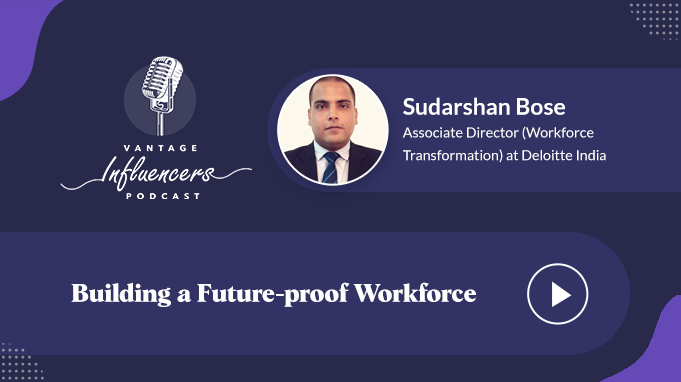
Sudarshan Bose — Associate Director (Workforce Transformation), Deloitte India
Sudarshan Bose is an Associate Director with Deloitte India Consulting, advising large and mid-cap organizations on compensation, performance, organization design, job architecture, competency design, and career development. Prior to Deloitte, he worked with Hero, Aon Hewitt, Tata Administrative Services, and Maruti Suzuki. He holds a postgraduate degree in Human Resource Management from XLRI Jamshedpur and a bachelor's in engineering from Punjab Engineering College.
Connect with Sudarshan Bose on LinkedIn
Host
Sanjeevani Saikia — Vantage Influencers Podcast Host
What You Will Learn
- Why "future-proof" is more about mindset (risk tolerance, intrinsic innovation) than raw technical skill
- The four core future skills: agility, innovation, data analytics, and influence-oriented communication
- Why diversity and inclusion efforts often stall at hiring quotas instead of reshaping learning, flexibility, and promotion policy
- The ethical tension in reskilling investment: staying open to the reality that not every skill bet will pay off
- The three real tensions to balance in workforce development: individual versus organizational interests, short-term cost versus long-term return, and varying individual learning capability
- Why retaining tenured, institutional-knowledge-carrying employees, not just hiring, is the true future-proofing differentiator
Key Topics & Timestamps
| Timestamp | Topic |
|---|---|
| 01:50 | Sudarshan's corporate journey so far |
| 03:05 | Defining a future-proof workforce |
| 08:32 | Role of reskilling and upskilling in building a future-proof workforce |
| 12:31 | Ethical considerations involved in building a future-proof workforce |
| 20:09 | Key hurdles to building a future-proof workforce |
| 24:20 | Measuring the progress of building a future-proof workforce |
| 28:53 | End note |
Full Transcript
Click to read the full episode transcript
As the world of work becomes more automated and AI-powered than ever before, it's important to make sure your employees aren't left behind like yesterday's news. That's why it's crucial to build a future-proof workforce that can adapt to new technologies and changing market demands. But building a future-proof workforce is not an easy task, especially with the ever-changing business landscape. Apart from wisdom, organizations also require expert guidance on how to move forward in this complex, ongoing journey. So whether you're a CEO, a team leader, or just a curious listener, join us as we explore what it takes to build a workforce that's ready for whatever the future throws at it.
Sanjeevani Saikia: Hello listeners, welcome to another episode of the Vantage Influencers Podcast, where we explore a wide range of HR topics designed to grab your attention and inspire you. I'm your host, Sanjeevani Saikia, and today we'll be having a conversation on building a future-proof workforce. And for that, I have with me Sudarshan Bose, Associate Director, Workforce Transformation, at Deloitte India. Hi Sudarshan. First of all, I'd like to thank you for giving your invaluable time and joining us in today's episode. Before we dive deeper into today's topic, building a future-proof workforce, could you kindly walk us through your corporate journey so far?
Sudarshan Bose: Absolutely, thank you so much for having me here — it's a pleasure. I work extensively in HR consulting these days. Over the last seven or eight years I've been doing core HR consulting, primarily around rewards, performance, and organization design. I've had the chance to work with Deloitte for the last three years, and before that I worked with Aon Consulting. I also served with the Tata Administrative Services early in my career. I completed my master's from XLRI Jamshedpur in Human Resource Management, and before that, my engineering degree, along with a two-year stint at Maruti Suzuki. That's roughly the journey and the places I've come from.
Sanjeevani Saikia: Wonderful, thank you for sharing your journey with us — you've clearly gained a lot of valuable insight along the way. With that context in mind, we can dive straight into the topic. In this episode, we'll be discussing how to build a future-proof workforce, but before we get into the ways of doing that, how would you define a future-proof workforce?
Sudarshan Bose: Just one follow-up — when you say future-proof workforce, what geography are you thinking of? Are we talking about where India stands today and its future workforce specifically, or a broader Southeast Asian or global context?
Sanjeevani Saikia: I'd particularly like to know the scenario in India, but it would be great if you could also give a brief overview of how this is playing out globally.
Sudarshan Bose: To define a future-proof workforce, we first have to define what the future itself looks like. If you look three to five years out, there's clearly some uncertainty that will continue globally — cost pressures won't die down soon, and geopolitical uncertainty continues in various forms. Looking specifically at India, two things stand out. First, FDI and FII inflows have slowed compared to the past. Second, and this surprised me too when I first saw the data, there are over 87,000 startups in India today that have some form of organized funding — likely more we don't know about. India has also been trying to bring down its current account deficit, and one clear lever for that is boosting exports — we're at roughly $750 billion in exports today, among the top five or six globally, close to Japan, and the goal is to push that to $2 trillion within four years. That means a large part of "Make in India" going forward is really about exports of both goods and services growing at a rapid pace, which means real momentum in heavy manufacturing, semiconductor manufacturing, and services uptake, assuming global demand cooperates. India is also trying to build "best-in-class," niche products domestically, because anything produced at the right cost and quality threshold becomes exportable.
Now, if you look at future-proofing the workforce specifically — the baseline definition, in my view, is people willing to take the next step toward creating change, and I don't mean small incremental improvements. I mean people who are intrinsically innovative, who realize their ambitions are bigger than what's in front of them at their desk. Those people will fill roles much faster than people who see a job purely as a 9-to-6 station. Someone willing to take risks, willing to create impact — that's the core mindset we're talking about from a workforce standpoint. On the technical side, you'll see a big uptake in core engineers across electronics, mechanical, and computer science disciplines, pharma graduates developing medicines and vaccines, and management graduates continuing to fuel the services economy through consulting, legal, and technology services.
Sanjeevani Saikia: I imagine you'd agree employers are increasingly looking for candidates who are adaptable and possess a wide range of skills applicable across different parts of the business, which makes it imperative for employees to continuously update their skills to stay competitive. What are some of the key skills employees will need to develop to remain relevant in the future workforce?
Sudarshan Bose: Let me break this into two aspects: technical skills and behavioral skills. On the technical side, my knowledge is admittedly closer to the consulting space, but you'll see continued demand for strong engineers — I was reading about our railway minister's vision recently, which isn't just about building trains that run well in India, but coaches that can eventually be exported. That captures the shift well: good technical talent who can build things domestically that eventually become exportable will be in high demand, alongside management graduates as Indian organizations and business units scale up.
On the behavioral side, if I had to name the skills for tomorrow: first, agility — how much pressure and change someone can absorb and keep moving. Second, and distinct from agility, innovation — the ability to look at your own work and create smaller opportunities that can be translated into bigger value propositions. Third, data analytics — because decisions at a global, national, or even state level increasingly need to be backed by data; it's much less likely today that an idea gets accepted without data behind it, so understanding what data you need and how to analyze it toward a logical conclusion matters a great deal. And fourth, communication — which is underrated, because I don't just mean basic communication, I mean a level of influence and negotiation. Beyond the analytics and the innovation you bring to the table, your ability to communicate that value proposition and influence key stakeholders plays a huge role in whether an idea actually gets driven forward. So: agility, innovation, data analytics, and communication/influence.
Sanjeevani Saikia: You've mentioned some really significant skills there. Moving on, as we continue exploring future-proofing the workforce, it's important to consider the ethical implications of preparing for the future of work. Could you shed some light on the ethical considerations involved in building a future-proof workforce?
Sudarshan Bose: Ethics is a broad subject, and it can mean different things across different organizations, but let me name a few considerations intrinsic to future-proofing specifically. First is equal opportunity — India will continue to see a lot of new-age talent, fresh graduates, entering the workforce, alongside a sizable cohort of employees who are 40, 45, 50 years old and may not be adapting at the same pace as someone in their 20s. Employers and institutions need to give everyone the opportunity to scale up the curve, even if the pace at which people can learn naturally varies. Second is diversity of learning approach — some people pick up data analytics quickly but need more time with change management or innovation, and vice versa; giving people flexibility in how and when they learn different skills matters, similar to how an MBA student might dislike math in year one but discover its value after a semester of macroeconomics.
Third, and I think this is really critical, is being honest that the future is genuinely uncertain, and not everything an organization invests in will show clear results. As an employer, if I'm scaling my workforce toward certain skills, I have to accept that I'll probably be right maybe 60-70% of the time, not 100%. If a segment of my workforce was trained on skills that end up less relevant than expected, the ethical response isn't to write off that investment as a failure of the employee — it's to be open to reskilling them again, because that's genuinely how the world is moving.
Sanjeevani Saikia: Speaking of diversity and inclusion, since companies are investing heavily in this area — are you satisfied with how companies are approaching their D&I initiatives?
Sudarshan Bose: This is a slightly tricky one, because there's a difference between how I feel as a professional reflecting on organizations I've worked in, versus what I observe more broadly as an individual watching the news and various platforms. I'll answer mostly from that outside-observer lens. Larger Indian organizations talk a lot about diversity internally, in leadership presentations, in board meetings — D&I strategies exist as part of broader HR strategy. Where I haven't seen much good execution is in how that strategy actually gets implemented. It can't just be diversity in hiring or diversity in promotion numbers — it has to be diversity built into policy itself, with the flexibility built in from the start. It can't be that I'm hiring a certain percentage of women purely to hit a diversity number, or that I've added a wheelchair ramp to my corporate office and called that "diversity achieved."
Real diversity means policy-enabled decisions — for instance, if I can enable people who may need more time to learn by giving them lighter workloads and more explicit learning goals, that genuinely strengthens their career trajectory over time. That's real diversity, versus, say, simply lowering the promotion bar at year-end for someone from an underrepresented background because their numbers didn't quite meet the standard — that's not the right way to think about it either. Diversity has to run through policy, learning opportunities, hiring, promotion decisions, and access to management roles — it can't be a quota system, it has to be an enablement system, where organizations are genuinely comfortable that they've created opportunities that are equal, or at least reasonably at par, so people from different backgrounds get a fair shot at different roles and levels.
Sanjeevani Saikia: It's pretty clear that future-proofing the workforce is a complex, ongoing process requiring careful planning and a real commitment to continuous learning and adaptation. What are some of the biggest challenges companies are likely to face when trying to future-proof their workforce?
Sudarshan Bose: Interesting question to start with. The biggest challenge is that the future itself is uncertain, and increasingly, people take charge of their own careers rather than relying purely on what one employer offers — which is a great thing individually, but tricky for employers, because you as an employer might want to skill someone in one direction while the employee wants to be skilled in a different one. So the first real tension is balancing individual learning interest against organizational skilling priorities — someone might want to learn AWS while the organization wants them trained in data analytics, and that has to be balanced.
The second tension is cost over time — the future is uncertain enough that export targets or growth goals might not play out exactly as anticipated, in which case an organization might pivot toward different services or rebuild internal capabilities instead. Investment in people is good, but if you're investing, you want to see returns within a reasonable timeframe, so balancing the cost of that investment against a realistic payback horizon is a real challenge. Third is capability itself, beyond interest — an organization might assume someone can learn data analytics in six months, another person in three, but the reality is some people genuinely need nine to twelve months or more, and depth of learning required can vary too. People working intensely in demanding roles, hitting every deliverable and volume target, often have very little bandwidth left for learning hours, versus people with better work-life balance who have more room to learn — and some people, even with equal time, may not pick it up at the same capability level as others. As an employer thinking about 1,000 or 10,000 people, you're not trying to move the needle for just 10-15% of the workforce, you're trying to shift 60-80% of it, so balancing for capability differences at that scale is genuinely the third big challenge.
Sanjeevani Saikia: We're arriving at the end of today's episode, but before we let you go, there's one last question both our listeners and I would love your take on — how can companies measure the success of their workforce development efforts, and what metrics should they be tracking to ensure they're actually building a future-proof workforce?
Sudarshan Bose: Very interesting question, and the exact definition will vary a lot by industry — banks look very different from FMCG companies or manufacturing setups. But at a baseline, three things stand out. First, simply put: is your overall cost of performing the job coming down over time, at a rate better than linear? If I could produce 100 units at a cost of 10 rupees and 200 units at 20 rupees, that's linear growth — but if I could produce those 200 units at 15 rupees instead, my operating margin has genuinely improved, meaning I've leveraged more return for the same proportional cost. Tracking per-capita productivity over, say, a five-year window, and whether it's growing faster than linear, is one metric organizations have tracked and will continue to track.
Second is non-financial impact goals — milestones beyond pure revenue, like a bank targeting a certain asset size, or a manufacturer targeting a certain daily or monthly production volume. Third, and I think this is the most underrated risk, is attrition — specifically the attrition of critical talent. Anyone who stays in an organization long enough builds real institutional value. In a stable, process-driven setup where not much is changing internally or externally, you can hire new people and train them at a baseline level reasonably easily. But if you're an organization trying to break out and create exponential growth, which is where a lot of Indian organizations are headed, every person on that curve is building disproportionate value, and you're also building more dependency, because everyone's running at a speed that requires matching, and a lot gets left to individual discretion — how data gets managed, how processes get handled — without extensive systems constantly checking on it. So retaining critical individuals, the people carrying institutional knowledge, becomes genuinely important. If your workforce is, say, 100 people, and 15-20% are new hires who need grooming, and roughly 60-65% form the core, experienced cohort, how you build opportunities to retain that core group is what will really differentiate future-proofing efforts in the long run.
Sanjeevani Saikia: Thank you very much for sharing your perspective — this has been very insightful. We've reached the end of today's podcast. Do you have any message for our listeners? And how can our audience stay in touch with you?
Sudarshan Bose: Absolutely, it was wonderful talking with you — a great topic for a Monday morning conversation. For our listeners, there's so much we're absorbing today as professionals — around scaling, roles, structures, opportunity — and I think the important thing is learning to process that information selectively, asking yourself honestly what actually applies to your context. Are you someone who's excellent at a specific role and should stay the course for the next five years, or someone who thrives on learning new things and should look at more diversified roles? We're not in an environment with limited opportunity anymore, and we're not in a place where the size of your role is only what an employer defines for you — a lot of people carve out broader, larger roles for themselves. Asking yourself what genuinely fits you, and then shaping a career or learning path around that, has made a real difference for a lot of the people and leaders I've interacted with, and it's something I try to apply to myself too, so I'll pass that message along. Beyond that, I'm available on LinkedIn, which also has my email — I'm always happy to engage further. Over the last year and a half, I've also been engaging with universities and various groups to discuss exactly this kind of topic, and I'm glad to continue those conversations through LinkedIn or email.
Sanjeevani Saikia: Wonderful, Sudarshan, it's been a pleasure to have you as our guest today. Your insights and expertise have been invaluable, and we're grateful for the time you've taken to share your knowledge with our listeners. Thank you so much, thanks a lot.
Sudarshan Bose: Thank you so much, hope you have a good day, and hope the listeners enjoy this one too. Thank you.
FAQ
What makes a workforce "future-proof"?
Sudarshan Bose defines it more by mindset than raw technical skill: employees who are intrinsically innovative, willing to take risks, and see their current role as a starting point rather than a fixed destination, paired with agility, data analytics ability, and strong influence-oriented communication.
What ethical considerations come with reskilling a workforce?
Sudarshan Bose highlights equal access to learning opportunities, flexibility in how people learn different skills, and honesty about uncertainty — employers can't be 100% right about which skills will pay off, so they need to stay open to reskilling employees again rather than treating an unsuccessful skill bet as employee failure.
Why does Sudarshan Bose think most diversity and inclusion efforts fall short?
He argues D&I too often stops at hiring quotas or superficial accommodations, when real diversity has to be built into policy itself — flexible workloads, learning goals, and promotion criteria — rather than lowering standards at the point of promotion to hit a number.
Why is retention, not hiring, the real future-proofing challenge?
Sudarshan Bose argues that as organizations chase faster growth, they build more dependency on tenured employees who carry institutional knowledge, making the retention of that core, experienced workforce — not simply hiring new people — the actual differentiator in future-proofing.
Related Reading
Also listen on