Civility in the Workplace: The Unspoken Superpower
Episode Overview
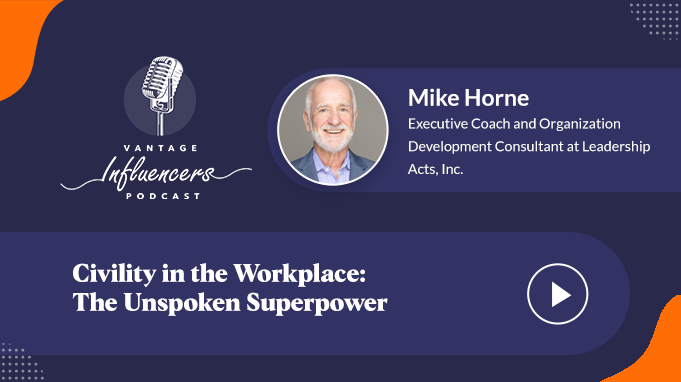
Mike Horne argues that civility is not a soft skill leaders can bolt onto a culture after the fact, it has to be built into how people lead, disagree, and make decisions every day. In this conversation, he traces civility back to something surprisingly simple: acknowledging the person in front of you, rather than treating them as a function of the org chart. He walks through how disagreement between senior leaders can be reframed as a question of facts, methods, or values rather than personal conflict, and why installing clear decision-making processes reduces the friction that often gets mistaken for incivility.
The conversation also covers how civility intersects with authentic leadership, trust, and engagement, and why treating people with dignity is not just a moral choice but a business one. Horne draws on his experience working with leaders across the US, Western Europe, India, and other regions to explain why cultural context changes how civility shows up, even when the underlying human need for respect stays constant. He closes by connecting civility to the future of work, including shorter work weeks and the rise of the gig economy, and why he believes civility will only become more essential to how organizations attract and retain talent.
Episode Highlights
- Civility means showing respect, politeness, and consideration in everyday interactions, even during disagreements.
- Leaders can navigate conflict more effectively by identifying whether a disagreement is about facts, methods, or values.
- Clear, transparent decision-making processes reduce the friction that often gets mistaken for incivility.
- Civility and diversity, equity, and inclusion efforts share the same starting point: acknowledging people for who they are.
- Cultural context shapes how civility shows up, but the underlying human desire for dignity and respect stays constant everywhere.
- A genuine habit of saying hello is often the simplest, most effective first step toward a more civil workplace.
About the Guest
Mike Horne, Executive Coach and Organizational Development Consultant
Mike Horne, Ph.D. is a seasoned global HR and organization development leader, executive coach, best-selling author, and sought-after speaker. Since launching his coaching career in 2018, he has helped leaders and teams adopt goal-directed behaviors for immediate and sustainable improvements. He collaborates with organizations like Zoll Medical, Impossible Foods, and BioMarin, and hosts The People Dividend Podcast, ranked in the top 10% of podcasts globally. Previously, he held key HR roles at Gilead Sciences, Brocade, and Genentech, and has over 30 years of experience in the field. His upcoming book, The People Dividend: Leadership Strategies for Unlocking Employee Potential, focuses on investing in employee growth to enhance organizational success. He also teaches at Golden Gate University and holds multiple coaching credentials, having earned his Ph.D. in Human and Organization Development from Fielding Graduate Institute and a Master's in HR and Organization Development from American University.
Host
Susmita Sarma, Vantage Influencers Podcast Host
What You Will Learn
- How to define civility and why it matters more than surface-level politeness
- How to work through disagreements between senior leaders using facts, methods, or values
- Why clear decision-making processes support a more civil workplace
- How civility connects to diversity, equity, inclusion, and belonging
- What global HR experience reveals about civility across different cultures
- The essential principles of a civility playbook for organizations
- Why civility will matter even more as remote work and the gig economy grow
Key Topics & Timestamps
| Time | Topic |
|---|---|
| 01:15 | Mike's corporate journey and key HR experiences |
| 03:40 | A transformative civility experience that led to workplace success |
| 05:46 | Integrating civility into leadership while driving results and accountability |
| 07:26 | Unconventional strategies to elevate civility and belonging in diverse teams |
| 08:50 | How a culture of respect enhances innovation and collaboration |
| 10:03 | Unique cultural approaches to civility and their adaptability for leaders |
| 13:10 | Top three principles for a civility playbook for organizations |
| 15:10 | The future of civility in remote work and the role of leaders in shaping it |
Full Transcript
Click to read the full episode transcript
Welcome to the Vantage HR Influencers Podcast. This podcast is sponsored by Vantage Circle, the simple and AI-powered rewards and recognition platform for employee engagement.
Hello and welcome to another exciting episode of the Vantage Influencers Podcast. In today's episode, we'll explore the power of civility in our professional lives. We'll dive into the importance of respectful communication, kindness, and collaboration in creating a thriving work environment.
So I'm your host for the show, Susmita, and today we have with us Mike Horne, Executive Coach and organizational development consultant. Join us as we share stories, strategies, and expert insights to help you foster a culture of respect and positivity in your workplace. So whether you are a leader, a team member, or just looking to improve your work relationships, this podcast is for you. Let's embark on this journey to cultivate civility together. Welcome to the show, Mike.
Mike Horne: Well, I'm so glad to be here, Susmita. Thank you so much for having me as a guest.
Susmita Sarma: Thank you so much for joining me today, Mike. Well, the topic of discussion today is civility in the workplace. Civility refers to the act of showing respect, politeness, and consideration towards others in a social interaction. It encompasses behaviors that promote harmony and constructive communication, even in disagreements. So it's about maintaining a level of decorum and kindness, and fostering an environment where everyone feels valued and heard. But it's not that simple a concept, it could easily be the focus of an entire episode, right, Mike?
Mike Horne: Of course.
Susmita Sarma: Yeah, so let's begin with the topic. Before that, Mike, would you like to share about your corporate journey?
Mike Horne: Oh, for sure, Susmita, that's very kind of you to ask. I define myself as a coach, mentor, and teacher, and throughout my career and all the roles I've had, I've worked at coaching, mentoring, and teaching. I think about my career in about three phases. I worked for some very big global consulting firms, where I was on the road one hundred percent of the time. I became a partner in one of those giant consulting firms, primarily focused on human resources. Then I had a corporate career where I led certain HR functions in very big corporations, including Marriott International, Roche Pharmaceuticals, and Genentech, along with a global telecommunications company. So, a big corporate career leading different aspects of HR and supporting top executives. In my role as a coach today, I offer coaching to executives and leaders in the C-suite, and I also run cohort programs where a company gives me a group of a few people and I work with them for six to eighteen months. Finally, because of my expertise in organization development, I write and create content on the topic, and I'm also engaged by companies and leaders for organization development activities: work redesigns, restructuring, team development. So that's my world, and so much of it is focused around my writing. My last book, Integrity by Design, and my upcoming book, The People Dividend, are both on the topics of dignity, kindness, and respect. That's why I think these issues of civility are so important in workplaces around the world.
Susmita Sarma: Undoubtedly. Thank you for sharing your experiences, Mike. And jumping right into the conversation, I'm really interested in hearing about a transformative experience, since you're such a seasoned workplace expert, where civility turned a challenging workplace scenario into a success story.
Mike Horne: That's a wonderful question. I can think about that at a few levels, so let's start small and then go big. On the small side, I was once engaged by an executive vice president in an organization to help reduce conflict between two very senior leaders who were at odds. Their disagreements, and their behavior with one another, were really impacting the team and, as a consequence, the entire organization. So I worked with that pair to increase civility. It's fine if they disagreed with one another, but I wanted them to do that in ways that were constructive, and to really discern whether the disagreement was over facts, methods, values, or something else. So that's civility at the small scale: working between and among executives and their teams, and you can do that through team-building activities too. On a larger scale, what I've done is help organizations install decision-making processes, so people are clear about the types of decisions being made, how those decisions are made, and what the roles are in decision-making. I think those are two examples of bringing civility into the workplace. Right now, I'm working on a proposal for a very large healthcare system, following the U.S. Society for Human Resource Management's big push on civility in the workplace, to train about 5,000 leaders in that healthcare system on civility at work.
Susmita Sarma: You mentioned civility and decision-making, that means civility is clearly linked to authentic leadership, which is fascinating. So how can leaders effectively weave civility into their leadership style while still driving results and ensuring accountability? Are there any particular strategies or practices you believe are essential to maintain that balance?
Mike Horne: It's such a great question, Susmita, thinking about that balance that organizations need for productivity. I've written about this before too, my book Integrity by Design is about working and living authentically, and I've talked a lot about what it means to be an authentic leader and the kinds of results authentic leaders produce in organizations. There's a well-known former CEO of a major medical device company, and a Harvard faculty member, who's often credited with coining the term authentic leadership. He described it as finding your true north, or your North Star. In all the work we do around authentic leadership, it starts with trust, and that requires a lot of contracting with employees around what's best for the organization. Engagement is a factor and a byproduct of trusting relationships, and that engagement drives the things organizational leaders and their shareholders want: better productivity, better profitability.
Susmita Sarma: Yes, and slightly on a different side, diversity and inclusion is such a trend in workplaces today. I'm curious, does it really elevate and create a sense of belonging among employees? What's the role of civility in implementing D&I strategies to foster a more inclusive environment?
Mike Horne: I think there's so much we can learn on our diversity, equity, inclusion, and belonging journey, and civility will certainly be a hallmark of any of those efforts. When I think about civility and its intersection with diversity, inclusion, equity, and belonging, it's really a common crossroads, because isn't the intent to be able to say hello to one another without rancor or judgment, without wondering which team, society, or group a person belongs to? It starts with a hello, and acknowledging people for who they are. A lot of people come to me as a coach, and I don't know what happened to them five minutes before we met, or what will happen to them five minutes after. We have a moment in time in which we can exercise our respect for one another, and in turn, our civility for each other's views and opinions.
Susmita Sarma: So important in the workplace, but at the same time, it's not just a nice-to-have, right, Mike? It should be seen as a strategic advantage. Can nurturing a culture of respect and kindness also enhance innovation and collaboration within teams?
Mike Horne: It's a little like, I read something recently, this may not be exactly on point, but it's a bit like how some people see a rainbow flag, which represents diversity, inclusion, equity, and belonging, and they get angry about it. I think what civility teaches us to do is acknowledge the other person standing in front of us. It emanates from human values. To get to your question: what company would want turnover as a result of uncivil behavior? What company would want rancor or disengagement instead of productivity? So I think investing in civility eliminates a lot of the negatives that come with uncivil workplaces.
Susmita Sarma: And with a global perspective, Mike, our audience and I would love to know, is there any unique cultural approach to civility that you've encountered in your work?
Mike Horne: All cultures are different, and that's one of the things you experience as a global human resources executive. I've been lucky to work throughout most of Western Europe, India, South America, and North America, and I fundamentally believe most people want to do the right thing, regardless of where they are on the planet, regardless of their circumstances or background. You have to be culturally aware and culturally sensitive. For me, when I was a young consultant, often the most difficult places to work were other native English-speaking countries, you go to Australia or New Zealand, for example, or the UK. As a native English speaker myself, I often assumed we shared the same views on culture and beliefs, and nothing could be further from the truth. Those moments were a real wake-up call. It was probably my early formative experiences working in the Solomon Islands, in what was described at the time as the fourth world, life on a remote speck in the Pacific, that gave me a deep appreciation for the value of dignity. No matter where a person is, no matter their station, the ability to treat others with dignity, kindness, and respect is foundational to a great relationship or a great organization.
Susmita Sarma: That should prove beneficial even when integrated into a traditional corporate setting. And do you see this in your own organizations as well? I mean, you've had the opportunity to work with people around the world.
Mike Horne: Yes, of course. When I used to manage teams in India, I managed a recruiting team there, and you have to be so aware of differences, how people treat differences, and what differences mean in different cultures, and be sensitive to that while still moving forward. That's why I think it's so important for organizations, as a way of furthering civility in the workplace, for leaders to be clear about the values they want people to embody, whether that's a value of integrity, compassion, or something else. Whatever the values are, being clear about them helps people operate from the same, or a similar, agenda.
Susmita Sarma: Yes, of course. I have a very interesting question coming up for you, Mike. If you could design a civility playbook for organizations, what would be the top three essential principles you'd want to include?
Mike Horne: If I were designing a civility playbook for organizations, the first thing I'd include is teaching people to say hello, to actually stop and say hello, not to see the person in front of you as an element of production, a cog in the wheel, but to acknowledge them as someone with unique hopes, aspirations, and dreams.
Susmita Sarma: So important, just to say hello. That doesn't mean you have to have a whole social conversation, or even that you have to like the person, it just means showing respect, acknowledging that the other person is in front of you.
Mike Horne: Yeah, that's right. So that's what I work on first, and it breaks down a lot of barriers. The second thing I work on is developing managers and leaders throughout the organization. I don't know about other parts of the world, but we have plenty of bad managers, people who get promoted for their technical abilities rather than their leadership. So I'd continue working with managers, that's the second element: acknowledging the person first, then developing managers' and leaders' own leadership ability. That way, leaders can create environments where trust is at the center of the experience. The third thing I'd do is work with the executive team on instilling and implementing the organization's values, so people are clear on them. That enables participation and helps create the kind of community that's so important in organizations.
Susmita Sarma: Lovely answer, Mike, thank you so much for that. Looking ahead, especially with the rise of remote work and evolving teams, what do you envision as the future of civility in the workplace? What role do you think leaders will play in shaping that future, and how can they ensure civility remains a priority even as work environments continue to change?
Mike Horne: It's a wonderful question. What I see moving forward with civility, and the economy, is that we're moving, at least in the United States, eventually toward a four-day work week. It's going to be a shorter work week, and I think that will happen in the next ten to twenty years. We'll also see more of the gig economy, people will have multiple jobs. The days of working for one big corporation for forty or fifty years will still be true for some people, but not for many. Between a gig economy and a shorter work week, if you want to attract and retain talent, you're going to have to focus on the basics of civility. It's the number one basic. This isn't about teaching people manners or sending them to an etiquette class, it's about instilling a deep-seated belief that humans are essential to all enterprise activity.
Susmita Sarma: Thank you so much. A big thank you for your time and the insights you shared during our conversation today. Your thoughts on civility in the workplace were not only eye-opening but also really inspiring. Your experience and strategies will definitely help shape how we approach things moving forward.
Mike Horne: It's been great to be in conversation with you today, and I certainly love this podcast. Thank you again.
Susmita Sarma: Thanks again for being so generous with your knowledge. Let's definitely keep in touch. Thank you very much. Thanks for listening to the Vantage HR Influencers podcast. Please do subscribe to the Vantage HR Influencers podcast on Apple Podcasts, Spotify, and our YouTube channel for new episodes.
FAQ
What does civility mean in the workplace?
Civility means showing respect, politeness, and consideration in daily interactions, even during disagreements. It includes behaviors that promote harmony and constructive communication so that everyone feels valued and heard.
How can leaders bring civility into difficult decisions and disagreements?
Leaders can bring civility into conflict by helping people discern whether a disagreement is about facts, methods, or values, and by installing clear decision-making processes so everyone understands how decisions get made and what role they play in them.
How is civility connected to diversity, equity, and inclusion?
Civility and DEI share the same starting point: acknowledging people for who they are rather than which group they belong to. Mike Horne describes it as a common crossroads, where saying hello without judgment becomes the foundation for a more inclusive workplace.
What are the essential principles of a civility playbook for organizations?
Mike Horne's civility playbook centers on three principles: teaching people to genuinely acknowledge each other, developing managers and leaders beyond just technical skill, and having the executive team clearly instill and model the organization's values.
Related Reading
- Respect in the Workplace: Building a Culture of Dignity
- Workplace Incivility: What It Is, Why It Spreads, and How to Stop It
- Diversity and Inclusion in the Workplace: A Complete Guide
This episode is part of the Vantage Influencers Podcast, where we bring HR thought leaders to discuss engagement, compensation, benefits, and everything related to HR.
Also listen on