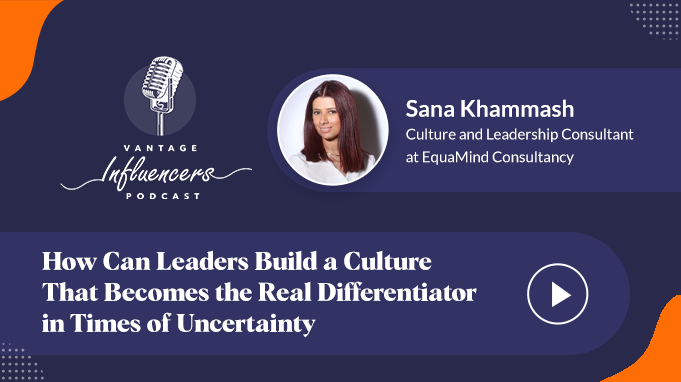
How Can Leaders Build a Culture That Becomes the Real Differentiator in Times of Uncertainty?
Episode Overview
Uncertainty has stopped being an occasional disruption and become a permanent condition of work. In this episode of the Vantage Influencers Podcast, Sana argues that this shift changes what culture is actually for. It stops being a set of statements on a wall and starts working like an organization's immune system: not something that prevents disruption, but the thing that determines how fast people recover from it. Leaders who swing to either extreme, forcing positivity or going silent to control information, end up eroding the same thing: trust. Sana walks through why culture, more than strategy or technology, is becoming the real differentiator once conditions stop being predictable.
The conversation also digs into what authentic leadership actually requires when a leader does not have every answer. Sana reframes it away from having answers and toward being honest about where you stand, building the kind of psychological safety that lets people name shared uncertainty instead of pretending it away. She connects this directly to engagement, arguing that people disengage not because leaders admit uncertainty, but because they sense leaders faking confidence. Naming the anxiety, offering the certainty that genuinely exists, and reconnecting people to a shared purpose, in that order, is what keeps teams engaged even when outcomes are not guaranteed.
Episode Highlights
- Leaders often break trust in two opposite ways during uncertainty: over-promising that everything will be fine, or going silent and hoarding information.
- Culture isn't managed by HR, it's modeled by leaders through the decisions, priorities, and words they repeat every day.
- Authentic leadership isn't about having every answer. It's about being honest about where you stand and creating psychological safety for people to admit uncertainty too.
- Culture works like an organization's immune system: it won't stop disruption from happening, but it determines how fast people recover from it.
- Engagement doesn't mean positivity. Naming the anxiety, giving people the certainty you actually have, then reconnecting them to purpose, drives real engagement.
- A resilient culture is rooted and responsive: clear on its values, like a bamboo tree's roots, but flexible enough to bend with changing conditions.
About the Guest
Sana Khammash, Culture and Leadership Consultant, EquaMind Consultancy
Sana Khammash brings more than 17 years of experience working across multinational organizations in the Middle East, with a specialty in culture and organizational development. She works with companies across industries through a consultancy, training, and coaching approach, holding certifications including an ICF-accredited coaching credential, a Hogan-certified coaching qualification, a leadership studies certification, and a master practitioner credential in NLP. Her work centers on helping leaders build cultures of trust, psychological safety, and resilience, particularly in times of uncertainty and change.
Host
Riha Jaishi, Vantage Influencers Podcast Host
What You Will Learn
- Why leaders break trust when they either over-communicate false certainty or go silent during uncertain times
- What authentic leadership looks like when a leader doesn't have every answer
- How to build psychological safety so people can acknowledge uncertainty together
- Why culture functions like an organization's immune system during disruption
- How to keep employees engaged without pretending everything is fine
- How to build a culture that is rooted in values yet flexible enough to adapt
Key Topics & Timestamps
| Timestamp | Topic |
|---|---|
| 02:55 | What leaders often get wrong about culture during uncertainty |
| 05:42 | What authentic leadership looks like without having all the answers |
| 10:18 | How culture shapes the way employees respond to change |
| 14:04 | How leaders can keep employees engaged without pretending everything is fine |
| 20:04 | How to build a culture that is resilient yet flexible enough to evolve |
| 24:07 | Why culture may become a bigger differentiator than strategy or technology |
Full Transcript
Click to read the full episode transcript
Welcome to the Vantage Influencers Podcast. This podcast is sponsored by Vantage Circle, the simple and effective recognition platform for employee engagement.
Riha Jaishi: Hello, everyone. Welcome back to another episode of the Vantage HR Influencers Podcast. I'm your host, Riha Jaishi. And today we're talking about something every leader is being tested on right now, that is, how to build a workplace culture that can stay strong, clear, connected, even when the business environment feels uncertain.
Now, change is no longer occasional. It is part of how organizations operate every day. Teams are dealing with shifting priorities, evolving employee expectations, market pressure, and new ways of working. And in these moments, culture becomes more than just a set of values. It becomes a real force that shapes how people respond, collaborate, make decisions, and keep moving forward. But the bigger question here is, how can leaders actually create a culture that does not simply survive uncertainty, but helps the organization stand out because of it? And to explore this, I'm joined by Sana Khammash, Culture and Leadership Consultant at EquaMind Consultancy. Welcome to this show, Sana. It's a pleasure to have you with us today.
Sana Khammash: Thank you, Riha. The pleasure is mine.
Riha Jaishi: Okay, so to kick things off, Sana, can you briefly take us through your professional journey so far? We are eager to learn about your journey.
Sana Khammash: Thank you, Riha. My journey is mainly a human-centered one, let me say. I started my career in the HR field with more than 17 years of experience in the Middle East region. I've worked with multinational companies where I covered different areas of HR expertise, so I'd say I've done it all. My specialty is in culture and development, and I've also worked with companies from different industries in the region through a consultancy, training, and coaching approach. I'm a certified coach from the ICF, a Hogan-certified coach, certified through the Center of Leadership Studies, and a master NLP coach as well. So that's my journey in a nutshell.
Riha Jaishi: That's such an inspiring journey, Sana. Thank you so much for sharing your experience.
Sana Khammash: Thank you.
Riha Jaishi: Okay, so now, with your permission, I'd like to delve further into our topic. Shall we?
Sana Khammash: Yes, of course, let's do that. It's an interesting topic, and I think it's a hot topic at the moment.
Riha Jaishi: So, Sana, when uncertainty hits, what do you really think leaders usually get wrong about culture? What do you have to say about this?
Sana Khammash: Okay, so we're living in a time of uncertainty, and I see leaders go to one of two extremes. They either over-communicate, saying that everything is going to be fine, trust the process, it's okay, or they stay silent, thinking that withholding information gives them control. Both approaches break trust in the organization. You need to know what to communicate, when to communicate it, and how to show up, and it's okay not to know everything.
The other mistake I see is that leaders hold HR accountable for managing culture. But culture isn't managed by HR, it's modeled by leaders in every decision they take, in every word they say, in how they communicate, who they protect, and what they prioritize. It's not something that's managed by HR, it's something that's modeled by leaders.
I always say in my sessions and my training that change is the only constant in life, and change creates uncertainty. With everything happening, especially in the Middle East, the geopolitical situation and constant change create uncertainty. The organizations that survive aren't necessarily defined by what they do or how they present themselves as an organization.
Riha Jaishi: Sana, thank you for sharing such a fresh take on the importance of culture and leadership, particularly in times of uncertainty. Self-judgment often makes it harder for people to face uncertainty. And like you emphasized, change is the only constant. That's the biggest takeaway, people generally know that change is inevitable, we can't stop or skip it. But it's during these uncertain times that people, companies, and leaders tend to fall apart. At the same time, leaders carry the major responsibility of leading the company and becoming the model for their employees out there.
Sana Khammash: True, one hundred percent. And this is what differentiates a leader from a manager.
Riha Jaishi: Okay, so moving forward, Sana, what does authentic leadership look like when leaders themselves do not have all the answers?
Sana Khammash: It's a very interesting question, because people think leaders should have all the answers. Authentic leadership isn't about having all the answers, it's about being honest about who you really are, where you stand, and how you lead people at all times, whether it's a time of uncertainty or any other time.
Emotional intelligence and adaptability have been ranked as the top leadership competencies for 2025 and 2026, and if you look at the data from previous years, half of organizations have moved toward naming them the top competency. Emotional intelligence has four pillars, and the first and most important is self-awareness: understanding yourself, your uniqueness, your capabilities, your abilities, and being honest about what you stand for.
Let me give you an example from a recent organization I worked with, where leadership demonstrated authenticity by being honest in a time of uncertainty. Among the initiatives they ran was a focus group, a round table with about 50 managers from the organization. In that focus group, there was no pretending to have all the answers. Leaders acknowledged the uncertainty and were honest about what they knew, then asked people what they wanted. That created psychological safety and reduced the distance between leaders and employees. It wasn't only employees who were uncertain, leaders were being transparent too, and that creates more trust. I think that's the most important thing a leader can do, create trust.
Riha Jaishi: Sana, you've beautifully addressed this aspect of leadership. There's a common assumption that leaders should have all the answers to every question, but that's far from true. Like you said, it's more about being authentic and vulnerable whenever such situations come into the picture. I really liked how you highlighted emotional intelligence, empathy, and adaptability as crucial for leaders, and that example about a group of leaders coming together, acknowledging the uncertainty, and creating psychological safety. That's a big takeaway, a unique factor in building trust. Ultimately, it's all about trust, right?
Sana Khammash: Yes, building trust, I think it's the most important thing. Let me take one step back. When we think about leadership in general, whether it's a time of assurance or a time of uncertainty, what is leadership? If you search the definitions online, you'll find many different meanings. But the definition I feel is most direct is that leadership is about creating the highest influence. It doesn't mean only managers can be leaders, anyone in an organization can be a leader by how they create influence. As a leader, you want to create the highest influence on engagement and on performance. There's no single formula for everyone, but there are pillars that, when you stick to them, help you create that influence.
Riha Jaishi: Absolutely, well said, Sana. Okay, so moving ahead, Sana, how can culture influence how employees respond to change, disruption, or tough business decisions?
Sana Khammash: Culture is the lens through which you look at an organization. It shows how people deal with each other, how leaders show up, how decisions get made, and how work gets done, not only in certain times but in uncertain times too, how you manage challenges and role model behavior day after day.
I want you to imagine culture as an immune system. Does your immune system always prevent you from encountering viruses? No, an immune system determines how quickly you recover from illness. Culture works the same way. If you have a strong culture, you might still encounter disruption from the outside, but how you respond to it, how quickly you react and recover, that's what culture really is.
I believe companies that have core values and real commitment to them create psychological safety and demonstrate it daily. It's not just statements on the wall. Sadly, when I work with organizations, I often see nice value statements on the wall and on the website, but when it comes to reality, people don't know what those values actually mean in practice. The more clearly and consistently we practice these behaviors daily, the stronger our immune system becomes for dealing with unexpected or unpleasant events.
Riha Jaishi: Sana, the very first thing you said really caught my attention, comparing culture to an immune system. That's such a fresh perspective, culture as the immune system of an organization and how it responds to disruption. And this point about how daily behavior builds that immune system is a big one. It's not enough to just have core values without living by them, it's the daily behavior that shapes that culture and immune system.
Sana Khammash: Yeah. Interestingly, in one of the organizations I worked with, we changed the word "values" to "behaviors," because we didn't want to just put big words on things. Values mean behaviors. When I say "voice your opinion fearlessly," that's something people need to demonstrate, and we show them how to do it. It's a daily practice. I've seen organizations treat building a cultural framework as a one-time job, working on values once and moving on. But it's not a one-time job, it's ongoing, it has to be practiced daily.
Riha Jaishi: Yes, it's a constant practice. Okay, great, so moving ahead, Sana, when uncertainty increases, employee anxiety increases too, that's a given. So how can leaders keep people engaged without pretending everything is fine?
Sana Khammash: The common myth here is that engagement means positivity, and I think that's simply not true. Engagement means finding real meaning, real meaning at work, and real meaning for leaders. Studies show that leaders who are purposefully connected to their organizations perform far better and are more results-oriented than other leaders.
So what do I advise organizations to do? Connect people back to purpose, but acknowledge the moment first. There are three steps. First, name the anxiety. Acknowledge that anxiety exists and show people that you're on the same page with them, don't pretend everything is okay, tell them it's not okay, create the safety, we're all on the same page. Second, give people certainty, certainty about the things you do know. For example, if you're going through a restructuring, people will naturally feel uncertain and disengaged. You may not be able to share outcomes yet, maybe it's an exercise that takes a year or so, don't commit to outcomes, but you can commit to how decisions will be made, the timeline, and how people will be informed and updated. Assure people with everything you are sure about. Then, create meaning, refocus people on purpose. We talked about leaders being eight times more engaged when connected to purpose, the same is true for employees. There's a whole course I run on this, and it showed a great impact, something like a 13 percent increase in engagement, just from connecting leaders and their people back to why they're coming to this work in the first place.
Don't fake it, because people know when you say things that aren't real, they're smart enough to know. So you don't need big statements, just be authentic and real, acknowledge, assure, and then connect to purpose. That's when people become more engaged. According to Gallup, only 30 percent of employees worldwide are engaged. This is the lowest it's been, and it's alarming.
Riha Jaishi: Sana, you began with that myth-breaking statement that engagement isn't equal to positivity. That's the biggest myth-breaker, it's not about positivity, it's more about connection to purpose, like you mentioned. And I really liked how you emphasized acknowledging the uncertainty, giving assurance to employees, and then connecting them with purpose. That journey itself is central to leadership.
Sana Khammash: True, a hundred percent. I think this is the bread and butter. Let me add one more thing. I use this with leaders in my coaching sessions, something I call the clarity anchor conversation. I always work with leaders on three things that should never change no matter what: values, commitment to people, and direction. When these three are well defined, people feel engaged no matter what happens.
I can tell you a story from a time of uncertainty, a long story from about 20 years back, even before I joined, but I was impressed by it. At one company, there was a financial crisis and bonuses couldn't be paid, but because those three things were clear, employees stayed engaged. They scored higher on the annual engagement survey, because the leader was only authentic and transparent with them. He told them, yes, we're all going through anxiety, I'm affected as well, but here's why we're taking the decisions, and this is why we're here to work.
Riha Jaishi: Absolutely, that authenticity is what won the trust of the people. Had the leader been unauthentic and covered things up, things would be different. But this is a true example of authentic leadership.
Sana Khammash: Yes, a hundred percent. When you look at the formula for creating trust, authenticity comes first, followed by consistency and transparency. Those are the three main components: authenticity, consistency, and transparency. Authenticity is always the foundation.
Riha Jaishi: Absolutely, true. Okay, so Sana, moving ahead, how can leaders build a culture that is resilient enough to handle uncertainty but flexible enough to evolve with it? What do you have to say about this?
Sana Khammash: When you look at the market, you'll see organizations acting on both extremes. Some organizations are very rigid in their culture, clear and consistent, but fragile. Others are so flexible that they have no identity. So why not have a mix of both? That gives you a rooted and responsive culture, rooted in values but flexible in approach.
Again, behaviors shouldn't just be a statement on the wall, they need to be rooted in the culture. So when I tell people transparency is one of our values, I ask what transparency actually means for the organization and how people should demonstrate it. That's what we work on in training sessions, embedding the values, because it's easy to write nice statements about transparency, authenticity, and agility, the real question is how we actually practice them.
So tell people what transparency means when things get tough, when they walk into a difficult Monday morning meeting, how should they demonstrate it? Then you need to build psychological safety so everyone feels safe bringing their real selves, expressing themselves, and voicing their opinions. You're embodying the culture and modeling how to approach challenges.
And the most important thing is developing leaders to be more adaptable. When people ask me what I provide as a consultant, I say culture and leadership, and I don't see them as separate, because leaders are the ones who shape the culture. You can have the best framework, the best consultants, the best resources, but if you don't have the right leaders who are adaptable and resilient enough to build a culture of resilience, none of it will stick. Adaptability is one of the pillars we teach in resilience, being able to accommodate change.
Riha Jaishi: Well said, Sana. The emphasis you placed on adaptability in leaders is a crucial factor here. In times of uncertainty, resilience and adaptability help leaders face those uncertain times, and that's more of a flexible approach, learning from a difficult situation and coming out of it having evolved, rather than just surviving it.
Sana Khammash: Right, but even with adaptability, you need a solid culture and values. Imagine a bamboo tree, it's very solid, and whatever the weather, it won't break, because its roots are very strong, it deals with it, it doesn't break. That's how we want culture to be, resilient, deep on the root, but it can move with the wind, with the wave, that's fine, we adjust the approach, but we're clear on what we want.
Riha Jaishi: Yes, absolutely. Okay, so before we wrap up our session, Sana, looking ahead, do you think culture will become a stronger differentiator than strategy or technology? What do you have to say?
Sana Khammash: I think it already is a differentiator. When you ask people why they want to join an organization, a very high percentage say they want to join because of the work environment or culture, I can't recall the exact figure, but it's significant. Strategies can be copied, and technologies can be purchased, I'm not diminishing the work of good consultancy or good strategy work, that work is very valuable. But culture can't be created without the people who are creating and role modeling it.
You can put the best framework on your website, on your proposals, on your walls, but if you don't demonstrate it, it won't be something that differentiates you as a culture and as an organization. I've seen this especially in companies that are growing into larger enterprises and taking on investors, because they don't have a clear culture, they struggle a lot. They face high turnover and a lot of gossip because there's no strong, solid culture in the organization. Even big organizations can fall because of culture, and people will leave, you'll lose the best talent.
Everyone talks about wanting to attract the best talent in the market, and you see governments like the UAE and Saudi Arabia, with their Vision 2030 initiatives, really focusing on developing high-potential talent. Those high-potential talents won't be attracted to an organization that doesn't have a defined culture, I don't want to say a polished culture, because that sounds ideal and perfectionist, but a defined culture, one that defines how people live, interact, take decisions, and what they stand for.
Riha Jaishi: Sana, that's such an interesting perspective. Like you said, strategy can be copied, technology can be purchased over time, but culture, which you emphasized, can't be created or replicated without its people, because it's built through everyday behaviors and trust.
Sana Khammash: Yes, a hundred percent. People are at the center, the root of culture. It's the heart of any organization, and it's not something you can copy. You can bring any value statement and copy it from anywhere, but if it's not truly role modeled, it means nothing.
Riha Jaishi: Absolutely, that's why culture differs from organization to organization. No two organizations have a similar culture, it differs, right?
Sana Khammash: Yes, definitely, not at all. You'll find people who will accept lower salaries, lower compensation, because of a culture where they feel they can thrive and be themselves. It provides a lot of psychological safety, they align with the values and the meaning of the work. And by the way, we see this a lot in Generation Z. Millennials, myself included, didn't pay that much attention to this early on, but the new generations coming into the market, including Generation Alpha, who will start entering the workforce in about ten years, so it's not very far off, they really care about the cause and the purpose, and what the organization stands for, and how it treats its employees.
Riha Jaishi: Okay, so Sana, we've finally come to the end of our session. Thank you so much for joining us today and sharing your incredible insights. It's been a pleasure hearing your perspective on leaders taking the central role in building a culture during times of uncertainty. We truly appreciate your time and your expertise, and I'm sure everyone tuning into this session is inspired by your expertise and is walking away with a wealth of information to think about.
Sana Khammash: Thank you. The pleasure is mine. I hope everyone gets at least one value out of this session.
Riha Jaishi: Yes, definitely, they will. Okay, and to our listeners, thank you for tuning in. We hope you found today's conversation as enlightening as we did. So until next time, take care, and we'll see you soon.
Thanks for listening to the Vantage Influencers Podcast. Be sure to subscribe on Apple Podcasts, Spotify, and our Vantage Circle YouTube channel for the latest episodes. We'll see you next time on Vantage Influencers.
FAQ
What do leaders often get wrong about culture during uncertainty?
Leaders tend to go to one of two extremes: over-communicating false certainty, or staying silent to maintain control. Both approaches break trust. Culture also isn't something HR can manage on its own, it's modeled by leaders through the decisions, priorities, and behaviors they demonstrate every day.
What does authentic leadership look like when a leader doesn't have all the answers?
It isn't about having every answer. It's about being honest about where you stand and creating the psychological safety for people to acknowledge shared uncertainty together, rather than pretending everything is under control.
Does engaging employees during uncertain times mean staying positive?
No. Engagement means finding real meaning, not projecting positivity. The approach that works is naming the anxiety, giving people the certainty that genuinely exists, and then reconnecting them to a shared sense of purpose.
Can culture really become a bigger differentiator than strategy or technology?
Strategy can be copied and technology can be purchased, but culture can't be replicated without the people who role model it every day. That makes a well-defined, consistently practiced culture one of the few differentiators competitors cannot easily copy.
Related Reading
Also listen on