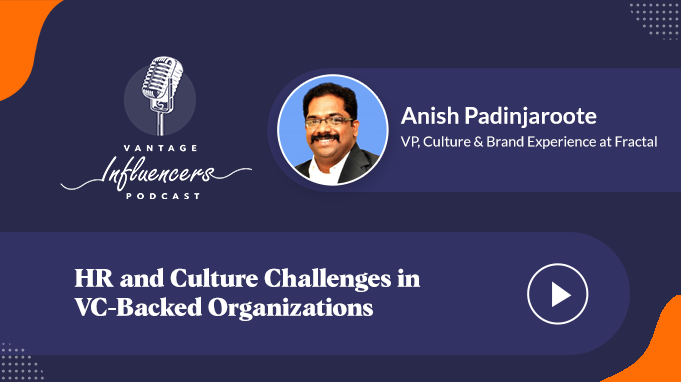
HR and Culture Challenges in VC-Backed Organizations
Episode Overview
Anish Padinjaroote opens this episode with a blunt take on what actually happens once venture capital enters a growing company: hiring accelerates, performance metrics tighten, and the hustlers who built the company from scratch suddenly have to share the room with professional managers hired for scale. He walks through why that shift breeds anxiety, imposter syndrome, and a very real fear of job loss among early employees, and argues that founders, not HR alone, carry the responsibility for easing that transition. From there, he makes the case that a strong employer brand for VC backed companies has almost nothing to do with ping pong tables or free snacks. It comes down to two things: a vision and mission that candidates can rally behind, and work that is genuinely cutting edge.
The conversation then turns practical. Anish lays out a three step approach to keeping culture intact through rapid scaling: codify your values before you need them, align your leadership team around them, and design onboarding so new hires absorb the culture from day one. He also shares two concrete examples of how AI powered virtual assistants can plug gaps that traditional HR structures cannot, keeping new hires engaged during long notice periods and coaching first time managers with real data on their teams. The discussion closes with two harder problems: why the majority of mergers and acquisitions fail on cultural integration rather than financials, and what it takes for a VC backed company to protect its innovative edge as it grows from a handful of founders into a large organization.
Episode Highlights
- Why venture capital funding usually arrives once a company already has scale, and how that changes hiring pace, performance metrics, and the balance between early hustlers and incoming professional managers
- The two things Anish believes should anchor employer branding for VC backed companies: a clearly articulated vision and mission, and the nature of the work itself, rather than perks like free food or ping pong tables
- A three part playbook for protecting culture through rapid scaling: codifying values, aligning leadership around them, and designing an onboarding experience that immerses new hires in company rituals from day one
- Two practical ways AI powered virtual assistants can support HR, from closing the engagement gap between offer and joining date to coaching first time managers with real data on their teams
- Why Anish estimates that 70 to 80 percent of mergers and acquisitions fail due to poor cultural integration, and the due diligence steps that reduce that risk
- How flat hierarchies, smaller team sizes inspired by the Dunbar number, and genuine obsession with the client's problem help VC backed companies keep innovating as they mature
About the Guest
Anish Padinjaroote, Vice President of Culture & Brand Experience at Fractal
Anish brings more than two decades of cross functional experience in engineering, operations, sales, product development, and HR across India, the US, and the UK. His career began in sales, moved through a stint as a Java developer, a project management role in the UK, and operations in investment banking, before shifting into HR leadership. He later spent almost three years running his own AI in HR startup before returning to the corporate world, where he has spent close to seven years at Fractal, first leading HR and now heading culture, social media, and brand experience. He has a proven track record of delivering results in fast paced, high growth, and complex environments across sectors including IT, ITES, GCC, retail, energy, AI, and consulting, and is immensely passionate about scaling through culture, technology, and data to strengthen employee engagement. He believes in mindfulness, being biased to action, gratitude, leading from the back, and being nice to people, and describes himself as a lifelong learner, avid reader, biker, wannabe chef, photographer, and writer in the making.
Connect with Anish on LinkedIn
Host
Sanjeevani Saikia, Vantage Influencers Podcast Host
What You Will Learn
- How to recognize the early warning signs that venture capital funding is about to reshape your company's hiring, performance management, and culture
- How to build an employer brand around vision and cutting edge work instead of surface level perks
- A repeatable framework for codifying values, aligning leadership, and designing onboarding so culture survives rapid headcount growth
- Where AI virtual assistants can realistically help HR close engagement gaps in hiring and manager development
- What to prioritize during merger and acquisition culture due diligence so you are not part of the majority that fails
- Why flatter hierarchies and smaller team structures help VC backed companies protect innovation as they scale
Key Topics & Timestamps
| Timestamp | Topic |
|---|---|
| 00:00 | Introduction and why culture challenges in VC backed organizations matter |
| 02:08 | Anish's 24 year career journey across sales, engineering, operations, and HR |
| 04:58 | How venture capital funding reshapes HR strategy and workplace culture |
| 09:53 | Building an employer brand that VC backed companies can sustain |
| 14:07 | Preserving core values and culture through rapid scaling |
| 18:52 | Using AI chatbots and virtual assistants in HR |
| 26:15 | Handling investor pushback on hybrid and remote work policies |
| 30:04 | Cultural integration challenges in mergers and acquisitions |
| 34:19 | Keeping innovation alive as VC backed companies mature |
Full Transcript
Click to read the full episode transcript
Welcome to the Vantage HR Influencers Podcast. This podcast is sponsored by Vantage Circle, the simple and AI-powered rewards and recognition platform for employee engagement.
Sanjeevani Saikia: Hi listeners, I'm your host Sanjeevani Saikia, and I'm back with yet another episode. Today, we have with us Anish Padinjaroote, the Vice President of Culture and Brand Experience at Fractal. Anish believes in a very simple philosophy, that is happy bosses make happy employees and happy employees make a happy company. Currently, he's on a mission to help business leaders with great workplace experience and culture. I believe this could be the very reason why he has agreed to have a conversation with us on the topic, HR and Cultural Challenges in VC-backed organizations. Now, you must be wondering why this topic and why only the VC-backed organizations particularly. Well, the reason is actually very simple, it's a crucial topic. In the very first quarter of 2024, global venture capital funding grew by approximately 16% quarter over quarter, reaching $89 billion distributed over 4,600 deals. The US experienced the most substantial spike with a 72% increase in funding. These stats from Bain & Co. show that VC-backed organizations are on the rise. But beyond the numbers, there's a bigger story, one of rapid scaling, cultural challenges and evolving HR practices. That's also precisely why we are here today, to explore how HR professionals in these organizations can navigate these complexities and build a thriving workplace culture. So, without further ado, let's begin the conversation. Hi Anish, thank you so much for being here with us today. Before we jump into today's topic, HR and Cultural Challenges in VC-backed organizations, can you kindly give us a quick rundown of your professional journey so far?
Anish Padinjaroote: Sure, sure. Nice joining this call. Sanjeevani, thanks for inviting me. So, I have about 24 years in the corporate so far. So, my career here has been a roller coaster. So, I finished my graduation in Chennai in physics, and my first job was, particularly even before finishing the college, my first job was in sales, I was selling credit cards. Then after my college, my first job was as a Java developer. I did that for about two years, then went to UK as a project manager, then moved into again a sales role, enterprise software sales role. From there, moved into operations for one of the investment banking units of a company, but there for about two, three years of that. There, I think they gave me an opportunity to move into HR. We had some people issues and stuff and they said, "No, why don't you come and solve these problems for us?" And that's how I came into HR. There, I was heading business HR for all over their India presence, then moved on to another company heading HR. It's also IT company, basically, a software services company. After that, I started my own startup and did it for almost three years. It was into AI in HR, but miserably failed. Came back to corporate in the current company. I've been with the current company for about seven years. I've been leading HR for Fractal for some time. Now, I'm leading culture, social media, and brand experience for Fractal. That's about me from an overall career perspective, married. I live in Bangalore with two boys and my wife. That's it.
Sanjeevani Saikia: Wonderful. Thank you so much for sharing your journey with us, Anish. It's great to have you on the show. With your permission, I'd like to begin today's discussion on the topic. Would you like to go for it?
Anish Padinjaroote: Sure, sure. Go on.
Sanjeevani Saikia: Wonderful. Okay. I'm sure you'll agree that with the arrival of substantial venture capital, organizations often undergo transformations, and that to rapid ones, I suppose. Now, this influx can drive aggressive growth strategies and necessitate swift changes in HR policies. It's obvious that these changes will have an influence on core values and everyday interactions within the company. How do you see the influx of venture capital impacting the HR strategies and cultural dynamics within an organization?
Anish Padinjaroote: Sure. That's a good question. It's a good question. I think as VCs come in, they usually come in for the scale of the organization, usually unless if it is a deep tech or a blue ocean product companies, they go at seed. But otherwise, it's usually VCs come at the scale stage. So when they come in, I think some of the changes which happens in the companies, number one is the hiring. The hiring has to be rapid scale because if you have a scale, you need more people into the company. So that basically comes in. Performance focus, still a VC come in. I mean, before the VC come in, it's mostly founder-led and everything, right? People are mostly hustlers. Everyone in the team will be hustlers. But once a VC comes in, then there'll be certain level of professionalism that is expected. So that comes with a lot of performance, you know, driven metrics and other stuff. Retaining talent will be a challenge because you already have a set of hustlers who's been working and been able to grow the company so far. But to scale, you need different type of people. People who have seen scale and they may be hustlers plus hustlers plus managers, right? So when they come in, there'll be a lot of rift. Retaining talent, the old talent versus new talent will also come in. Those are some of the impacts which I can think of. Part of that, some structural changes, right? Because one of the core things happens when a VC comes on board is they look at the structure of the company, how the company is and what is the communication flow and what's the relationship between the founder plus the core team plus the execution team. All this needs to change. So overall, it's a big change management impact that happens which needs to be, you know, looked up critically and handled very well. Otherwise, you know, most of the problems keeps in which may also cause the failure of the particular company, right? But that's a core element, an impact that happens.
Sanjeevani Saikia: Yeah. You know, I think there has always been a lingering fear among employees that they may lose jobs as soon as, you know, the company gets funding or new people come into control. Why do you think that fear particularly exists? Why is there a notion for that matter?
Anish Padinjaroote: I think for most of it, I don't think it is very prevalent unless and until, you know, we basically have, as I said, right, the hustlers when they join a startup. They may have, let's say, two, three years experience or even freshers who join. They will work in multiple roles and they've developed everything. And suddenly a VC comes and the professional managers come in. There is a level of imposter syndrome which comes into play. Some level of self-doubt, some level of questioning their own identity. Okay, what am I doing now? You know, now since the company has grown, am I in the position to scale with the company also, right? So hence, some people, if they are not able to scale with the company scale, they will have a fear of job loss, right? Not just job loss, but also their importance in the particular startup or a company. So that's where the problem happens. But mostly, I would say it is the founders who have to handhold and necessarily come on board to ease this change, right? We can't magically expect to, okay, install a HR team and that team will come and solve for all this. But I think founders along with the VC backers have to ease into these core employees or hustlers, as I call them, to be secure in the way that they perform.
Sanjeevani Saikia: Anish, I don't know whether you'll agree with me or not on this, but I believe VC backed organizations must really craft compelling employer brands to stand out and attract up to your talent. And it's not just a matter of offering competitive salaries or simply just advertising to be a big name, but creating an environment that resonates with potential employees' values and career aspirations. So you may differ, but if you agree, can you tell us how can VC backed organizations build and maintain a strong employer brand to attract top talent?
Anish Padinjaroote: Absolutely. I think it's a very important question, right? And there's a lot of trade-offs. One has to think about this also. As I said, VCs usually come from the scale of the organization. And as we scale, one of the core important points is to attract great talent from the industry. And employer brand is one of the core element to attract the great talent, right? And I completely agree that one needs to focus on employer brand, and particularly for a VC backed organization. Initially, I think their biggest moat is their vision and the work that they do, right? Apart from anything else, of course, there are some regular kind of table stakes, like good compensation and all that is there. But I think the key moat would definitely be how they articulate the vision and mission of the company. Number one, and number two is the work itself, right? That's the moat because people join these kind of companies for the kind of work, cutting-edge work that they can do, right? So those two are the key elements where the entire employer brand has to be focused on, rather than just saying, okay, we also do work-life balance or showing some carrots off. Okay, we have ping pong tables, free food, and all those kind of things. While all this is okay, but those are not the key elements of employer branding, right? For me, I think the two key elements of employer branding is number one, what is the company or why does the company even exist, right? That's the vision and mission, you know, is it clearly articulated? Does it rhyme well with the TG, which is a target group of candidates who would want to work for this company? And number two is basically the overall work itself, how cutting-edge it is, and how can they learn and grow faster with the company, right? These are the two elements which should be blown up, and strategies of employer brand should be around these two things is what I think.
Sanjeevani Saikia: Yeah, so when there is VC funding, like you have mentioned the two elements, one is the vision and mission, what is the company, what it really stands for, and overall the work itself, how they are learning and growing. So what is the impact on these two areas? How do the new owners, they kind of work out with that?
Anish Padinjaroote: I think it all depends on the context, right? Number one, why did they first invest? They would have definitely invested because they saw the company going far and wide. So number one is that concept, if they understand that context well, if they understand what the founders basically stand for, I think those are the two basic things, right? The context of the business from a market landscape and the context of the founders, why they are doing it and how passionate they are in the overall game. Those two, if that is something the VC, the new owners as you call them, have an understanding around, then it should be a much easier journey towards scale than otherwise.
Sanjeevani Saikia: Yes. Again, it is no secret that rapid growth is often a key objective for VC-backed organizations. That should be the case, in fact. However, the accelerated expansion can put immense strain on the company's culture and core values. And new employees join en masse and processes evolve quickly. There is always a risk of losing the very essence that made the company attractive to investors and early employees. Anish, here again, could you guide us on how can HR professionals ensure that the company's core values and culture are preserved during periods of fast expansion?
Anish Padinjaroote: Super. This is a super important question, actually. I think culture basically forms from the leader or from the person who starts the company itself. That is how the culture forms. And in the early stage, usually the culture and the decision making everything happens in a smaller group, so people understand each other very well. And it is more of a group of friends coming together and working in building something together. But as we scale, that is where the problem happens. A small group, let's assume a group of people in a room develops into a city, then a village, then maybe a state and country. That's how the scale grows. As the scale grows, the moment you hit 100+ people in a company, that's when your culture, your values, everything gets questioned. And there's some level of destabilization, some level of identity crisis. All this starts happening, which if we don't address it in the beginning itself, it will definitely pose a lot of more difficult challenges for the company. Some of the things, definitely HR, I would say HR and the leaders of the organization, particularly the founders and the backers and everyone should definitely think of doing. Number one is to codify their committed values. That is something which many people usually don't do. They think that people will understand it intuitively, but they will understand it intuitively in a smaller group. But as you get bigger, geographically and demographically, number one, it's very difficult. Number one is how do you codify your values clearly, your vision and mission statement. That's the core. Number one is codify those values. Number two is once you codify, you will definitely have a core leadership team. Align the codified value with the leadership team where from them it will go down to the teams, whichever teams they are responsible for. So codify your values, align it with the core leadership team very ritually. And number three, I think is, yeah, as we scale, we hire a lot of people. So onboarding is one of those crucial elements which is very important when it comes to culture immersion. So design a great onboarding experience for when new people come in. From the day one, they're getting immersed into the kind of culture of the company. And just follow some of those rituals. Any company will have their own rituals and some traditions, which cannot be written in a rule book or a policy per se. But these are some of those, you know, unsaid rules and rituals that happen. So have a kind of a cadence to make sure that these rituals and traditions are followed and everyone coming new also are getting into the ring of these rituals. So these are some of the areas which I think are very important. Last but not the least is also how people make decisions. When you're a smaller company, how you make decisions may be definitely different than when you're becoming a larger company. So there is a change in how you view your values and how you make your decisions also. So those decision making alignment also has to be made and communicated very clearly within the company. As you grow bigger, you will also have some subcultures within the company, which is very normal. So this kind of decision making alignment is very, very crucial to make sure these subcultures are all coming together in the greater mothership, as I call it, the bigger company. And overall success of the company is also mostly guaranteed if that happens.
Sanjeevani Saikia: Great. You have mentioned about designing overall employee experience, which is very, very crucial. Again, now I'd like to shift gears towards a trending topic that is AI in HR. Many experts in the field of HR are sharing their views and experience of using AI. So this episode will be incomplete without your take on this subject. So please, Anish, please let us know how can companies leverage AI technologies like chatbots and virtual assistants to enhance their HR functions. And kindly, if you could also mention how they can, I mean, how VC-backed organizations at the same time could leverage it in a different way.
Anish Padinjaroote: Sure, sure, sure, sure. Okay. So I told you about one of my earlier roles, I used to run a startup before this company, right? So this was in 2014, I started my startup and that startup was in AI in HR, right? For three years, I think I may be a little bit early to the market, but I very strongly feel that technology can change a lot in the way that we operate with people, right? And this is just, it's not just HR, but people as overall, right? Any business is a people business. Nowadays, they call any business AI business or tech business, but everything to be run, you need people. So from that angle, when I see, I think we can leverage the new AI technologies at a larger level in companies, right? One example, I'll give you one, not one, actually two examples. Number one example is in onboarding, right? One of those crucial and critical element of any company is talent attraction and bringing them aboard and making them successful within the company so that the company can also succeed, right? So that onboarding can be done much, much better using technology nowadays, right? I'll just give you a small brief example. Let's assume, you know, a person, let's assume a person, but Asha. Asha has like five years experience, a software engineer, a full stack engineer, and you've offered Asha. Usually what happens in an Indian context is the engagement level from the interview till the offer is very good because the recruiter is always talking to Asha, right? And it's very good. And in India, unfortunately, we have the average notice period is about two to three months in India, right? So from the date of offer till the date of joining, there is a big valley of two to three months. And many things can happen in this two to three months and mostly companies don't do anything, right? Once the offer is done for a recruiter, it is like, okay, it's done, my job is done, then I'm working on another offer. For HR manager to know even this person, Asha as a person exists will only happen at the date of joining. Same for the hiring managers and so on and so forth, right? So what happens in this two to three months where there is no engagement? That's where your technology can help you, right? You can use AI technology to keep on engaging with Asha at regular intervals. But at the same time, nudge Asha's future manager, the HR manager at the right intervals to communicate with Asha at certain milestones of the company or whatever it is, right? As simple as getting documents, as simple as, you know, going and following the company page, you know, so many of these can be done. And also some surveys to see how Asha is feeling, what is the propensity of her joining the company. She's still upbeat about joining the company and all, right? So the whole pre-boarding piece can be done wonderfully well with these virtual assistants or the so-called AI bots. And the same can happen in onboarding also, right? Once Asha joins, you know, you can basically onboard her well and make sure, you know, she gets the necessary information without even asking, right? So the AI bots are very good in learning how the whole onboarding of multiple people happens in a company and also learning how the overall culture of the company, if they have codified it and give those information whenever Asha needs it, then she coming and asking anyone else, right? So that will make sure Asha succeeds in the company much more smoother in that angle, right? So that is one example of using AI chatbots on virtual assistants. Another example is, let's assume there's another person, right? Okay, let's, I'll use your name, Sanjeevani. Sanjeevani is a manager. She has, let's assume eight years of experience. Of the eight years, she was core individual contributor for seven years, and last year she became a manager, right? And today we are living in a hybrid world where Sanjeevani may not see all or direct reports or team members in office every day. There may be few people working from home, few people working from office and multiple these things, right? How do you make sure Sanjeevani becomes a great manager, thus becomes a great leader in the near future and future, right? The old methodologies usually, okay, call Sanjeevani for a training, give her a training for one day or a two-day workshop, then let her do her own stuff, right? Or it's kind of a pray and spray methodology, which people fall. But today with the AI technology, you can create an AI board or a virtual assistant based on the company's leadership ethos, leadership principles, and a lot of data sets that the company has, and help Sanjeevani to become a better manager. It helps Sanjeevani to get connected with her core team members, give her information about her team members, right? Run some quick pulse survey for Sanjeevani and give her the report of it. This is the condition of your team, this is how it is, or even as simple as telling, hey, okay, Anish's work anniversary is coming next week. Do you want to do something special? Help Sanjeevani become that a little bit more, you know, better manager to better handle people. So this is a best use case because today we all feel, okay, having a HR business partner will solve the problem, which will not. And today, if you go any organization, the average ratio of HR business partner to people is about 1 is to 300 in large organization. In small organization, it will be anywhere between 1 is to 150 to 200, right? So one person will not be able to influence this 200, 300 people. They can run some processes and be there to support, but they will not be able to influence this 300 people. The only person who can influence these managers like yourself, Sanjeevani and many others, who will have smaller, you know, circle of control, right? You may have 8 people, maximum 10 people reporting to you. So if this kind of a board can help you become better leader, you will become better leader for those 10 people. And by nature, that has a cyclical effect, right, for the overall company. So those are the two examples I wanted to share.
Sanjeevani Saikia: Yeah, great. Thanks for sharing this example with us. Really interesting. If you don't mind, can I give you a slight situation? I'd like to know your perspective on that.
Anish Padinjaroote: Sure.
Sanjeevani Saikia: So as we're shifting hybrid work culture, as you've mentioned right now, if I give you a situation that the current VC investors don't really believe in such kind of a work culture, would rather perform employees that offers more than, you know, allowing them to work remotely or hybrid for that matter. How do you think the HR team can really convince the new investors other ways? Because again, that will be a shift in how people think the employees, if they really like the hybrid work culture and there's someone new who just wants to do away with this. What kind of actions should the HR team really take or the HR leaders for that matter? What would you like to say?
Anish Padinjaroote: Sure, sure, sure. I think it all depends on the context, right? See, at the end of the day, no one has any, you know, data or any backstory agenda of bringing everyone to work, to office or anything. We used to work like this pre-COVID. After COVID, the whole thing changed and currently hybrid work, right? So number one thing for HR or anyone for that matter should understand the context behind why this request has been made. I know, I personally know a lot of startups, which is also the scaling stage where the founders themselves, you know, require everyone to come into the office as a team. And there is a strong reason behind it from a productivity perspective, from an innovation perspective, from a smooth, you know, organization of because it's a new startup and they're working on some great products and stuff, right? So there is a reason for that. So in those kinds of situations, I would rather go with them and do the other way around, right? How do I make sure everyone understands the context behind this ask? And they also come with their own rigor, not just because it's in the rulebook, number one. Number two, if your example, which we just gave is just like VCs coming and saying, okay, everyone has to come to office for no reason, right? In those kinds of things, HR or the founder, in most places HR, I personally believe HR may not have that much of influence, but it is the HR with the founder. I think they need to definitely put in paper, you know, what is the requirements of work? How does this company work? And, you know, there will be certain jobs which can be done fully remotely, and there will be certain jobs which can be done hybrid, and there will be certain jobs which can only be done together in the office, right? So if we can put that logically and then go with that and talk to the person VC or whoever it is with the proper reason and logic, I think we can correct that. And it would be a win-win situation in both levels. That's what I would feel.
Sanjeevani Saikia: Super. Great response. That was a quick situation that, you know, came up in my mind and I thought of asking you, and you had a very logical and calm response. So thank you so much again.
Anish Padinjaroote: Sure.
Sanjeevani Saikia: So Anish, mergers and acquisitions are often seen as strategic moves to expand market share or acquiring cutting edge technologies. However, these transitions bring more than just financial and operational challenges. They often lead to complex interplay of different organizational cultures, each with its own values, norms, and ways of working. So as an HR professional, how do you employ to ensure that the blending of these cultures doesn't undermine the very success of the merger and acquisition that was meant to achieve? What strategies would you like to employ?
Anish Padinjaroote: Sure, sure, sure. I think as a data set, I've read this somewhere, I don't know where to quote it, but I've seen almost 70 to 80 percent of M&As usually fail due to the integration. The integration does not happen properly, right? And maybe the 20 to 30 percent just pass because so the integration in an M&A, an assimilation of the company which is acquired into the mothership or the bigger company is very, very, very crucial for the success of both the companies, right? The acquirer and the acquired. So I think some of the strategies which I think we see that companies or any companies with that matter who's going through M&A should follow or will have to think about is the differences between the company culture, right? Each company, as you know, has its own sets of values and the way they operate, the way they take decisions and everything. One has to do that due diligence much before the M&A happens. You know, that is one thing which very less, I think very less people do, but I think that is one of the core things apart from the financial due diligence, process due diligence, operation due diligence. This particularly culture due diligence has to be done to see how that integration can be done, right? So that's number one. Number two is the communication level, right? Because once this M&A happens, the nature of M&A is that there are chances of mistrust. There are chances of non-alignment on certain things. So that needs to be held at the initial period itself. So one needs to understand what are the communication styles and how do we adopt it when this M&A goes through, right? Number three is the point which you said, right? What happens to the company which has been acquired, will the employees feel loss of job or loss of identity. Now that basically happens. It also basically goes into loss of employee morale and retention problems will also come, right? So that is one of the challenges which one needs to think about. Last but not the least, I think the overall leadership styles, right? For example, the acquiring company, the CEO may become a VP or something in the mothership company, right? So in that angle, this leader's way of managing would be different than when he or she joins the bigger company, right? So that can also bring in certain level of power struggles which can emanate and which can come into the teams which comes with this leader also, right? So that is very important to note. And finally, if it is a multinational acquisition, there will be a geographical difference also, right? For example, an Indian company acquiring a US or a Europe company, the geographical difference also plays a crucial part. So overall, I think the people and culture element is super important when it comes to M&A from the due diligence till the strategy plan and execution, right? So it can take anywhere between 6 to 12 months for the whole process to go through. And of course, it's an ongoing journey afterwards also for the company to fully integrate into this new firm.
Sanjeevani Saikia: Great. So Anish, we are arriving at the end of today's episode. But before we let you go, there's one last thing I'd like to know your take on. And that's how can VC-backed organizations ensure that their initial innovative culture evolves sustainably as they mature?
Anish Padinjaroote: Ah, wow. I think all the difficult questions, but I'll try to answer this in the way that I feel is the right way. I think with the scale comes a lot of problem, right? One of the problem is also the scalability. With scalability, can we retain the same culture? Can we bring in the kind of innovation that we used to when we were a smaller company as we grow bigger? A lot of these problems basically crops in. I think for that, the response which I gave in the employer branding aspect also, right? The number one thing is the vision and mission of the company should be the front and center. That needs to be there. However, more you scale and everything, people should know what are they rallying behind. That's super core. So from the leaders to everyone should keep that in mind and communicate and over-communicate on that aspect, right? That's number one. Number two, I don't see many companies doing it and many people take this for granted also is, as we scale, we unnecessarily keep on building up hierarchies, which I don't think is a good strategy. I think hierarchies in the new world, which we are in also, the hierarchies has to be as flat as possible so that your communication happens properly, your scale happens properly, and also it breeds innovation if your hierarchy is more flat than, let's say, a theme of 12, 15 levels within a company, right? So I think that's number two. Hierarchies is very important. And also, I don't know whether you've heard of this Dunbar number concept, right? The maximum number of a group team is about 150 people, right? And a maximum number in a small group team is about 12. This is average, I'm just saying, right? So keep your teams small. As you scale, yes, you will become 1,000, 10,000, whatever it is, but within that, keep a group of people so that it is easy to communicate, to lead, to manage, and to also innovate, right? So keep your teams small. I think you would have heard of this Jeff Bezos two-pizza rule, right? So that also comes into play in the overall thing for innovating more, bringing in new product solutions and everything. And last but not the least is, once all this is said, I think the level of customer or client obsession has to be built into any company. Any company exists to solve a problem, and to solve a problem to another entity person or whoever it is, right? So that obsession towards that particular person or entity has to be real. And that's when your innovation muscles, that's when you're, you know, even if you don't have budgets or there are multiple things happen, right? But if you are so close and obsessed about solving this problem for this particular entity or client, innovations usually basically comes out without even pushing too much. So that's what I would look for.
Sanjeevani Saikia: Incredible. I guess these were very thoughtfully said, you've conveyed it in a very logical manner. So really amazing. Anish, we have covered a lot today. And as we wrap up, do you have any final thoughts or messages you'd like to share with our listeners? I know they'd love to hear from you. And for those who want to stay connected with you after this episode, can you let them know the best way to reach out to you?
Anish Padinjaroote: Sure, sure, sure, sure. I'm not a person who's very fond of giving free yarn. But for the risk of sounding a little bit more philosophical, I would say, I think every business is a people business, right? You're both your clients, people, partners, you know, employees, everyone, everyone has people. So number one thing is, is to define why and the what of your company, right? A VC-backed or a startup or a company which is running for a long time. I think that is super important to define that. Number two is keep your managers and leaders happy because I firmly believe as you scale, not in the initial state, but as you scale, happy managers make happy employees, make happy clients, make happy company, right? I'll repeat it again. Happy managers make happy employees, make happy clients, make happy company. So it's very crucial to make sure that your managers and leaders are happy. When I say happy, to make sure all that we discussed just before, right? To have the communication strategy clear, to have multiple things in the place clear so that these are the people who will take your company to a larger heights. And last but not the least is every company will have its own culture and subcultures to maintain and sustain those cultures. I think it's very important to identify the rituals that happens in a company and as you scale, scale the rituals also so that everyone understands that this is what working in this company means, right? It can be anything. Some companies can call all of them to work in office and that is a different culture. Some company can do hybrid. Some companies I know are fully remote, right? It depends on each company and the way they want to work and the way they think that they can solve the client's problem much more efficiently. So based on that, follow those cultures based on your company's context and follow the rituals and scale the rituals as you grow. So these are the three things I would definitely suggest to anyone who's listening to this podcast, and reaching to me is very easy. I'm available in LinkedIn. So please reach out to me in LinkedIn, send me a Connect request. I'm usually a person who accepts all the Connect requests and I try to answer as many questions as it comes because I'm a strong believer of this phrase where "givers move the world". So you need to keep giving than just thinking of mindlessly taking. So I try to give as much as I can.
Sanjeevani Saikia: So happy managers leads to happy employees and happy employees leads to happier clients. Am I correct?
Anish Padinjaroote: That's correct.
Sanjeevani Saikia: So I think that be our biggest takeaway. It will definitely be the biggest takeaway for our listeners and their new motto. Anish, thank you so much for joining us today. It was a wonderful conversation I had with you. And thank you for sharing your insights with all of us. Thanks a lot.
Anish Padinjaroote: Thank you. Thank you, Sanjeevani. I appreciate the time and thanks a lot.
FAQ
What happens to company culture when venture capital funding comes in?
According to Anish Padinjaroote, VC funding typically arrives once a company already has scale, and it brings faster hiring, tighter performance metrics, and structural changes to reporting lines and communication flow. The early hustlers who built the company often find themselves working alongside professional managers hired for scale, which can create friction and a fear of job loss if it is not managed deliberately by founders and HR together.
How should VC backed organizations build an employer brand that attracts top talent?
Anish argues that a strong employer brand has little to do with perks like free food or ping pong tables. It rests on two things: a vision and mission that clearly resonates with the kind of candidates a company wants to attract, and work that is genuinely cutting edge and offers fast learning and growth.
Why do so many mergers and acquisitions fail, and how can HR prevent it?
Anish estimates that 70 to 80 percent of mergers and acquisitions fail because of poor integration, not financial or operational issues. He recommends running a culture due diligence process alongside the usual financial and operational checks, being deliberate about communication styles, and paying attention to employee morale and leadership style clashes as the acquired company integrates into the larger organization.
How can VC backed organizations keep their culture innovative as they scale?
Anish recommends keeping the company's vision and mission front and center as it grows, avoiding unnecessary layers of hierarchy, and keeping teams small, drawing on the Dunbar number and Jeff Bezos' two pizza rule as reference points. He also stresses that a genuine obsession with solving the client's problem is what keeps innovation alive, more than budgets or formal processes.
Related Reading
Also listen on