Decoding And Driving Happiness At Work
Episode Overview
Dr. Tim Sharp argues that a happy workplace looks different in every organization, and that no single perk or program fixes it the same way twice. He traces his own path from clinical psychology, where he spent years treating stress, depression, and anxiety, into the early beginnings of positive psychology two decades ago, when a handful of researchers began asking what's right with people instead of only what's wrong. From there he explains why happiness at work is not a nice to have: stressed, anxious teams cannot collaborate, innovate, or perform at their best, while positive workplaces show more creativity, better problem solving, and stronger results. He is careful to add a caveat too, since no one is happy every single day, and any honest conversation about workplace happiness has to leave room for the bad ones.
He also pushes back hard on the idea that ping pong tables and bean bags build a happy workplace, insisting that psychological safety and trust have to come first before any lighter perks can do anything at all. From there he lays out what actually moves the needle: giving employees real control over how they do their work, letting them bring their psychological strengths to the job instead of only their technical skills, and building genuine relationships between colleagues. He weighs in on rewards and recognition too, warning that it backfires the moment organizations reward hours logged instead of what people actually produce, and closes by making the case for treating mental health "me time" exactly like physical sick leave, since ignoring stress early only leads to longer absences later.
Episode Highlights
- Dr. Tim Sharp moved from clinical psychology, where he treated stress, depression, and anxiety, into positive psychology in the early 2000s, when researchers began studying what makes people thrive instead of only what goes wrong.
- He argues a happy workplace looks different in every organization, but psychological safety and trust have to be in place before perks like games rooms or massages can have any real effect.
- Giving employees genuine control over how they do their work, sometimes called job design, builds a stronger sense of efficacy and leads to better performance and greater happiness.
- Only about 20 percent of employees feel they can bring their psychological strengths to work every day, according to Gallup research he cites, a gap he calls a massive waste of potential.
- Rewards and recognition work well when they reinforce the right behaviors, but rewarding long hours instead of actual output undermines the whole effort.
- He compares taking time off for mental health to taking sick leave for a broken bone, arguing that addressing stress early prevents longer absences down the line.
About the Guest
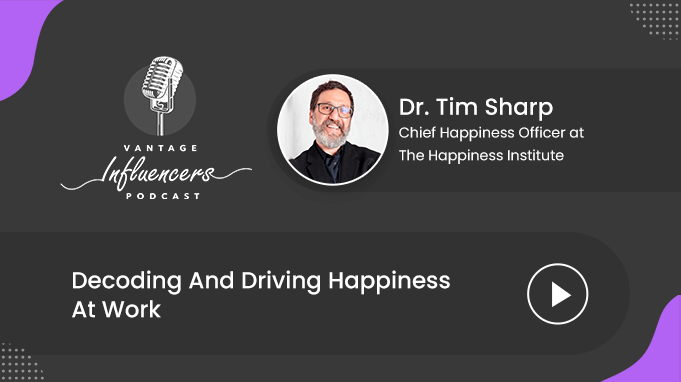
Dr. Tim Sharp, Founder & Chief Happiness Officer, The Happiness Institute
Dr. Tim Sharp is an internationally renowned leader in positive psychology and mental health, working as a consultant, executive coach, speaker, writer, and spokesperson. Known across Australia as Dr. Happy, he holds three degrees in psychology, including a Ph.D., and built an extensive career as an academic, clinician, and coach. He previously established and ran one of Sydney's most respected clinical psychology practices along with a highly regarded executive coaching practice, before founding The Happiness Institute, Australia's first organization devoted solely to enhancing happiness in individuals, families, and organizations.
Host
Susmita Sarma, Vantage Influencers Podcast Host
What You Will Learn
- Why happiness at work looks different in every organization, and why there is no single formula for it
- Why psychological safety and trust have to be in place before perks like games rooms or massage days can have any effect
- How giving employees control over their own job design boosts both performance and happiness
- Why bringing psychological strengths to work matters as much as technical skills, and why most employees rarely get the chance to
- How to use rewards and recognition in a way that reinforces the right behaviors instead of just rewarding long hours
- Why treating mental health "me time" like physical sick leave prevents bigger problems down the line
Key Topics & Timestamps
| Timestamp | Topic |
|---|---|
| 00:43 | Introducing Dr. Tim Sharp and today's topic |
| 01:18 | What inspired Tim to work in the field of happiness |
| 03:12 | His shift toward enhancing happiness specifically at work |
| 04:06 | Why happiness at work matters for performance and collaboration |
| 06:13 | What a genuinely happy workplace looks like |
| 08:25 | Balancing authentic care for employees with productivity goals |
| 11:34 | Practical ways to boost happiness and productivity through job design and strengths |
| 15:05 | Using rewards and recognition without it backfiring |
| 16:53 | Why "me time" matters for mental health |
| 19:47 | Practical advice for parents juggling mornings and self-care |
| 22:23 | Where to find and connect with Dr. Tim Sharp |
Full Transcript
Click to read the full episode transcript
Welcome to the Vantage HR Influencers Podcast. This podcast is sponsored by Vantage Circle, the simple and AI-powered rewards and recognition platform for employee engagement.
Susmita Sarma: Employers are increasingly focusing on their employees' happiness because research suggests that companies with happier employees are more successful on average than those with unhappy employees. Happy employees are often healthier, more productive, and seem to have better workplace relationships. So who do you think is responsible for employees' happiness at work? Is it the employer, a manager, a colleague, or a consumer? What are the determinants of happiness in the workplace? We'll learn everything about that in today's episode with our guest speaker. I'm so excited to welcome Dr. Tim Sharp, an internationally renowned leader in the fields of positive psychology and mental health. Dr. Sharp is a consultant and executive coach, speaker, writer, and spokesperson. He's Australia's very own Dr. Happy, at the forefront of the positive psychology movement, and founder of The Happiness Institute. Welcome to the show, Tim.
Dr. Tim Sharp: Thanks for having me.
Susmita Sarma: Okay, so Tim, you have set up The Happiness Institute and you are its Chief Happiness Officer. In fact, you're known as Australia's very own Dr. Happy. What inspired you to work in the area of happiness?
Dr. Tim Sharp: Well, I need to go back a few years to explain that story. My background originally was in clinical psychology. I started out as a therapist, an academic, and a researcher. In my early career, I worked as a therapist helping people with problems like stress, depression, anxiety, and coping with chronic illness. I did some research and taught at one of the major universities here in Sydney, Australia. I did that for many years, and even after I left the public system and the university, I established a private clinical psychology practice, which was very successful. But around the early 2000s, I stumbled across what were the very early beginnings of positive psychology. For those who might not be familiar, historically psychology has focused mostly on problems: on stress, depression, anxiety, negative emotions, and dysfunction. The idea was that if we could identify those problems and help people overcome them, we'd be doing a good job, and that's partly true. But about 20 years ago, a few psychologists started to say, well, for so long we've been asking what's wrong with people and how do we fix it. What if we were to actually ask what's right with people and how can we make the most of it? From then, they started to more formally study thriving, flourishing, happiness, and positive emotions, and to look at applications not just for the individual but for families, organizations, workplaces, and communities. It was then that I established The Happiness Institute as a way of promoting what I thought were very exciting principles of positive psychology. So that's how it started.
Susmita Sarma: Right. So your main area of interest has always been enhancing happiness at work, am I right?
Dr. Tim Sharp: Yes. When I started out, I wasn't really sure, it was a fairly new area, and I was just excited by the idea of promoting positivity and happiness. Here in Sydney, Australia, I was pretty much the first person really talking about that, and it just so happened that I got a lot of interest from organizations and businesses, large and small, who could see the potential benefits of having an engaged, positive workforce. So from those early days, I started doing a lot of work with leaders and teams, helping them build positive engagement and build a positive culture. We now know from a lot of good research that a positive culture is associated with positive outcomes like performance, productivity, and ultimately profitability.
Susmita Sarma: Right. Okay. So why do you think happiness at work is important?
Dr. Tim Sharp: I can answer that in two ways. If we look at the opposite of happiness at work, at stress, burnout, and overworking, we know that's distinctly unhelpful. It's pretty simple, really. If you imagine a workforce full of miserable people, full of people who are stressed, anxious, and worried, how could they possibly be expected to perform at their best? They can't perform well individually if they're stressed, anxious, depressed, and frustrated. And they can't perform well as a team either, because we don't collaborate as well or work as well with others when we're stressed and anxious. So that's the negative side. If we don't get it right, and we see a lot of burned-out, stressed individuals, we're not going to get the most out of them. The flip side is we know from research that happiness in its broader sense, positivity in the workplace, is correlated with more creativity and innovation, which means better problem solving and better collaboration with teammates and clients, more resilience, more connection, more of all the good things that ultimately lead to good performance. So happiness at work is a vital component of a successful workplace. That said, I want to add one caveat: it's important to be realistic and acknowledge that none of us will be happy all the time. No one is happy every minute of every day. We're all going to have our good and bad days, some days when we have to do things we don't really like. But overall, if the general trend leans towards positivity, that's undoubtedly a good thing.
Susmita Sarma: Right. Okay. So when we talk about the determinants of happiness at work, it's definitely more than just a combination of smart investments and good returns. So what does a happy workplace look like?
Dr. Tim Sharp: That's a really good question, but it's actually a hard one to answer, because it looks like different things in different workplaces. I get asked this a lot, and people publish books and articles about what a happy workplace looks like, but the reality is there's no single answer, because workplaces, cultures, and organizations differ for all sorts of reasons. So one answer is that a happy workplace looks different in every organization. That said, there are some common factors that are relevant to most organizations most of the time, and importantly, those common factors aren't necessarily what a lot of wellbeing programs focus on. This frustrates me quite a lot, actually, because you see a lot of talk in the press about ping-pong tables, bean bags, and rest rooms. There's nothing wrong with those things, and nothing wrong with having someone come in to give massages once a week. But the reality is you've got to get the fundamentals right first, and those superficial elements won't work if you don't have the fundamentals. The fundamentals of a positive workplace, of a positive culture, are things like psychological safety. Psychological safety is when we feel comfortable bringing our real selves to work, when we feel comfortable putting up our hand and disagreeing with someone, or commenting without fear of negative consequences. It's about trust and respect. You need to get those things, like psychological safety and trust, right before you can start adding some of the other, simpler things, which can be useful but won't work without the basics.
Susmita Sarma: Right. Yeah. So nowadays, most companies invest in happiness coaches, team-building activities, games, funsultants, and, as you know, Chief Happiness Officers. These practices and titles may appear lighthearted, but they're taken quite seriously by businesses. On the other hand, most employees believe that companies utilize happiness to extract superior efficiency from their workers, not because they really want them to be happy. So how can officers or managers strike that balance so that their efforts don't seem adulterated?
Dr. Tim Sharp: Again, really good question. There are a couple of different components to that. There's no doubt that a lot of people are taking this more seriously now, and that's a good thing, although I think there's still a long way to go. A lot of organizations do this poorly, and as a result they're missing out. Organizations that don't value this, that don't put resources into it, aren't going to get the best out of their people. But you're a hundred percent right: you can bring in someone like me, or coaches or consultants, but that's not really going to work if the intentions are wrong. The intentions have to be around building a positive culture, a place where people feel comfortable, safe, secure, and trusted. If organizations are doing it for the wrong reasons, that will be obvious to employees, and it can actually backfire and work against the outcomes people want. I think the big issue is this dichotomy people create between organizations that bring in someone like me because they genuinely care about their employees, and those that do it just to get more productivity. I'd say those two can and should work well together. This is the secret, the holy grail, so to speak. When positive psychology principles are properly, authentically, and genuinely integrated into an organization's systems and processes with good intention, they'll be about caring for employees and providing support and trust, but ultimately they'll also get good results. So I do think they can work really well together. The final piece of the puzzle is that as much as I like being invited into organizations, an outsider like myself can only achieve so much. What I think my job is to do is ultimately make myself redundant, by making the CEO, the senior leaders, the managers, and executives each effectively a chief happiness officer. Because if it's just one person, whether it's me or the head of HR, that's never really going to work. Every senior leader, every senior manager, everyone in the organization needs to play a role in this to some extent. That's a really important part of the best cultures we see: it's not totally reliant on just one individual.
Susmita Sarma: So what are some of the best ways to boost happiness at work and increase productivity?
Dr. Tim Sharp: As I said earlier, I'll preface this by saying it differs for different organizations. Even within large organizations, I've worked with some really big banks and large organizations with tens of thousands of employees, and it's not just that it differs from one organization to another, but even different teams within the same organization differ, because different teams have different personalities and goals. So it's not one-size-fits-all, but some things we know from research work well. As much as possible, we want employees to have as much control as possible over what they do. This is sometimes called job design. We want each employee to design their own job as best they can, to suit their strengths and personality. What that means is, if I'm your manager, I'll say these are your goals, these are your KPIs, this is what I want you to achieve, but I'll let you achieve it in a way that works for you. Rather than telling people exactly how to do it, letting them decide and giving them that control, allowing them to design it in their own way, leads to a greater sense of efficacy and confidence, which leads to more happiness and better outcomes. That's not possible a hundred percent of the time with every individual and every job, but it can be done a lot more and a lot better, and the research suggests that when people have a sense of control over their day-to-day jobs, they tend to perform better and enjoy it more. A big part of that is also allowing people to bring their strengths to work. Psychological strengths are positive attributes we all have, and too many organizations don't take advantage of this. I think too many organizations focus only on skills, which are important, we all need skills, knowledge, and experience, but there's another layer we all have: psychological strengths, which are significantly underutilized. Gallup research found that only about 20% of people feel they can bring their strengths to work each and every day. That means about 80% don't feel they can bring their strengths to work, and that's a massive waste. So finding ways to let people bring their full selves, their psychological strengths, to their job, and use them as best they can, is another great way to enhance both productivity and happiness and satisfaction at work. There are lots of other things, but one of the other big ones is building positive relationships at work. People who feel more connected, closer, and have more friendships within the workplace tend to have a greater sense of belonging and enjoy themselves more. So much of what we do at work is collaborative. Very few of us work totally alone; most of us work with other people in teams. So the better we get on with those people, the more we like and trust them, the better those relationships are, the better the outcomes for everyone involved. There are lots of other smaller things, but those are a couple of the big ones that a lot of organizations could do a lot better.
Susmita Sarma: So what do you think about rewards and recognition as a factor to boost happiness at work?
Dr. Tim Sharp: Rewards and recognition are an age-old strategy. I think every organization, most HR managers, use that in some way, and there are definitely benefits to it. We know that having a sense of accomplishment and achievement is good, that when we feel like we're achieving and accomplishing something, that's a form of happiness, which is good for us. And we also know that when we do achieve something, being recognized and appreciated is really important. So there's no doubt that showing appreciation, managers and leaders showing appreciation to their employees, is a very effective strategy. However, I think it's often done poorly, or sometimes actually counterproductive, and it comes down to what we actually reward. One of the mistakes often made is that people are rewarded for spending long hours in the office, regardless of what they're actually producing. There's a myth that if you're at your desk for 10 or 12 hours a day, that's something to be celebrated. Well, not necessarily, not if those hours are unproductive or if you're wasting time. If someone is actually achieving more in six hours, they should be rewarded for that instead. So the idea of reward and recognition is inherently a good one in principle, as long as we're focusing on the right behaviors and processes, the ones we really do want to reinforce and reward.
Susmita Sarma: So one of the most beneficial things we can do for our mental health is to take time for ourselves, what we call me-time. Why is me-time so vital, and why should we never feel guilty about having it during work pressure?
Dr. Tim Sharp: It's pretty simple, really, although simple doesn't always mean easy to do. It's simple because it's no different from aspects of our physical health. We know that if someone gets physically sick, they might need to take sick leave, time off, whether it's a broken bone, a bad case of the flu, or maybe, at the moment, a case of COVID. If someone is physically sick or needs dental work, they'll go to the doctor or dentist, get treated, and might take a few days, maybe even a week or two, off to recover. Mental health should be no different, and in fact it's just as, if not more, important. If someone has an episode of mental ill health, if they're stressed, depressed, or anxious, they should be allowed, in fact encouraged, to attend to that: to go to the relevant doctor or health professional, get the appropriate treatment. Because if they don't, they'll only suffer more, and if they suffer more, they'll ultimately need more time off, or they'll be less productive for a longer period. So ideally we should address this as early as possible, and by taking things into our own hands, by practicing self-care, we can hopefully avoid needing to see a doctor at all, or at least only need half a day off rather than a few weeks. It's a really important thing to do to ensure our longevity in the workforce, and in life. The reason it's difficult, though, is that most of us aren't taught to do that. Most of us are taught to soldier on and keep pushing, particularly when it comes to mental health. Most of us are taught to hide it, not to talk about it, because of the stigma. But that's inherently problematic, and in fact counterproductive, because if we don't talk about these things, if we don't acknowledge and address them, they'll only get worse. So we do need to smash the stigma. That's a really important part of it. We need to break down some of those misconceptions and make it more common practice for people to put up their hand and say, "I'm depressed," the same way they'd put up their hand and say, "I broke my arm," or "I need to see the dentist." If we can get to that stage, it'll be a lot easier for people, and if it becomes easier, they'll act on it sooner and more effectively. That can actually save workplaces a lot of money, because sick leave and absenteeism are very expensive. So if we can minimize that, it's good for the individual, and it's also good for the organization.
Susmita Sarma: So mornings can be a nightmare for working moms, especially when they're working from home. Between sticking to a schedule, making breakfast, handling other household work, getting the kids ready for school, and not being late for work themselves, most mothers tend to skip breakfast. I read an article where you mentioned the importance of breakfast, so let's end this podcast with some foodie talk. We'd love to hear your suggestions.
Dr. Tim Sharp: Well, firstly, as a parent myself, though not a mother, let me start by acknowledging how difficult that is. It's a tough job, especially if you're working at the same time. One of the things I've talked and written a lot about is parenting, and the first thing I'd recommend is adopting the philosophy of good-enough parenting. A lot of us try to be perfect parents, and I think working moms in particular try to be the perfect worker, the perfect mom, the perfect wife, and so on. It's virtually impossible to be perfect at all of it, in fact it's impossible, and I think a lot of working moms are very hard on themselves if they don't get everything perfect, if the lunch isn't perfect or the clothes aren't all perfectly washed. So the first thing I'd recommend is to adopt the philosophy of good-enough parenting: do the best you can, and accept that it won't be perfect. It doesn't really matter if things aren't a hundred percent perfect a hundred percent of the time. Coming back to the question, it's the same with getting your child ready for school or getting yourself breakfast: just do the best you can. In an ideal world we'd all sit down and have a well-balanced, nutritious meal and take our time to enjoy it, but as you said, that's hard to do, it's often a lot more rushed than that. So if the food isn't a hundred percent nutritious, it doesn't really matter, just do the best you can as often as you can. And also, don't feel like you have to do it all on your own. You mentioned working moms, but hopefully husbands and fathers can help too, and other people in the workplace or friends can help as well. I think as a general rule, too many of us try to be too strong on our own. That's okay, we do want to cope and do the best we can, but we don't always have to do it alone. If we can reach out and ask for help, whether from a husband, wife, partner, parent, sibling, or colleague, reaching out and asking for help is a form of strength, and it can make a lot of things a lot easier.
Susmita Sarma: Right. Okay. So finally, how can a listener reach out to you?
Dr. Tim Sharp: If they want to find me, they can go to my website, drhappy.com.au. They can find me on Instagram and Facebook at The Happiness Institute, or on Twitter at Dr Happy. I'd love for people to come and say hello, and if they've got any other questions, they're welcome to ask.
Susmita Sarma: Brilliant. It was a great conversation with you. Thanks a lot for joining me on the Vantage HR Influencers Podcast.
Dr. Tim Sharp: Thanks again for having me.
Find our YouTube channel for new episodes.
FAQ
What does Dr. Tim Sharp say makes a workplace happy?
Dr. Tim Sharp argues there's no single blueprint. A happy workplace looks different in every organization, but the fundamentals, psychological safety and trust, have to be in place before lighter perks like games rooms or team outings can have any real effect.
Why does Dr. Tim Sharp say rewards and recognition can backfire?
He says recognition is an age-old and generally effective strategy, but it backfires when organizations reward the wrong behavior, such as long hours logged at a desk, instead of what people actually produce. Reward and recognition only works when it reinforces the right behaviors.
What does Dr. Tim Sharp mean by job design?
Job design means letting employees decide how they meet their goals and KPIs instead of dictating the exact process. He says giving people that control over their own work builds a stronger sense of efficacy and confidence, which leads to better performance and greater happiness.
Why does Dr. Tim Sharp compare mental health days to sick leave?
He argues mental health deserves the same treatment as physical illness. Addressing stress, anxiety, or depression early, the same way someone would treat a broken bone or the flu, prevents it from getting worse and requiring more time off later.
Related Reading
Also listen on