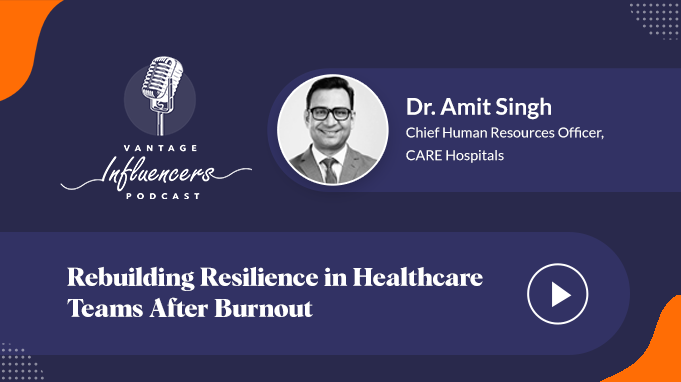
Rebuilding Resilience in Healthcare Teams After Burnout
Episode Overview
Dr. Amit Singh opens this episode by reframing burnout as something far more layered than long shifts and sleepless nights. He breaks it down into six psychological drivers: workload, control, reward, community, fairness, and value alignment, arguing that the sixth, whether the work aligns with a person's core values, matters more than the number of hours on a roster. Nurses, he points out, absorb roughly 80% of every patient's journey but rarely get the recognition surgeons receive during a discharge or a surge, and that imbalance in acknowledgment quietly compounds exhaustion into something structural.
From there, the conversation moves into what actually rebuilds a team after a period of collective strain. Dr. Amit Singh describes individual trust as resting on competence and character, but says teams need something more: belonging, shared perspective, acceptance, hope, and humor, the last of which he calls the glue that binds the other four together. He also draws on Timothy Clark's four stages of psychological safety, inclusion, learner, contributor, and challenger safety, to explain why teams that can question and disagree with each other recover faster than teams that simply endure. The discussion closes on India's uneven progress with diversity and inclusion in healthcare, and his belief that resilience has to be built into a system long before a crisis puts it to the test.
Episode Highlights
- Burnout in healthcare has six core drivers: workload, lack of control, insufficient reward, community respect, fairness, and misalignment with personal values, and the last one matters most.
- Nurses handle roughly 80% of the patient touchpoints in a hospital journey, yet recognition often defaults to surgeons and senior staff during high-pressure moments.
- The strongest reward for healthcare teams isn't monetary. It's a genuine thank you, career growth support, and a manager relationship that stays intact.
- Trust builds through competence and character individually, but teams need belonging, shared perspective, acceptance, hope, and humor to actually recover together.
- Timothy Clark's four stages, inclusion, learner, contributor, and challenger safety, explain why some teams can question each other and bounce back faster than others.
- India's healthcare sector shows a wide range in DEI maturity, with some organizations building genuine inclusion and others treating it as a compliance checkbox.
About the Guest
Dr. Amit Singh, Chief Human Resources Officer, CARE Hospitals
A seasoned Human Resources professional with more than two decades of experience, Dr. Amit Singh has led large-scale people strategies across growth phases, mergers and acquisitions, offshoring, shared services, and core HR delivery. His work spans healthcare, consulting, IT and ITES, manufacturing, publishing, education, edtech, and digital health and e-commerce, with transformation initiatives across South East Asia, the Indian Subcontinent, the U.K., Europe, and the GCC region. He also works as a leadership and management coach, partnering with senior leaders to strengthen business performance and organizational impact.
Host
Sanjeevani Saikia, Vantage Influencers Podcast Host
What You Will Learn
- The six psychological drivers behind healthcare burnout, and why value alignment outweighs workload.
- Why nurses and support staff are the most under-recognized roles in a hospital's patient journey.
- How to design rewards that go beyond monetary incentives, from personal connection to career growth support.
- The difference between individual and systemic causes of burnout, and how organizations can address both.
- Why trust, belonging, and humor are what actually rebuild team resilience after a crisis.
- How Timothy Clark's four stages of psychological safety help teams recover and challenge each other constructively.
Key Topics & Timestamps
| Timestamp | Topic |
|---|---|
| 01:12 | Dr. Amit Singh's path to becoming Chief Human Resources Officer at CARE Hospitals |
| 03:45 | Why burnout in healthcare runs deeper than long hours or exhaustion |
| 09:36 | What reward and recognition should actually look like for healthcare teams |
| 12:12 | Reframing burnout as a systemic issue, not just an individual one |
| 14:50 | The role of trust in rebuilding team resilience after collective strain |
| 18:50 | How everyday team dynamics and psychological safety guard against burnout |
| 21:11 | The state of DEI and inclusion across India's healthcare sector |
| 24:41 | Imagining a healthcare culture where resilience is built into the system |
| 27:58 | Closing thoughts on recognizing, reversing, and rebuilding resilience |
Full Transcript
Click to read the full episode transcript
Welcome to the Vantage Influencers podcast. This podcast is sponsored by Vantage Circle, the simple and effective recognition platform for employee engagement.
Sanjeevani Saikia: Hi, everyone. Today, we are opening up a conversation that's long overdue. We're talking about burnout in healthcare, not just the long hours and exhaustion we always hear about, but the deeper layers that often go unnoticed. And more importantly, how resilience can move from being a crisis response to something that's genuinely built into our culture. To help us explore this, I'm joined by someone who's been closely involved in understanding these challenges and supporting those on the front lines, Dr. Amit Singh. Dr. Amit, I'm so glad to have you with us today. Thanks for being here.
Dr. Amit Singh: Thank you, Sanjeevani. Absolute pleasure to be here as a part of your podcast. I've seen some of your Vantage Influencers podcast episodes and they're very deep and astounding, and I'm deeply influenced by them. Thank you for this opportunity to be on your broadcast.
Sanjeevani Saikia: Absolutely, a pleasure. Before we jump into the heart of our conversation, could you share a bit about your professional journey so far and what inspired the path you're on now?
Dr. Amit Singh: Thank you. I'm currently the CHRO, Chief Human Resources Officer, at CARE Hospitals. My role is that of an enabler, and that's how I look at it. This topic that we're discussing today has been personally deep for me, because my ability is how do I help my people be more resilient and contribute to a better healthcare industry.
I bring close to 20 years of experience across healthcare and non-healthcare. I've been Chief of Human Resources here for the last two years, and we've been trying to get this subject across the boardrooms, corridors, and conversations of the hospital. Prior to this, I spent eight years with another large healthcare organization based out of the Middle East, in Dubai, where I headed HR across various units and the corporate center. One of the milestones we were tremendously proud of was becoming an employer of choice through employee well-being, and that's a subject I've dealt with closely.
Before that, I had non-healthcare experience with large education companies like Pearson, one of the largest education companies in the world, and with manufacturing organizations. That's where I started. I'm a graduate in dental surgery, and as a doctor of dental surgery, little did I know that this entire world is more psychological than physical. Once your inner mind is made up, the physical mind replicates it. That's the context that has led me to my story so far.
Today, in my role, I balance the emotional side, the rational side, the economic side, and the physical side of the business, to create an experience that our people enjoy being part of. That's roughly my introduction. I'm joined by a group of very capable colleagues who support me and have supported me throughout my career.
Sanjeevani Saikia: Wonderful. Thank you so much for sharing your journey with us. Once again, Dr. Amit, thank you for joining us. So, with your permission, I'd like to begin today's conversation.
Dr. Amit Singh: Please, I'm excited too. We've been waiting for this.
Sanjeevani Saikia: Yes, same here. So, when we talk about burnout in healthcare, the first thing that comes to mind is always the long shifts, the sleepless nights, and the sheer emotional weight of the job. But it's starting to feel like there's something deeper beneath that, something beyond just exhaustion or overwork. Maybe it's the emotional disconnect that builds over time, or the constant moral strain that healthcare workers face. I know you'll be able to point that out better. So why do you think burnout in healthcare runs deeper than just exhaustion or long hours?
Dr. Amit Singh: Yeah, so I think this conversation goes beyond healthcare, though healthcare is one of the most affected industries when it comes to burnout. Why is healthcare affected more than other industries? There are various reasons. One, healthcare is more akin to disease and sadness, because nobody comes here in moments of joy, except in one particular circumstance, like the birth of a child. The rest is largely issues that people want to avoid. Healthcare is a delivery institution dealing with sickness, death, geriatric care, and pain, and when you're dealing with all of that, it's an industry that's more prone to absorbing it yourself. As human beings, you take on what surrounds you, and it takes real effort to distance yourself from the work you're doing, to be part of it without soaking in the negativity that surrounds it.
To your question, Sanjeevani, I think burnout is more psychological than physical. Most researchers point to about five or six key elements in this entire process. The first is workload. If you've got tolerance for ten pounds and I put twelve pounds on you, that's burnout, initially transient, then continuous. But the remaining points are more psychological than physical, because only the workload is physical, and even that depends on your level of preparedness. So it's not really the ten pounds, it's your level of acceptance of the load that decides whether it's a higher or lower workload.
The second is the level of control. If you feel that no matter what you do, you're not going to win, that's a very important part of burnout, and that's internal. The third is reward: no matter what I do, I'm not rewarded enough. In this industry, there's a disproportionate lack of resources, especially for nurses, who work around the clock in shifts. Whenever there's a discharge or a surge, it's usually the surgeon who gets recalled and recognized, when the support staff and nurses are actually about 80% of the touchpoint in the entire patient journey. So that's the third element, when you don't get rewarded enough. If every patient walked back and said thank you for being a great part of my journey, that's the reward a nurse is really looking for, not necessarily monetary. It's recognition.
The fourth is community: how does the community look at each other? Thankfully, healthcare workers get a lot of respect, and post-pandemic, that respect has grown even more, which has been an added advantage for healthcare organizations. The fifth is fairness. How fair are we? In most organizations, it's very difficult to be fair across the entire ecosystem, and a sense of perceived fairness is very important. When I see the system as unfair or biased, I have a higher sense of burnout.
The sixth, and I think the most important, is value alignment. Is there alignment between the work I do and my core values? If I see that the work isn't connected to my core values, that's when I feel a sense of dissonance. To be honest, I've been very lucky to do work I'm happy about, which is why I've been able to thrive through my career. But if I was given something I wasn't happy about, I'd go home upset. That's the starting point of burnout. So it's never really about the number of hours or the workload alone, those are part of it, but the larger part is value alignment. I consider that very important. One thing I often tell young talent is to find work that puts you in what we call a moment of flow, when you're in the zone and don't even realize the day has passed. That's the best phase anyone can be in.
So those are the six important elements of burnout. If someone reflects on where they stand on each of these six, that self-assessment can give a bigger boost to the entire healthcare ecosystem and workforce.
Sanjeevani Saikia: Yes, I think that was well said. You've highlighted the significance of rewarding people in this particular industry. So, according to you, what kind of reward or motivation factor works best in this industry?
Dr. Amit Singh: I think reward includes both recognition and reward, physical reward which is monetary, and non-monetary reward. I'll share my personal experience. Teams that have worked with me have often said they felt the deepest trust, not because we did less work, but because we always spoke of the bigger picture, of how the work helps the organization and everyone around it. People need to find meaning in what they're doing, and that's a big piece of the reward.
The second is personal connection. I try to build a personal connection before handing out work. There are two kinds of relationships: a transactional one, where I come to you, hand off a task, and you deliver, and a transformational one, where every interaction is an opportunity to connect and build fondness. I think every transformational relationship is itself a reward, because it means a deeper relationship exists. Studies have shown that attrition is lowest where the manager's relationship with the team stays intact. We often say people don't leave organizations, they leave managers, which means the manager's relationship contributes to the highest form of engagement and, to your point, reward.
The third reward is simple acknowledgment, being genuinely concerned, even a simple thank you. I've had situations where someone delivered work late, and just calling them and saying thank you made a real difference, as long as it's genuine.
Another kind of reward is career management, helping people build skills that uplift their careers, help them earn better, and reach better positions. For me, that's the highest form of reward, helping people build skills that let them uplift themselves and their careers. Monetary outcomes are a subset of that. If you contribute more, the world can't deny you what you deserve.
Sanjeevani Saikia: True. Moving on, it's interesting because we often hear solutions centered around self-care or mindfulness, individual fixes for a larger problem. But the more we look at it, the more it feels like burnout is baked into the system itself: the workload, the hierarchy, the expectations. So it's not just about the person, it's about the environment they're working in. It's important to understand how organizations can move from treating burnout as an individual issue to seeing it as a systemic one.
Dr. Amit Singh: I think it's both a systemic issue and an individual issue. When you look at burnout, organizations need to be better at defining the level of control a person has over their work. If someone is completely dependent on the environment for how the work is structured, that's a systemic issue, when people don't have the authority to make decisions. In progressive organizations with high-performing teams, everyone has the authority to make decisions on the spot, and that gives them the ability to really act.
Second, when you look at this as an individual or collective responsibility, the real question is how do you build people's ability to cope with trauma, catastrophe, and threat. I consider this a pattern of behavior. When you have happy people around an unhappy person, that person starts becoming happier too, because everyone around is talking about happiness. Similarly, if everyone around you is talking about unhappiness, that pulls people toward unhappiness. These are collective responsibilities. Can external factors change it? Yes. The narrative of the group's conversation matters a great deal. For example, if every conversation began by first highlighting what the team has achieved and how well things are going, before getting into pending work, that changes the narrative. But in our world, in trying to save ten or twenty seconds of building rapport or goodwill, we jump straight to the task. Some of these habits in how people organize and work have shaped how collective responsibility gets built, or doesn't.
Sanjeevani Saikia: When an entire team goes through a period of strain, say during a pandemic or a crisis, it's not just about bouncing back individually. The team itself takes a hit too. So rebuilding that sense of safety and dependability feels just as important as any wellness program. So I'd like to ask about the role trust plays in rebuilding team resilience after a collective period of strain.
Dr. Amit Singh: That's a great question. Trust is a very important factor. I look at trust as resting on two things when it comes to individuals: competence and character. But teams work slightly differently. When you look at teams, the first thing is belonging. The first part of building a team is whether people feel they belong. When you don't belong to a team, you can put on a performance and get through the day, but you don't want to be there again. Imagine having to live that day in and day out, feeling you don't belong. When you feel a general sense of belonging, that you're here to contribute, that's the first part.
The second is perspective: do I have perspectives that are familiar or similar to mine? Not diversity of taste in food or lifestyle, but perspective on life or on how things should be done. If I love service and someone hates it, that's a conflicting perspective that won't blend well.
The third is acceptance of each other as we are, and that's very important. Diversity is great, but if diversity isn't accepted, it can be detrimental, whether it's caste, creed, religion, thought process, or ethnicity. Acceptance of that difference is a gift.
The fourth and fifth are hope and humor, and together I call them the two edges of this five-part model. If a team can hope together, that's a very important part of the ecosystem. And fifth, can the team laugh together? Is there humor? I've noticed that in teams I didn't enjoy working with, there was very little humor, we did the transaction, got the job done, and left the meeting. But the teams I've loved being part of laughed at one another, laughed at things around them, and there was a lot of humor and gentle pranking. Humor can look external, but it's actually very internal, because when you're with close family or a close team, the jokes are so specific that outsiders wouldn't even find them funny, but you do, because the context is so internal. That's what teams do, that's what families do with each other. If you ask who the real teams in life are, it's a husband and wife, best friends, and parents. If there's no humor, something's lacking. You can have belonging, shared perspective, acceptance, and hope, but humor is what binds all four together. It means you belong, that you share perspectives, that you accept each other, and that you have hope that tomorrow will be better.
Sanjeevani Saikia: Well said, you've highlighted some very important points. Moving on, I keep thinking, what is the real solution to burnout? It isn't recovery programs or resilience workshops, but how teams function every single day, how people communicate, support each other on tough days, how leaders actually listen. Now, how do those everyday dynamics become a real shield against burnout, instead of just a reaction to it?
Dr. Amit Singh: I think what those behaviors should create in organizations is something called psychological safety. When I come into work, do I feel psychologically safe, do I feel protected? Once you're able to create that, a lot of the rest happens on its own.
I'm hugely inspired by the work of Timothy Clark, who defined the four stages of psychological safety. The first is inclusion safety: do I belong here? The second is learner safety: can I question others, and can others question me, within the team? The third is contributor safety: are my ideas respected, can I learn from others' ideas, and when I contribute an idea, is it acknowledged? The fourth, and I think the most important, is challenger safety: can I challenge somebody, can I disagree with them without needing to be nice about it? This connects to what's discussed in The Five Dysfunctions of a Team, which points to the absence of trust as the root issue. When you trust somebody, you can challenge them. Some of these elements of challenger safety are where real trust begins. These four pillars are a strong reminder of how we build psychologically safe teams.
Sanjeevani Saikia: You mentioned inclusion. If we speak about the Indian scenario, how do you think the inclusion factor really works? Are people accepting of each other? I want to understand the DEI side of the healthcare system, especially in the Indian context.
Dr. Amit Singh: The Indian context is really broad. There's a group of organizations that genuinely respect and embrace DEI, with a lot of initiatives, and there are also parts of the unorganized sector where I hear of firms that won't hire based on religious bias, which surprises me, but that's the other end of the spectrum.
When you look at inclusion and diversity across organizations, some are very evolved, doing real work around acceptance and even promoting conversations around LGBTQ+ acceptance. Others are okay with it privately but don't want to talk about it openly, while some still have real gaps. This isn't just about Indian organizations, these tolerances reflect the wider society. There's also a difference based on where these hospitals are located. We have hospitals across tier-one, tier-two, and tier-three cities, and the level of DEI maturity differs a great deal, not because the doctors and nurses have different qualifications, they often have exactly the same qualifications, but because of the ethnic background and openness of the environment someone was raised in.
What happens in our world is we talk a lot about DEI and there's a lot of external signaling around it, but at the core, true acceptance isn't always there. Some companies have made a real shift toward genuine acceptance and inclusion, while others are still sitting on the fence, pretending to be inclusive to win an award, without really believing in it. True inclusivity happens when there's acceptance across levels, tiers, and dimensions, not just around diversity and inclusion as a label, but acceptance in human thought. That's the transformation Indian firms need to build toward, especially the more advanced firms taking responsibility to help other firms that are still struggling with these concepts of human acceptance. DEI isn't a vanity tool, it's a tool for human acceptance and a better way of working, to build not just better business outcomes but a happier world. We have a long way to go. Some organizations have hit real milestones, others are still on that journey. It's a very broad and wide range.
Sanjeevani Saikia: Dr. Amit, we're coming to the end of today's conversation, but I can't wrap up without hearing your take on how you envision a future where resilience isn't something we keep trying to restore after every setback, but something that's deeply built into the healthcare system itself.
Dr. Amit Singh: True. Even before we talk about the healthcare system, healthcare is a tough journey from the start, it demands a lot of education. Ask any young person today and the first thing they'll say is they don't want to be a doctor because of the hard work involved. In my generation, people wanted to be doctors, it was seen as a great, respected profession. Today, young people see it as very tough. I think the first shift needed is recognizing that nothing is inherently tough or easy, sport is just sport, being a YouTuber is just about building followers. Tough and easy is a state of mind, and we need to help the younger generation understand that if you enjoy something, you're going to be great at it.
Building a great healthcare ecosystem starts right from the grassroots, where more young people want to become doctors and nurses. We're clearly seeing a decline there, because people want ease, and there's a difference between laziness and ease. Easy is something you're great at. A great badminton player or Michael Phelps winning a gold medal looks easy, because they're great at it. That mindset needs to start in schools and colleges, helping people see that even something physically or mentally demanding is really just a pattern of behavior, and building resilience has to start from school.
When I talk about resilience, I mean the ability to cope with trauma, catastrophe, and threat, and it's more a pattern of behavior than anything else. If I consider studying a threat rather than a catastrophe, that's a shift in mindset. No researcher in the world says their job is tough, they say they love their work and their motivation is discovering something the world didn't know before. A great badminton player, a great athlete, however much energy they put in, never calls it a tough job, it's belief that drives them. I think the belief among the younger generation that healthcare is a tough industry needs to change early on, and two people are most responsible for shaping that belief: teachers and parents. Parents often say, if you don't become a doctor it's because it's too tough, you need to study hard, and that's a biased framing. Studying isn't bad, nobody should treat studying and toughness as the same thing. If some of these mindsets change, it could make a real difference in how healthcare is seen by our younger generation, today and in the years to come.
Sanjeevani Saikia: Well, Dr. Amit, you've responded to all our questions so beautifully. Thank you so much. But before you go, is there any message for our listeners?
Dr. Amit Singh: Thank you, Sanjeevani, for this time. I think I've shared the message I wanted to share. This is a growing industry, and burnout will be a part of it. We have to address burnout, recognize it, and reverse it, and build a more resilient ecosystem. Throughout this conversation, I've tried to lay out the foundations of what could create a great ecosystem toward resilience, and against burnout, especially in an industry like healthcare. It's been wonderful talking to you, Sanjeevani, you've been a great listener and a great partner in this podcast. I wish you all the best, and I'd be happy to talk again.
Sanjeevani Saikia: Thank you so much.
Thanks for listening to the Vantage Influencers podcast. Be sure to subscribe on Apple Podcasts, Spotify, and the Vantage Circle YouTube channel for the latest episodes.
FAQ
Why does burnout in healthcare go deeper than long hours?
Dr. Amit Singh points to six psychological drivers behind burnout: workload, control, reward, community, fairness, and value alignment. Of these, he argues value alignment matters most. When the work itself feels disconnected from a person's core values, that dissonance drives burnout more than shift length or patient volume ever could.
What kind of recognition actually works for healthcare teams?
According to Dr. Amit Singh, the strongest rewards aren't monetary. They're personal connection, genuine acknowledgment, and career growth support. He notes that nurses and support staff handle roughly 80% of every patient touchpoint but are rarely recognized the way surgeons are during high-visibility moments like a discharge or a surge.
How does psychological safety help teams recover from burnout?
Dr. Amit Singh draws on Timothy Clark's four stages, inclusion, learner, contributor, and challenger safety, to explain why some teams recover faster than others. Teams that can question and challenge each other without needing to be diplomatic about it tend to have deeper trust and greater resilience.
What role does trust play in rebuilding team resilience?
Trust in individuals rests on competence and character, but Dr. Amit Singh says teams need five additional elements to truly recover together: belonging, shared perspective, acceptance, hope, and humor. He describes humor as the glue that binds the other four, since laughing together signals belonging, shared outlook, acceptance, and hope all at once.
Related Reading
Also listen on