Unlocking the X Factor: Well-being in Total Rewards
Episode Overview
Most conversations about employee experience start with a familiar contradiction. Companies keep expanding pay bands, benefits menus, and perks catalogs, yet burnout and quiet disengagement haven't gone away. Meera Mohandas argues that gap has a specific cause: organizations still treat rewards as a transaction, salary here, a benefits list there, while employees are navigating something far more emotional and social. Competitive pay meets a financial need, she says, but it rarely meets the human need for meaning, community, and psychological safety. That mismatch, more than any flaw in compensation design, is what shows up as exhaustion and disengagement even where pay is well structured.
Meera's answer isn't to add more perks. It's to build what she calls a wellbeing ecosystem, one shaped by everyday culture, manager behavior, and how safe people feel raising concerns, not just what's listed in a benefits deck. In this conversation, she walks through what most reward strategies overlook, how to actually measure whether rewards are supporting wellbeing rather than just being used, and the small, low-cost changes, from renaming sick leave to training managers to spot distress, that shift a culture from offering wellbeing to living it.
Episode Highlights
- Most organizations still treat total rewards as transactional, salary and a benefits catalog, while employees are operating in a far more emotional, psychological, and social environment.
- Wellbeing is not one dimension. It's shaped by psychological safety, social connection, financial confidence, and the everyday behavior of managers and leaders, not just insurance or fitness reimbursements.
- Employees judge wellbeing offerings less by how many benefits exist and more by how supported they feel when they actually need help.
- Measuring whether rewards support wellbeing means moving past benefit utilization data toward psychological safety, manager support, and correlating wellbeing participation with engagement and retention outcomes.
- Small, low-cost shifts, like renaming sick leave to wellbeing leave or training managers to spot distress, often move the needle more than adding new wellbeing apps or programs.
- As wellbeing becomes central to total rewards, organizations will move toward hyper-personalized, AI-informed benefits and start evaluating leaders on the environment they create, not just business outcomes.
About the Guest
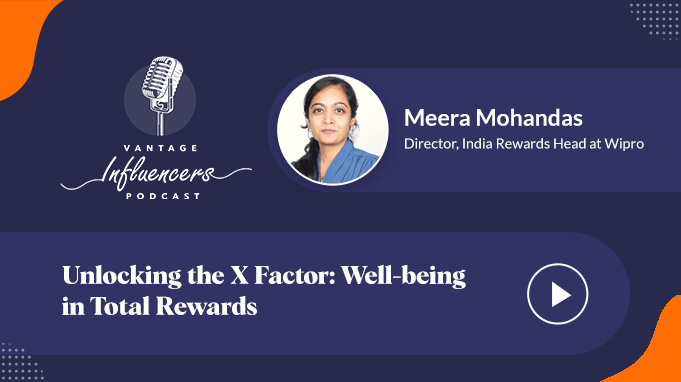
Meera Mohandas, India Head of Rewards, Wipro
Meera Mohandas leads India Total Rewards for Wipro, where she also champions the company's global wellbeing and rewards and recognition programs. Her career has spanned talent management, post-acquisition HR integration, and business partnering roles before she moved into total rewards. Recognized as a Jombay HR 40 Under 40 honoree, she holds an MBA from the Symbiosis Centre for Management and Human Resource Development (SCMHRD) and is known for designing HR solutions that treat wellbeing as core to employee experience and business outcomes.
Connect with Meera on LinkedIn
Host
Sanjeevani Saikia, Vantage Influencers Podcast Host
What You Will Learn
- Why total rewards conversations that stay purely transactional fail to address the psychological and social needs behind employee burnout
- The wellbeing dimensions most reward strategies overlook, beyond visible benefits like insurance and fitness reimbursements
- How to measure whether a rewards strategy is actually supporting wellbeing, not just being utilized
- What a wellbeing ecosystem looks like in practice, from manager behavior to policy language
- Small, low-cost changes any organization can make to close the gap between rewards and lived employee wellbeing
- How total rewards may evolve as wellbeing becomes a core business priority, from hyper-personalization to leadership accountability
Key Topics & Timestamps
| Timestamp | Topic |
|---|---|
| 01:31 | Meera's corporate journey and path into total rewards |
| 03:11 | Why employees feel exhausted despite competitive pay and benefits |
| 06:18 | Wellbeing elements organizations tend to overlook |
| 10:23 | How to measure whether rewards truly support wellbeing |
| 15:23 | Small but meaningful changes organizations can make |
| 20:58 | How total rewards may evolve as wellbeing becomes a core priority |
Full Transcript
Click to read the full episode transcript
Welcome to the Vantage Influencers podcast. This podcast is sponsored by Vantage Circle, the simple and effective recognition platform for employee engagement.
Sanjeevani Saikia: We often hear organizations say they are investing more than ever in people, better pay, broader benefits, and more perks on paper. And yet at the same time, burnout, disengagement, and that quiet sense of exhaustion or fatigue seem to be everywhere. So somewhere between what's being offered and how employees are actually feeling, something isn't quite landing. That's where I want to begin today's conversation, by unpacking what's missing, what's overlooked, and what really needs to change if total rewards are meant to support wellbeing in a meaningful way. To help us explore this, we have Meera Mohandas with us. She's the India Head of Rewards at Wipro. She's someone who works closely with rewards in practice, so I'm very sure that her perspective will bring a very real, on-ground view. So, hi, Meera. Thank you so much for joining us today.
Meera Mohandas: Thanks, Sanjeevani, and I'm really excited about the discussion and looking forward to a conversation on a topic which is really close to me.
Sanjeevani Saikia: It's a pleasure to have you on the show. Before we begin today's conversation, would you like to walk us through your corporate journey so far?
Meera Mohandas: Surely, Sanjeevani. So my professional journey started almost 14 years back, when I joined Wipro from campus after completing my MBA in HR from the Symbiosis Centre for Management and Human Resource Development, Pune. And since then, it's been a rollercoaster of a ride for me, with multiple roles in the HR function, spanning across different areas, including talent management, capability building, post-acquisition HR integrations, and business partnering roles. The most recent one has been in the space of total rewards, a role I've been in for the last two and a half odd years. I currently lead India Total Rewards for Wipro, along with championing Wipro's global wellbeing and R&R programs.
Sanjeevani Saikia: Wonderful. Thank you so much for sharing your corporate journey with me and our listeners. So, with your permission, I'd like to begin today's conversation on the topic.
Meera Mohandas: Surely.
Sanjeevani Saikia: Great. You know, we often hear organizations say they are investing more in people than ever before. I think we hear this almost all the time. There's better pay, broader benefits, more rewards on paper. And yet at the same time, many employees still talk about feeling drained. They talk about feeling disengaged or quietly burnt out. And in recent times, that pattern is hard to ignore, which kind of makes me wonder, where does this gap usually come from? You know, the difference between what companies offer and what employees generally feel.
Meera Mohandas: Right. Exactly. So, in my view, Sanjeevani, this gap typically exists because most organizations still view total rewards primarily through a transactional lens: salary, bonuses, a catalog of benefits. Whereas employees today are operating in a far more emotional, psychological, and social environment. So competitive pay may meet a financial need, but it often does not meet the human need for meaning, the need to be part of a community, and the psychological safety that you expect. So over the last few years, the industry has seen a marked rise in burnout, in loneliness, in emotional fatigue, even in organizations with very well-designed compensation structures. Employees these days are navigating blurred boundaries around hybrid work. There's increased caregiving responsibilities that a lot of us carry. So rewards that don't account for these realities, they naturally fall short.
And what employees are telling us, through engagement surveys, through exit conversations, or through the different channels through which we hear them, is that they want more than remuneration. They want support systems. They want to be able to balance work without guilt. And they want to work with managers who are able to understand wellbeing, and a culture that normalizes seeking help.
One insight that I've personally observed, Sanjeevani, is that employees don't value wellbeing offerings by the number of benefits you're extending, but by how supported they feel when they need help the most. And a culture where a manager says, please take the time that you need, your wellbeing is what matters, has more impact than any policy document.
So the exhaustion and disengagement that we see in many workplaces these days, it's not a failure of compensation. It's a failure of looking at total rewards as more than pay. And when companies shift from providing benefits to enabling wellbeing, that's when the engagement gap truly starts to close, Sanjeevani. So that's my perspective.
Sanjeevani Saikia: Yes. You rightly pointed it out, and there are many stats that can back what you just said. People don't just need remuneration, but they're also looking at the overall quality and how supported they feel, most importantly, with what the company is offering. So, moving on, when we start pulling at that very thread, it feels like the conversation around total rewards often stays very structural. We usually talk about numbers, we talk about policies, frameworks, while wellbeing, on the other hand, is something far more lived and personal in day-to-day work. So taking that into account, when organizations talk about total rewards, what do you think they often overlook in terms of employee wellbeing?
Meera Mohandas: So what I think organizations tend to overlook typically is that wellbeing is not a single dimension. It's a multi-layered experience, shaped by psychological safety, social connection, financial confidence, and the everyday behaviors of managers and leaders. And yet, in most total rewards conversations, the focus typically gravitates towards the more visible elements, insurance coverage, fitness reimbursements, EAP access, whereas the deeper drivers of wellbeing remain under-addressed.
And across industries, there's a growing recognition that physical wellbeing alone is not what keeps employees engaged and energized. The real differentiators today are mental, emotional, financial, and social wellbeing, all of which have a significant impact on how people show up at work. Employees may have excellent benefits on paper, but if they don't feel safe raising concerns, if they feel isolated, if they lack clarity on financial decisions, or if the work design itself drains them, then those benefits lose meaning.
So this is where many organizations miss the mark. They invest in wellbeing programs, but not in building a wellbeing ecosystem. And that ecosystem is shaped most strongly by the everyday culture, the leadership tone, and the community belonging that exists in the organization.
At Wipro, this insight has shaped how we've evolved our wellbeing philosophy. Our body-mind-community framework moves beyond physical health to focus on mental health pathways, volunteering opportunities, inclusion networks, financial wellbeing resources, and cultural practices that build connection. And what's helped us most in this journey is recognizing that wellbeing cannot live in HR alone. It needs managers who know how to spot behavioral indicators of distress or burnout. It needs leaders who are able to share their own wellbeing narratives and help normalize vulnerability in wellbeing conversations. It needs peer groups, it needs ERGs where employees can find safe space and solidarity. And it needs policies that reflect empathy, like wellbeing leaves, flexibility, and caregiver support.
For us, ultimately, it's not just about whether a company offers wellbeing, it's about whether the company lives wellbeing. That distinction tells you whether wellbeing is embedded into the culture versus whether it's just a slide in a benefits deck. And that distinction is what separates workplaces where people merely work versus those where they can truly flourish and thrive.
Sanjeevani Saikia: Yes, yes, again, well said. Now, assuming organizations genuinely want to do better, the next challenge becomes measurement, how they really measure it. Although engagement data exists, and there's plenty of it, it doesn't always tell us whether rewards are really working on the ground or helping people sustain performance over time. And without that clarity, wellbeing can easily remain an assumption rather than an outcome. So I need to ask you here, how can organizations measure whether their reward strategy genuinely supports wellbeing, and not just something on paper, like you previously mentioned?
Meera Mohandas: Right. I think measuring whether a reward strategy truly supports wellbeing requires organizations to move beyond the traditional utilization-based reports they typically rely on, which is more about how much your benefits are being used by employees. Instead, look at the quality of the employee experience and the outcomes those rewards are shaping.
Across the industry, employers are now moving towards a more multi-dimensional wellbeing measurement framework, one that combines quantitative data, say attrition trends, burnout indicators, absenteeism patterns, EAP usage, with qualitative insights around psychological safety and manager support. More progressive organizations are also correlating wellbeing participation data with engagement scores, productivity metrics, and even risk indicators such as high-stress attrition pockets.
This marks an important evolution: wellbeing measurement is no longer about just counting participation. It's about linking wellbeing investments to behavioral and cultural outcomes. At Wipro, we use a PERMA-based wellbeing survey. PERMA is an acronym: positive emotion, engagement, relationships, meaning, and accomplishment. This survey tool is based on Martin Seligman's positive psychology theory, and it helps us measure the level of wellbeing at Wipro.
For us, what's equally important is pairing the survey with the story behind that data: how employees talk about wellbeing in listening forums, how comfortable they feel reaching out for support, or how often managers lean into having wellbeing conversations. Our EAP utilization data, wellbeing leave uptake, and involvement in initiatives such as our Global Wellbeing Fest all help us understand not just usage, but the level of confidence and trust our people have in our wellbeing ecosystem.
What I've particularly found valuable is looking at insights at a micro level, business units, geographies, demographic cohorts, to understand localized pressures and tailor interventions. For example, if a certain unit shows a high level of counseling utilization but limited participation in preventive sessions, that tells us something about the environment, about the possible unspoken pressures employees in that unit may be navigating. These nuanced indicators are often more powerful than any aggregated dashboard.
So I believe the real measure of success is whether wellbeing has moved from being just a program to becoming a cultural signal, where managers proactively check in, where leaders openly acknowledge their own challenges, and where employees feel safe declining a meeting or requesting flexibility without fear of judgment. That's when you know whether your reward strategy is supporting wellbeing in a truly meaningful fashion.
Sanjeevani Saikia: Yes, and Meera, thank you so much for sharing what Wipro is doing as well, because other organizations can really take inspiration from that. I think you've lucidly highlighted your initiatives and how you're moving forward, so once again, thank you for that. Moving on, I think we all realize that not every organization can overhaul its entire rewards framework overnight, but often it's the more minor, intentional changes, like how rewards are communicated, or how they're accessed, or how they're reinforced by managers, that make the most significant difference in how employees actually feel. So from a very practical standpoint, what are a few small but meaningful changes organizations can make to close the gap between rewards and real employee wellbeing?
Meera Mohandas: I think there are a lot of simple but powerful elements that can be picked up. One starting point is normalizing conversations about wellbeing. This doesn't require any budget, it's just a shift in behaviors, which can be difficult, definitely. When managers consistently check in, not just on deliverables but on energy levels, on stress patterns, on what support their team needs, that builds psychological safety. When leaders model this by speaking honestly and frankly about boundaries, fatigue, or recovery, it reframes wellbeing as a shared responsibility, not a personal weakness. This single cultural nudge is often more impactful than a dozen wellbeing apps an organization might introduce. And this needs to start from the top, from leadership, from managers across the layer. If we're able to bring about these conversations that normalize wellbeing, that's a huge step in the right direction.
Another important small but transformative change is to rethink the language we use in our policies and in how we communicate wellbeing offerings. For example, we've renamed sick leave to wellbeing leave. That change may seem trivial, but it has an outsized impact, because employees felt permitted to take care of themselves without justification or guilt. A small wording choice affects how people behave and what they feel entitled to. That's another area organizations can start small with, but it has a huge impact.
Third, organizations can make wellbeing more accessible by integrating it into daily touchpoints rather than siloing it into HR portals. What we've done is embed wellbeing nudges and resources directly into a chatbot that sits on Microsoft Teams, our collaboration tool. So employees don't have to go hunting for support, they just reach out to the chatbot and know what's available to them. It sits where work is already happening, making it all integrated into their daily work.
The other meaningful shift is helping employees take small preventive steps rather than waiting for a crisis, whether that's offering short mental health micro-sessions during team meetings or spotlighting financial wellbeing resources during key life events. For example, when someone joins us from campus, we nudge them at that point to start investing in pension schemes. It might sound far-fetched, but the earlier you start, the better prepared you are financially. Nudging people at the right life stage can make a huge difference, or promoting volunteering opportunities as a wellbeing practice. These are small things, but they help build the right habit before burnout sets in. These additions don't have to be grand, they just need to be timely and pegged at the point where they make the most impact.
And finally, the most underrated but high-impact change is empowering managers. Managers' behavior accounts for a significant proportion of employees' day-to-day experience. If you equip managers with simple tools, how to spot distress within their team, how to have wellbeing conversations, clarity on flexibility boundaries, these simple things immediately improve the environment employees operate in. At Wipro, we've seen that even managers who don't see themselves as wellbeing experts, and not all of us are, can make a substantial difference when given the right support. These are small actions, Sanjeevani, that build a culture where wellbeing is felt, not just advertised.
Sanjeevani Saikia: Yes. My biggest takeaway from that response is that there has to be a shift in behaviors, how people communicate is also very important, how we use language is again very crucial, we have to make it more accessible to employees all around, and give them volunteering opportunities. But at the same time, you also highlighted the importance of empowering managers. So these were some very critical things you highlighted in that response, so again, thank you so much. We're almost at the end of today's episode, but before we wrap up, I want to zoom out and look ahead for a moment. As we already know, wellbeing is slowly moving out of that nice-to-have space and into more serious conversations. If organizations really start treating wellbeing as something core to how they operate, it makes us pause and think about what that means for rewards overall. So looking ahead, how do you see total rewards evolving if wellbeing truly becomes a core business priority?
Meera Mohandas: So if organizations fully embrace wellbeing as a core priority, I see total rewards shifting from just being a package of offerings to becoming an integrated employee sustainability system.
The first big shift would be towards hyper-personalization. We're already seeing this as a global trend, where employees want to curate their benefits based on their life stage, identity, and personal goals. So the future of rewards won't entail static plans or generic wellbeing programs. It will be dynamic, AI-informed, and responsive to employees' emotional, financial, and physical needs, which are very personal to that individual. Instead of a one-size-fits-all approach, organizations will start offering flexible wellbeing wallets, modular benefits, and personalized mental health resources, recognizing that wellbeing is deeply individual.
The other shift is the evolution of wellbeing being integrated into career growth and performance management systems. Traditional rewards frameworks have separated wellbeing from performance, but ironically, wellbeing is one of the biggest drivers of performance. So in future-ready organizations, we may also see leaders being assessed not just on business outcomes, but on their ability to create psychologically safe, inclusive, and resilient teams.
And one big change we'll possibly see in the near future is wellbeing getting embedded into the structural fabric of work design itself, workload planning, team rhythms, meeting norms, digital boundaries. This is where most organizations have a lot of untapped potential. Benefits can support wellbeing, but work design itself determines wellbeing. Whether I'm able to experience that changed culture, that changed ecosystem, a lot of it is determined by the nature of the work, the work design that's allocated. So the future rewards model will reward teams and leaders who create healthy, high-trust working environments.
And lastly, I think the most important evolution will be in how organizations measure success. Instead of tracking utilization or cost alone, companies will evaluate wellbeing's impact on culture, retention, and innovation. And I believe the strongest indicator of this evolution will be when CXOs stop asking what are our benefits and start asking instead, how healthy is the environment we're creating for our people. So if wellbeing becomes central to total rewards, the future of rewards will be more compassionate, more intelligent, more human. It will reflect a shift from how do we reward performance to how do we enable people to perform sustainably. And in that future, wellbeing will no longer be an advantage, it will become the X factor that differentiates thriving organizations from surviving ones. That's the last thought I want to leave you with.
Sanjeevani Saikia: Yes, so we've also arrived at the end of today's episode, and you've very beautifully unlocked the X factor, the topic we were covering today, unlocking the X factor, wellbeing in total rewards. You've responded to each of our questions very beautifully, so thank you so much, Meera. Before we leave, is there any message for our listeners, anything you'd like to say in particular?
Meera Mohandas: The only message I'd want to leave our listeners with is that you have the power to determine your own wellbeing, and you play a significant role in determining the wellbeing of the people around you. So keep that in mind in every action you take, at your workplace or in the organizations you're a part of. This can go a huge way in determining the wellbeing quotient of your organization. So once again, thank you so much for joining us today, it was a pleasure to have you on the show.
Sanjeevani Saikia: Thanks a lot, Meera.
Meera Mohandas: Thank you so much, Sanjeevani. I thoroughly enjoyed the conversation today, and I hope our listeners find this discussion valuable. Thank you so much for the opportunity. Have a good day.
FAQ
Why don't better pay and benefits fix employee burnout?
Meera Mohandas argues most organizations still treat total rewards through a transactional lens, salary, bonuses, a catalog of benefits, while employees are navigating a far more emotional, psychological, and social environment. Competitive pay meets a financial need but rarely the human need for meaning, community, and psychological safety, which is why burnout persists even where compensation is well designed.
What do organizations typically overlook when designing total rewards?
According to Meera Mohandas, most reward strategies focus on visible elements like insurance coverage, fitness reimbursements, and EAP access, while deeper drivers of wellbeing, psychological safety, social connection, financial confidence, and everyday manager behavior, remain under-addressed.
How can organizations measure whether their rewards actually support wellbeing?
Meera Mohandas recommends moving beyond benefit utilization reports toward a multi-dimensional framework that combines quantitative signals, attrition trends, burnout indicators, absenteeism, and EAP usage, with qualitative insights on psychological safety and manager support, correlated against engagement, productivity, and retention outcomes.
What small changes can organizations make to improve employee wellbeing without a big budget?
Meera Mohandas points to normalizing conversations about wellbeing, rethinking policy language (such as renaming sick leave to wellbeing leave), embedding wellbeing resources into everyday tools employees already use, and equipping managers to spot distress and hold wellbeing conversations.
Related Reading
Also listen on