Developing and Sustaining Employee Engagement
Episode Overview
Jason Lauritsen joins the podcast to talk about developing and sustaining employee engagement, framing work as a relationship rather than a transaction between employer and employee. He argues that the engagement data consistently points to a handful of relational drivers, feeling valued, cared for, trusted, appreciated, and recognized, and that most HR programs are still built around getting work done rather than nurturing that relationship. Instead of treating feedback as a backward looking critique, Jason introduces the idea of feed forward, an approach that acknowledges past performance but channels the conversation into specific, forward looking suggestions employees can act on. He walks through a golf coaching analogy to show how good coaches focus entirely on what happens next rather than relitigating what already went wrong, and explains why that framing produces less defensiveness and more genuine behavior change.
The conversation moves into how leaders can design work experiences that fit both large and small organizations, starting by treating employees the way a product designer treats users, understanding their needs before building programs around them. Jason breaks down the three habits he saw repeatedly while studying top workplace cultures, relentless two-way communication, deliberate connection building, and consistent appreciation, and offers a low cost engagement hack any manager can use immediately, simply asking employees what would make their day to day work feel better. He also weighs in on measuring engagement, pointing to employee net promoter score as a useful single metric while cautioning that it isn't diagnostic on its own, before closing with thoughts on his employee engagement leader community and advice for people newer to HR.
Episode Highlights
- Work should be treated as a two-way relationship, not a transaction, with feedback, listening, and appreciation built into daily management, not saved for reviews.
- Feed forward replaces backward looking criticism with specific, actionable suggestions for what to do differently next time, reducing defensiveness and increasing follow-through.
- Designing a good employee experience starts with genuinely understanding what your people need, then building programs around common needs rather than assumptions.
- The best places to work share three habits: relentless two-way communication, deliberate connection-building among employees, and consistent appreciation.
- A simple, no-cost engagement hack: ask employees directly what would make their work experience better, then act on what they tell you.
- Employee net promoter score is a useful high-level engagement metric, but it isn't diagnostic on its own and works best alongside a clear internal definition of engagement.
About the Guest
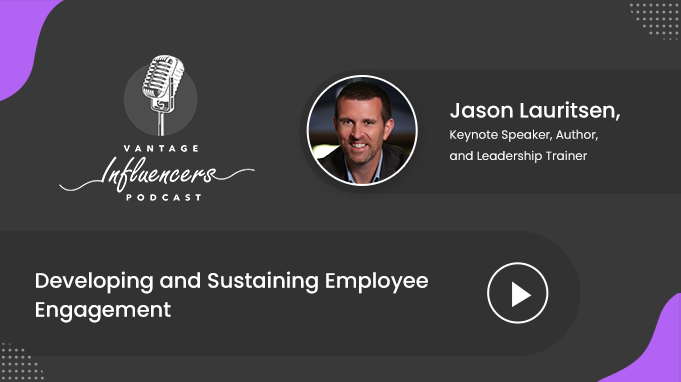
Jason Lauritsen, Keynote Speaker, Author, and Leadership Trainer
Jason Lauritsen is a keynote speaker, author, and leadership trainer who has worked with organizations including Quantum Workplace, Union Bank and Trust, and West Corporation. He is the best-selling author of Unlocking High Performance and Social Gravity, and spent three years leading the research team behind Quantum Workplace's Best Places to Work program, studying the employee experience at thousands of companies to understand what top workplaces do differently to engage their people. Jason is known as a workplace evangelist who believes work can and should be a fulfilling experience for every employee, and he runs an employee engagement leader community that offers HR leaders affordable training and group coaching.
Host
Rohit, Vantage Influencers Podcast Host
What You Will Learn
- Why engagement is driven primarily by relational factors like feeling valued, trusted, and appreciated rather than by programs alone.
- How to use feed forward instead of traditional feedback to coach performance without triggering defensiveness.
- How to design work experiences that fit both small teams and large organizations by starting with real employee needs.
- The three habits that repeatedly show up in the best places to work.
- A simple, low-cost way to hack employee engagement using direct conversations.
- Why employee net promoter score is a useful, though not diagnostic, engagement metric.
Key Topics & Timestamps
| Timestamp | Topic |
|---|---|
| 00:00 | Introduction |
| 02:49 | Valuing employees during the COVID-19 crisis |
| 06:05 | How to give effective feedback without sounding critical |
| 12:36 | Designing work experiences that optimize employee relationships |
| 19:20 | Best ways to hack employee engagement |
| 22:31 | Metrics to measure employee engagement |
| 26:18 | Jason's book, Unlocking High Performance, and his community |
| 27:58 | Jason's favorite business book |
| 28:38 | Advice for young HR leaders |
Full Transcript
Click to read the full episode transcript
Welcome to the Vantage HR Influencers Podcast. This podcast is sponsored by Vantage Circle, the leading employee benefits and engagement platform.
Rohit: Everyone, this is Rohit, welcome to the Vantage Influencers Podcast, and I'm excited to have Jason Lauritsen, who's a keynote speaker, author, advisor, and leadership trainer, who has worked with companies like Quantum Workplace, Union Bank and Trust, and West Corporation among others. Jason is known as a workplace evangelist who is passionate about his work, and is a best-selling author of the book, Unlocking High Performance. Welcome to the show, Jason.
Jason Lauritsen: Thanks for having me.
Rohit: Awesome. So, Jason, how did you get into HR? And what excites you about being in this phase of HR?
Jason Lauritsen: Well, I think like a lot of people, I didn't know that I wanted to be in HR. When I started my career, I kind of found my way into it, or was called into it, I guess. My early career, I actually started as a salesperson, and sales led me eventually into recruiting. I became a recruiter, a third-party recruiter. As I was doing that work, I was working with HR people a lot of times, and I had the opportunity to see inside organizations. You're talking to people about their jobs, talking to organizations about why people are leaving, why people would come, talking to individuals about why they want to go work somewhere or what they're looking for. And what I noticed in those conversations was a lot of dysfunction. It seemed like work wasn't working very well for a lot of people. There was stuff broken that was causing people to leave. People described all sorts of terrible things happening to them at work. Eventually I got really interested in the relationship between people and their work, and the dynamics that exist there. I was puzzled as to why it wasn't working very well for so many people, and I think that's what ultimately drew me into corporate HR. Getting into the human resources business, I wanted to be able to do something about it, to be part of fixing it. So once I made that jump, the rest is history. I was always interested in leadership and human behavior and those kinds of disciplines. I was fascinated by that. So once I found my way into HR and could bring it all together and have an impact on the experience people were having, I was hooked.
Rohit: Got it. You often talk about work as a relationship and not a contract. As we're recording this at the tail end of the COVID crisis, how can new-age leaders look at this? How can employees be valued, and how can we build a culture where work is looked at as a relationship and not a transaction between employer and employee?
Jason Lauritsen: Sure. That's a big question because there are a whole bunch of layers to it. But fundamentally, one of the moments in my career where things started to come into focus about how we could fix this work relationship was recognizing that all the employee engagement data we have tells us that engagement is really driven by things like feeling valued at work, feeling cared for and trusted, appreciated and recognized. These are all relational constructs. They're things that generally exist in the context of a relationship with other human beings. So when we think about how to fix this in the employer-employee relationship, it's about moving away from treating work through the lens of what have you done for me lately. Most of our HR programs and processes are designed around making sure employees are getting the work done and living up to their end of the bargain. But when you think about it through the lens of what employees are looking for, what they need relationally, it's about how we treat people at work more like there's a two-way relationship going on, with the same considerations we'd have in any other relationship. That means asking for feedback more often, being in two-way conversation more often, really listening to what people are saying, and making sure people feel seen, valued, and appreciated for the effort they put into the organization. These are fundamentally simple things that make someone feel good about the relationship, but we often overlook them because we're so busy enforcing our programs and making sure people are hitting their metrics. Performance is important, obviously, but if over time I don't feel like you care about me and the relationship is broken, I'm not going to want to perform as well for you. So we have to put the relationship first and make sure people feel that connection to work and to the people they work with and for, in order to do their best.
Rohit: Interesting, and building on your point about feedback, I want to talk about how to give effective feedback to employees without sounding too critical. How should a leader approach giving feedback to their team members?
Jason Lauritsen: The interesting thing about feedback is that for some reason, over the last several decades of managing people at work, we've decided that feedback needs to be critical, that we're mostly focused on looking backward at what you did yesterday, last week, or last year, and telling you all the things you did wrong and need to fix. The problem is there's a whole body of social science telling us that's just not an effective way to motivate performance improvement or behavior change. I think the key is adopting a very different mindset, which is why we've been hearing so much about coaching in the context of work, and managers thinking of their job more as a coach than a manager. This really sunk in for me when I think about my own experience with the best coaches I've had. A number of years ago I hired a golf coach to help me play a little better. I'm not a great golfer, but I needed to play well enough for business reasons. I went out with this guy to hit golf balls, and he just said, go ahead and hit some balls. He'd watch me swing, then say, hey, before your next swing, let's talk about your grip a little, give me a piece of advice, and say, just try that and see how it goes. Sometimes he'd ask a question, like what were you thinking about when you hit that ball, and then suggest something to try next time. The thing I realized is that not once during that entire process did he ask me about how I'd played in the past. He was never critical of my swing or telling me what I was doing wrong. The only thing he focused on was giving me helpful guidance on how to perform better in the future. When you think about every good coach, that's what they're doing. They might bring your attention to something that's not working well, but they're not going to spend time criticizing you for something on the last play, because we can't change that. It's already gone. Coaches know their job is to optimize how you perform on the next play, the next game, in the future. Once we recognize that coaching is about improving and optimizing performance, we realize we need a different approach. The best way I've seen this articulated, and it's a term I didn't invent, it's been used by others before me, most notably Marshall Goldsmith, is called feed forward. Instead of feedback being critical about past performance, feed forward notices past performance but then provides advice and suggestions toward future improvement. For example, if someone at work botched a presentation, did a couple of things poorly, feedback would mean calling them into your office, being specific about what they did wrong, what the impact was, and telling them what they should do differently next time. That's feedback, and it focuses on criticism, which triggers defensive reactions. Feed forward would look like saying, hey, would you be interested, I had a few thoughts about things you could do on your next presentation, just wanted to give them to you so you have them for next time. You invite them into it, and they say, sure, I'd love to hear that, because most people love suggestions, they just don't like criticism. Then the feedback sounds something like, one of the things I got to thinking about as you were presenting is that I like to start my presentations by outlining the agenda specifically so people know what I'm going to cover, that might be helpful for you, or one of the things that's really effective is pacing how quickly you're presenting, because when you speak too quickly people can't follow, so next time you might want to think about that. The idea is you're helping them with suggestions for next time, and instead of being defensive, they take it as an interesting coaching tip they can use and internalize. That's the approach I tend to coach people on.
Rohit: We create examples about coaching and giving suggestions to people so they can look at improving their performance in the future. I want to understand how we design work experiences for employees so their work relationship is optimized. Everybody in the company has different needs, some want more flexible working hours, some are more ambitious and have different desires. How do we design work experience for a company as large as 10,000 employees or as small as 100, and how does a leader go about creating that right culture?
Jason Lauritsen: Well, there are some great lessons we can learn from studying the design process itself. You used the optimal word there, design, which is about creating with intention, and specifically creating with intention for the person it's for. Designers know that the first step in any design process is to go study and really get to know the people they're designing for. That's where we often fall down, we make assumptions about our employees and what they want and need. You're right that there are all sorts of different needs based on each individual, but it depends on the scale you're designing for. If I'm a manager or leader thinking about my team, I need to be in conversation with my team to understand what their needs are and what's most important to them. I can understand that in the context of what's within my responsibility or scope of authority, and then bring those two things together to create the best situation I can for my employees. So if flexibility is within my responsibility as a leader, I can create whatever work scheduling my people need, as long as the work gets done, and work with each person individually to figure out what works best for them while making sure they're crystal clear on what's expected in terms of outcomes. At a team level, you can do that. At an organizational level, it's a bit broader, more like designing products, being a product designer at a consumer electronics company. You can't design a product that meets every consumer's needs perfectly, but if you talk to a broad enough group of your employees to understand their needs, you can identify the needs and wants that seem to be common among them. Once you understand and can articulate those needs, you can build workplace culture, processes, and programs around meeting them broadly. You won't get it perfect for everybody, but if you actually get to know your people and what matters to them first, you'll be a lot farther ahead than most organizations that just write rules based on what's been done in the past or what they assume people want. Start by really knowing your people.
Rohit: Correct. Knowing your people is very important, especially as a team leader. What elements can we find in these best places to work, and how can they tell us how to create the most engaging workplaces, if we want to implicate all those value systems and culture from these best-places-to-work organizations?
Jason Lauritsen: At its foundation, when I unpack this for people, and it's a common question people want to know, what do these organizations do differently that positions them to win these accolades for best places to work? I boil it down to three things, and I don't know if this is the order of importance, but the first one you see is that they're really dedicated to creating clarity, and that's all about communication. When I was studying best places to work during my time at Quantum Workplace, we talked to organizations and looked at their practices to understand how they were getting these outcomes, and one of the things you see over and over again is that they were relentless about communication. And communication wasn't just about pushing information out, like we often think about with corporate communication. They were constantly in two-way communication, sharing information with transparency from leaders and managers, but also giving employees the opportunity to ask questions and provide feedback. It was an ongoing conversation at an organizational level, and you'd see that all the time. That was probably the biggest thing, those organizations were in that feedback loop or conversation constantly with employees. The other two are related to that, sort of relational. The second is that they fostered connection at all levels. They're really serious about making sure people feel a strong sense of connectedness with their peers and their manager, and they create space for that to happen, room for people to really socially connect and become close with the people they work with. And the last piece is that they really go out of their way to make sure their employees feel appreciated, recognized, and acknowledged. Generally they have systems, processes, and rituals in place to make sure people really feel like the organization cares about them and values the impact they have on the organization. So those are the three things that tend to rise to the top when you look into these organizations and what they're doing differently.
Rohit: Correct. What is the best way to hack employee engagement? What practical advice would you give to leaders to get more engagement from their employees?
Jason Lauritsen: Well, I'd think of this as a hack because it's something small, easy to do, every manager or supervisor on the planet can do it, and it doesn't get used often enough, which is to sit down and ask your people. Ask them about their work experience. Ask them questions like, what could we do as a team to help make the work experience feel better for you on a day-to-day basis, or to make working here feel more energizing. A manager could also ask, what could I do to be more supportive of you in your work, or how could I be a better manager for you? Or even simpler, going back to the list I shared earlier, if I think about appreciation, what's the best way I can show appreciation to you, or show you that you're doing a great job? How do you prefer to hear that? Or asking, what's the best recognition you've ever gotten at work, something you feel really good about? When you ask questions like that, employees will tell you. And if you stay in conversations like that periodically through one-on-ones, that's really important. Fundamentally, go ask your people about their experience, listen closely, they will tell you what needs to be done, and then do those things, or find a way to try to meet those needs. The other thing I'd point to is the one-on-one meeting between managers and employees. It's the easiest and fastest way to improve engagement. If your organization isn't requiring people who supervise others to have a structured one-on-one conversation or meeting with each member of their team at least monthly, start there, because that one-on-one meeting is probably the most effective tool you have. And if your managers aren't skilled at this, give them a simple framework, a few questions to start with, much like what I just shared, and coach the managers that their job in that one-on-one is to ask questions, listen, and provide support and coaching, as opposed to talking at the employee. If you do those two things, those are probably the fastest and best hacks or techniques you can use to improve engagement, and they work almost overnight if you start using them right away.
Rohit: Right, yeah, absolutely. A one-on-one conversation with your team member or team leader is a very effective way to understand the needs of the team. Are there any metrics HR leaders should use to measure employee engagement? If there's a disengaged employee, how would they understand that, who's an engaged employee and who's disengaged, and what metrics would you suggest people use to measure employee engagement?
Jason Lauritsen: In that question, there are sort of two questions implied, one is general metrics, and the other is how do you know if you have a disengaged employee. On the first, the quick answer is, if you're looking for a really powerful, singular measurement to understand in general where you're at with engagement, and be able to compare it externally to other companies, employee net promoter score is becoming the standard metric. If it's a singular item, it's a really powerful tool, but it's not enough on its own to transform your culture or be the basis of any major ongoing effort. It's not diagnostic, but it will tell you where you're at, so employee net promoter score would be my suggestion for a singular measure at a high level. Beyond that, a lot of it has to do with how you define and think about engagement at your organization. The problem we often have is organizations don't take the time to get clear about what they mean when they talk about engagement. They've read some articles, they know engagement is important, so now they want to measure it and do something about it, but what exactly does engagement mean at your organization, what does it look like, how does it drive your business, what impact does it have? Until you answer those questions, it's really hard to get a clear idea of how to measure it effectively. So it starts with definition, and then you can use surveys and other feedback mechanisms to make sure what you've defined and expect is actually happening. Surveys can be really effective once you're clear on that. As far as disengaged employees, oftentimes you don't necessarily need a metric to tell you an employee is disengaged, particularly if you're clear about what engagement means, because you'll see it, they're probably not performing optimally, or they might be performing okay but their behavior isn't consistent with what an engaged employee looks like. An engaged employee is someone who cares about their work, who's leaning in, raising their hand to do more, to help, to build, to grow, to be part of forward momentum. They're putting energy into the system as opposed to taking energy out, they provide suggestions versus criticism. Those are the kinds of things that are part of how you define engagement. Generally, at an individual level, it's fairly straightforward to recognize those behaviors, and then you coach them up or out. That would be a quick answer to that question.
Rohit: Got it. You've written a book, Unlocking High Performance, you also run your coaching business, and you've started an employee engagement leader community. What is that community all about, and how are you using different resources and assets to help others?
Jason Lauritsen: I'm excited about the community, we just launched it in June, and the reason I launched it is that especially at this time in history, understanding how to evolve employee engagement is more important than it's ever been, and I wanted to find a way to provide a resource, support, and kind of group coaching and a network that would support HR leaders in their journey to improve their organization, but in a way that was cost affordable, because hiring an individual coach or consultant can get really expensive. I wanted something that was really accessible in these times, still high value but lower cost, so people could find the kind of ideas, support, training, and coaching at a level they could afford. So I launched this community, it's basically a place where you get monthly training relevant to topics that are important right now around engagement, and a community where you can connect with peers, and there's a group coaching element to it. I'm excited about that, and there's information about it on my website if people want to check it out.
Rohit: I quickly want to ask, what's your favorite business book?
Jason Lauritsen: Probably my favorite business book of all time is Fierce Conversations by Susan Scott. It's so good, I've read it probably four times and I learn something every time.
Rohit: Do you follow anyone, or is there someone whose work you admire?
Jason Lauritsen: I tend not to follow specific people, more organizations and what they're doing, but one person I'd call out is Richard Sheridan, who runs a company called Menlo Innovations and has written a couple of books. I really admire what he's done with his organization.
Rohit: As I mentioned earlier, we're recording this during the COVID times. What is one piece of advice you'd give to young HR leaders who might be graduating from school or stepping into HR?
Jason Lauritsen: I'd say study human behavior, psychology, and social sciences more than you study best practices, because the more you understand how people operate, how people are motivated, how they work, and can connect that back to how to help them do better work, you'll be better positioned than by just studying how we've done HR for the last couple of decades, because we haven't always gotten it right.
Rohit: Lastly, what's the best way for people to reach out to you and learn more about your work?
Jason Lauritsen: Sure, my website is the best place to find me, and my email is listed there too. I'm pretty easy to catch up with and engage with, and if you reach out, I'll reach back and I'm happy to field any questions.
Rohit: Thank you so much for taking the time and speaking with us. I really enjoyed this conversation.
Jason Lauritsen: Absolutely, thanks for the invitation.
Thanks for listening to the Vantage HR Influencers Podcast. Please subscribe to the Vantage HR Influencers Podcast on Apple Podcasts and Spotify for new episodes.
FAQ
What does Jason Lauritsen mean by treating work as a relationship instead of a contract?
He means shifting away from a transactional mindset where HR programs are designed only to make sure employees deliver on their end of the bargain. Instead, leaders should apply the same considerations they would in any relationship, consistent feedback, two-way conversation, and genuine appreciation, because engagement is driven by relational factors like feeling valued, cared for, and trusted.
What is feed forward, and how is it different from traditional feedback?
Feed forward acknowledges past performance but focuses the conversation on specific, actionable suggestions for what to do differently next time, rather than dwelling on what went wrong. Traditional feedback tends to focus on criticism, which triggers defensiveness, while feed forward is framed as an invited suggestion, which people are far more likely to accept and use.
What is the simplest way for a manager to improve employee engagement?
Jason suggests directly asking employees questions like what would make their day-to-day work experience feel better, or how they prefer to be recognized, and then acting on the answers. Paired with structured monthly one-on-one conversations, this is one of the fastest ways to improve engagement without any additional budget.
Is employee net promoter score a good way to measure engagement?
It's a useful high-level metric that allows organizations to benchmark themselves against others, but Jason cautions that it isn't diagnostic on its own. He recommends organizations first get clear on what engagement specifically means for them before relying on any single survey metric.
Related Reading
Also listen on