Diversity and Inclusion in the Remote Workplace
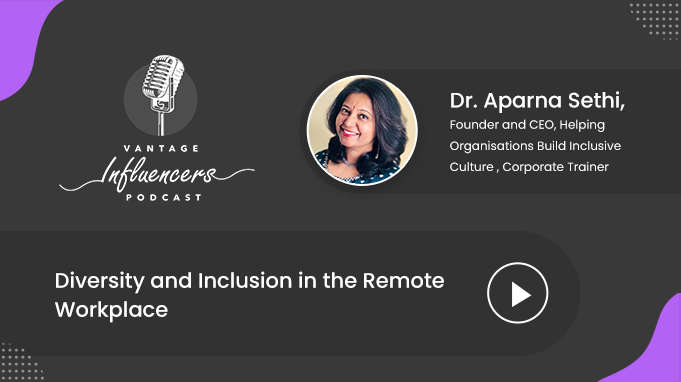
Episode Overview
Dr. Aparna Sethi argues that diversity and inclusion should not need a business case to justify them: every person, regardless of background, already has a right to opportunity. In this conversation with host Susmita Sarma, she draws a sharp line between two words companies often use interchangeably. Diversity, she says, is simply the presence of differences: culture, race, age, religion, disability, sexual orientation, and gender. Inclusion is a separate and harder question: are those different people actually respected, heard, and given a fair shot once they are in the room? A company can hire for diversity, she points out, but inclusion depends on the daily behavior of every employee, and without it, diversity has no real meaning.
The conversation then turns to what remote work exposed about inclusion that office life had kept hidden. Dr. Sethi describes how the shift to working from home forced households to renegotiate who does the housework, and how several men reported noticing, for the first time, a drop in the respect they received once they were doing domestic tasks themselves. She uses that shift to build a broader argument: real progress on diversity and inclusion depends on leadership acknowledging that inequality exists in the first place, and on individuals recognizing the unconscious biases that quietly shape hiring, promotions, and everyday assumptions about who needs which benefit. She is especially critical of the reflex to assign benefits like flexible hours or daycare support by gender by default, and closes with a case for treating diversity and inclusion as a matter of personal accountability rather than legal compliance or brand image.
Episode Highlights
- Dr. Aparna Sethi defines diversity as the presence of differences, such as culture, race, age, gender, disability, and sexual orientation, and inclusion as whether those differences are actually respected, arguing that diversity without inclusion has no real meaning.
- She pushes back on having to prove a business case for diversity, since equal opportunity is a right, though diverse teams still show higher innovation, faster problem solving, and lower attrition.
- Remote work surfaced unconscious bias inside households, with several men reporting that they noticed a drop in respect for the first time once they were doing housework themselves during lockdown.
- She frames a working D&I program around heart, head, and hand: compassion, a concrete plan for change, and follow-through in daily practice rather than a policy that sits on a shelf.
- The two biggest blockers to a real D&I program, in her view, are leadership refusing to acknowledge that inequality exists and the unconscious biases that quietly shape hiring, promotions, and workload decisions.
- She also argues that benefits like flexible hours, work-from-home, and daycare support get assigned by gender by default, and that companies should offer them equally while keeping biology-specific benefits like maternity leave separate.
About the Guest
Dr. Aparna Sethi, Founder, Protouch
Dr. Aparna Sethi brings 20 years of experience across manufacturing, services, and academia, spanning roles in sales and marketing before she moved into HR. She is the founder of Protouch, a corporate training organization that runs HR certification programs and talent transformation initiatives aimed at building sustainable business and organizational culture impact. Her diversity and inclusion work grew out of her own experience of exclusion as a child and as a woman in the workplace, and it later expanded into training on the prevention of sexual harassment and initiatives for women's leadership. She has authored the book 'Where To Draw The Line,' which addresses the prevention of sexual harassment at the workplace.
Connect with Aparna on LinkedIn
Host
Susmita Sarma, Vantage Influencers Podcast Host
What You Will Learn
- How to separate diversity (the presence of differences) from inclusion (whether those differences are respected), and why one without the other falls short
- Why chasing a business case for diversity can miss the point, even though diverse teams still show measurable gains in innovation, problem solving, and retention
- How working from home exposed hidden inequities in unpaid domestic labor and reshaped how partners viewed each other's contributions at home
- A simple framework, heart, head, and hand, for turning diversity commitments into daily practice instead of a policy that never gets used
- The two biggest obstacles to a working D&I program: reluctant leadership and the unconscious biases built into everyday hiring and promotion decisions
- Why benefits like flexible hours, work-from-home, and daycare support should not default to one gender, and where biology-specific benefits still make sense
Key Topics & Timestamps
| Timestamp | Topic |
|---|---|
| 00:00 | Cold open: introducing the Vantage HR Influencers Podcast |
| 00:09 | Meet Dr. Aparna Sethi and her career across sales, HR, and entrepreneurship |
| 01:12 | What personally drew her to diversity and inclusion work |
| 02:26 | Defining diversity versus inclusion at the workplace |
| 04:40 | Why "proving" the benefits of diversity misses the point |
| 07:35 | Has remote work narrowed or widened the scope of inclusion? |
| 09:21 | The three Hs: heart, head, and hand of a working D&I program |
| 11:49 | The two biggest obstacles to implementing a D&I program |
| 15:07 | Employee benefits, gendered assumptions, and equal access |
| 19:56 | Her biggest piece of advice for organizations starting out |
Full Transcript
Click to read the full episode transcript
Welcome to the Vantage HR Influencers Podcast. This podcast is sponsored by Vantage Circle, the leading employee benefits and engagement platform.
Susmita Sarma: Hi, everyone. This is Susmita from the Vantage HR Influencers Podcast. Today we have with us Dr. Aparna Sethi, who has been conducting wide research in the areas of marketing and HR management and their application in the corporate world. Welcome to the show, Aparna.
Dr. Aparna Sethi: Thank you so much, Susmita.
Susmita Sarma: So before we start, we would like to know a little more about your experience and achievements.
Dr. Aparna Sethi: Okay, so I come with 20 years of experience. I worked in manufacturing, then in services, and then I shifted to academics. And now I'm completely on my own. Throughout my journey, I've worked across two profiles. I started in sales and marketing, and then worked widely in the HR area. I also have my own venture called Protouch, and we are completely into corporate training solutions. We give a lot of certification programs in HR as well, and that is where my diversity and inclusion work started.
What motivated me to work in diversity and inclusion is personal. Being a dark-skinned child, I went through a lot of exclusion, and a lot of emotional ups and downs. And being a woman, I also came across a lot of inequality many times. So somewhere I felt, why not work in this area? After exploring this area, I also got into the prevention of sexual harassment at workplaces. All of this led me to take up initiatives for women's leadership, and that is the area I work in. I have also authored one book, which is all about POSH, that is, the prevention of sexual harassment at the workplace. And though I work a lot in the area of women, I truly believe in equality. So that is what I am all about. I hope that helps.
Susmita Sarma: Okay, sure. So coming to the topic, as we navigate the impact of COVID-19, it is important to continue developing a culture of belonging. With several of our staff working remotely, we should concentrate on helping our employees interact and find new ways to emphasize inclusion. So today, we'll be talking about diversity and inclusion while working from home. Let's start with the basics. How would you simply define diversity and inclusion, and what factors does it include?
Dr. Aparna Sethi: Okay, so after working in this area, I also realized there is one thing we need to be very focused on: what these words mean to us. Diversity is all about differences, diversity is about variety. For example, people coming from different cultures, different races, ages, religions, disabilities, sexual orientations, and gender, that's another very important part of diversity. So this is all about diversity.
But diversity is incomplete without inclusion. I always say, if you look at a company's culture and top leadership, they will get people from various parts, you will have five generations working together. But what is very important is, are they being respected and appreciated? Are they being included, or is there still exclusion happening at the workplace? Because on diversity, a company can work, but on inclusion, each and every employee needs to work. And that is where their belief system and their culture make a huge difference. So inclusion is a measure of the culture that enables diversity to thrive. If inclusion is not there, then diversity has no meaning.
Susmita Sarma: Right. So I'm sure we can see some clear benefits of diversity and inclusion in employee engagement. Would you like to highlight some?
Dr. Aparna Sethi: Sure. Having said that, Susmita, I fundamentally do not understand this question: what are the benefits? Because what I personally feel is, why do we need to express or discuss the benefits of diversity in the first place? People coming from different walks of life, whether they're Black, white, tall, aged, men, women, or transgender, everyone has a right to get the job. But the unfortunate part is that now we need to define and discuss the benefits so that people will get convinced about it. Having said that, this is the requirement right now.
But there is a lot of research which shows that once you have diversity at the workplace, you may have higher innovation, different perspectives, and faster problem solving. And again, diversity doesn't mean only men and women, it means including people from all levels. Even your office assistant can give you a really wonderful idea. There are so many businesses losing market share just because they have positioned their products in a certain way. So can we come up with a more neutral product? The more we come up with neutral products, the better our businesses will be. For example, I can give a recent example of an urban services company that started offering beauty and grooming services for men, not just women. The moment you include people, companies grow together.
I can give you another example of an Indian company, Haldiram's. Earlier, they used to have only sweets, which we considered unhealthy, but now they are coming up with healthier options. So if you include people with different tastes, preferences, thoughts, and needs, who benefits? Only the company. So you can see increased profits. When diverse people work together, you will have lower attrition. And the best part is, it becomes part of the company's reputation. For example, the younger generation wants to work with a diverse workforce. So these are a few of the benefits we can see when a company has diversity and inclusion at the workplace.
Susmita Sarma: Right. So now work from home has become the new norm. Do you think that remote working has narrowed the scope of inclusion at the workplace?
Dr. Aparna Sethi: It is too early to say anything. Having said that, the best part we get to see is that diversity and inclusion, Susmita, has the highest impact from social culture, which comes into the workplace unconsciously and unintentionally. For example, in our society, housework was always degraded, it was not respected. During this lockdown period, people realized the importance of housework, how much effort goes into it, once they started sharing the responsibility. Now I'm sure when people come back to the workforce, they will understand the challenges women face, and the challenges the younger generation faces, especially around gender differences. For example, several men have expressed that they could see the respect going down once they were at home doing this work themselves. There is a huge change there. So sharing responsibility, respecting every job, and being more empathetic, this is behavior you will see post-COVID. That is my take. But again, it has to become part of our DNA when we work on diversity and inclusion.
Like I always say, when you're working on diversity and inclusion, there are three Hs you need to work on. One is heart: first of all, you should have that feeling, that compassion, you should feel that everyone on this planet deserves equal treatment. Second is head: you need to think about what it is that you can do to bring equality, and you need to build that into practices at the workplace, because policies sitting in a policy book alone will not help. And third is hand: are those practices actually being practiced, or are they just there to decorate the shelf? If you have all three of these at the workplace, it will be really helpful.
Susmita Sarma: Right. So how can managers or employers foster an inclusive at-home workplace? Also, if you can share some of the best D&I activities that most top companies are following nowadays.
Dr. Aparna Sethi: To my surprise, many companies are still working on diversity and inclusion, and honestly, it doesn't matter whether you're working from home or not. There are some sections of society, and unfortunately, we've had to run a lot of sessions highlighting things like respectful treatment and preventing domestic violence. Because during COVID-19, two things went up drastically: domestic violence and sexual harassment. Now, many people ask, if employees aren't coming into the workplace, how can sexual harassment still take place? But there are text messages being sent, video links being shared, and even company laptops being misused. So many companies are running a lot of sessions related to this as well, because there is a lot of stress. Many companies and people may be surprised by this kind of initiative, but it is happening.
Susmita Sarma: So, most often, getting all employees on board with diversity and inclusion initiatives is really difficult. What do you think is the most difficult part of implementing a D&I program? What are your views on it?
Dr. Aparna Sethi: There are two things I look at when it comes to diversity and inclusion and the challenges. First is commitment of leadership. When I say commitment of leadership, what do I mean by that? Most importantly, we need to acknowledge that there are challenges, that inequality exists, that it's a possibility, because sometimes things happen in a very subtle way that we don't even realize. Most incidents don't happen right in front of us, so we assume this isn't happening. So first, we need to acknowledge that it does happen. Once that acknowledgment comes from top-level management, it will flow down and reach the bottom level, because then you'll come up with practices and policies around equality. That's one thing we need to work on.
The second important thing I'd like to highlight is the unconscious biases we all carry. Every human being has unconscious biases, we don't even realize we're being biased while we work, especially when it comes to hiring, promoting, and giving out job roles and responsibilities. We make a lot of decisions, and those unconscious biases need to be addressed. When bias or discrimination is out in the open, there are laws and policies that can act on it. But unconscious biases are different, we don't even realize these things are happening. For example, people often tell me, "Madam, you conduct these sessions, but we feel there's no gender gap here, there's nothing like that." But after the session, it starts coming to their minds. I always give the example of how, when the British were ruling India, that felt like normal life to people at the time, until a few freedom fighters came forward and pointed out that this was subjugation. They created that awareness, and that's when people realized they needed to work for change. Similarly, these are unconscious things around us that we need to accept, and not just accept, but appreciate, because they are blind spots we carry, and that's where we need to be careful. There's also a neurological angle to this. For example, our brains are programmed in a certain way, psychologically, and we need to work on that too. So, two challenges: leadership, and the unconscious biases prevailing in society and among us.
Susmita Sarma: Okay, so we hear a lot about employee benefit programs. Can these programs help boost workplace inclusion?
Dr. Aparna Sethi: There are various programs and initiatives, and some mandatory laws too, like having women directors on boards, maternity leave, rights for persons with disabilities, and LGBT rights. This is what we're talking about when we say diversity, it's not only about women, it's a much bigger picture. So there are certain things companies are doing right now, maybe somewhat forcibly, because otherwise these things wouldn't exist. When there's a compulsion or a mandate, companies follow it, whether you're working from home or not, during COVID or in a normal situation, this still applies.
Having said that, I personally don't think there are many initiatives companies take specifically keeping one community or gender in mind, things like flexible work hours or work from home. Let me tell you, there are so many case studies that show people always assumed flexible timings or work from home were needed only by women employees. But when these initiatives were actually offered, many male employees opted for them, and many female employees did not. That was a surprising finding. After running a survey, we found out that many male employees wanted work from home, while women said they wanted to be away from home for at least eight hours, because it made them feel fresh and part of the system, and helped them focus more. Just imagine, so many working women are saying that their workload has gone up because they're also looking after the house, since the bulk of cooking and kitchen work still falls to them and many men aren't able to handle it. Even women on my own team say things like, "When are we going back to the office, so I can at least lock the house and be away from it for eight hours, without my other duties taking over?" So this is another unconscious bias, assuming that certain people need a particular thing and others don't.
I'll give you another example: daycare facilities. We always assume daycare facilities are only needed by women employees. But please understand, it's about the nature of the work, not about someone's sex or gender. For example, my job requires me to be at my desk in the office, so I need to go in whether I'm male or female. Similarly, earlier we used to have maternity leave only for women, but fathers wanted to enjoy that phase of life too, so eventually we introduced paternity leave. I was speaking to a few HR heads recently, and they said paternity leave is now being extended up to three years in some companies. For example, if paternity leave is 20 days for male employees, they can use those days anytime over three years, because the need for that support doesn't exist only at the time of delivery. So we can't simply copy what the Western world is doing, we have to look at our own social context. For example, at the time of delivery, a woman usually has a lot of people around to help her, but three months later she might need someone's help and not have it. So we can't blindly follow Western models. We have to move past giving benefits only to men or only to women. There are some biological differences, and specific benefits are needed for those. But for everything else, daycare facilities, compensation and benefits, work-from-home and flexible timing, it all has to be equal. That's my take on this.
Susmita Sarma: So what is your biggest piece of advice for getting started with D&I?
Dr. Aparna Sethi: I think currently we're working on diversity and inclusion in three ways. One is mandatory, legally, we're compelled to have inclusion, women employees, LGBT rights, people with disabilities, because if we don't follow it, there will be consequences, and so we do it. The second is that many people do it for branding purposes. For example, if a company hires someone from the LGBT community, they show them off almost like a trophy, and people think it will get them a brand, a profit, or more business, so that's why they do it.
I personally feel the most important thing is what I'd call social and individual accountability, it has to come from your heart, the belief that you want to do this, and that everyone on this earth deserves equal rights. Just because someone belongs to a community that society has decided is a weaker section, that community shouldn't suffer when it comes to opportunities, respect, and recognition. If that's how you're doing it, it's the biggest mistake, because if you make it purely mandatory, it creates resentment, people start saying so-and-so got the job only because she's a woman, and that creates a hit to the culture. What's really important is doing it from the heart, treating it as your own individual accountability. That would be my key advice.
I'd also like to add one more thing: when we talk about equality, let's talk about equality on equal terms. Right now, especially in urban areas, diversity and inclusion conversations tend to focus only on women. That has to go beyond just women. Otherwise, a few years down the line, we'll see another campaign swing the conversation entirely the other way. Let's not get to that point. Let's not blame men either, not every man is at fault, and we can't paint an entire gender that way. That is what real equality looks like.
Susmita Sarma: So there's a lot more to learn and understand to reap the best benefits of D&I in business. Could you share the best way people can reach out to you for more?
Dr. Aparna Sethi: So, my name is Dr. Aparna Sethi. You can search me directly on Google as Dr. Aparna Sethi, and you'll get all the details about me. You can also reach out to me on LinkedIn. My company's website address is www.protouchpro.com, and people can get in touch with me there as well.
Susmita Sarma: It was a great session with you, Aparna. We hope to have you again. Thanks a lot for joining.
Dr. Aparna Sethi: Thank you so much. Thank you so much for the opportunity. Thanks a lot.
Thanks for listening to the Vantage HR Influencers Podcast. Please do subscribe to the Vantage HR Influencers Podcast on Apple Podcasts and Spotify for new episodes.
FAQ
What is the difference between diversity and inclusion, according to Dr. Aparna Sethi?
Diversity is the presence of differences, such as culture, race, age, religion, disability, sexual orientation, and gender. Inclusion is whether those different people are actually respected, heard, and given a fair shot once they are part of a team. She argues that diversity without inclusion has no real meaning, because a company can hire diverse talent while individual employees still exclude them day to day.
Did remote work help or hurt diversity and inclusion, in her view?
She says it is too early to give a definitive answer, but remote work did surface bias that had stayed hidden inside offices. Many households had to renegotiate who does the housework during lockdown, and several men reported noticing, for the first time, a drop in the respect they received once they were doing domestic tasks themselves.
What are the biggest obstacles to implementing a diversity and inclusion program?
Dr. Aparna Sethi points to two: leadership's willingness to acknowledge that inequality and bias actually exist, and the unconscious biases every person carries into hiring, promotion, and day-to-day decisions without realizing it.
What is her biggest piece of advice for organizations just getting started with D&I?
Treat it as individual and social accountability rather than a legal mandate or a branding exercise. She warns that compliance-only or "trophy hire" approaches to diversity create resentment and hidden resistance, while a genuine, heart-led commitment builds a program that actually lasts.
Related Reading
Also listen on