Most companies can point to a diversity number that looks good on a slide, a genuine mix of genders, races, and backgrounds across every level, and treat that number as proof the work is done. What it can't tell them is whether those people stayed long enough to build a career there, because inclusion gets decided after the hire, and almost nobody watches that part as closely as the hiring dashboard.
That's where inclusion efforts quietly come apart. A company can hit every target it sets and still lose people from underrepresented groups within a year or two, and the exit interviews rarely say why in so many words. Employees don't write "lack of inclusion" on their way out. They mention a manager who didn't listen, a project they were quietly left off, a joke nobody called out, and enough of those add up to exactly what it looks like, even though nobody used the word.
Diversity and inclusion get treated as one initiative, but they fail for different reasons and need different fixes. What follows is what actually separates the two, 11 practical ways to build inclusion rather than assume it, and what any employee can do to move it forward, with or without a title.
Key Takeaways
- What Is the Difference Between Diversity and Inclusion?
- Why Inclusion at the Workplace Matters
- 11 Actionable Ways to Build Inclusion at the Workplace
- What Can You Do as an Individual Employee?
- Frequently Asked Questions
- Conclusion
What Is the Difference Between Diversity and Inclusion?
Diversity is getting a seat at the table. Inclusion is whether you actually feel like you belong once you're sitting in it.
A diverse workforce is a headcount: a mix of genders, races, and sexual orientations that looks good on the company's brochure. An inclusive workplace culture is what that headcount experiences after being hired, whether people are shielded from unconscious bias in how they're treated, evaluated, and heard, regardless of who they are or how they identify. One is a hiring metric. The other is a daily experience.
The clearest way to see the difference is a familiar analogy: a dinner party. Every guest has their own preferences, some are vegetarian, some are vegan, some have a gluten or egg allergy. A host who serves one set menu regardless has technically invited everyone; that's diversity. A host who adjusts the menu, guest by guest, until everyone at the table can actually eat, has built inclusion. Diversity is getting the invitation. Inclusion is making sure everyone enjoys the meal.
That difference is why the two get confused so often. A company can hit every number on its diversity dashboard and still run a workplace where entire groups of employees don't feel safe speaking up, don't get credit for their work, or don't see themselves reflected in who gets promoted. Diversity is a number. Inclusion is an experience, and it's the experience that decides who stays.
Recommended Article: A Definitive Guide on Diversity and Inclusion in the Workplace
Why Inclusion at the Workplace Matters
Inclusion at the workplace matters because it's the difference between a diverse hire staying and a diverse hire quietly leaving. In a Deloitte survey, 80% of employees said inclusion is an essential factor in choosing an employer, and that number holds up because the underlying reason hasn't changed: people don't stay somewhere they don't feel like they belong.
Recognition behavior is one of the clearest signals of whether that belonging is real, not just stated in a values deck. Vantage Circle's own research with Great Place To Work® India, The Recognition Effect Report (2025, 5.7 million responses across 1,800+ companies), found that recognition itself isn't handed out evenly: men are 5 percentage points more likely to feel recognized than women, and leaders feel appreciated at nearly twice the rate of frontline employees. That gap matters because it compounds. Employees who feel genuinely recognized across all four emotional signals the report measures, appreciation, acceptance, validation, and accomplishment, are 97% likely to say they intend to stay. Inclusion and recognition aren't separate initiatives. The same distribution problem shows up in both.
11 Actionable Ways to Build Inclusion at the Workplace
The significant challenge for inclusion is to build a company culture where everyone feels included.
You go through significant trouble to bring diverse talent into your organization, so it's worth making sure their employee experience is more than stellar. Here are 11 actionable steps to build an inclusion strategy that actually works.
1. Educate Managers About Inclusion At The Workplace

Managers decide whether an inclusion policy stays on paper or shows up in who gets heard, credited, or included day to day. Training can't be a one-time module either. In 2018, a Starbucks store in Philadelphia was rocked by an act of racial bias so public that the chain closed almost 8,000 stores for a day of mandatory bias training across 175,000 employees, a costly fix that ongoing training could have caught much earlier.
A few deliberate habits close that same gap:
- Tip 1: Make cultural training recurring, not a one-time workshop. Run diversity workshops on a regular schedule, and use them to actively work against unconscious bias by explaining why everyone's inclusion matters to how the team actually performs, not just as a compliance box to check.
- Tip 2: Audit how inclusive your workplace really is, not how inclusive it looks on paper. Check for non-gendered washrooms, whether anyone is quietly being left off projects over their sexual orientation, and whether thinly veiled comments about gender or race are going unaddressed in the work environment day to day.
- Tip 3: Build a real employee feedback loop, and actually assess what comes out of it. A feedback system that collects input but never gets reviewed is functionally the same as having no feedback system at all. Unless employees have a genuine voice, you won't know what's going wrong until it's already cost you someone.
2. Creating Inclusive Workplace Culture Through Rethinking Workforce Policies

Building an inclusive culture often means creating new policies, or retiring old ones, across everything from recruitment to performance management. Skip this step, and even a genuinely diverse hiring pipeline stalls out once people are actually on payroll, since pay, leave, and promotion decisions are where a policy either holds up or quietly falls apart. Three changes tend to matter most:
- Tip 1: Broaden how you hire. Source candidates through community outreach programs, targeted job fairs, and hiring consultancies, not just the same channels that already produced a homogeneous team.
- Tip 2: Audit pay by skill and role, not identity. As of 2026, women working full-time still earn only about 82 cents for every dollar men earn, according to Bureau of Labor Statistics data. Make sure your own pay bands are set by skill and job title, not gender, race, or sexual orientation.
- Tip 3: Build leave policy around your actual workforce. Let employees take leave for holidays that matter to them, even ones not on the official company calendar.
3. Communicate Inclusion Goals And Measure Progress

Simply creating inclusive workplace policies isn't enough if nobody communicates them. Employees need to feel they can raise a concern with their manager without it going nowhere, and managers need to meet that with an open mind instead of assumptions. A few habits make that channel real instead of theoretical:
- Tip 1: Ask for feedback on a regular cadence, not just once a year, so concerns surface while they're still small.
- Tip 2: Stand up a dedicated diversity panel with members from across departments, so the process stays visibly transparent instead of run by a single team.
- Tip 3: Give that panel real ground to act on discrimination in the workplace, since not every employee is comfortable raising it directly.
Measuring whether inclusion efforts are actually landing can't rely on assuming silence means things are fine. Regular pulse surveys, like the eNPS-based check-ins built into Vantage Pulse, give HR a real, recurring read on whether employees across different backgrounds feel equally heard.
A single company-wide inclusion score can also hide real gaps between teams. Department-level sentiment data shows exactly where inclusion efforts are landing, and where they're not, instead of averaging the problem away.
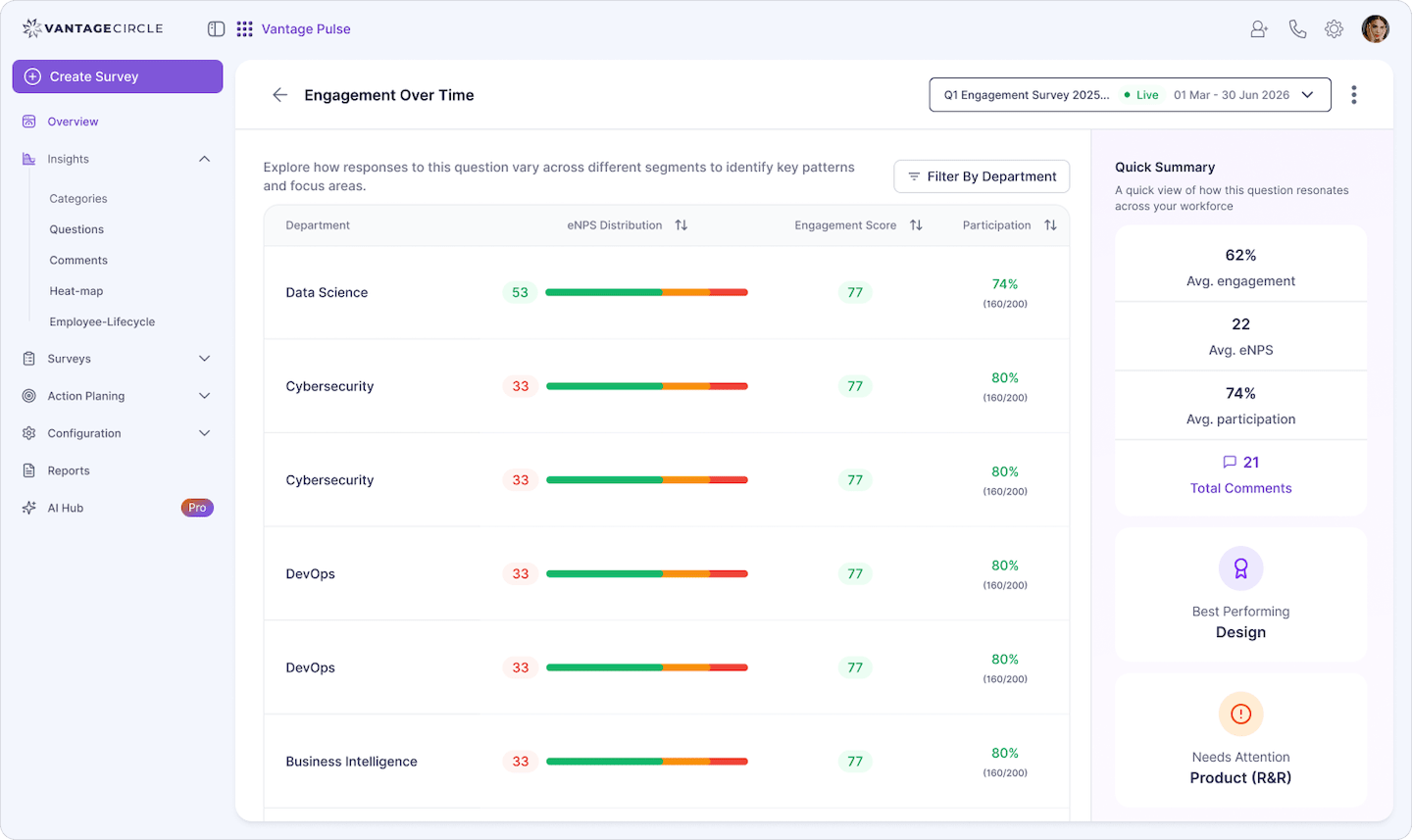
Explore: See Sentiment Analysis in Vantage Pulse
4. Celebrate Differences To Make Everyone Feel Included

Encouraging employees to practice their own culture and traditions inside the company is one of the clearest ways to show you respect them, and it lands best as specific, repeatable moments rather than a single annual event. A single Diversity Day on the calendar reads as a gesture. Weaving it into the normal rhythm of work reads as something the company actually means.
- Tip 1: Host potluck lunches where people bring food that reflects their own culture.
- Tip 2: Recognize days that matter beyond the standard calendar, like Black History Month in February or Juneteenth and Pride Month in June.
- Tip 3: Give employees of different backgrounds real input into decisions, not just a seat at the table for optics.
- Tip 4: Make space for people to share their own story, through an internal publication or forum, instead of assuming their experience is already understood.
5. Diverse Opportunities For Employee Engagement

A better employee experience increasingly depends on giving people real exposure to perspectives beyond their own team, not just a policy that states diversity is valued. That exposure changes how people work together in a way a values statement never will, since it replaces assumptions about a colleague's background with an actual, first-hand reference point.
- Tip 1: Let employees visit other office locations for first-hand exposure to how different cultures actually work, not just a slide about it.
- Tip 2: Run an employee pulse survey to find out what diversity-related experiences your team actually wants more of.
- Tip 3: Pair employees with a mentor from a different background, so the mentee sees a real example that talent, not sameness, is what gets someone ahead.
6. Early Introduction To Inclusion (At Onboarding!)

Inclusion has to start on day one, not after a new hire has already formed an impression of the culture. State it as a real company value in public channels, your website, social posts, interviews, so it's a commitment candidates can see before they accept an offer, not just a line in the handbook.
- Tip 1: Tell new hires directly that your company is a safe place for every gender, race, culture, and disability, instead of assuming the handbook says it for you.
- Tip 2: Walk them through current D&I policies, including what to do if they experience discrimination themselves.
- Tip 3: State plainly that discrimination carries real consequences, not just a verbal warning.
- Tip 4: Run an onboarding survey to find out where your D&I-focused hiring and orientation process is actually falling short.
7. Make Pronouns Matter

Inclusion means little if people aren't respected for who they identify as, and pronouns are a small, concrete place where that respect either shows up or doesn't. Getting someone's pronouns wrong repeatedly isn't a minor slip; it's a real source of stress. A few practical fixes make it easier to get right:
- Tip 1: Add a pronouns field to employee ID cards, so it's stated once instead of guessed every time.
- Tip 2: Normalize asking for pronouns during initial introductions, so it isn't singled out as unusual when someone does it.
- Tip 3: Screen job postings for gendered language with a tool like the Gender Decoder app.
- Tip 4: Catch unconscious bias in everyday communication with a tool like Alex, before it reaches a job post or a team message.
8. Diversity And Inclusion (D&I) Communication Channel

A company culture shouldn't just practice inclusion quietly. It needs a channel that keeps the conversation open and ongoing. Without one, most of what employees actually notice, an offhand comment, a colleague quietly left off a project, never reaches anyone who could act on it.
- Tip 1: Use the tools you already have. Share articles, news, and support resources for your diverse workforce through Slack or Microsoft Teams instead of building something new.
- Tip 2: Run regular D&I seminars with outside leaders or advocates who can speak to experiences your own team may not have.
- Tip 3: Offer volunteering opportunities tied to communities that face discrimination daily, so support extends beyond the office.
None of it works without follow-through: keep educating people on the bias minorities actually face, and keep adjusting how the organization responds to their needs.
9. Form A Diversity And Inclusion (D&I) Committee

A diversity and inclusion (D&I) committee makes inclusion someone's actual job, not just a shared aspiration. The committee promotes, supports, and checks whether your inclusion strategies are actually working, and because its own members are employees rather than management, it functions as a real bridge: people recognize and empathize with bias faster from inside the team, and the committee tends to feel far more approachable than escalating a complaint straight to a manager.
Not every employee is comfortable raising an inclusion concern by name, even to a D&I committee. An anonymous feedback channel gives people a way to flag what's not working without the social risk of being identified.
Suggested Reading: An anonymous channel only works if people trust it's actually anonymous, not just labeled that way. Check out our blog on Confidential vs Anonymous Surveys Explained
10. "Round Robin" Meetings

Meetings are one of the clearest ways to gauge whether your workplace is actually as inclusive as it claims to be. If certain employees consistently dominate the floor, others get cut off mid-sentence, or your most diverse hires stay quiet in every meeting, that's not a personality trait. It's a sign they haven't been given a real opportunity to participate.
The round-robin method fixes this directly: every person in the meeting gets an equal, uninterrupted turn to speak, share, or demonstrate, which levels the floor by default instead of leaving airtime to whoever speaks up first or loudest.
Round-robin meetings work because they force a baseline level of psychological safety into the room: everyone gets airtime whether or not they'd have spoken up on their own. That same habit is what builds a real sense of belonging at work beyond just the meeting itself.
11. Tie Inclusion to Everyday Recognition

The last, and most crucial, step is making inclusion part of your everyday work culture, not a once-a-year initiative. The most effective way to do that is to recognize and reward the behavior directly: when an employee goes out of their way to respect a colleague's customs or needs, appreciate their effort publicly instead of letting it pass unnoticed.
Inclusive behavior is easy to praise once, in a meeting, and easy to forget the next week. A visible recognition feed, where any coworker, not just a manager, can call out a specific inclusive action, turns it into a repeated habit instead of a one-time mention.
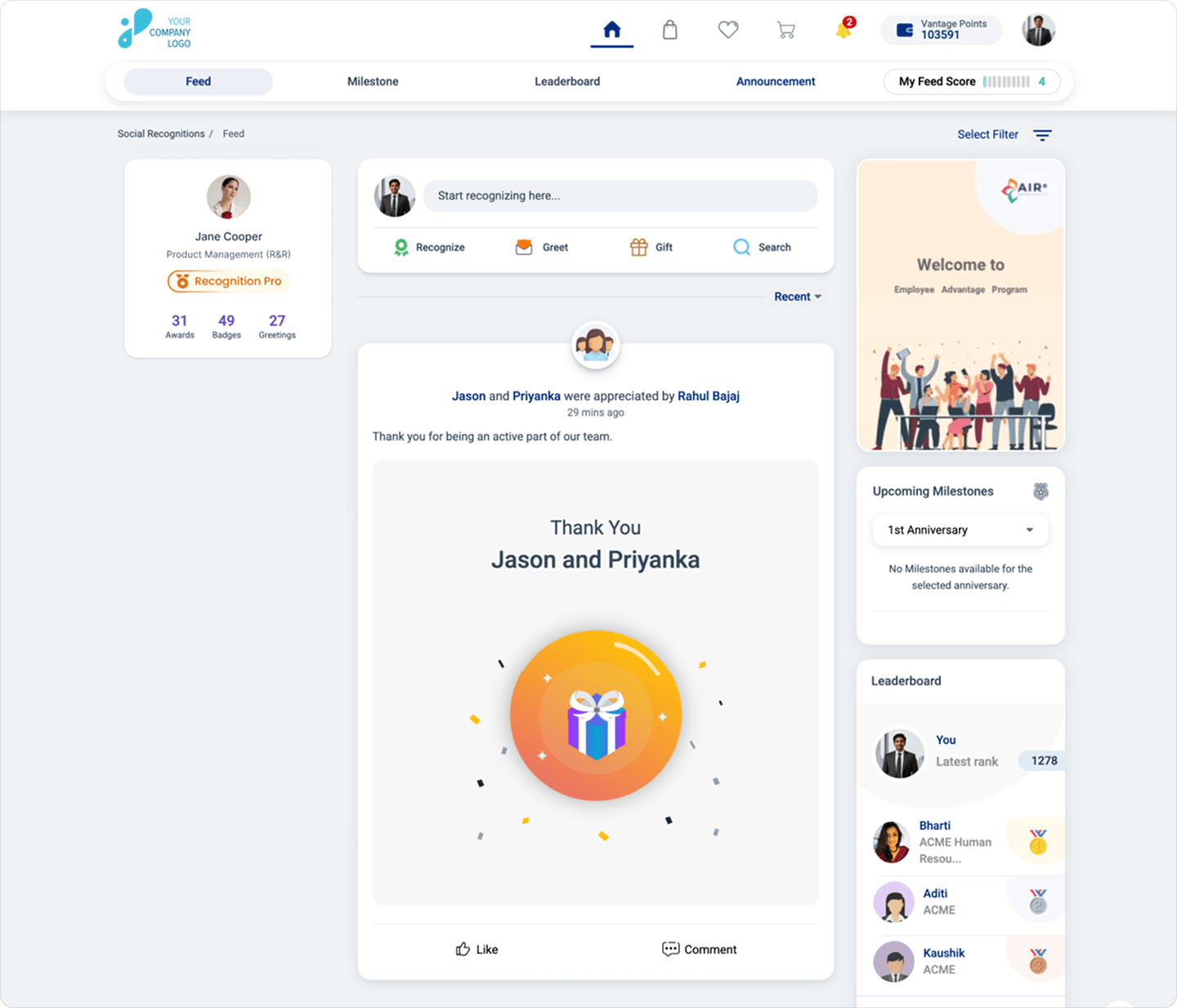
Although being transparent and nonjudgmental is the bare minimum, recognizing specific practices publicly is what actually sets the standard that you value individuals who treat others with dignity.
Explore: See how Vantage Rewards makes inclusive behavior visible
What Can You Do as an Individual Employee?
You don't need a manager title or a seat on the D&I committee to make your workplace more inclusive. Most guidance on inclusion is written for leaders and HR, but just as many people search for a different question: what can I actually do, day to day, without any organizational authority?
The honest answer is that individual inclusion happens in small, repeatable moments, not grand gestures. It's redirecting a conversation back to a coworker who got talked over. It's noticing that a colleague's holiday isn't on the team calendar and mentioning it instead of waiting for someone else to. It's saying something, even briefly, when a joke crosses a line, instead of letting silence read as agreement.
None of it requires waiting on a policy change:
| Situation | What You Can Do |
|---|---|
| A coworker keeps getting talked over in meetings | Redirect the conversation back to them by name: "I'd like to hear more from [name] on this." |
| You're one of the only people from your background on the team | Find or build an informal peer network instead of waiting for HR to create one |
| A colleague's holiday or cultural event isn't on the team calendar | Mention it openly and invite the team to acknowledge it. Normalizing it doesn't require a policy change |
| You hear a biased comment or joke | Address it in the moment if you're comfortable, or follow up with the person privately afterward |
| You want inclusion to be a daily habit, not a program | Publicly recognize a coworker's inclusive action instead of just noticing it privately |
Whether your team is remote, hybrid, or in person, the same principle holds: inclusion at the individual level is less about one big action and more about which small ones you're willing to repeat.
Frequently Asked Questions
Q1. What are the 7 pillars of inclusion?
A. The 7 pillars of inclusion, from the Play by the Rules framework widely adapted for workplaces, are Access, Attitude, Choice, Partnerships, Communication, Policy, and Opportunities. Together they cover whether people can physically participate, how they're treated, whether they have a say, and whether systems actually support them staying included.
Q2. What are the four P's of inclusion?
A. The four P's are most often defined as Present, Proactive, Persistent, and Passionate: showing up consistently, acting before being asked, sticking with it when progress stalls, and genuinely caring about the outcome. Other versions swap in Policies, Practices, or Power, so treat it as a memory aid rather than one fixed standard.
Q3. What are some real-life examples of inclusion in the workplace?
A. Real-life examples include using gender-neutral job postings, letting employees list pronouns on ID cards, running round-robin meetings so no one dominates discussion, recognizing cultural holidays beyond the standard calendar, and publicly appreciating employees who go out of their way to include diversely different peers.
Q4. What is a good example of inclusion in the workplace?
A. A strong example is a manager who actively invites quieter or newer team members into a discussion by name, rather than only calling on the people who speak up first. It shows inclusion as a repeatable behavior, not just a stated value or a one-time policy.
Q5. Can you give me some examples of inclusivity?
A. Examples of inclusivity include offering leave for holidays outside the standard company calendar, providing non-gendered restrooms, using accessible meeting formats for employees with disabilities, and creating anonymous channels so employees who aren't comfortable speaking up publicly can still raise concerns.
Q6. What is a good inclusion statement?
A. A good inclusion statement names specific, observable commitments instead of general language like "we value diversity." It should state what the organization actually does, such as how it hires, accommodates, and listens to employees, and hold up when an employee compares it to their actual day-to-day experience.
Conclusion
Diversity and inclusion get talked about as one initiative, but they aren't. Diversity gets people in the door. Inclusion decides whether they build a career past that door, and it's inclusion, not the hiring number, that's missing from every resignation letter that never quite explains why someone left.
None of the 11 practices above wait for a perfect policy. They show up in whether a manager gets trained before an incident instead of after, whether a quiet colleague gets asked directly instead of talked over, and whether recognition reaches the person who earned it, not just the person already in the room. Vantage Circle makes that last part visible and measurable, for every employee, not just the ones already close to management.

Shaoni Gupta is a content marketing specialist at Vantage Circle, with expertise in scriptwriting and copywriting in the field of employee rewards and recognition.
Connect with Shaoni on LinkedIn.