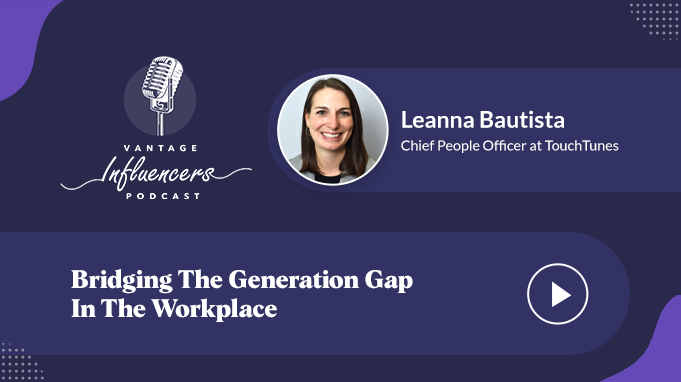
Bridging The Generation Gap In The Workplace
Episode Overview
Leanna Bautista opens by reframing what a "generation gap" actually is: not a fixed line drawn at a birth year, but a difference in experience, life stage, and career stage that shows up in how people communicate and make decisions. She argues that Baby Boomers and Gen X bring structure, process, and professional maturity that has carried corporate organizations for decades, while Millennials and Gen Z push for purpose driven work and greater employee agency. The tension between the two, she says, isn't a problem to manage away: it's the source of a more well rounded, better performing team, provided people stop assuming "they're not like me" and start being curious about why a colleague from a different generation sees a problem differently.
From there, the conversation turns practical. Bautista walks through how coaching language (asking "why has this worked before, and could it work here?" instead of asserting there is one right way to do things) keeps younger employees engaged rather than shutting them down. She describes a formal mentoring program built deliberately as a two way exchange rather than a one directional handoff of experience, and points to something as simple as shared music in the office as a low pressure way for colleagues to start talking about their backgrounds. She closes with a concrete measurement approach: track engagement and inclusion survey results by generational cohort, not just as a company wide average, to see where the gaps actually sit.
Episode Highlights
- Multi-generational teams work best when structure-oriented experience from Baby Boomers and Gen X pairs with the purpose-driven, change-ready energy Millennials and Gen Z bring to the table.
- Generational friction often starts with stereotyping ("they're not like me") rather than an honest look at differing experiences and life stages.
- Coaching language, questions like "why has this worked before, and could it work here?", opens more doors than absolute statements about the "right" way to do things.
- Cross-functional teams built with an eye toward varied generational perspectives, not as a checkbox exercise, sharpen problem-solving.
- Reverse mentoring, where senior leaders learn from newer employees just as much as they guide them, is one of the most effective tools for closing the gap.
- Progress is measurable: track engagement and inclusion survey results by demographic segment, not just as an organization-wide average, to spot where gaps persist.
About the Guest
Leanna Bautista, Chief People Officer at TouchTunes
Leanna Bautista is the Chief People Officer at TouchTunes, the jukebox and music experience found in more than 65,000 bars, restaurants, workplaces, and other social venues across North America and Europe. She brings both a results-oriented and empathetic approach to shaping culture, creativity, and energy in the workplace, drawing on more than 15 years of experience at organizations including Pharmapacks, PepsiCo, Tory Burch, and Pfizer, where she built expertise in employee relations, talent development, and retention strategy. At TouchTunes, she leads initiatives that boost employee connectivity, engagement, and business performance, often incorporating the company's own music platform into the employee experience. She holds a bachelor's degree in sociology and anthropology from Colgate University and a master's degree in industrial and labor relations from Cornell University.
Connect with Leanna on LinkedIn
Host
Sanjeevani Saikia, Vantage Influencers Podcast Host
What You Will Learn
- Why generational differences are shaped more by life stage and experience than by birth year alone
- How coaching language and open-ended questions defuse generational friction on teams
- How to structure mentoring programs, including reverse mentoring, that bridge generational gaps
- How to build cross-functional teams that intentionally draw on varied generational perspectives
- Informal culture-building tactics, like shared music in the workplace, that help colleagues connect across generations
- How to measure progress on generational inclusion using segmented engagement survey data
Key Topics & Timestamps
| Timestamp | Topic |
|---|---|
| 00:00 | Cold open and episode introduction |
| 01:53 | Leanna's corporate journey to Chief People Officer at TouchTunes |
| 02:56 | Why bridging generational differences matters for organizations |
| 04:04 | Three ways different generations strengthen a workforce |
| 05:27 | Major challenges multi-generational teams face |
| 07:14 | The role of communication and language in closing the gap |
| 09:46 | Cross-functional teams and mentoring as bridge-building tools |
| 16:15 | Measuring progress on intergenerational understanding |
| 18:03 | Closing thoughts and how to connect with Leanna |
Full Transcript
Click to read the full episode transcript
Welcome to the Vantage HR Influencers Podcast. This podcast is sponsored by Vantage Circle, the simple and AI-powered rewards and recognition platform for employee engagement.
In today's dynamic and diverse work environments, bridging the generational gap has emerged as a crucial topic demanding our attention, with a workforce that encompasses multiple generations, including Baby Boomers, Generation X, Millennials, and Gen Z. Understanding and addressing the challenges that arise from these generational differences is of utmost importance. By fostering effective communication, collaboration, and mutual understanding among generations, organizations can unlock the full potential of their workforce. Therefore, delving into the intricacies of bridging the generational gap is essential to foster a cohesive and thriving work environment that embraces the strengths and perspectives of each generation. So without further ado, let us embark on the journey of exploring ways to bridge the generational gap in the workplace.
Sanjeevani Saikia: Hello listeners, welcome to another episode of Vantage Influencers Podcast, where we explore a wide range of HR topics that are sure to grab your attention and inspire you. I'm your host Sanjeevani Saikia, and today we will be having a conversation on bridging the generation gap in the workplace. For the same, I have with me Leanna Bautista, Chief People Officer at TouchTunes. Hi Leanna.
Leanna Bautista: Hi Sanjeevani.
Sanjeevani Saikia: First of all, I would like to thank you for giving your invaluable time and joining us in today's episode. Before we dive deeper into today's topic, bridging the generation gap in the workplace, could you kindly walk us through your corporate journey so far?
Leanna Bautista: Sure, sure. I'm happy to be here and thank you so much for having me. This is a great topic and I'm happy to share some ideas and thoughts on it and talk with you about it. Just a little bit in by way of background, I'm the Chief People Officer at TouchTunes, and previous to this worked at ecommerce company Packable as the Chief People Officer, and then also spent time at PepsiCo, Pfizer, and Tory Burch in my career. I spent a lot of time as a talent management and organizational effectiveness professional, as well as an HR business partner, but love this role as a CPO of being able to bring together all the different aspects of HR to help set that strategy.
Sanjeevani Saikia: Great. Thank you for sharing your journey with us. It has truly been remarkable, Leanna. I think we can now dive straight into the topic. Since in this episode we'll be talking about bridging the generation gap in the workplace, I feel it's important to know why it's so crucial for organizations to overcome generational differences. So what's your take on that?
Leanna Bautista: Yeah, I think the reality that we have is that we have so many different generations that are in the workplace at the same time. And people come from different experiences, perspectives, and ways of working, and being able to find commonality, bring people together, and build a community that encompasses the best of all the different generations is an unlock for an organization to be able to take advantage of and leverage the skills and experiences across the generations. It can really make it so that you've got a much more well-rounded viewpoint and perspective, as you would with all different types of demographics and diversity of experiences that people have. So truly being able to think of this as an unlock is what will help to drive the performance of your teams, your organizations, and ultimately your individuals.
Sanjeevani Saikia: That's true. So if I have to ask you, what are the three primary reasons you think having multiple generations in the workplace is very, very important? Could you just tell me three very specific ones?
Leanna Bautista: Sure. So I think the Baby Boomer generation actually brings a lot of the structure and the process, and some of the components of professional maturity that have been driving our corporate world for so long, and that really continues to move organizations forward. But then you start to see the Millennials and Gen Z bring in new ways of thinking, a lot more in terms of employee agency and how they can help shape the future, being really focused on being purpose driven, and how to help the organization drive it in a way that is beyond just delivering the business outcomes. Being more purpose driven is something we're seeing Millennials and Gen Z bring into the workplace more. And so I think those are two kind of sides of the spectrum, and obviously there's a lot of gray, and those are some stereotypes that I've made, but I think those different perspectives together help to shape an organization and keep some of the rigor and process that have made corporate America work really well, but also bring in a lot more entrepreneurial spirit.
Sanjeevani Saikia: True. When working with teams that consist of members from different generations, there can be numerous challenges, and I guess it's important to identify those challenges in order to create unity across different age cohorts in the workplace. So could you kindly shed some light on the major challenges that arise when working with multi-generational teams?
Leanna Bautista: So what I would say is actually, I think it starts with this idea of stereotypes, or viewpoints of "I can't relate," or "how this person reacts to things doesn't resonate with me." And it could start with this separation of "they're not like me." And again, I mentioned earlier this happens a lot in all different types of cohorts, but generationally, it is not just about age and the years you're born. It's also about your experiences, and how far along in life and your career you are changes your perspective. And being able to appreciate the perspective that the other group brings in is something that comes with time. And I think if you have a group where you don't have open dialogue and discussion, there are certain assumptions being made about people's work ethics or their openness to change, etc. That's when you see the challenges arise, and that multi-generational team is not as effective, because you start to have splintering of people based on this. If you can actually help to acknowledge some of those differences and bring people together, hopefully that resolves some of the negative stereotypes and lets people see the benefits of the different perspectives coming in.
Sanjeevani Saikia: I agree. Leanna, I think you'll agree that differences in communication styles and language can create a gap that may hinder collaboration. I was wondering if we could discuss the role of communication and language in bridging the generation gap.
Leanna Bautista: Yeah, so I think even how people communicate starts with their approach and their identity and where they're coming from, and starting to use more common language of inclusivity, where you're seeking to understand, versus language that is very clear that "there's a right way to do things, there's a wrong way to do things." Language that seems to imply judgment, I think, drives the difference between the generational gaps more. If somebody who is a Baby Boomer or Gen X has a very strong stance of "we've always done it this way, that's how we should do it," and their language and the way of communicating conveys that, that may not be as engaging for somebody in Gen Z who's just coming into the workplace, or a Millennial who is more focused on "how do we try something new," has that growth mindset, because they maybe haven't had that same years of experience, or they just have a different perspective on how to view things. And closed language may shut them down and make it so that they're not engaging and having that kind of full team relationship, creating a separation between the generations in your workforce. Whereas if you can use your language to be really purposeful and use more coaching language, like "help me understand why this has worked before, and do we think it could work here," or "what ideas do you have, or have you seen other things like this out there," that's more effective. We recently did some sessions around growth mindset here, and one of the things we talked about during different sessions is how do you bring in people with different perspectives and ask questions in a way that gets them to step outside their comfort zone and think from somebody else's perspective, or have empathy. So as much as you can use that type of language around open-ended questions, trying to seek to understand and build your empathy about where somebody else is coming from or why they might believe something, that's going to help break down some of those barriers between relationships and build a much more cohesive team.
Sanjeevani Saikia: Correct. Do you think creating cross-functional teams that include members of different generations can also help break down silos and foster collaboration?
Leanna Bautista: Yeah, absolutely. I think anytime you build a team from various perspectives, it helps to break down the different barriers that may be based on different demographics. I don't necessarily think you'd want to purposely say "we're building this team for the sole purpose of having somebody from different generations," but I think as you build a cross-functional team, being able to say "what are the profiles of the people on this team, what might they be bringing, what's the perspective, what's the experience that they're bringing to the table, and how do we make sure we're having a balance of that," that includes different generational perspectives, is really a smart thing to do as you're approaching solving a business challenge.
Sanjeevani Saikia: Yes. I believe that employers again have a huge role to play in closing the divide between age groups and harnessing the strengths of each generation in the workplace. So I wanted to know your take on how employers can effectively do that, because I believe your suggestions will help them in the longer run to attract and engage employees of different age groups and retain them. Also, Leanna, I'm curious to know how employees can bridge that gap too. So I would like to know both perspectives together.
Leanna Bautista: Okay, so starting with the organization, I think it starts with your culture, and are you creating an inclusive culture that really values and appreciates various perspectives. And it comes from everything, from your corporate level communications, to your DE&I initiatives, to the programs that you run within your organization. So for example, one of the things that we do here is we have a formal mentoring partnership and program. And as we look at that mentoring program, we make sure that we're really purposefully connecting people who are not necessarily the same, who will have different perspectives, and generation is one of those components that we look at. How do we take somebody who brings different experiences and a different perspective and pair them with somebody who's newer to the workforce, and how can they help to guide them? But we don't just see that as the more experienced individual mentoring the less experienced individual, we see it as almost a reverse mentoring, where the mentor is also learning from the mentee and starting to shift some of their perspective and mindset as part of it. I think another thing, and this is related to TouchTunes, we offer a TouchTunes Unlimited service where we have jukeboxes that can go in different offices. And we've actually found that something like music, and being able to have people select music and play their own music in the workplace, is a great way, in a more informal way, to break down the generational gaps, because it allows people to start talking about their perspective, their experiences, who they are, and their backgrounds, in a more informal way. And so you start to appreciate the different genres of music based on the generations, you're appreciating what was happening in somebody's life when a certain song was playing, and it starts to create this appreciation that people have experienced different things. They have different tastes, but that kind of unique unifier of music brings people together in how they experience things, and starts conversations. That's one example, but there are other things we can do around office engagement activities that get people of all different generations enjoying it in a more informal way. I think being able to make it clear that everybody has connections, even if you're in different generations, and creating an atmosphere where people start to talk about that, is a really positive way an organization can do that. And then thinking from an individual perspective, I think there are two main things. We talked a lot about this during the courageous conversations when I was at PepsiCo, and we were working toward our social equality journey, educating people on the different demographics and what they experienced. The two big things, and I think this applies very much to generational dynamics too, are: listen and ask questions. Be curious. That is so important for every individual, instead of making an assumption of "oh, this person, they don't understand what I experienced because they haven't done X, Y, and Z." Instead of making an assumption, be curious, ask questions, and then listen to what somebody is telling you, and start to think about where the commonality is versus where the differences are. So that's the first thing. But then the second one is: be open. Think about how you can share your experiences in a way that helps people understand where you're coming from and why you might be coming from things, because a lot of the time the assumptions can be conveyed in a really negative way. The stereotypes are seen as a negative, but something like Gen Z being really focused on employee agency, and believing they can make a difference and impact anything in this world, including their work environment, that could be seen as a negative, or it could be seen as a positive. So having people of that generation talk about why they operate that way, and what's the power behind why they do that, gives people more of an understanding of who you are. So it's listening and being curious about others, but also being open and willing to share about where you're coming from and why you might operate the way you do.
Sanjeevani Saikia: Yes, I think these are some really key pointers that you have shared. So Leanna, we are arriving at the end of today's episode, but before we let you go, there's one last question that both our listeners and I would love to know your take on. And the question is: what metrics or indicators can companies use to measure and track progress in fostering intergenerational understanding and bridging the generation gap in the workplace?
Leanna Bautista: Yes, as with so many areas of HR, and I'm sure you hear this a lot in your different podcasts, it's sometimes hard to find the measures. But this is one where I think how you measure engagement in your organization, as well as inclusion, is through survey data, whether you do an annual survey or you're taking more of a pulse approach, which is becoming more popular, making sure that you're asking questions in that engagement survey around overall engagement, and then looking at your demographics to see if there's a difference in how people are experiencing your environment, and what you can do to address that. And then the other one is making sure that one of those questions is specifically related to inclusivity, and whether people feel like their opinions are valued, whether they feel like they are treated fairly. Having some of those questions, I think, is a great way to start measuring this and see if there's progress being made. And it's not just measuring your employee body as a whole, but as I said, looking at the different demographics, understanding their take on the different questions, and then being able to be more targeted in your approach if you're seeing a gap in certain teams, functions, or across the organization.
Sanjeevani Saikia: Great. So Leanna, we have reached the end of today's podcast. Do you have any message for our listeners? Our listeners would be delighted to hear it from you. And also, our audience might want to stay in touch with you, so it would be great if you could tell them how they can reach out to you.
Leanna Bautista: Great. I would just say my final message is that this is an area I'm especially passionate about in terms of inclusivity in the environment. We talked today about the generational gap, but I think you see this across so many different demographics. And I'll leave the audience with this idea: everybody has an identity that's been shaped by how they grew up, where they are now in life, and so on. You have commonality with so many people that you wouldn't know at the surface level. So make sure you're going below that surface level to understand somebody's full identity, make those connections, and experience things from a place of understanding and empathy. I think that will just make us all better people, and our workplaces much more effective. So that's my advice to everybody: think about how you personally do that and drive it in your organizations as HR professionals. In terms of being in contact, I'd love for anybody to reach out. I have a passion for talking to people about this, giving advice, and I'd love to hear the best practices that you all have. So you can reach out to me through my email. It's l.bautista@touchtunes.com.
Sanjeevani Saikia: It's been a pleasure to have you as our guest today. Your insights and expertise have been invaluable, and we are grateful for the time you have taken to share your knowledge with our listeners. So Leanna, thank you so much, thanks a lot.
Leanna Bautista: Thank you so much, appreciate being asked to join, and thank you to everybody listening.
FAQ
What causes friction between generations at work?
Leanna Bautista says it usually starts with stereotyping, an assumption that "they're not like me," rather than an honest look at real differences in experience and life stage. Without open dialogue, teams start splintering along these unspoken assumptions about work ethic or openness to change, which makes the multi-generational team less effective as a whole.
How can leaders use language to bridge the generation gap?
Bautista points to coaching language over declarative language. Phrases like "help me understand why this has worked before, and do we think it could work here?" invite input, while absolute statements about the one right way to do things tend to shut down employees who are newer to the workforce or used to working differently.
What is reverse mentoring, and how does it help close the generation gap?
In a reverse mentoring setup, a more experienced employee guides someone newer to the workforce, but the relationship runs both ways: the mentor is also expected to learn from the mentee and shift their own perspective. Bautista describes this as one of the more effective structured tools for building cross-generational understanding, alongside informal culture builders like shared music in the office.
How should companies measure progress on generational inclusion?
Bautista recommends using engagement and inclusion survey data, whether through an annual survey or a more frequent pulse approach, and cutting the results by demographic group rather than looking only at a company-wide average. Questions about whether employees feel their opinions are valued and whether they're treated fairly help surface where gaps still exist across teams or functions.
Related Reading
Also listen on