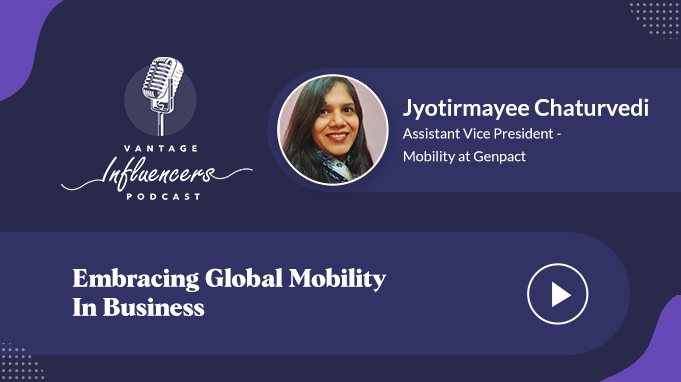
Embracing Global Mobility In Business
Episode Overview
Jyotirmayee Chaturvedi argues that global mobility is far bigger than moving people from one office to another. In this conversation, she breaks down why cross border talent movement has become a genuine business lever: it gives organizations access to skills beyond their home geography, supports market expansion by putting people on the ground where cultural nuance matters, sparks knowledge exchange between employees from different backgrounds, builds leadership capability through cross cultural exposure, and ultimately makes organizations more agile. She also connects mobility directly to diversity, equity, and inclusion, making the case that physically bringing people together from different geographies is one of the most effective ways to put D&I values into practice.
The conversation then moves into where global mobility is headed. Jyotirmayee walks through the people, technology, and regulatory trends reshaping the field: shorter assignments and remote work replacing long term relocations, the rapid spread of digital nomad visas since Estonia's 2020 launch, and AI's growing role in personalizing cultural training, powering employee chatbots, and helping mobility professionals learn from past assignment data. She is equally candid about the friction points: cost overruns, the emotional toll of relocation, and a shifting regulatory landscape around tax, social security, and data privacy. Her advice throughout comes back to one habit: treat mobility as a discipline of constant unlearning and relearning rather than a fixed rulebook.
Episode Highlights
- Global mobility means far more than moving employees between offices. It is an exchange of ideas, technology, and cultures that drives measurable business outcomes.
- Talent access, market expansion, knowledge exchange, people development, and organizational agility make up the core business benefits of a mobility program.
- Workforce movement trends are shifting from long term assignments toward shorter stints, remote work, and gig style arrangements, with digital nomad visas spreading fast since Estonia introduced the first one in 2020.
- Artificial intelligence is already reshaping mobility work through personalized cultural training, real time chatbot support for employees, and better use of past assignment data in decision making.
- Cost, human, and regulatory challenges, from relocation expenses to visa rules to new data privacy laws, require deliberate planning at every stage of an assignment.
- Cultural training, language support, buddy cohorts of past and current assignees, and aptitude based candidate selection all help employees adjust faster and stay longer in a host location.
About the Guest
Jyotirmayee Chaturvedi, Assistant Vice President, Mobility at Genpact
Jyotirmayee is a Chartered Accountant with close to a decade and a half of experience in managing mobile populations and designing mobility strategy to drive business solutions, spanning both consulting and industry roles. A consummate professional with a passion for continuous learning, she treats the cycle of unlearning and relearning as the core skill required to keep pace with an ever evolving mobility landscape.
Connect with Jyotirmayee on LinkedIn
Host
Sanjeevani Saikia, Vantage Influencers Podcast Host
What You Will Learn
- Why global mobility delivers business value well beyond simple employee relocation
- The five ways cross border talent movement benefits organizations: access to talent, market expansion, knowledge exchange, people development, and agility
- How workforce trends like remote work, digital nomad visas, and gig style arrangements are reshaping international assignments
- Where artificial intelligence is already helping global mobility professionals, from cultural training to chatbot support to decision making
- The cost, human, and regulatory challenges organizations must plan for before relocating employees
- Practical strategies for pre-departure, during-assignment, and post-assignment support that keep transferred employees engaged and retained
Key Topics & Timestamps
| Timestamp | Topic |
|---|---|
| 00:00 | Cold open: why navigating global mobility matters |
| 01:56 | Jyotirmayee's professional journey into global mobility |
| 03:07 | Why global mobility matters in today's business context |
| 09:06 | Trends across people movement, technology, and regulation |
| 18:45 | Common challenges in managing a global workforce |
| 23:01 | Strategies for a seamless employee relocation experience |
| 26:08 | The future of global mobility and how businesses should prepare |
| 29:04 | Closing thoughts and how to connect with Jyotirmayee |
Full Transcript
Click to read the full episode transcript
Welcome to the Vantage HR Influencers Podcast. This podcast is sponsored by Vantage Circle, the simple and AI powered rewards and recognition platform for employee engagement.
Managing and facilitating the movement of employees, skills, and talent across different countries and regions is not an easy task. In this dynamic era of cross border collaborations and international talent, businesses are facing both challenges and openings on an unprecedented scale, making things a little more complex.
So it is imperative to delve deep into the strategies, insights, and real life anecdotes that illuminate the path to effectively steering through the complexities of global mobility. So settle into your workspace, whether it's a corner office or a cozy home desk, as we unravel the significance of global mobility in the corporate realm. Let's explore how to turn challenges into triumphs and how to embrace a world that's always on the move.
Sanjeevani Saikia: Hello listeners, welcome to another episode of Vantage Influencers Podcast, where we explore a wide range of HR topics that are sure to grab your attention and inspire you. I'm your host Sanjeevani Saikia, and today we will be having a conversation on navigating global mobility, how businesses can embrace a world on the move. And for the same, I have with me Jyotirmayee Chaturvedi, Assistant Vice President, Mobility at Genpact. Hi Jyotirmayee.
Jyotirmayee Chaturvedi: Hi Sanjeevani.
Sanjeevani Saikia: First of all, I want to express my gratitude for your precious time and presence in today's episode. Before delving into today's focal topic, navigating global mobility, would you kindly walk us through your professional journey so far?
Jyotirmayee Chaturvedi: Sure Sanjeevani, and first of all thanks for having me on your show.
Sanjeevani Saikia: It's a pleasure to have you.
Jyotirmayee Chaturvedi: Likewise. So I'm a chartered accountant by profession and hold approximately a decade and a half of experience, and all of this has been in mobility, split into consulting and industry. Over the years, I think I have learned a lot about mobility. When I started, I didn't know anything about it, but now I spend every day grilling myself to know a little more about it, and I'm so happy that I've come a long way.
Sanjeevani Saikia: Amazing. Thank you for sharing your journey with us. With your permission, I'd like to delve into the topic.
Jyotirmayee Chaturvedi: For sure.
Sanjeevani Saikia: Today we'll be discussing navigating global mobility, how businesses can embrace a world on the move. To get us all started, can you give us a summary of the significance of global mobility in the business context, and explain why it's gaining greater importance in the modern era?
Jyotirmayee Chaturvedi: Sure. So global mobility, I would say, is precisely the movement of employees between geographies, and every organization needs that in today's times because it gives them the opportunity to tap talent from different geographies. However, I would want to look at it more deeply and hold a much wider meaning, because when employees are travelling, ideas, experiences, and technology travel along with them, there is an intermingling of cultures, and it's fascinating that there could be so much more to it than meets the eye. Perhaps that's the reason it has gained so much importance in present times.
All these movements and exchanges give businesses benefits like access to talent. In the competitive world we're in, businesses are being pushed to hire and retain the best talent. COVID also taught organizations that their talent pool could not be concentrated in one geography, so organizations are now focusing on the global talent pool to fill skill gaps and bring in specialized expertise. Global mobility helps companies recruit and retain the best employees regardless of geographical location.
The second would be market expansion. Businesses today are operating in a volatile and uncertain market space, whatever you want to call it, VUCA or BANI, but businesses are posed with a big challenge: to stay relevant, they have to diversify, increase market share, and increase their customer base. All of this requires being physically present in that geography, and global mobility comes to the rescue because it allows you to place employees physically in a geography. What that brings along is that employees are able to understand local preferences, local needs, and cultural nuances, and that helps an organization tweak and tailor its solutions to meet those challenges. That's an effective market entry strategy, and also a strategy for successful expansion.
The third, to my mind, would be exchange of knowledge. Every individual in this world carries unique perspectives, ideas, and experiences. As an organization, when you foster collaboration and knowledge sharing among employees from different backgrounds, you're fuelling creativity and helping them adapt to change. Imagine a situation where people from all backgrounds sit together, you give them a problem statement, and the solution they come up with would be a wow factor for anyone.
Sanjeevani Saikia: Yes, absolutely.
Jyotirmayee Chaturvedi: And then I'd say people development. Modern day organizations typically need leaders and individuals who can demonstrate adaptability, sensitivity, inclusion, and spontaneity, along with technical expertise. So when you give employees that global opportunity, it enhances their cross cultural understanding, adaptability, and leadership skills. This helps bridge the skill gap and enables employees to become effective in a global context.
And lastly, mobility also provides agility to an organization. Agility, to my mind, is a combination of speed, adaptability, and resilience. When you expose employees to multiple situations, multiple business models, and multiple locations, they learn to adapt and become more cross culturally sound. All of this helps in the rapid sharing of ideas, keeps people updated with changes, and gives organizations an edge in the market.
Sanjeevani Saikia: So I would like to ask you again, in today's day and age, companies are going big on diversity and inclusion, implementing policies around D&I. Do you think this kind of global mobility can help make diversity and inclusion efforts bigger and better?
Jyotirmayee Chaturvedi: I would say absolutely. At the crux of diversity, equity, and inclusion is bringing together people from different backgrounds, ethnicities, races, and nationalities, and nothing does that better than global mobility, because it lets you bring people to one spot from different geographies to share their ideas and perspectives. So certainly, human mobility does help with D&I initiatives.
Sanjeevani Saikia: Thank you for explaining that so clearly. In the landscape of workforce mobility spanning various nations and regions, could you share some notable trends you've identified along the way? Specifically, we'd love to hear about the patterns you've noticed in employee movement and placement, and how these trends are impacting businesses on a global scale.
Jyotirmayee Chaturvedi: So Sanjeevani, I would really want to bucketize these trends: the people movement trends, the technological trends, and the regulatory trends.
Talking about trends with respect to people movement, there is a shift from long term assignments to shorter ones. People are also exploring opportunities to work remotely, and I believe that as more millennials join the job scene, we will see a shift towards gig workers. A lot of countries have already recognized this and introduced what we call digital nomad visas. Going by an OECD research paper from 2022, Estonia was the first OECD country to introduce such a visa, in August 2020. Since then, six OECD countries and at least 22 non-OECD countries have introduced similar visas. Most of these were launched in response to COVID-19 related travel restrictions, but the trend is here to stay.
Moving to technological trends, automation and digitization have been buzzwords for a while, but we're now talking about artificial intelligence. A lot of work is underway, and it enthralls me to think where we could reach with AI in the times to come. AI could prove useful in multiple ways, like employee orientation and cultural training, where sessions could be tweaked to meet specific employee requirements rather than relying on prepared presentations or videos. It could also help streamline administrative tasks. Every global mobility professional deals with huge volumes of work that take up time and sometimes stifle personal growth, but AI loves repetitive tasks, so some of that work could be handed off to it, possibly with better accuracy. AI can also improve employee experience, because mobility staff can't be present everywhere at all times. If you feed information into chatbots, employees can get answers to their questions in real time. It may lack the human touch, but getting that initial guidance is very helpful. Lastly, AI could help enhance decision making. Every global mobility professional carries a wealth of information from research and experience, and if that's put into a system, imagine the ease with which past experience could guide the future: my experience could help someone in my role three to five years from now, and I could learn from someone who held the same position a decade earlier, all without hassle.
Now, quickly moving to regulatory trends, I'd first pick up immigration. From an immigration perspective, countries across the globe have eased restrictions, and the world is trying to return to a pre-pandemic state. However, COVID did result in a skill gap, so we see some countries in the European region reducing minimum salary levels to attract foreign talent. From a tax perspective, we haven't seen much movement yet, but I'm hopeful we'll see changes to govern the compliance challenges that remote working brings, similar to the framework agreement that became effective in July in the European Union, which lays out how social security compliance works for cross border workers. The last regulatory area would be privacy regulations, which is another area picking up. India also has its own data privacy law, which became effective just last week. The kind of information we share today is huge, and it's shared very rapidly, so such laws are welcome because they help protect employees' sensitive data. And as we already discussed, mobility also contributes to D&I initiatives. There's a concept of sustainable mobility picking up pace too, and it contributes to the ESG goals organizations aim to achieve. So these trends reflect the evolving nature of work and the growing importance of talent mobility.
Sanjeevani Saikia: So apart from immigration laws and taxation regulations, employment laws also come into play, and these vary from country to country when it comes to compensation, benefits, and termination. How can HR make this work for employees relocated to a different place? Is any training or guidance provided, or is a particular structure given to employees?
Jyotirmayee Chaturvedi: International assignments can be very isolating and stressful for employees. What HR can bring along is cultural training. Providing pre-departure cultural training to employees can be very helpful, because working cultures can differ quite a bit.
Sanjeevani Saikia: Absolutely, working cultures could differ to quite an extent.
Jyotirmayee Chaturvedi: Besides familiarizing assignees with the cultural norms of the host location, it's equally important to show them how it's distinct from their own culture, because most trainings tend to cover only one side. If employees know how their culture differs from that of the host location, they can use better judgment when put in a situation. HR could also organize language training. No one becomes proficient in a language overnight, but we should aim to give employees a working level of knowledge, because they're going to a location to stay, not just to visit, which means they'll have to manage daily situations and interact with the local community, so they need to know the language. It also helps build a connection with the local population.
Another thing organizations can do is create a cohort of volunteers made up of three categories of employees: those who have already completed an assignment, those whose assignment is ongoing, and new employees about to start one. A lot of questions that new or ongoing assignees have can be answered within this cohort, and it gives comfort to know a few colleagues or seniors in the new location, which is very reassuring for anyone travelling to a completely unfamiliar place.
One thing I think often gets overlooked is that we tend to select employees for an assignment based on their technical skill set. But going on an assignment requires a completely different aptitude, and not everyone adjusts to new surroundings easily or is comfortable living out of a suitcase. An aptitude test can go a long way in selecting candidates with the right mindset to complete their assignments successfully.
Sanjeevani Saikia: Well said. I believe this aspect of doing business isn't free from challenges. As businesses expand their horizons globally, managing a mobile workforce presents its own complexities. Could you help us identify the challenges frequently encountered in this arena, and offer insights into effective strategies for overcoming them?
Jyotirmayee Chaturvedi: Sure, Sanjeevani. I'd say there are a few challenges that cut across all businesses, besides the specific challenges every organization has.
The first would be cost challenges. Any assignment brings additional costs: cost of living allowances, assignment related benefits, relocation costs, and tax equalization costs. It's imperative for businesses to understand these costs up front so their margins aren't impacted. The strategy to meet this challenge would be to try local hiring, which tends to cost less, or shorter assignments, where you can access treaty benefits and totalization agreement benefits, should they exist.
The second challenge would be human challenges. Assignments can be stressful and isolating, and there can be situations of communication breakdown due to cultural differences, along with personal situations an employee is put into. It's important for organizations to arrange cultural training, local language training, and create a network. Global mobility professionals do a great job discharging that duty of care, providing support and hand holding to employees. It's all about planning, and planning better.
The third would be regulatory challenges. When an employee makes a move, there's an interplay of multiple factors: the country combination and the employee's nationality both have a bearing on the process. Immigration requirements differ depending on nationality. Tax compliance requires understanding local laws, whether a treaty exists, and what benefits can be claimed. Employer compliance and registrations vary too, and the list goes on. Social security is another important factor, because in most countries there's a portion of employer contribution that adds to the overall cost of an assignment, and it's important to understand whether employees can withdraw those contributions when they leave, otherwise it's effectively a sunk cost. Lastly, there are privacy regulations. A lot of countries have introduced these, and while the intent is the same, to protect personally identifiable information, the provisions and how they're implemented can differ quite a bit. The only strategy to navigate regulatory challenges is to stay updated, stay abreast of changes, and communicate this to the business so you can evaluate the impact together.
Sanjeevani Saikia: I think you'll agree that facilitating employees' cultural adaptation when relocated to new places is crucial, especially to ensure smoother transitions while maintaining productivity in diverse work environments. Could you delve into the strategies businesses can implement to facilitate a seamless transition for employees during relocation?
Jyotirmayee Chaturvedi: I think we touched on this earlier, so let me navigate through similar points. I'd break it into pre-assignment, during-assignment, and post-assignment aspects.
The pre-assignment aspects are similar to what we discussed: cultural training and language training, which help employees adapt better and reduce the stress of travelling to a completely unfamiliar geography. During the assignment, organizations can provide hand holding around the compliances employees are expected to complete. Imagine being recruited from your home country and now having to file a tax return, register for a tax identification number or social security number, or figure out when you'll actually get paid so you can manage your finances. If the organization can better hand hold employees through this, it becomes a much more pleasant experience.
Post-assignment, post-repatriation, organizations need to focus on reinstating employees into a role that suits the experience they've gained overseas. Employees shouldn't be left wondering whether they'll return to the same level they left at; they should get the recognition they've earned over the years while on assignment. Those would be a few things that help navigate the entire assignment life cycle.
Sanjeevani Saikia: Jyotirmayee, we're arriving at the end of today's episode, but before we let you go, there's one last question that both our listeners and I would love to know your take on. How do you envision the landscape of global mobility evolving in the coming years, and what should businesses do to prepare for these changes?
Jyotirmayee Chaturvedi: That's an interesting one, and it makes me think about the uncertain, volatile environment we've been discussing. There are a lot of changes happening and a lot of trends starting to show up, but I'll share a couple of the top ones I see coming our way.
One, technology will impact assignments and business travel. During COVID, we saw a lot of usage of applications like Zoom and MS Teams, and that impacted travel patterns too. Assignments aren't always post-efficient, so whenever businesses can manage the work from offshore using these applications, they'll choose to do so. Assignments that aren't very integral, and that can be managed remotely, would rather not happen, with employees interacting with clients and customers virtually instead.
The second is the type of assignment. We touched on this briefly: long term assignments will be fewer, and businesses will lean towards shorter assignments. Likewise, remote work and hybrid setups are here to stay, and as global mobility professionals, we'll need to continue analyzing and planning for the compliance needs these arrangements bring.
The third would be the use of technology and AI, which we've already discussed for various aspects of global mobility. I think process automation will be the next big thing, taking away a lot of the regular, repetitive work from global mobility professionals and allowing them to focus on bigger learnings and larger strategies.
And lastly, mobility will, and should, find its way to the strategic decision making table, because it contributes not just to business facilitation but also to other goals we've spoken about, like D&I. And the most important thing, last but not least: stay agile. You learn, you adapt, you fall, you learn, you adapt again, and I think that's the key to success.
Sanjeevani Saikia: Thanks for sharing your perspective, this has been very insightful. We've reached the end of today's podcast. Do you have any message for our listeners? I'm sure they'd be delighted to hear it from you. Our audience might also want to stay in touch with you after this podcast, so it would be great if you could tell them how they can reach out to you.
Jyotirmayee Chaturvedi: I think the message I'd share comes from having been a global mobility professional myself: it's all about unlearning, then learning again, adapting, then unlearning again, because the world is changing at such speed. So just stay open, stay curious, keep learning, and keep adapting to the changes. That would be my message. And if anyone wants to reach out, you can find me on LinkedIn under the same name, Jyotirmayee Chaturvedi.
Sanjeevani Saikia: Wonderful. It's been a pleasure to have you as our guest today. Your insights and expertise have been invaluable, and we're grateful for the time you've taken to share your knowledge with our listeners.
Jyotirmayee Chaturvedi: Thank you so much. Thanks a lot, Sanjeevani. Thanks for having me.
FAQ
What is global mobility, and why does it matter for businesses?
Global mobility is the movement of employees, skills, and talent across countries and regions. It matters because it gives businesses access to talent beyond their home geography, supports market expansion, encourages knowledge exchange between employees from different backgrounds, builds leadership capability, and makes organizations more agile in a competitive world.
What trends are shaping global mobility today?
Three types of trends are converging: people movement trends like shorter assignments, remote work, and the rise of digital nomad visas; technological trends like AI powered cultural training, chatbot support, and decision assistance; and regulatory trends spanning eased immigration rules, evolving tax and social security frameworks, and new data privacy laws.
What are the biggest challenges of managing a global workforce?
Cost challenges (relocation, cost of living allowances, and tax equalization), human challenges (isolation, stress, and cultural communication breakdowns), and regulatory challenges (immigration, tax compliance, social security, and privacy regulations that vary by country) are the three recurring pressure points.
How can HR support employees relocating for global assignments?
HR can offer pre-departure cultural and language training, build a cohort of past, current, and new assignees who can support each other, use aptitude based selection alongside technical skills, provide hand-holding for compliance tasks during the assignment, and ensure fair reinstatement once employees return from an assignment.
Related Reading
Also listen on