How Back Office Outsourcing is Quietly Redefining the Way HR Teams Work
Episode Overview
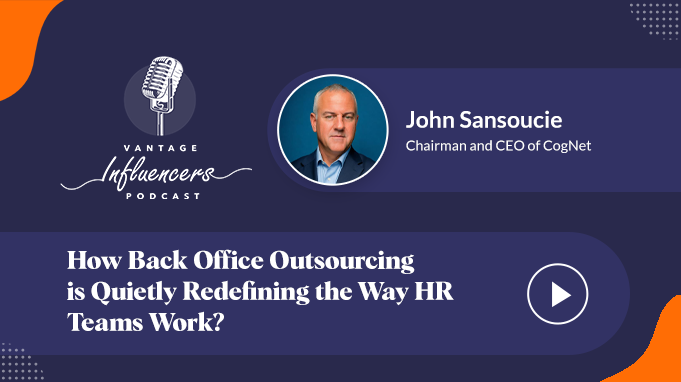
John Sansoucie argues that most companies get outsourcing backward. They treat it as a headcount play: hand off a stack of transactional work and free up internal capacity, full stop. He pitches something different, an "extended office as a service" model where the outsourcing partner behaves like an internal team rather than a vendor executing a fixed price contract. In this conversation, he explains why he will turn away a prospective client if the relationship looks more like a handoff than a partnership, and why documented, ISO 9001 driven processes paired with second by second transparency through a client portal do more to build trust than any sales pitch.
The conversation then moves from control to strategy. Sansoucie makes the case that outsourcing back office transactions is what actually buys HR a seat at the table: once payroll, tax, and compliance stop eating the calendar, HR can focus on culture, succession planning, and the behavioral side of the business that outsourcing can't touch. He also gets specific about where the ground is shifting fastest. Artificial intelligence is already changing how companies source candidates and process HR data, and he warns that leaders who ignore those tools, or expect them to run unsupervised, are heading for a rude awakening. His advice for HR leaders navigating that shift comes down to one word: measurement. Show the number, not just the feeling, or the case for outsourcing never lands with the CFO.
Episode Highlights
- Why John frames outsourcing as "extended office as a service" instead of a vendor relationship, and why he will decline a client who wants a pure handoff.
- How documented, ISO 9001 driven processes and real time client portals turn outsourcing from a loss of control into a gain of control.
- What actually changes for HR once payroll, tax, and compliance work move off their desk, and why that shift takes longer to land in the US than in India.
- Why company culture inside CogNet's own 600 person Chennai office matters as much as it does for their clients.
- How artificial intelligence is already reshaping recruiting and payroll, and why John is skeptical of vendors who oversell AI's current maturity.
- Why measurement, not sentiment, is the argument that gets outsourcing decisions past a skeptical CFO or COO.
About the Guest
John Sansoucie, Chairman & CEO of CogNet
John Sansoucie serves as the Chairman and CEO of CogNet, a business process management solutions company he founded in 2004 after 27 years of experience in TPA, HRO, and PEO. He has set up and managed four global service operations and has led human resource business operations in the India market since 2004. Before founding CogNet, he held senior executive roles at leading HR outsourcing firms, including CFO at US Personnel, VP of Finance and Product Management at Advantec, and Group Controller for a division of Dun & Bradstreet. Sansoucie holds a degree in Finance from the University of Missouri and an MBA from the University of South Florida.
Host
Riha Jaishi, Vantage Influencers Podcast Host
What You Will Learn
- Why "extended office as a service" is a fundamentally different model than traditional outsourcing
- How transparency and documented processes turn outsourcing into a control gain, not a control loss
- What changes for HR teams once back office transactions are no longer on their plate
- Where artificial intelligence is already reshaping recruiting, payroll, and HR data analysis
- Why measurable outcomes, not soft claims, are what convince a CFO to approve outsourcing
- How to manage the human side of an outsourcing transition without eroding team trust
Key Topics & Timestamps
| Timestamp | Topic |
|---|---|
| 00:00 | Cold open and episode introduction |
| 01:11 | John Sansoucie's professional journey and how CogNet was founded |
| 03:12 | What back office outsourcing truly means for HR teams beyond admin support |
| 05:04 | Balancing efficiency and ownership when outsourcing HR functions |
| 08:00 | What actually shifts for HR once back office functions are outsourced |
| 11:03 | How outsourcing is reshaping the strategic role of HR |
| 13:37 | Technologies and tools that enable seamless HR-outsourcing collaboration |
| 16:41 | Advice for managing change without disrupting team trust |
| 19:14 | The one mindset shift HR leaders need to thrive in this new era |
Full Transcript
Click to read the full episode transcript
Welcome to the Vantage Influencers podcast. This podcast is sponsored by Vantage Circle, the simple and effective recognition platform for employee engagement.
Riha Jaishi: Hello, everyone. Welcome back to another episode of the Vantage HR Influencers podcast. I'm your host, Riha, and today we're unpacking a transformation that's reshaping how HR functions behind the scenes: back office outsourcing. As HR takes on a more strategic role within organizations, leaders are under constant pressure to achieve more with less, to stay people-centric while also streamlining operations. But what keeps that engine running efficiently? The answer often lies in the background, in smart, scalable outsourcing models. To explore this, I'm joined by Mr. John Sansoucie, the Chairman and CEO of CogNet. Welcome to the show, John. It's a pleasure to have you with us today.
John Sansoucie: Thank you, Riha. It's a pleasure to be here.
Riha Jaishi: Great. So, to kick things off, can you briefly take us through your professional journey so far, John? We are eager to learn about your journey.
John Sansoucie: Absolutely. And it involves India from both sides, actually. So, a little over 20 years ago, I went to Southeast India, to Chennai, and I was the customer. I worked at an HR outsourcing firm here in the United States that serves small and medium-sized businesses. We were a client there for about four years. That company was sold, and the new owner wasn't interested in the offshore operation. So the reality hit me that I had trained and developed people for US payroll and US taxes, things that are probably more complex than they should be. I raised a little money with family and friends and kept all the top employees I had at the time, probably about 20. The good news is the majority of them are still with me today. We turned that around and said, "Okay, now we're going to be the provider." I used my contacts here in the US within the HR outsourcing space: professional employer organizations, staffing companies, payroll companies, everything in that space. Now we are the provider, so they come to us to outsource whatever they wish. The good news is that in the PEO space, you do everything for everybody. We're organized that way, in practice areas: US payroll, payroll tax, benefits, HR transactions, finance and accounting. We're able to provide all of it, and we've been growing the company pretty rapidly over the last three or four years.
Riha Jaishi: That's such an inspiring venture, John. Thank you so much for sharing.
John Sansoucie: Oh, my pleasure. And sharing where we're going is equally important to me.
Riha Jaishi: Yes. Okay, so with your permission, I'd like to delve into our topic further. Shall we?
John Sansoucie: Sure.
Riha Jaishi: Okay, great. So, to begin with, what does back office outsourcing truly mean for HR teams today, beyond just administrative support? What do you have to say about that, John?
John Sansoucie: We always come at it with one concept: we use the phrase "extended office as a service." We want to be part of their team. Let me give you a typical example. You're processing payroll, and you may have people doing that work in the US. You really want them to be client-centric, client-forward, talking to clients, solving problems. We can come in and take 80% of the transactional work off their plate and let our clients redirect their focus to being client-facing. We usually tell them, "We want you to worry about new revenue, keeping revenue, and actually servicing clients, and let us do the work."
Riha Jaishi: That's such a great way to put it, John, about being client-centric and where that focus should be. And it really reframes the thing: outsourcing is more like a partnership, right? Not a delegation.
John Sansoucie: Absolutely. I will say no to a client if we don't believe we're truly going to be part of the team, versus the larger models, the big players like Cognizant, Accenture, and so on down the list. They'll do something for you with as many people as they possibly can at a set price. We're not interested in that. We want to be part of the team. The best part of a relationship, for me, is when I'm out of the picture and the people actually doing the work on both sides are communicating and working together as a team.
Riha Jaishi: Yes, great. Okay, moving ahead. You see, John, there are many organizations that hesitate to outsource because they fear losing control over HR operations. So how can leaders strike the right balance between efficiency and ownership?
John Sansoucie: Yes, one thing that has helped, and it might be accidental from our past, is that we're an ISO 9001 shop. When we come in, I'll tell you, a lot of the time our clients don't have documented processes. They don't have anything in writing, so there's a discomfort there, as you mentioned. Coming in, documenting that for them, and then maybe evaluating or improving the process, is a big leap. It also lets them relax a bit. It's not, "Hey, I'm just picking off your work while I go to a conference next week." My pitch can never be, "Hey, why don't you hand me a bunch of stuff, I'll take it to India, and your people can do something else." That isn't where we're trying to be, or ever want to be. It has to be a partnership. But the toughest part to manage through is exactly what you said: the cultural aspect, the fear of job loss, and convincing the client that we can not only do it at a better price point but probably more efficiently, so they can go on to do bigger and better things for their clients.
Riha Jaishi: Yes, that fear of the cultural aspect, that fear of job loss, I guess that's what makes organizations hesitate about outsourcing, right? So instead of thinking of it as losing control, they should think of it as sharing control. That change in perspective can really bring a change in mindset too.
John Sansoucie: Yeah, I'll even go further and say it's a gain in control. One of the things we do is give our clients a portal where we measure everything we do down to the second. I ran this payroll, I'm done. I did this transaction, I'm done. They have transparency into that, they can look at it. So I want them to feel they're in control, because they are. This is their team doing their work their way. We're not trying to alter the tools they use or the manner in which they do the work, so there's ownership there. Where it works best, I call it the win-win-win: when you're a growing concern and you can grow toward us while keeping your headcount fairly client-facing and steady, nobody loses their job on this side. I have a large client who does that every month. He writes a big zero up on the board and reminds everybody how many jobs have been lost through offshoring.
Riha Jaishi: Exactly.
John Sansoucie: And usually people get it in their heads that it's purely a cost-savings play, or what I used to call "lift and ship." You can do those, but they're not very successful.
Riha Jaishi: Yes, that's a great perspective, John. So we often talk about freeing up HR to focus on people, but what does that shift actually look like in practice once the back-office functions are outsourced? What do you think?
John Sansoucie: Well, I've been on the other side of the coin. I was a CFO for years at HR companies, both software and outsourcing companies. It takes a while. There's a shift where they realize they have less to do, the transactions are out of their purview, and then they have to add value and earn a seat at the table. In my market, in the US, that's a little harder to do, but HR is starting to add a different level of strategic success. That's always the sale, if you will, to a VP of HR or whoever runs it: I'm here to make you look good and get you a seat at the executive table so you can work on culture, succession, and the things you actually want to work on. Otherwise you're stuck down here fixing a problem with your payroll vendor on a Wednesday.
Riha Jaishi: That thing about working on culture and succession, that's a very good take, because I think HR really gets to focus on culture, like you said, instead of compliance checklists, right?
John Sansoucie: Yes, focus on something more important and more specific to them, rather than doing everything on their own. In fact, I'll give you an internal example. We have 600 employees today in Chennai, and we're looking at other cities. I had to ask that question of ourselves: I haven't seen the handbook, where is it? Even though it doesn't apply to me, I'd like to read it. We installed some new systems and basically practiced "physician, heal thyself" on ourselves. We asked, what are we doing, are we compliant? I asked that question on my last trip and got a very long silence, and said, okay, if we're going to preach this to others, we have to do it for ourselves. But I've seen that culture matters even more specifically in India. We have a lot of young employees, and culture matters a lot to them. Our HR department is very focused on activities and culture, things that, unfortunately, don't really exist in the US market. You've got a job, they pay you, that's great, and if you want another one, go ahead. The cultural aspect isn't as deep here. For our customers, we want to create a sense of team, and probably the bigger moment is when clients want to come with me to India. On my next trip, in about two weeks, I'm doing exactly that with my largest client: they want to meet the people, see where the work gets done, and understand what the team is doing.
Riha Jaishi: That's an interesting perspective, John. Okay, how has outsourcing influenced the strategic role of HR? What do you have to say about this?
John Sansoucie: It's, again, about the seat at the table. HR was, as a CFO I felt the same way, a necessary evil. I used to joke with my staff that we're "off-center": we don't make money, we keep people out of trouble and out of jail. HR functions very similarly. But at the same time, we want to evolve past that and be part of the team, talking about where the company's going and how we grow. Example number one for HR is the quality of people coming through the door from a recruiting perspective. What I see in the market is that artificial intelligence is going to drastically challenge and change that area. The days of paying a human being to go find another human being are going to change a lot in the next five to ten years. That's one of our big focuses: figuring out how to get better at that, versus a year or two ago, before those tools existed, when recruiting meant getting on LinkedIn, asking who you know, hiring out or outsourcing recruiting. Going forward, HR organizations are going to have to figure out how to use the tools now available to them, and how the type of people they hire and retain makes them different from their competitors.
Riha Jaishi: Well said, John. I really think HR now is not just an enabler but more of a strategic influencer. This outsourcing shift is really redefining HR's identity, from operational support to organizational leadership, right?
John Sansoucie: Yes. And being part of the growth story.
Riha Jaishi: Yes.
John Sansoucie: CFOs are notorious for being growth inhibitors, with all their rules, and HR can be similar. How does the VP of HR transform into someone thinking, "let's grow the company," and figure out what that means from a staffing perspective, while also integrating themselves with the technology in the business and figuring out which tool sets will make them more efficient going forward?
Riha Jaishi: Absolutely. Now moving ahead, what technologies or tools do you think are most critical in enabling seamless collaboration between in-house HR and outsourced partners?
John Sansoucie: There's your standard tool set, but I'll skip that, because this is where we're going: we're becoming more of a business process management company. That means bringing technology into the relationship in a transparent fashion. We'll tell a client, "I love doing this manually for you in India with three people, but I think we can automate it, and maybe it takes one person now, or maybe none." It feels a little self-defeating from my perspective, but it's going to happen anyway, and that's where we are as a company. I think HR departments have to think that way too. AI is coming whether you like it or not. Large companies will use it throughout the HR process, and some of them want no humans in the HR process at all, which is a little crazy to me. It's called human resources for a reason. But if you ignore those tool sets today, you're in for a rude awakening soon enough. We work with our clients on that. As you mentioned, you've got a payroll system and multiple sources of data. Large language models are excellent at taking all that data, organizing it quickly without a lot of expertise, combining it, analyzing it, and giving HR trends and analysis they probably didn't have before.
Riha Jaishi: It's great to see how these technologies are bridging the gap between internal teams and vendors. It's not separate ecosystems anymore, it's more like a shared platform, like you said, where the data, decisions, and actions all happen together, right?
John Sansoucie: Yes, absolutely. In my market, the payroll platform has become the AI that runs your comparatives from last month and says, "I think I found a mistake for you." It's basically a bot in the corner trying to run your payroll, catching things that intuition and human beings used to catch. I think those tools will make us, and our clients independent of us, more effective. I also think they're a little oversold relative to their current maturity. It's not going to just make your payroll magically happen every week without you worrying about it. It doesn't work that way, not after years and years in this business. So the application of the tools will matter just as much to HR as the tools themselves.
Riha Jaishi: Great, John. Now, coming to change management, that's often the toughest part. What advice would you give HR leaders who are trying to introduce outsourcing without disrupting team morale or trust?
John Sansoucie: One thing we do is help our clients with exactly that. I've been in their seat, I understand it, and I try to soften the blow because I know what it looks like from their side. My biggest piece of advice is measurement, which is why we're very transparent with our clients. HR has to come back and show the impact of the decision to outsource: this much in savings, or time-to-hire from first contact dropped by half. You have to provide a measure. When you're coming back to talk to someone like me in a CEO, CFO, or COO role, you have to bring numbers. It's one thing to say it got better, it's another to come back with a measurement. The good news is that a lot of these tools make that data available.
Riha Jaishi: The human side is often overlooked, right? But everyone also needs to understand why the change is happening, that it's designed to make the work more meaningful, not redundant. If people understand that, I'd imagine they're more willing to adopt it and show less resistance, right?
John Sansoucie: Yes. I always try to tell them we're trying to make them look good here. They'll still fight it. Taking half your day off your plate to apply it elsewhere is hard for some people. We've had instances where we took payroll people and tried to make them client-facing, and tax people even more so, and they've come back and said, "I do this job because I don't like talking to people." Well, okay, but we don't have that job anymore, we have the job where talking to people matters. So there's a cultural process where you have to figure out who's doing what job and why, and be conscious of it. It's very important for the HR department, or our client, to decide where to place those people, because in the imperfect scenario, maybe they're in the wrong job. They're on the bus, but they need to be in a different seat, and that has to be managed carefully by the client or the VP of HR we're working with.
Riha Jaishi: Absolutely. So, John, before we wrap up, what's the one lesson or mindset shift you believe every HR leader needs to embrace to thrive in this new era of HR transformation?
John Sansoucie: Look broadly at as many outsourcing solutions and tools as you can. People are quick to adopt software or tools and believe it's some sort of panacea that will fix their problems. It's not, they're all pretty similar. We joke with our clients when they say, "I have this system, you wouldn't understand it," and we say, "Oh, yes we would, we've seen them all, we understand them." So focus on process, that's my biggest one. Our ISO background brings that out in us as an HR function: know what your hiring process actually is, look at it constantly, and figure out how to improve it, whether through tools, outsourcing, people, or analytics. Whatever gets you to be more efficient. It was no different for me in finance and accounting: how do I close the books faster, better, cheaper? With people, it's a different skill set. Leaders need to ask themselves whether they want to spend time on culture and actually talking to human beings, or get on the phone with providers trying to figure out why something isn't working. That's what will differentiate you as an HR leader.
Riha Jaishi: Thank you so much for such a refreshing perspective, John. There's so much for HR leaders out there to look forward to.
John Sansoucie: Yes, my pleasure.
Riha Jaishi: Okay, John, we've come to the end of our session. Before we wrap up, thank you so much for joining us today and sharing your incredible insights. It's been more than a pleasure hearing your perspective on how back-office outsourcing is redefining the way HR teams work. We really appreciate your time and expertise. I'm sure everyone tuning in is heavily inspired by your expertise and is walking away with a wealth of information to think about.
John Sansoucie: And they know where to find me. My only regret is that we didn't get to do this last week, I could have wished everyone a happy Diwali.
Riha Jaishi: To our listeners out there, thank you for tuning in. We hope you found today's conversation as enlightening as we did. Until next time, take care, and we'll see you soon.
Thanks for listening to the Vantage Influencers podcast. Be sure to subscribe on Apple Podcasts, Spotify, and our Vantage Circle YouTube channel for the latest episodes.
FAQ
What does "back office outsourcing" mean for HR teams today?
Beyond administrative support, back office outsourcing today means handing off transactional HR work, like payroll processing, tax filing, and benefits administration, to a partner that behaves like an extension of the internal team rather than a low cost vendor. John Sansoucie describes this as "extended office as a service": the goal is to free HR and their client-facing staff to focus on strategy while the outsourcing partner absorbs the transactional load.
How can HR leaders outsource without losing control over HR operations?
According to Sansoucie, documented processes and transparency are what convert an outsourcing relationship from a loss of control into a gain of control. His company runs on ISO 9001 based process documentation and gives clients a portal that tracks every transaction as it happens, so HR retains visibility even though the work is happening offsite.
What role is AI playing in HR outsourcing right now?
AI is already reshaping recruiting and payroll processing, according to Sansoucie, with large language models handling data organization and analysis that used to require dedicated expertise. He cautions that these tools are still oversold relative to their current maturity, and that how they are applied, not just access to them, is what will determine whether they actually improve HR outcomes.
How should HR leaders manage the human side of an outsourcing transition?
Sansoucie's core advice is to lead with measurement: HR needs to come back to leadership with concrete numbers, like time-to-hire reductions or cost savings, rather than general statements that things "got better." On the people side, he recommends being upfront that outsourcing is designed to free employees for more meaningful, client-facing work, and to actively help employees who are better suited to a different role find the right fit rather than forcing a transition that doesn't work for them.
Related Reading
Also listen on