How do you build a talent strategy that aligns with business goals?
Episode Overview
Surobheet Bhowmik argues that most talent strategies fail for a simple reason: they treat hiring and retention as the whole job, when those are really just the entry and exit gates of a much longer employee journey. In this conversation, he lays out a four layer approach to building a talent strategy, starting with a hard look at where the business is headed and only then translating that vision into the capabilities, culture, and metrics an organization needs to get there. He walks through real examples from his own career, including a company where attrition looked healthy on paper while skills quietly fell behind the market, to show why HR leaders need to look past surface level retention numbers.
The conversation also covers what happens when talent strategy goes wrong: mistaking HR programs for strategy, chasing short term fixes, ignoring culture, skipping data, and running initiatives without buy-in from business leaders. From there, Surobheet turns to two of the more urgent questions HR teams face today: how to rethink upskilling as AI reshapes roles, and why diversity, equity, and inclusion belong inside the business case for talent strategy rather than as a separate initiative. He closes with a practical starting point for any organization building its talent strategy from scratch.
Episode Highlights
- Talent strategy needs four connected layers: understanding the business model, translating business needs into workforce capabilities, designing people practices as enablers, and measuring progress along the way.
- Recruitment and retention are the entry and exit points of the employee journey, not the whole strategy; what happens in between determines whether an organization actually succeeds.
- The most common pitfalls include confusing talent strategy with HR programs, focusing only on the short term, overlooking culture and employee experience, skipping data, and running initiatives without business leaders on board.
- AI and automation are pushing organizations to build for transferable capabilities like problem solving, digital fluency, and adaptability instead of training people for a single job title.
- Continuous, in the flow of work learning is replacing the old model of annual workshops, and upskilling works best when tied to employees' own career aspirations.
- Diversity, equity, and inclusion are not a side initiative. Diversity fuels innovation, equity ensures fair access to growth, and inclusion drives the engagement and retention that make a talent strategy stick.
About the Guest
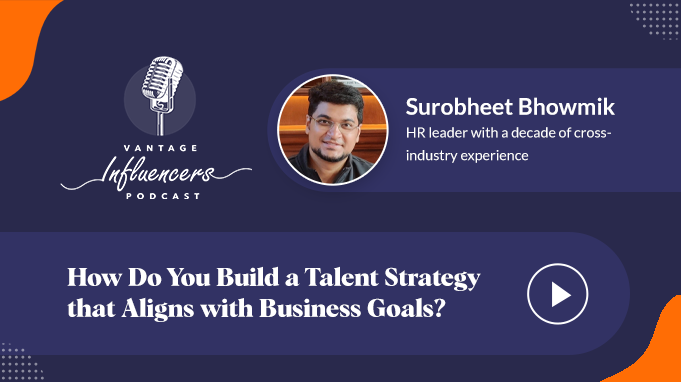
Surobheet Bhowmik, HR leader with a decade of cross-industry experience across MNCs, Indian conglomerates, and high-growth startups
Surobheet Bhowmik is an HR leader and an alumnus of IIT Kharagpur who has spent the better part of a decade driving talent strategy for businesses across MNCs, large Indian conglomerates, and high-growth startups. His work spans building talent strategies for organizations moving through major transformations, from traditional lenders repositioning as digital-first financial services players to companies rethinking their workforce for the age of automation and AI. Across these roles, he has focused on connecting HR decisions directly to business outcomes, using capability building, leadership development, and data-driven people practices to turn talent strategy into a driver of growth rather than a support function.
Connect with Surobheet on LinkedIn
Host
Riha Jaishi, Vantage Influencers Podcast Host
What You Will Learn
- Why treating talent strategy as just recruitment and retention leaves organizations reactive rather than proactive
- How to translate a company's long-term business vision into concrete workforce capabilities
- What separates a stalled talent strategy from one that measurably accelerates business performance
- The most common mistakes HR teams make when building a talent strategy, and how to avoid them
- How to rethink upskilling and reskilling as AI and automation change the nature of jobs
- Why diversity, equity, and inclusion are a strategic lever for business performance, not a compliance checkbox
Key Topics & Timestamps
| Timestamp | Topic |
|---|---|
| 00:00 | Introduction to Surobheet Bhowmik and his HR background |
| 02:30 | Why talent strategy must go beyond recruitment and retention |
| 09:56 | Connecting talent strategy to the company's long-term business vision |
| 16:32 | A real-world example of talent strategy accelerating business performance |
| 21:07 | Common mistakes organizations make when building a talent strategy |
| 28:59 | Rethinking talent development and upskilling as AI reshapes jobs |
| 38:37 | The role of diversity, equity, and inclusion in talent strategy |
| 46:05 | One piece of advice for organizations starting from scratch |
Full Transcript
Click to read the full episode transcript
Hello listeners, welcome back to another episode of the Vantage HR Influencers podcast. I'm your host Riha, and today we are diving into a topic that every business leader has on their mind: how to build a talent strategy that truly drives business goals. Every organization wants growth, but without the right talent plan, even the best business strategy can fall flat. So how do you connect the dots between people, performance, and purpose? To help us unpack this, I'm joined by Surobheet Bhowmik, a passionate HR leader with a decade of cross-industry experience across MNCs, large Indian conglomerates, and high-growth startups. Welcome to the show, Surobheet. It's a pleasure to have you with us today.
Surobheet Bhowmik: Thanks, Riha. Thanks for introducing me and thanks for having me on the podcast.
Riha Jaishi: Thank you, we are equally delighted to have you with us today. Now, to kick things off, can you briefly take us through your professional journey so far? Our listeners and I are eager to learn about your journey.
Surobheet Bhowmik: A decade of industry experience as a leader in the HR space, an alumnus of IIT Kharagpur, and as you mentioned in the beginning, I've worked with conglomerates, MNCs, and high-growth startups. For the better part of the last decade, it has been about driving the talent strategy of multiple businesses, and that is something which truly drives me to bring out my best. With that, I'll hand it back to you to shoot the questions you have for me on the agenda of talent strategy: how to build it, and how to align it with the core principles, or let's say the pillars, of the employee life cycle.
Riha Jaishi: That's an inspiring venture, Surobheet, thank you for sharing your experience. Now, as we move ahead, let's delve into our topic further. Let's start with the basics. Why do you think it is essential for organizations to view talent strategy as more than just recruitment and retention?
Surobheet Bhowmik: Before that, let's understand how to build a strategy that aligns with business goals, and then we will delve into the recruitment and retention piece. For me, building a talent strategy that truly aligns with business goals starts with one simple principle: HR can't work in isolation. Talent, for me, is not a support agenda, it's a business agenda. So the starting point has to be clarity on where the organization is headed: its strategic objectives, its growth aspirations, and the value it wants to create for customers and stakeholders.
Once that clarity is established, I think of the process in four interconnected layers. One is understanding the business model and the growth levers. The second is translating the business needs into workforce capabilities. The third is designing people practices as enablers, not processes. The fourth is how we measure and course-correct as we go along the journey.
Now, coming back to the question of why it's essential for organizations to view talent strategy as more than recruitment and retention: I believe when people hear the words "talent strategy," they immediately think about hiring the right people and trying to keep them. Those are the two guardrails through which people outside the HR function define the whole construct of HR. Of course, those are critical, but if we stop there, we are playing a very short-term game. Let me put it this way: recruitment and retention are like the entry and exit gates in the employee journey. But what happens in between, how people grow, how they are engaged, how they innovate within the firm, how they connect with the purpose of the organization, that's what truly defines whether the organization will succeed or not.
So I usually emphasize three reasons why talent strategy must go beyond filling positions and preventing attrition. The first pillar is that a business is not only about headcount, it's also about the capabilities being built around it. You can hire thousands of people, but if they don't have the skills or the mindset the business needs, you are not building a competitive advantage. The real question is how we build the right capabilities to deliver on our strategy: focusing on learning, career pathways, leadership development, and building agility and adaptability in the workforce.
The second core pillar is culture, which is the glue that holds the organization together. If we are hiring people and just retaining them, that can be meaningless if they stay back for the wrong reasons. Employees should stay back because they feel connected with the culture and purpose of the organization, because they see growth, and because they have avenues to do meaningful work. That's why a holistic talent strategy invests in values, leadership behaviors, inclusion, and employee experience, not just salaries and perks.
The third pillar is how we future-proof the organization. Business models are shifting faster than ever: digital disruption, AI, sustainability, hybrid work, remote work. If a talent strategy is limited to hiring and retaining, organizations will always be reactive rather than proactive. Applying a broader lens beyond hiring and retention lets you anticipate future skills, redesign roles in anticipation of those skills, and proactively shape the workforce of the future.
Let me give you an example. In one of the organizations I worked with, attrition was stable, so on paper the traditional definition of talent strategy, hiring and retention, looked successful. But when we looked deeper, we realized that while people were staying, they were not evolving. Their skills were outdated compared to the industry, which meant the company was losing market share even though attrition was low, people weren't leaving, and engagement scores and NPS were fine. It was a wake-up call for us to evolve our talent strategy and ensure we were building future capabilities and agility into the organization, not just focusing on retaining people.
So the shift is this: recruitment gets you talent, retention gets you to keep that talent, but a true talent strategy is the one that unlocks potential, builds culture, and aligns people to the larger purpose the organization exists for in the first place. That's why I always say talent strategy isn't about headcount management, it's about value creation.
Riha Jaishi: That's a great point you've made here, a big takeaway: how talent strategy is more than headcount, and it's more about value creation. That's such a unique take coming from you about the pillars you mentioned. It shows how the general public often thinks HR is only about hiring and retention, when as an HR leader you'd know there's a lot more to it. That's such a big takeaway for our listeners, so much to learn. So moving ahead, when we talk about business growth, it often comes back to long-term vision. How can HR leaders ensure that their talent strategy is directly connected to the company's long-term business vision?
Surobheet Bhowmik: That's a very interesting question. I believe one of the most critical responsibilities for HR leaders today is to anchor or align the talent strategy with the long-term vision of the firm. If that isn't done properly, it becomes a collection of short-term, isolated, siloed HR programs that are bound to fail.
The way I see HR leaders ensuring this alignment happens in a few ways. One thing that has always worked for me is ensuring I sit at the strategy table, not the policy table, as an HR leader. Too often HR gets pulled into execution only after business strategies are finalized in the boardroom. But true alignment between talent strategy and business vision only happens when HR is part of those strategic discussions, understanding where the company wants to be in the next couple of years, which markets it wants to play in, and what kind of culture it aspires to build.
The next thing is translating the vision of the organization into capabilities. The long-term vision needs to be broken down into human capabilities. For example, if the vision is to be an innovation-led company, HR must ask what skills, what mindset, and what leadership behaviors will fuel that innovation. That translation exercise is where the alignment really takes shape.
Another thing is designing for the future, not only the present, and that can only happen if HR is sitting at the strategy table rather than taking a more execution-focused approach. Business vision is always forward-looking, but is the talent strategy forward-looking? That's a question mark. The talent strategy must anticipate: scenario planning for future skills, investing in the right leadership capabilities, investing in succession pipelines, and building a workforce that can adapt to disruption. Disruptions are happening at such a fast pace that if you're not adapting the organization and the workforce for future disruption, you're always running behind the curve.
The final piece is how we metricize the talent strategy against business outcomes. A talent strategy will only remain a siloed statement, and alignment will never truly happen, if we're not able to measure it. If the business vision is about global expansion, HR should track internal mobility and cross-cultural leadership readiness. If it's about driving a culture of customer obsession, HR should measure the employee behaviors tied to customer impact. Metrics create accountability and ensure the connection between talent strategy and business vision stays tangible.
Let me share another example from one of my earlier roles. The company's long-term vision was to become a digital-first financial services player, but our existing workforce was quite traditional in mindset and skill set. So the talent strategy wasn't just about hiring digital talent, it was also about reskilling large pockets of the existing workforce where that shift in mindset hadn't happened. We needed to embed agile ways of working and rehash our leadership models to drive experimentation and collaboration. Within 12 to 15 months, that alignment helped the company reposition itself successfully in the market.
So the answer to your question is that HR leaders must act as translators of business vision into people capability. When they do that well, the talent strategy doesn't just support the vision, it accelerates it.
Riha Jaishi: You've mentioned some unique pointers here about HR's role, about how HR should not only be limited to execution but should have a presence in strategic decisions. That's a very good point, because that's what changes things in the long run, particularly how the current business plan connects with the long-term vision, and how HR should become the translators for business capabilities. And about metrics, about measurement, how essential that is for the long run. These are some unique pointers we need to take note of.
Now moving ahead, theory aside, the best way to understand impact is through real-world examples. Can you share an example where a well-aligned talent strategy significantly accelerated business performance?
Surobheet Bhowmik: A very interesting question, and one that's close to my heart. Let me share an example that really stands out from my own experience. I was part of an organization in the financial services space with a very ambitious goal: to move from being a traditional lender to a digital-first financial solutions company. The business vision was clear: scale rapidly, improve customer experience, and compete with emerging fintech players who were far more agile, all at the same time.
For our talent strategy to deliver on this vision, it was important that we focus not only on recruitment and retention but also tie our talent strategy directly to that vision. The first piece was reskilling. We realized close to two-thirds of our workforce came from conventional banking backgrounds, so it was important to invest in transforming their mindset through large-scale digital fluency programs. We trained them on analytics, digital tools, and customer-first design, so the capability was built from within organically rather than bought from outside the market.
The second piece was rehashing our existing leadership capabilities. To drive a digital-first agenda, we needed leaders who could encourage experimentation and foster cross-functional collaboration, so we redesigned our leadership development journeys to emphasize agility, risk-taking, and customer-centric decision-making rather than just operational efficiency.
The third pillar was strategic hiring for new capabilities. Alongside organic reskilling, we also needed an outside-in perspective, so we brought in talent from technology, e-commerce, and fintech to infuse fresh thinking. Importantly, we didn't just hire them, we also built cultural integration programs to help them thrive in our legacy-driven work environment.
Within close to 18 months, the results were visible. We launched digital products at twice the speed we had originally planned, customer onboarding time dropped by a third, and employee engagement scores actually went up, even during a major transformation. That could only happen because the talent strategy was aligned with the business vision, and because the talent strategy wasn't only supportive, it was an enabler, an engine of transformation rather than something that just supports it from the background. That was a key lesson for me: when HR connects to the "why" of the business, performance outcomes naturally follow.
Riha Jaishi: That's such a powerful example, Surobheet. It really shows how businesses can be impacted when strategy and talent are truly in sync, when they work together and go hand in hand.
Now moving ahead, it's a given that not every attempt at building a talent strategy is successful. What are the most common mistakes organizations make when building their talent strategy?
Surobheet Bhowmik: I believe if I'm successful today, it's because of the mistakes I've made, and mistakes in talent strategy tell us more than successes do. Let me share a few patterns I've seen that can undo a talent strategy even when it's built with a lot of rigor.
One of the most common pitfalls is that talent strategy gets confused with HR programs. Most organizations mistake talent strategy for a set of HR transformation initiatives: leadership development, a talent management program, an engagement survey, a cultural transformation, a recruitment transformation. All of these are tools, not strategies. A true talent strategy starts, as I said earlier, with the business vision and asks what capabilities and culture are needed to achieve it. That linkage is usually missing, which is why many talent strategies fail at execution: they remain tactical and operational rather than strategic.
The second pitfall is that HR strategies stay focused on the short to mid term at most. I've seen a lot of organizations design talent approaches around immediate requirements, like filling a niche vacancy, addressing attrition, or rehashing the performance cycle, but they forget to anticipate the future. Skills are evolving so fast that if you don't build a pipeline for tomorrow, you'll always be in firefighting mode. Short and mid-term delivery matters, but losing the long-term perspective can be detrimental and can cost you credibility with leadership.
The third pitfall is overlooking culture and employee experience. I've seen companies hire great talent that's difficult to retain because the culture doesn't enable them to succeed. You can build a perfect HR strategy, but if your culture is misaligned, recruitment and retention will always fail to keep people engaged, included, and connected to the purpose.
The fourth pitfall is not using enough of a data-centric approach. Too many HR strategies are born out of intuition rather than evidence. Today we have powerful people analytics tools that can predict attrition, identify skill gaps, and even measure leadership effectiveness in concrete terms. Ignoring data means flying blind, and that's a huge missed opportunity.
The fifth pitfall is running HR programs in silos and failing to involve business leaders. I've seen HR strategies design programs in isolation, but talent isn't just an HR priority, it's a business priority. When business leaders aren't bought in, execution is very likely to fall flat. The best strategies I've seen succeed are the ones where business heads are as invested in talent outcomes as HR is. If either side doesn't believe in the outcome that's been co-created, it's bound to fall flat.
Let me give you an interesting example. I worked with an organization, one of the startups I was at, where leadership initially thought their biggest challenge was hiring faster. When we looked deeper, the real issue wasn't the people we hired, it was that the people we hired left within a year because the managers leading them weren't prepared to integrate or develop them. The mistake was solving a symptom rather than addressing the root cause. Once we addressed managerial capability and built career pathways, hiring speed became less of a bottleneck.
So to me, the biggest pitfall is treating talent strategy as an HR agenda rather than a business agenda. When that mindset shift happens, most of the other challenges get corrected automatically.
Riha Jaishi: These mistakes you've highlighted really shed light on the fact that organizations often overlook certain things, like how talent strategy often gets confused with HR programs, how it's more short-term oriented than long-term, and how some organizations overlook culture, employee experience, and being data-centric. All of this shows there are certain aspects organizations really overlook, and as a result, things take a downturn.
Surobheet Bhowmik: Exactly. Those are the pitfalls I've seen from my own experience, but the landscape can be more varied if you talk to HR leaders from other industries. That's just my observation.
Riha Jaishi: As you know, the world of work is rapidly evolving with AI and automation coming into the picture. As they reshape jobs, how should companies rethink their talent development and upskilling?
Surobheet Bhowmik: This is probably the defining question of our times. AI and automation are no longer on the horizon, they're here, and they're fundamentally changing how work gets done. The danger is that many organizations are still trying to use yesterday's cookie-cutter learning models to prepare for tomorrow's jobs. I believe organizations need to rethink talent development through three big shifts.
The first shift is moving from skilling for roles to skilling for capabilities. In the past, we trained people for specific job titles, but with automation and generative AI, many of those roles will evolve or disappear. What will remain are core capabilities like problem solving, digital fluency, agility, adaptability, empathy, and cross-functional collaboration. Companies should focus on building these transferable skills rather than certain kinds of roles, because the pace of disruption keeps changing, today it's generative AI, tomorrow it could be something else, but these fundamental capabilities remain transferable, and a combination of them will define new roles in the future.
The second shift is moving from isolated, episodic training to a continuous learning ecosystem. The old model of sending employees to a one or two-day workshop once a year doesn't work anymore. Learning has to be embedded in the flow of work rather than being a once-a-year or once-a-quarter activity, which means more micro-learning and AI-driven personalized learning modules, coaching-led by leaders in the organization or peer-to-peer. This allows employees to learn just in time rather than waiting for a scheduled program.
The third shift is moving from top-down programs to more employee-centric journeys. Upskilling can't just be mandated like a compliance exercise. Employees need to see the link between the learning and their own growth. Smarter organizations are creating career marketplaces where employees can pick projects, encouraging more internal mobility so employees look for roles that interest them within the organization rather than looking outside, and tying learning to employees' own aspirations rather than pushing a predetermined agenda on them. When employees feel ownership, learning becomes more of a pull than a push.
Let me share an example. In one firm where I worked, automation was expected to impact almost a third of the transactional roles in the operations team. Instead of planning to move those employees out of the organization, we created reskilling exercises where employees could opt into digital skill tracks we'd built: data analysis, vendor management, RPA management, and customer design, created with a design-thinking approach that put the end user first. Within about three quarters of making that shift, a lot of those employees were able to transition internally into roles that weren't going to be impacted by automation in the near future. We preserved jobs, built loyalty and agility in the organization, and retained employees who had been with us for a long time and were a strong culture fit.
The mindset shift is this: AI and automation won't make humans redundant, they make human capabilities more valuable. Rather than seeing the glass as half empty, we can see it as half full. Organizations that embrace this mindset will be more agile and adaptable, design more continuous learning journeys, and come out of it with a workforce that's stronger, more resilient, and more capable.
Riha Jaishi: Those are some amazing pointers. That was such a unique take, particularly on AI and automation and how people are adapting to it. I really liked your take on upskilling and reskilling around transferable skills like problem solving and empathy, and how this transition can happen internally through coaching. It's quite a relief to hear that AI is not meant to replace humans but to help them evolve, because this debate can feel quite serious and people are scared.
Surobheet Bhowmik: I believe AI won't take jobs, but people who use AI better will be able to replace those who are not using it to the best of their abilities, let me put it this way.
Riha Jaishi: Yeah. So we really have to keep ourselves updated. Think of it this way: go back 20 years and think of something as basic as knowing Excel. Twenty years ago that was probably a big deal, but 20 years down the line, those who are Excel-agnostic aren't able to bring a data-centric approach into their work, which isn't how the world operates today.
Surobheet Bhowmik: Absolutely. Think of AI as the Excel of today, something that was a big deal 20 years ago and is now just how the world works.
Riha Jaishi: Absolutely, yes. Well said.
So moving ahead, there's another vital dimension while building workplaces that are inclusive and fair. What role do diversity, equity, and inclusion play in creating a business-aligned talent strategy?
Surobheet Bhowmik: You asked about diversity, equity, and inclusion, DEI, so let's break it down word by word.
Diversity isn't only about including people from different genders or communities. For me, diversity has a broader scope: it's something that fuels innovation. If your business vision is about growth or disruption, which is true for most stable businesses today, you need people from different walks of life who bring different perspectives, experiences, and ways of thinking, because homogeneous teams rarely create breakthrough ideas. Homogeneity has its own advantages, but that diversity of thought never enters the playbook without it.
The second part is equity, which is about bringing fairness into the process. A talent strategy can't just be about bringing people in. It has to ensure everyone gets a level playing field regardless of their background or the ideologies they believe in, and equitable access to growth, development, and leadership pathways. I use the word "equitable" rather than "equal" because equal treatment means giving everyone the same space regardless of performance and potential, whereas the value someone brings to the table is the value the organization should place on them. Without equity, you'll have diversity at the entry level and the bottom of the funnel, but not in the decision-making layers, which undermines long-term business strength.
The third part is inclusion, which is not only about driving performance or attention, it's about enabling people to feel that they belong in the workplace and that their voices will be heard no matter what. An inclusive culture organically increases engagement, lifts productivity and customer satisfaction, and supports the innovation that's so critical today.
Let me give you an example. In one of the global organizations I worked with, our business goal was to expand into new customer segments. We realized our existing workforce couldn't serve a diverse market, so we had to bring in a workforce with different skills and one that better reflected the geography we were entering. The talent strategy had to deliberately focus on hiring diverse talent while also building a more bias-free performance system, more inclusive leadership training, and more diverse people practices. Within a couple of quarters of that hiring push, we saw representation improve, and customer engagement scores in those geographies actually came in at 1.5 times what we had initially projected. Usually it takes time to build visibility and credibility as a new entrant in a market, but hiring for a diverse skill set we'd envisaged years in advance got us there faster.
So DEI isn't just about doing the right thing socially, it's about doing the smart thing strategically. A business-aligned talent strategy that ignores the DEI dimension will be incomplete, because it misses one of the biggest drivers of today's competitive advantage.
Riha Jaishi: DEI today is absolutely the biggest competitive advantage, and your example really shows how tying inclusion back to business alignment delivers credible results. It's clear through this example that DEI isn't optional anymore, it has to be a core aspect of your talent strategy.
Now let's wrap it up on a practical note. If you had to give one piece of advice to organizations starting from scratch with their talent strategy, what would that be?
Surobheet Bhowmik: An interesting question. I believe too often, organizations that are just beginning their talent journey, meaning those yet to frame a talent strategy at all, jump straight into designing recruitment policies, the performance construct, engagement initiatives, and compensation or total rewards. Those are important, no doubt, but they're just tools, parts of the puzzle, unless they're anchored to where the business wants to go, whether that's growth aspirations, a customer promise, or cultural DNA. Without that anchor, the talent strategy will always be fragmented, and that's one of the biggest pitfalls.
What usually happens is organizations have a natural inclination to benchmark against others in the same space, what they're doing with recruitment, leadership journeys, ESOP allocation, or short, mid, and long-term incentive strategy, and in doing so they miss the bigger picture of what their own business actually wants, because every business is different.
When you start by building the business vision and integrating your people processes with it, you naturally ask different questions: what kind of workforce will help us achieve this vision, rather than using a cookie-cutter approach to get a certain kind of workforce with a certain skill set. You then ask what leadership capabilities will be critical to realizing that vision, and what kind of culture will help drive a competitive advantage in achieving it. Once those basic answers are clear, every HR practice, hiring, learning, total rewards, performance, or learning and development, becomes an enabler of that bigger story.
To put it simply, a talent strategy isn't about people processes in isolation. It's about people processes being the engine of the business rather than just a support function. If organizations start there, they'll be able to build strategies that are not only effective but enduring, and connect every pillar of the people process to the larger business vision their leaders want to execute. That's when they become the engine of the success that drives the business.
Riha Jaishi: Absolutely. This point about how people processes should be the engine that drives the business is a big takeaway for anyone starting a business or a talent strategy. That's a great piece of advice, and I'm sure listeners will find it a solid starting point.
Surobheet Bhowmik: I hope I was able to do justice to the questions you asked in terms of sharing my perspective.
Riha Jaishi: Definitely. Great, glad to know that. So Surobheet, we've finally come to the end of the podcast. Before we wind up, I'd like to thank you for joining us today and sharing your incredible insights. It's been more than a pleasure hearing your perspective on how to craft talent strategies that go hand in hand with business goals. We really appreciate your time and expertise, and I'm sure our listeners have been inspired and are walking away with a wealth of information to think about.
Surobheet Bhowmik: Thanks a lot for having me on this podcast. I'm glad to know I've been able to add value in making your listeners aware of what the organization of the future could look like, and the critical pieces they need to make sure are part of the building blocks of that journey. Thanks for bringing me into this podcast and for asking such pointed questions, which I could relate to my own career, the pitfalls I've seen, and how I've been able to drive talent strategy in the organizations where I've worked.
Riha Jaishi: Thank you once again, Surobheet, and to our listeners, thank you for tuning in. We hope you found today's conversation as enlightening as we did. Until next time, take care, and we'll see you soon.
FAQ
What is a talent strategy, and how is it different from recruitment and retention?
A talent strategy connects people decisions directly to business goals, capabilities, and culture. Recruitment and retention are only the entry and exit points of the employee journey. According to Surobheet Bhowmik, a real talent strategy also covers how people grow, get engaged, and connect with the organization's purpose once they are already inside it.
How can HR leaders align talent strategy with a company's long-term business vision?
By sitting at the strategy table rather than the policy table, translating the business vision into required capabilities, designing for future skill needs rather than just current ones, and measuring talent metrics against business outcomes such as internal mobility or customer-impact behaviors.
What are the most common mistakes organizations make when building a talent strategy?
Confusing HR programs, such as engagement surveys or leadership training, with an actual strategy, focusing only on short-term fixes, overlooking culture and employee experience, skipping data-driven decision-making, and building talent initiatives without buy-in from business leaders.
How should companies approach upskilling as AI reshapes jobs?
Shift from training people for specific roles to building transferable capabilities like problem solving and digital fluency, replace one-off annual training with continuous, in the flow of work learning, and tie upskilling to employees' own career aspirations instead of mandating it top-down.
Related Reading
Also listen on