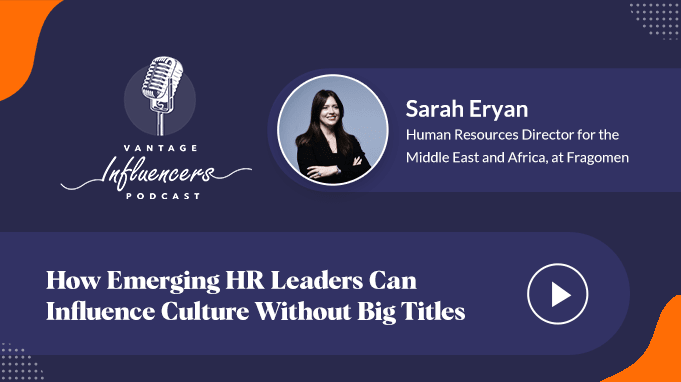
How Emerging HR Leaders Can Influence Culture Without Big Titles
Episode Overview
Sarah Eryan opens this episode by taking apart a common assumption in HR: that influence has to come from a senior title. She argues that culture does not shift because someone at the top announces a new value. It shifts through what people experience in their everyday interactions with the colleagues around them, regardless of who holds a formal leadership seat. For anyone early in their HR career who wants to make a mark, her advice runs counter to instinct: resist the urge to walk in with a list of fixes. Listen first, understand why things work the way they do, and let small, consistent, visible actions build credibility over time.
The conversation then moves into how that credibility turns into real influence. Sarah walks through building relationships across every level of an organization, not just upward with leadership, and learning to spot the informal culture carriers whose opinions move a room more than any org chart position does. She ties this directly to trust, arguing that consistency, confidentiality, and honesty, including the willingness to say "I don't know", do more to earn people's confidence than formal authority ever could. The discussion closes with her view of diversity and inclusion as a daily practice rather than a policy statement, plus practical ways to work through the resistance that anyone trying to drive change in an organization will eventually run into.
Episode Highlights
- Influence in HR does not require a senior title. It comes from consistently showing the impact and value you create for the people around you.
- Before proposing changes, listen first. Understanding why existing practices exist prevents well-intentioned fixes from backfiring on day one.
- Small, visible wins, like a better onboarding experience or more human feedback, add up faster than big, sweeping initiatives.
- Building relationships across every level of the business, not just with leadership, uncovers the informal culture carriers who actually move opinion.
- Trust is built through reliability, confidentiality, and honesty, including comfort with saying "I don't know" rather than guessing.
- Diversity and inclusion show up in daily decisions: who gets access to opportunities, whose voice gets heard, and how psychological safety gets modeled for a team.
About the Guest
Sarah Eryan, Human Resources Director for the Middle East and Africa, Fragomen
Sarah brings over 22 years of experience spanning people strategy, leadership, and business transformation. She partners closely with senior leadership teams to translate business strategy into practical, human-centered decisions that drive performance, adaptability, and long-term growth, with a particular focus on building future-ready organizations in an increasingly complex world of work. A vocal advocate for modern HR, she believes the function's greatest value lies beyond process management, in shaping how work actually gets done through empathy, sound judgment, and the courage to make meaningful decisions. She is also deeply committed to responsible business practices, with a focus on diversity, equity, and inclusion, employee wellbeing, and sustainability.
Connect with Sarah on LinkedIn
Host
Riha Jaishi, Vantage Influencers Podcast Host
What You Will Learn
- Practical first steps for making a cultural impact in HR without a senior title
- How to build informal influence through relationships, internal networks, and identifying culture carriers
- Why aligning your personal leadership style with organizational values matters, and how to self-assess that alignment
- Techniques for building trust quickly, including consistency, confidentiality, and honesty
- How HR professionals can foster diversity and inclusion through everyday actions and decisions
- Strategies for overcoming resistance and common challenges when driving cultural change
Key Topics & Timestamps
| Timestamp | Topic |
|---|---|
| 04:02 | Practical first steps for emerging HR leaders without a senior title |
| 09:07 | Using informal influence, relationships, and internal networks to drive change |
| 14:10 | Aligning personal leadership style with organizational core values |
| 19:00 | Building trust quickly without formal power or a big title |
| 25:05 | Fostering diversity and inclusion as part of influencing culture |
| 31:14 | Common challenges and overcoming resistance to culture change |
Full Transcript
Click to read the full episode transcript
Welcome to the Vantage Influencers podcast. This podcast is sponsored by Vantage Circle, the simple and effective recognition platform for employee engagement.
Riha Jaishi: Hello everyone. Welcome back to another episode of the Vantage HR Influencers podcast. I'm your host, Riha, and today we are exploring a topic that speaks directly to the next generation of HR leadership: how emerging HR leaders can influence culture without big titles.
In many organizations, influence is still associated with hierarchy. But in reality, culture is shaped every day by the people who ask better questions, challenge outdated norms, and lead through action rather than authority. Today's emerging HR leaders are proving that you do not need a senior designation to drive meaningful change. What matters is credibility, relationships, and the ability to connect people, purpose, and performance.
And to help us unpack how HR professionals can build real influence without formal power, I'm joined by Sarah Eryan, Human Resources Director for the Middle East and Africa at Fragomen. Welcome to the show, Sarah. It's a pleasure to have you with us today.
Sarah Eryan: Hello, Riha. Thank you very much. It's my pleasure to be here, and thanks for inviting me to your podcast.
Riha Jaishi: We are equally delighted. Okay, so to kick things off, Sarah, can you briefly take us through your professional journey so far? We are eager to learn about your journey.
Sarah Eryan: Absolutely. So I've been in HR for over 22 years now. And if you asked the little Sarah prior to that if she imagined a career in HR, my answer would have probably been no. That wasn't what I had in mind as a young teenager entering university and thinking about her future and her career. I started with economics, banking, and investments in mind. And I guess the world wanted something different for me, because I entered HR by pure coincidence at the first job I've ever had, back in 2004, in a real estate company, where I started off managing administrative work. Then I felt I didn't belong, I wasn't doing what I should be doing, and I just entered HR by pure coincidence. It was offered to me, and since then, I've been embracing it. I like to say that I was very much self-taught, and that's why this topic of supporting emerging HR leaders is very close to my heart, because I had very little professional HR help at the start of my career and had to figure things out on my own, being the only person managing HR with absolutely no HR background. So that's how I started. My career then evolved, I moved into the UAE, and I've been with my organization now for the past 13 years, and I've enjoyed every part of HR and the impact you make through an HR career. So that's my journey. I'm currently managing HR for my firm across the Middle East and Africa region, and I oversee all aspects of HR. But culture is very, very close to my heart, as are so many other things. I'm really excited for the conversation today.
Riha Jaishi: That's such an inspiring journey, Sarah. Thank you for sharing your experience.
Sarah Eryan: My pleasure. Thanks.
Riha Jaishi: Okay, so now, with your permission, I would like to delve into our topic further. Shall we?
Sarah Eryan: Let's do it.
Riha Jaishi: Great. Okay, so Sarah, for someone starting in HR without a high-ranking title, what are some practical first steps they can take to begin making an impact on the organization's culture?
Sarah Eryan: I would like to start by saying that this is such a great question. Maybe the one thing I'd like to touch on, and this is usually the best advice I'd give anyone starting a career in HR, is the need to show the value you bring to the table and the impact you have made or can make. I think that's the underlying message that needs to go to every HR person starting a career, because it's not about holding the senior title or having a seat at the executive table. Whoever has the title and a seat at the table earned that place because they've shown their impact and their value. Culture doesn't change because someone senior declares it. It changes because of what people experience in their day to day, and that means anyone in HR, regardless of title, can influence culture.
So that's setting the scene. But if we drill down into more practical tips for emerging HR leaders who are passionate about culture and want to make an impact, I'd say the first thing is: always start with listening, not fixing. The most powerful step is to listen deeply before you try to fix anything. We need to spend time understanding the lived experiences of the employees we work with and support, understanding how people experience the organization, not just how the policies read, but how we actually work with them and what they mean to us. When someone new joins my team, and you know how, when you're starting a new job, you want to prove yourself and usually come in on day two with a whole list of ideas and initiatives to change, my advice to them is always: give it another month. Take it in, understand why things are done the way they are, even if at first it doesn't seem like the best way, because sometimes there are reasons why things operate the way they do. So take the time to listen and understand before you come with a long list of things to fix.
The second step is how you show up consistently. People will always remember whether you follow through, whether you treat everyone with respect, and whether you can be trusted. Those small moments add up really quickly, and people remember how we made them feel, not what policies we put in place or how we handled a specific situation. It's about how we made them feel when things happened, and that influences culture significantly.
And then perhaps another point is focusing on small, visible wins. It doesn't have to be a big change, it's the small things that build up, the things we can control, because there are things we cannot control. Is there something I can improve in how I onboard people? How can I make them feel welcomed when they join? How do we manage expectations? How do we give feedback that is more human? It's all those little things that gradually help HR influence culture change, and obviously modeling those behaviors is key.
Riha Jaishi: Sarah, that's a great start to our session. You've given such an amazing perspective on starting off in HR. This point about impact and value being brought in first, rather than just the work itself, and the other pointers you mentioned, listening and not only fixing, and how to show up consistently, I think these are pointers that make a big difference when you're starting out, and in the future as well.
Sarah Eryan: Yeah, absolutely.
Riha Jaishi: Okay, so moving ahead, Sarah, how can emerging HR leaders use their informal influence, relationships, and internal networks to drive cultural change within the organization? What do you have to say about this?
Sarah Eryan: So again, just to set the tone for this question, I have to say that some of the most meaningful cultural changes I've seen throughout my career happened through informal relationships and informal influence. It's incredibly powerful, and it's really important for people starting their career in HR to understand the importance of those relationships. We cannot sit in our offices, in our little bubbles, and expect to make an impact without connecting with the outside world of our organizations, if I can put it that way.
So my first step would be building relationships across the organization, not just upward with leaders, but with managers, team leads, peers, more junior individuals just starting their careers, individual contributors, and other corporate functions like finance, legal, and marketing. Building these relationships helps influence culture more than we can even realize. Those are the people others listen to, who have an impact, who help embed the change we wish to make. So identifying those who also perhaps have the opposite, negative influence on people, knowing the ones who gather people around them just to complain, and creating relationships to understand their struggles as well, helps change the narrative so the influence becomes more positive.
Another very important point is knowing who the informal influencers are. I like to call them the informal culture carriers. In every organization, there are people who just naturally draw others toward them, and people listen to them. They don't necessarily have to be the most senior people, but they are influential and inspirational, and people listen to them. So you need to know who those people are, build relationships with them, and create narratives that help build that influence and change.
Also, speaking the business language matters. Sometimes we talk out of an HR bubble, in language the business doesn't understand, language we only use in HR textbooks or HR conversations. We have to speak the language of the business to get their attention. I'm sure many would resonate with sitting in a meeting talking the HR talk while people are disengaged, but once you start talking the language of the business, the words they want to hear about productivity, retention, risk, you start getting attention, and that's very important if you want to create influence.
And finally, a tip I'd love to share with everyone is co-create. You don't have to run every initiative as an HR initiative. Call in people, it doesn't even have to be sponsors, it could be junior people, get their ideas, make people part of the initiative and the change, and let them become your champions, ambassadors of the influence you're trying to build.
Riha Jaishi: Sarah, thank you so much for that amazing perspective on driving cultural change. I think the most important thing here is building relationships across the organization, that's how organizations come together and collaborate to move ahead. And this point about informal influencers and talking the language of the business is one major takeaway. I think the last thing you said is also significant, making people part of the initiatives. As HR, when everybody becomes part of the process, things become easier for HR as well. It's a collective effort, not a solo one.
Sarah Eryan: Absolutely.
Riha Jaishi: Yes. Okay, moving ahead. Sarah, how important is it for HR leaders to align their personal leadership style with the organization's core values, and what strategies can help them in that alignment?
Sarah Eryan: It is extremely important. If I don't believe in the values of the organization I work for, and they're not aligned with my values, how will I even be an ambassador for them? How will I preach them, embed them in the work I have to do? Anything you do in HR, you always have to think about your core values, your competencies, and how to align those in role expectations, performance ratings, even recognition. You embed them in your day to day. It's crucial. So if they don't align with my values, that's a big question mark for me. It's very important because it's the foundation. People will not listen to what HR says, but they will watch how HR behaves, and it's very important that those values really align.
So it's important to know your non-negotiables. It's important to be authentic, to be your true self, but we also sometimes need to be adaptable. That means knowing the non-negotiables, my integrity, my fairness, my respect, the lines I cannot cross, and adapting without crossing those lines, making sure they guide your decisions even when the situation is uncomfortable or you need to adapt your style to different environments.
It's also about translating values into behaviors. Because, as I mentioned, people watch and observe behaviors, they don't necessarily read or hear rules or policies, they watch how you behave. If the organization values respect, what does that look like in decision making? What does it look like in performance conversations? How do leaders deal with someone who made a mistake? That's how you translate values into actual behaviors, and adapting your style without losing your authenticity is very important. We can adapt, but we have to stand by our true selves.
Some tips to help align ourselves better: I really encourage regular self-reflection. We have to take a step back, pause, and self-reflect on the values, how we believe in them, how we apply them, and what they mean for our people. Is there something I need to reconsider or approach differently? Get feedback from people you trust. It's very important that we sometimes step outside of ourselves, no matter how much self-awareness we have, and let someone we really trust give us feedback. That's really helpful in keeping us on the right track. And also observe our leaders and how they behave, and understand how that links with the culture and values we're talking about.
Riha Jaishi: I really appreciate that insight, Sarah. This really reinforces that values are not just aspirational statements, they're something leaders must reflect in how they communicate, make decisions, and handle difficult situations. Like you said, staying true to oneself, being authentic, but also being adaptable by staying true to our integrity. And these strategies you gave about aligning our personal selves with the organization's core values, regularly self-reflecting, seeking feedback, observing leaders, these are essential strategies that emerging HR leaders should really consider practicing.
Sarah Eryan: Yes, 100%.
Riha Jaishi: Okay, great. Now moving ahead, Sarah, trust is essential to influence, as we know. But how can an emerging HR leader build that trust quickly, even without formal power or a big title?
Sarah Eryan: So I would say the good news is you don't need a title to build trust. You build trust because of your behaviors. One of the fastest ways is to simply do what you say you will do, and be consistent, even with small commitments, and people and leaders will notice your reliability. That's the first step. If you get too excited and over-promise or commit to things you don't know how you'll deliver on, it's not favorable to building that trust relationship. I'd rather say I'm going to do something smaller but actually do it, than commit to something big I'll never get to, because that would impact my credibility.
Another point, and it's a bit of a no-brainer, but we have to say it, is maintaining confidentiality. Being in HR, the amount of information we're exposed to is massive. You know about redundancies that may be coming up, how the business is performing, structural changes before they come to light, how year-end will go, data about people's health. You just have too much information, and to gain trust, leaders and employees need to trust that you're going to keep that confidentiality and protect the trust given to you. It's a no-brainer.
And be honest, even when the answer is "I don't know", that's okay. Nobody expects you to have all the answers. It's okay if there's something you don't know, but you should know how you're going to get to it. "I don't know now, but I'm going to find out." "I can't remember, but I'm going to check." There's nothing wrong with being transparent and telling the truth, even if it's not the ideal response. That's much more respected and builds trust, because people know they can trust you to be honest and not say something outside your capacity or sell dreams you can't deliver. It's key to building trust.
And being a fair advocate. Trust grows when people see that HR is fair and balanced, when you advocate thoughtfully, not emotionally, and consider both the employee and business perspective. There's a stigma in some organizations that HR is just there to support the business, which isn't entirely true, or at least not in every organization. People don't always see the conversations that happen behind the scenes, but it's important that people feel, after speaking to HR, that the matter was handled fairly. It may not make everyone happy, but there's a lot of behind-the-scenes advocacy that happens to build that trust, so it's important to be fair to both the business and the employees.
And maybe one last point: being there. For people to trust you, they need to see you, interact with you, and feel that you're accessible. Otherwise, how are we going to build that trust? Those are the main points I'd share at the moment.
Riha Jaishi: Sarah, you've highlighted some powerful pointers here about building trust. The first thing, maintaining confidentiality, I think that's a powerful point, so whether it's HR or anyone else trying to earn someone's trust, maintaining confidentiality is a must. And being honest, breaking that wall of transparency, and I guess being vulnerable at times also helps earn that trust, being visible and open about things, like transparency. And accessibility, that's also one important factor. As emerging leaders, the more accessible they are, the more that trust is built among employees. They can feel it, and they can really look up to their leaders, or to HR.
Sarah Eryan: Absolutely. And if I could add, Riha, just on the confidentiality piece, sometimes it's confidentiality even between leaders. You could be working with a leader who trusted you with something that would impact someone else, and even if that other person is also a leader, there are sometimes lines that cannot be crossed to maintain that trust.
Riha Jaishi: Yes, definitely, well said. Okay, moving ahead now. Sarah, how can emerging HR leaders play a role in fostering diversity and inclusion within the company, and why is this a crucial part of influencing culture?
Sarah Eryan: It's crucial, and I know it's going to sound like a broken record, but diversity and inclusion is a no-brainer. It's very important for people to feel they work for an organization that is fair, that treats them fairly regardless of their background, and that it's based on what they bring to the table, their performance, their skills, their credibility. It's important because that's how you create engagement. If people feel they work in a culture that's fair, that creates engagement, and it creates better decision making too, because the more diverse your employees are in skills and backgrounds, the richer the perspectives you get, and that has a positive impact on the organization.
But it's not just about having a diverse group of people, it's about how included they all feel. There's an example often used to describe diversity and inclusion: you invite everyone to the dance floor, that's the diversity part, everyone is invited, but then you make sure you give everyone dancing shoes so they can actually participate, that's inclusion. It's very important, and we can't fully realize how much of a role emerging HR leaders play in fostering this. It happens in the little things and the big things. HR can influence inclusion by asking better questions. Who has access to opportunities? Why is this person not included in the promotion process? Why are certain skills not looked at? How do managers handle interviews? How do managers deal with problems? Whose voices are being heard, and whose are being overlooked? Do we give someone something just because they made noise, when someone else in a similar situation, who stays quiet, doesn't get it because they're quiet? That's the role of HR, to make sure there's equity, that opportunities, hiring processes, and how compensation is allocated are all fair and based on objective criteria, not subjective, unconscious biases. I like to use the word unconscious because it's not always intentional. Sometimes there are just unconscious biases, and HR plays a big role in identifying them, calling them out, and making sure we have frameworks to help protect our leaders from going through those unconscious biases.
We also play a massive role in creating psychological safety. Even small actions matter: challenging biased language, encouraging diverse panels for interviews, creating safer spaces for feedback, making someone feel safe to share their view without worrying about losing their job or opportunities because they expressed themselves. Creating psychological safety and coaching managers and leaders to create those safe spaces for their teams to be vocal is very important.
Something else HR has access to is data, and sharing that data alongside human stories creates balance and impact, and helps influence leaders in their decisions. When you combine insights with lived experiences, leaders connect emotionally with the data, and that helps foster an inclusive culture. And don't be scared to speak up. There's a statement I hear a lot and really love: when you're invited to a meeting, you're there for a reason, your voice should be heard. If you're hired for a role, it's because the organization believes you have the skills they need. So speak up. Don't be scared. When you see things that don't align with your values, or things that make you uncomfortable, speak up. There's no harm in that. It's never about what you say, it's how you say it, remember that. You can always say what you'd like to say, but how you say it, and how it's perceived, is where you need to think about getting the benefit of what you're trying to say.
Riha Jaishi: Absolutely, Sarah. This perspective clearly shows that diversity and inclusion are not optional initiatives anymore, given the growing importance they're gaining in organizations today. It's essential for HR and leaders to build a culture where people feel seen, empowered, respected, and included, where they feel they're truly part of that inclusivity. And when HR leaders advocate for inclusion in practical ways, they shape how the organization treats people at every level.
Sarah Eryan: 100%.
Riha Jaishi: Okay, great. So, Sarah, before we wrap up our session, this is the final question. What are some common challenges that emerging HR leaders face when trying to influence culture, and how can they overcome resistance to their ideas?
Sarah Eryan: There are a lot of challenges, and it's a no-brainer that HR doesn't own the culture of the company, leaders do. But HR plays a massive role in helping influence it, bringing perspective, and helping shape it. The first and biggest challenge is not getting leadership buy-in, that stalls everything. Sometimes being viewed as too junior creates barriers to getting your ideas across. Sometimes it's as simple as resistance to change, we know that, we experience it ourselves too, sometimes we just like the way things are and don't want to change. And another challenge I've personally experienced is knowing something needs to change, or that there's a change you need to go through, but simply not knowing where or how to start, along with the limited control or authority we sometimes have to implement ideas, which again comes back to leadership buy-in.
So a few practical tips that might help emerging HR leaders overcome those barriers: the first is picking your battles. You don't have to fight for everything or solve everything. Focus on what's most crucial, what will have the most impact, not everything has to be solved at once. Pick your battles.
Another one, going back to the point about building relationships, is that one voice is easy to ignore, but a collective voice helps get things across. Find your people, find leaders with similar thinking, the ones who are usually creative, open to ideas, people-centric, and build relationships with them so they can help sponsor or advocate for the ideas you're trying to bring forward.
And always, I say this to everyone on my team, have data to back up any idea you want to put forward. Don't just come with a list of things you think we should do, explain why. If you share market data and say our competitors have done this, and if we don't do it we could start losing people to them, that lands. Take working from home during COVID as an example, an old one now, but if organizations hadn't adapted, they might have lost employees to more flexible employers. Use employee feedback data too. If you run surveys, share that data and say, this is the voice of employees, that's why it needs to be addressed, and here's how we think we can address it. Using data and evidence is key.
And maybe a final tip: be patient and be persistent. Don't give up when you try once, twice, or three times and your ideas get shut down. Stay focused, keep going, keep doing your job. Your job is to identify areas of improvement and ways to make the organization a better place for employees, and that reflects in better business outcomes, because engaged, productive employees benefit the business. So keep going, be persistent, but be smart in how you position your ideas, have your data, have your supporters, choose your battles, and I'm sure you'll succeed.
Riha Jaishi: Sarah, your response highlights that resistance is often part of the leadership process. Whenever HR leaders try to implement something or influence culture, there will always be some resistance from employees, but that's definitely not a sign of failure. You've given great approaches to these challenges. I really liked how you talked about picking your battles, not everything is worth fighting for, but the things that matter, you need to be particular about. And building relationships, gathering collective voices, and definitely data is of utmost use given the times we're in, backing up every opinion with data helps a lot, and every leader out there being patient and persistent. You've given such a beneficial set of pointers for emerging HR leaders.
Sarah Eryan: And if I may add, just hearing you go through them, something else comes to mind, also listening to the leader's perspective. Sometimes, and I've seen this myself, we're too fixated on what we think is the way forward, but we have to actively listen and try to put ourselves in the leader's shoes, because resistance isn't just there to make your life difficult, there's a reason, something is worrying them, something they're thinking about, a decision that feels off to them. Understanding that helps us tweak, adapt, and adjust our suggestions so they actually meet the needs of the organization better, and it also makes us more value-adding. How can you add value without the listening piece? Just wanted to add that.
Riha Jaishi: That's a great point, Sarah. Okay, so Sarah, we have finally come to the end of our podcast session. First of all, thank you so much for joining us today and sharing your incredible insights. It's been more than a pleasure hearing your perspective on the potential of emerging HR leaders to influence culture, regardless of title. We truly appreciate your time and expertise, and I'm sure everyone tuning in is inspired and walking away with a wealth of information to think about.
Sarah Eryan: Thank you so much, Riha. It was my pleasure too, thank you for inviting me. It was such a wonderful topic to talk about, and my best wishes to all emerging HR leaders out there. Just don't be scared, go for it, and I wish you all the success in your careers in HR.
Riha Jaishi: That's amazing, Sarah. Thank you once again, Sarah. And listeners, thank you for tuning in. We hope you found today's conversation as enlightening as we did. So until next time, take care, and we'll see you soon.
FAQ
How can HR professionals influence culture without a senior title?
According to Sarah Eryan, influence starts with showing the value and impact you bring, not the title you hold. She recommends listening before proposing fixes, understanding why existing practices exist, showing up consistently, and focusing on small, visible wins like better onboarding or more human feedback, since people remember how they were made to feel more than any policy.
How do you build trust as an emerging HR leader?
Sarah Eryan says trust comes from behavior, not authority. The fastest ways to build it are following through on even small commitments, maintaining strict confidentiality given how much sensitive information HR is exposed to, being honest enough to say "I don't know" when that's the truth, advocating fairly for both employees and the business, and simply being accessible.
What role do informal networks play in shaping culture?
Sarah Eryan explains that some of the most meaningful cultural changes happen through informal relationships rather than formal authority. She advises building relationships across every level of the organization, identifying the informal culture carriers whose opinions others follow, speaking in business language rather than HR jargon, and co-creating initiatives so more people become champions of the change.
How can HR overcome resistance when trying to drive change?
Sarah Eryan's approach centers on picking your battles instead of trying to fix everything at once, building a collective voice by finding like-minded leaders who can sponsor an idea, backing every proposal with data and employee feedback, and staying patient and persistent, while also actively listening to why leaders are resistant in the first place.
Related Reading
Also listen on