How HR Innovation Is Driving The Future Of Work?
Episode Overview
Dave Ulrich has spent close to four decades studying how organizations create value, and in this episode he lays out a simple but demanding thesis: HR is not about HR. It is about creating value for others through three levers people, organization, and leadership. He walks through his own journey from graduate work in organizational behavior to four decades as a professor at the University of Michigan, and explains why he treats every setback as data rather than defeat, a habit his wife once summed up by needlepointing him a pillow that reads "I'm not failing, I'm learning."
The sharpest, most concrete part of the conversation is his reframing of workplace values. Most leaders treat culture as the "roots of the tree," the internal statement that explains who they are. Dave argues the opposite: values only matter if they become the "leaves of the tree," the visible identity a customer or employee actually experiences and benefits from. He ties this back to technology, diversity, and leadership development, arguing that the leaders who rise furthest are the ones who learn to navigate paradox: being operational and strategic, top down and bottom up, at the same time.
Episode Highlights
- HR's real job is creating value for others through people, organizational capability, and leadership, not administering policy.
- Technology enables connection but cannot replace face to face relationships; overreliance on it creates distance even while it closes gaps.
- Great leaders climb a hierarchy of skills, from authenticity and trust to emotional intelligence and strategy, and the top skill is navigating paradox.
- Diversity works only when leaders treat it as an assumption that everyone has something to offer, not a training program or a headcount target.
- Formal education acts as a form of credentialing that stops HR from reinventing solutions its predecessors already found.
- Culture should be judged by the value it creates for customers and investors outside the organization, not just by the values statement inside it.
About the Guest
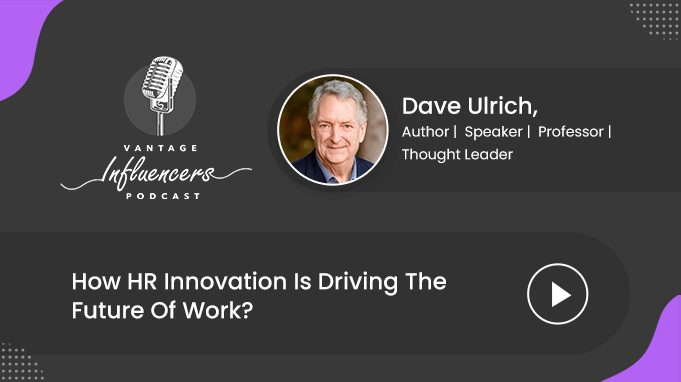
Dave Ulrich, Professor, Ross School of Business; Co-founder & Principal, The RBL Group
Dave Ulrich is a university professor, author, speaker, management coach, and management consultant. He is a professor of business at the Ross School of Business and co-founder and Principal at The RBL Group, and has spent close to 40 years researching how organizations build capability, develop leaders, and create sustained value for the people and stakeholders they serve.
Host
Susmita Sarma, Vantage Influencers Podcast Host
What You Will Learn
- Why reframing HR's purpose around "creating value for others" changes how you prioritize people, culture, and leadership work.
- How to treat setbacks as a growth mindset opportunity instead of a failure to be avoided.
- Why technology should support, not substitute for, personal connection and relationship building at work.
- What separates good leaders from great ones: the ability to hold two opposing demands, like short term and long term thinking, at once.
- How to think about diversity and inclusion as a leadership assumption rather than a program.
- Why culture should be measured by the value it delivers externally, not just by the words used to describe it internally.
Key Topics & Timestamps
| Timestamp | Topic |
|---|---|
| 01:15 | Dave's background and 40-year journey into organizational behavior |
| 03:01 | Two lifelong priorities: continuous learning and creating value for others |
| 05:09 | Redefining HR as creating value through people, organization, and leadership |
| 06:50 | Challenges facing HR: legacy perceptions, COVID, and social issues |
| 09:00 | Technology's role in connection, and its limits versus face-to-face relationships |
| 10:54 | The leadership hierarchy of skills and navigating paradox |
| 11:53 | Learning and development in a more diverse, mobile workforce |
| 13:50 | Dave's outlook on the future of HR |
| 14:39 | Whether organizations are prepared for HR's expanded role |
| 15:43 | The outside-in view of culture: values as the "leaves," not the "roots" |
| 17:52 | Closing message to listeners and how to follow Dave's work |
Full Transcript
Click to read the full episode transcript
Welcome to the Vantage HR Influencers Podcast. This podcast is sponsored by Vantage Circle, the simple and AI-powered rewards and recognition platform for employee engagement.
Susmita Sarma: Hi everyone and welcome to today's episode of the Vantage HR Influencers Podcast. I'm your host, Susmita, and in today's episode, we'll be talking about HR innovation and the future of work. We'll cover a wide range of things in this episode, including how HR can have a greater effect on leaders, organizations, and employees. We'll discuss the attributes that make a great HR officer. We'll talk about how technology and the future of work are affecting strategic workforce planning. For the same, I'm so honored and excited to welcome our guest speaker today, Dave Ulrich, who is a university professor, author, speaker, management coach, and management consultant. He's a professor of business at the Ross School of Business and co-founder and principal at the RBL Group. Welcome to the show, Dave.
Dave Ulrich: Susmita, what a privilege to join you. I'm honored to participate in this discussion. Thank you so much.
Susmita Sarma: Once again, thank you for joining us. So would you like to give a brief about your background and your journey in the corporate world before we start with the discussion?
Dave Ulrich: No problem. It's a very simple background. I did my graduate work in business in the field called organizational behavior. I got into it a little bit by fluke, but I've studied that. And for the last many, many years and even decades, I've tried to figure out how organizations be more effective at creating value for others. And so I start by thinking about what makes an organization, how does it work, how does it better serve employees, deliver its strategy, serve customers, investors and communities. My wife told me when I got into this field, and she's a very good psychologist, that I have OCD.
Susmita Sarma: I got this in one of your previous sessions, and I was about to ask you about that.
Dave Ulrich: Yeah, this continued. Well, what that means is organization compulsive disorder. And I look at an organization and try to improve it. And so when I go to a store or a restaurant or even to church, I have in my mind a checklist: here's how you can be more effective. There are some people that don't want to go to stores or restaurants or churches with me, maybe because I tend to give feedback when it's not always wanted. But I enjoy studying organizations. That's what I have a passion for and have spent much of my career trying to study through research. I've been a professor at the University of Michigan for probably about 40 years. I've written books and done research to try to figure out how organizations be more effective.
Susmita Sarma: Amazing. So I believe you wouldn't have gotten to where you are today if it weren't for your passion.
Dave Ulrich: Right.
Susmita Sarma: So if I'm not mistaken, you've had a successful career spanning 35, or 40 years, if I'm not wrong.
Dave Ulrich: That's true. Thank you for reminding me how old I am. I started my graduate work in 1977 and finished my PhD in '82. So that's about 40 years. That's a long time.
Susmita Sarma: So what have been your top organizational priorities throughout your journey?
Dave Ulrich: There are two priorities that I've worked on, and I'm betting, Susmita, you've done the same exercise. I'd love to hear yours. They're about value clarification: what are your values, what are the things that matter most to you professionally? For me, I've discovered there are two. One is to learn, hopefully over those 40 years I keep learning and growing. I have a rule that in my presentations I have 15 to 20% new material every 12 to 18 months, and so I want to keep learning and moving forward if I can. And second, that my learning is not about me, it's about how I help others get better. So learning to create value for others, that's my personal passion, and I try to help organizations do the same thing. How do we, as an organization, improve so that others get value from those improvements?
Susmita Sarma: Right. Learning forward, and I think also failing forward.
Dave Ulrich: I love the failing forward. My wife, who's a psychologist, has studied the growth mindset work of Carol Dweck. So I made my wife a pillow that said "I'm not failing, I'm learning," and that embroidery hangs on a pillow now on the couch in her office. We don't fail, we learn. So when something goes wrong, that's an opportunity to explore what we could have done better and improve in the future. So I love the failing forward: I'm not failing, I'm learning. To me, that's actually a really good thing, because I fail a lot, and if I'm not learning from it, I'm going to be in trouble.
Susmita Sarma: Okay, great. So coming to the topic today, HR innovation and the future of work. HR is all about the people, and also about enabling people to do things differently so they can go above and beyond their job role across the organization. So how does HR do that? I mean, nowadays just a pat on the back or a thumbs up is probably the best way to do it, right?
Dave Ulrich: Yeah, I would change the definition just a little bit. I've been using the term lately, human capability, and I think HR is about creating value for others. So that's the logic, but there are three things HR contributes to do that. One is the people, human capital, people, the employee, the talent, the workforce. That's so critical. If you look at your fingers, the five fingers represent people. But HR does more than that: it builds human capability. The human is the people, the capability is the organization. So turn your fingers into a fist: do we have the right team, do we have the right organization, do we have the right workplace, do we have the right culture, do we have what I call capabilities. And then combine your fingers into a fist, that's leadership: do we have leaders, not just at the top, but distributed throughout the organization. So my view is that HR is not about HR, it's about creating value for others, the premise, through talent (people), organization (culture), and leadership. And when HR innovates in those areas, it builds the right people, the right organization, and the right leadership to help companies and an organization succeed, not only in the marketplace, but with multiple stakeholders.
Susmita Sarma: Right. So I'm sure while doing that, there are a lot of challenges that HR faces, especially in today's COVID era.
Dave Ulrich: No question. A lot of professions, marketing, or finance, or supply chain, have a legacy, and HR has a legacy too. It grew up being very operational: terms and conditions of work, the labor force, the contract, how do we set the terms and conditions. And then it evolved: what are some emerging practices to take care of people and organization around talent, compensation, and org development. Then it became strategic: how do those practices drive strategy. Now in the HR field, we're trying to create value: how does what we do create value, not only for our employees and our strategy, but for our customers, our communities, and our investors. And in the last 18 months, with the horrendous demands of not only the global pandemic, which has affected the whole world, but also political toxicity and racial issues and injustice issues, all of those are more or less people and organizational challenges. And hopefully HR professionals can rise to that opportunity to not just do the administrative work, which has to be done, or the best-practice work or the strategic work, but work that creates value in the marketplace.
Susmita Sarma: Okay, so I believe many HR teams are also stretched with HR analytics now, right? And some of them are also struggling with the use of technology to get deeper bonds in their work.
Dave Ulrich: Both of those are so true, and there's false hope with technology. There's hope: technology allows us to have this conversation, technology is about connection and relationships. But the falseness is that it doesn't replace face-to-face personal connection. I remember a few years ago, and I probably shouldn't share a personal example, but our son was engaged to a great young woman, and they've now been married for over 10 years, so this was some time ago. He spent almost all of his time connecting with her through technology, tweeting, Instagram, texting, and he said, "Dad, do you have any advice?" And I said, "Yes, spend some time with her one-on-one, personally, because when you're married you're not going to just connect through technology. You've got to learn how she lives and how she acts and how she responds." And he got married, and he said, "Oh Dad, you were right." Technology is a great thing, but it cannot replace that personal connection and intimacy that we need to be part of a community. It's so much more than just getting likes on a LinkedIn post. It has to be really interactive and in person.
Susmita Sarma: No question, I think many of us are experiencing LinkedIn fatigue.
Dave Ulrich: In 2020, I added it up, I did over 200 webinars and podcasts online. I wasn't traveling, and I got to where I could do it, but it still felt a little bit empty. In fact, it's an interesting thing: tomorrow, for the first time in 18 months, I'm doing a live session with a couple hundred people, and I'm actually a little bit nervous. I hope it's like riding a bicycle, that I can stand in front of people and actually talk without telling them to turn off their distractions. Anyway, technology has been a blessing, it connects us in some incredible ways, but it also distances us in some difficult ways.
Susmita Sarma: Right. Also, when you talk about initiating behavioral change, that's not a very easy thing, and you have a business to run at the same time. So both of those have to coexist, isn't it?
Dave Ulrich: You know, one of the things we found when we look at the skills of a great leader is there's kind of a hierarchy. You've got to be authentic, we have to trust you, we have to believe in you. You have to have emotional intelligence, you have to be strategic. But as you move up that hierarchy of skills, the one our research found is you've got to navigate paradox. Paradox is what you just said: I need to be operational day to day and I need to be strategic long term. I need to be top down as a leader and set direction, and I need to be bottom up and engage others. I need to be long term and short term, whatever paradox you want to name. And the great leaders seem to know how to navigate between those two guardrails, and as a result they seem to have a perspective where they zoom out and they zoom in. They know how to help people move forward by turning those tensions that are part of paradox into opportunities to learn and grow.
Susmita Sarma: Employee learning and development is also another area where we see a lot of HR innovation. How can we learn in an era where the workforce is becoming more diverse and more mobile?
Dave Ulrich: Well, hopefully we begin by respecting diversity. Diversity is not just counting numbers of people with different backgrounds or orientations, it's not just a training program, it's not just a communication. It's actually a fundamental assumption about how we lead and run our organization, and that assumption is that my job as a leader is to use my power to empower others. My job is to help others get better. And a second assumption is that everyone has something to offer. Every employee in the organization, no matter what their background, has something to offer, and my job is to discover that offering and help them, and again to use my power to empower them. If we use that assumption, learning becomes a setting where divergent ideas help us move forward to future thinking, and managing that learning process becomes so powerful: to attend to a team, to have leaders take the lead, to shape an agenda, and to use learning as a setting for growth and for innovation.
Susmita Sarma: Right, so formal education, formal training is also quite important, isn't it?
Dave Ulrich: No question. Formal education becomes a form of credentialing. In fact, I'm amazed in our field that if we don't learn something, we end up reinventing it in HR. If we haven't learned what our predecessors have done, we discover something and they say, "we did that 20 years ago." Education allows us to build on the past to create a future, another paradox.
Susmita Sarma: That's fascinating. So Dave, how do you see the future of HR?
Dave Ulrich: I am an optimist. I think as long as HR is not about HR, it's about creating value for others through talent, leadership, and organization, if we can keep that in mind, the future is incredible. I love the line that just as the time coming out of the 2008 and 2009 financial and economic crisis around the world led to a number of changes in managing cash and managing debt, 2021 I think will be remembered as the people and organizational crisis. And if HR can rise to that opportunity, and not see it as a demand, I think we'll see the HR field becoming even more central to what we're doing in organizations.
Susmita Sarma: So do you think organizations are prepared with this new HR bandwidth?
Dave Ulrich: I hope so. Not all organizations, and not all HR people. We've learned sadly in this pandemic that vaccines will mitigate the risk of the pandemic, and yet there's still, I don't know what it is in your experience where you live in India, or in Australia, or in Brazil, but in America there's still 10 to 20% who refuse to be vaccinated, and you go, I don't understand that. But I do understand it, because in the United States there's still about 15% who won't wear seatbelts, about 10% who still think the world is flat. I think at some level we've got to move away from that group and focus on the other group and say, how do we help those who are willing and able to move forward, move forward in a positive way. And I hope that's what we see as we look to the future of HR.
Susmita Sarma: Okay, really deep. So moving on to the next question, we'd love to understand what is the outside-in view of HR and culture. I've listened to some of your previous sessions where you explained this very beautifully with a family example, so it'd be great if you could share that.
Dave Ulrich: Well, let me start with the family. Outside-in, as a simple example, and as you graciously pointed out at the beginning, I'm old, I've been married for 45 years. Whenever I get my wife a gift, who defines the value of the gift? It's not me, it's her. When I was first married, I would get her tickets to sporting events, and she would say, "enjoy yourself," because that didn't create value for her. So the goal of value is not what we do, it's what somebody gets because of what we do. Actually, it's interesting, yesterday I said to my wife, "what should we do to celebrate?" It doesn't happen to be her birthday, it's mine, but what would be meaningful? And we decided last night to schedule a trip to visit one of our children, because that would be meaningful for both her and for me. Value is defined by the receiver more than the giver. Now in organizations, we often talk about values, we talk about the values of an organization as the roots of the tree. I'd like to pivot that: the values of the organization should create value for the customers and the investors, and so instead of thinking of values as the roots of the tree, think about them as the leaves of the tree. What value does a customer get from the values that we have in our organization? That leads me to redefine culture. Culture is not just a value statement and a set of behaviors, it's an identity in the marketplace that captures the customer, so that they will then create better success for the organization and allow us to create the right workplace. I think culture is not just the values inside, it's the value of those values outside.
Susmita Sarma: Right. So is there a message that you would like to give to our listeners today?
Dave Ulrich: I hope, and again I don't want to impose my values on someone else, but I hope that most of us who listen are committed to learning, to seeing challenges as opportunities, to replacing fear with hope, and also to being willing to give back. Let me frame that with two or three questions. I had the chance to do a commencement speech for a university, and I don't have a rags-to-riches story like some famous entrepreneurs, but I coach, and the message I give to people is: question one, what do I want, what are my values, what matters to me, what are my strengths, what are my passions. Number two, who do I serve, who will get value because of what I do. And number three, how do I institutionalize, how do I build, how do I make an organization better. Now, having said that, Susmita, I'm not going to let you off. You're relatively new to HR, you're well known as a broadcaster, and in the last year or two, as you've gotten to know HR, what do you think HR contributes? You've done podcasts, you're a thoughtful observer, you're a clever thinker, what do you think HR should pay attention to? I'm turning the tables on you.
Susmita Sarma: I think during all this technological improvement, I believe the basic human element in HR has been lost, so it's time to reintroduce the human element into HR. In fact, the HR team should also work constantly to create an atmosphere, an environment, and a culture that encourages employees to bring their best version of being human to work every day.
Dave Ulrich: What a great message, the human in human resources needs to be looked at aggressively. Thank you for sharing that, that's a great reminder. Thank you for this discussion.
Susmita Sarma: Yeah, so finally, how can the listeners reach out to you, Dave?
Dave Ulrich: I've written a lot of books, but they take a year or two to get written and published, so I started posting on LinkedIn. Just follow me on LinkedIn, I post a new article every Tuesday, and I also get to engage with people on an article, I get comments, and if people disagree with me, that's wonderful, because that's how I learn. So the easiest way is to follow me on LinkedIn.
Susmita Sarma: Okay, thanks for joining me today, Dave. That was a great conversation. I hope we'll get you back soon on our podcast.
Dave Ulrich: I hope so too. Thank you again, and thank you for your insight, that was a very good reminder and very helpful, to remember the human in human resources. Thank you.
Susmita Sarma: You're welcome. Thanks for listening to the Vantage HR Influencers podcast. Please do subscribe to the Vantage HR Influencers podcast on Apple Podcasts, Spotify, and our YouTube channel for new episodes.
FAQ
What does Dave Ulrich mean when he says "HR is not about HR"?
Dave Ulrich argues that HR's purpose is to create value for others, specifically customers, investors, and communities, not to exist as an end in itself. He breaks this down into three levers: talent (the people), organization (the culture and capability), and leadership (distributed throughout the company, not just at the top). When HR innovates across all three, it helps the whole business succeed with its stakeholders, not just internally.
How does Dave Ulrich define company culture differently from most leaders?
Most organizations treat culture as the "roots of the tree," an internal values statement. Dave flips this and calls it the "leaves of the tree" instead: culture should be judged by the value customers and investors actually experience in the marketplace, not by how the values read on a wall. He illustrates this with a personal example about gift-giving, where the value of a gift is defined by the receiver, not the giver.
What does Dave Ulrich say is the most important skill for great leaders?
He describes a hierarchy of leadership skills: authenticity and trust come first, followed by emotional intelligence and strategic thinking. The skill his research found at the very top, though, is the ability to navigate paradox, holding opposing demands like being operational and strategic, or top down and bottom up, at the same time, and turning that tension into a growth opportunity.
How does Dave Ulrich think about failure and learning?
Dave treats setbacks as data rather than defeat, a mindset he credits partly to his wife's work as a psychologist studying growth mindset research. He keeps a pillow embroidered with "I'm not failing, I'm learning" in her office as a reminder. For him, if something goes wrong, it becomes an opportunity to identify what could be done better next time, rather than a reason to stop trying.
Related Reading
Also listen on