How HR Transformation Impacts Business Outcomes
Episode Overview
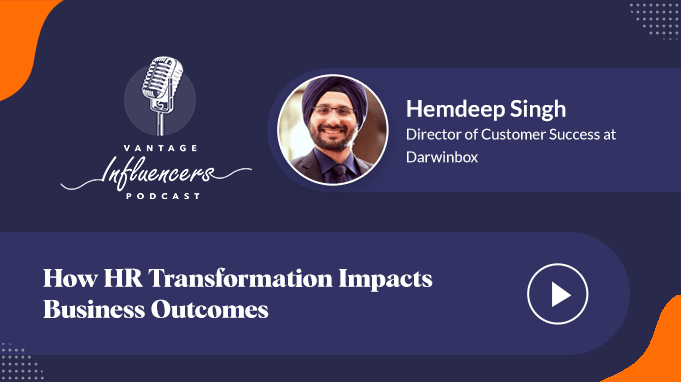
Hemdeep Singh joined this episode to unpack why so many HR transformation efforts stall despite looking successful on paper. His central argument is that teams treat transformation as a technology rollout, when the technology is only one piece of a puzzle that also needs process redesign and human behavior change. He compares handing employees a powerful new HR platform to handing a goods train driver the controls of a bullet train without training, supporting infrastructure, or redesigned tracks. Without eliminating outdated processes, simplifying them, and building change capability first, the new system just automates old dysfunction faster.
The conversation also gets concrete about how HR can prove its value to the board. Hemdeep walks through a real example of putting a single number, the dollar cost of attrition, in front of leadership to force a conversation about cost and revenue rather than vague engagement scores. He also argues for prioritizing employee experience over short-term operational efficiency, saying efficiency gains forced onto people evaporate while experience-led change sticks and reinforces itself. The two agree that transformation only survives when leaders model new behaviors daily, adoption gets tracked like any other business metric, and reinforcement continues well past go-live.
Episode Highlights
- HR transformation often fails because leaders assume new technology alone will change behavior, sidelining the change management work that has to start at the top.
- Hemdeep uses a goods train vs bullet train analogy: without trained drivers, supporting infrastructure and redesigned tracks, a new HR platform just runs the old dysfunction faster.
- Before automating anything, organizations should eliminate, simplify and streamline processes, only then automate, following what consultants call the ESSA framework.
- A real board presentation example shows how quantifying the dollar cost of attrition, hard and soft costs included, gets leadership attention that engagement scores never do.
- Employee experience should come before operational efficiency because efficiency gains forced on people fade, while experience-led change is adopted and sustained by employees themselves.
- Making transformation stick requires visible leadership role modeling, real-time dashboards instead of static reports, and ongoing reinforcement long after go-live.
About the Guest
Hemdeep Singh, Director of Customer Success, Darwinbox
Hemdeep Singh is the Director of Customer Success at Darwinbox, where he leads Customer Success for the India Western region and manages a large enterprise portfolio of global HCM clients as a strategic advisor to CHROs and C-level executives. With more than 15 years of experience spanning HR transformation, consulting, organization design and change management, he has held roles at EY India, Deloitte, Accenture, Firstsource and Reliance, leading large-scale people transformation, HR strategy and workforce initiatives across global markets.
Connect with Hemdeep on LinkedIn
Host
Riha Jaishi, Vantage Influencers Podcast Host
What You Will Learn
- Why most HR transformation programs default to buying technology instead of redesigning processes and building change capability
- How to quantify the cost of attrition in dollar terms that resonate with a CFO and CEO
- When to prioritize employee experience over operational efficiency, and why
- What reinforcement mechanisms keep a new HR system from being abandoned within months of launch
- How to structure an HR transformation roadmap that treats employees as co-owners rather than end users
Key Topics & Timestamps
| Timestamp | Topic |
|---|---|
| 03:01 | Where Most Organizations Get HR Transformation Wrong |
| 07:16 | How HR Transformation Can Directly Impact Revenue |
| 12:02 | Are Organizations Overestimating HR Technology? |
| 14:46 | Employee Experience vs. Operational Efficiency in Transformation |
| 17:21 | How to Make HR Transformation Part of the Culture |
| 21:21 | What to Do Differently When Starting HR Transformation Fresh |
Full Transcript
Click to read the full episode transcript
Welcome to the Vantage Influencers Podcast. This podcast is sponsored by Vantage Circle, the simple and effective recognition platform for employee engagement.
Riha Jaishi: Hello, everyone. Welcome back to another episode of the Vantage HR Influencers Podcast. I'm your host, Riha. And today we are diving into a topic that sits at the intersection of people strategy and business performance, how HR transformation impacts business outcomes.
When organizations talk about HR transformation, the conversation often stays at the surface: new platforms, new policies, new frameworks. But the real question is what actually changes for the business? Because transformation is not about what HR implements, it is about what the organization experiences: faster decisions, stronger performance, and better retention. The challenge is that many transformations look successful on paper but fail to move the needle where it truly matters, and that is where this conversation becomes very important.
To help us unpack this, I'm joined by Hemdeep Singh, Director of Customer Service at Darwinbox. So welcome to the show, Hemdeep. It's a pleasure to have you with us today.
Hemdeep Singh: Same here, Riha. Thank you for hosting me.
Riha Jaishi: Thank you. Okay, great. So Hemdeep, to kick things off, can you briefly take us through your professional journey so far? We are eager to learn about your journey.
Hemdeep Singh: Absolutely. So, just to talk about my own journey, I started my career in consulting, starting off with Deloitte, Accenture, and going on to work with the likes of EY. So mostly part of the HR consulting, people advisory space. But interestingly, I've also been on the other side of the table, part of the chairman's office and the CHRO's office in Reliance, driving HR transformation internally, also as a part of the Sanjeev Goenka Group. Very recently, I've joined the HR tech space, working as a customer success director at Darwinbox, largely driving adoption for HR technology implementations. So, just to summarize, I have been on the advisory side and on the other side of the table talking to consultants. It's been fun, a roller coaster ride.
Riha Jaishi: That's such an inspiring venture, Hemdeep. Thank you so much for sharing your experience. Okay, so now with your permission, I would like to delve into our topic further. Shall we?
Hemdeep Singh: Absolutely. Please go ahead.
Riha Jaishi: So Hemdeep, to begin with, at the definition stage, where do you think most organizations get HR transformation wrong? What do you have to say about this?
Hemdeep Singh: So I think, first of all, most companies assume HR transformation is equal to HR technology. They assume that just deploying an HR technology, people will start using that from day one, right? So largely, driving change management is something that is often overlooked. And change management starts from the top. You need sponsorship from the leadership, you need to define what the reasons for change are, you need to define what the milestones are, and of course, there has to be a shared belief in that change.
Generally, what happens is there are a few people at the top who want to do this change, and they assume that just bringing a technology will change the behavior of people. That's not how it happens. It's like going from, let's say, a 50-year-old example, alluding to Indian Railways, going from a goods train to the bullet train. We are just assuming that the driver of the goods train is going to suddenly learn how to drive a bullet train at the speed of 300 kph. That's not how it goes. Before the driver is given the new train, you need to make sure that, first of all, the driver is trained, the technology is known, and there is supporting infrastructure available in terms of the rail technology. I'm giving a very simple example so that people can understand and relate. So the process, people, and technology need to be aligned. Similarly, just like in a train, you need to have the right tracks, you need to have the right people, which is the train driver itself, you need to make sure that the driver is trained and the supporting technology is in place, and then process. So all of that needs to be in place, and that is where most companies fail.
And also, the other failure point is most companies, whatever legacy system they have, they just want to automate the legacy system as is into the new one. So what typically happens is that in new age technology, especially SaaS technologies, they are evolving every three months with every new release. So if your processes are 10 years old or 20 years old, you cannot automate all of that in the new age SaaS technologies. To simplify it, you cannot run a normal train on a bullet train track. It's as simple as that. If you want to run at the speed of 300, 350 kph, you need to align with the global processes, which means that you need to eliminate redundant processes, simplify some of those processes, streamline those processes, and then automate them. It's the ESSA framework that typically consultants follow: eliminate, simplify, streamline, and automate. Although this is widely known, this is where most organizations fail in HR transformation.
Riha Jaishi: Hemdeep, you have given a very interesting take on this. I really liked how you gave this example about the goods train and the bullet train comparison, it sits pretty well in this scenario. And you have highlighted the most important point, that assumption that organizations have that HR transformation is equivalent to HR technology, and only having that will change the scenario in a day or two. So I guess you have highlighted a very important point here, and how each and every process, streamlining, alignment, and all, everything is important, right?
Hemdeep Singh: Yes, absolutely. That's a big key takeaway here, Riha. Yeah, absolutely agreed.
Riha Jaishi: Okay, so now moving ahead. Hemdeep, can you walk me through a real example where HR transformation directly moved revenue or cost, and not just engagement scores?
Hemdeep Singh: So I'll give you, again, a very simple example. Typically in the BPO space, where frontline attrition is very high, when you go to board meetings, you just talk attrition numbers. HR is not able to translate those numbers into, let's say, a cost lever or a revenue lever.
Now, I had a similar problem because I was working as a chief of staff to the CHRO, and we had a board presentation to make on how do we address attrition, what are the short-term, medium-term, and long-term measures. But I'll tell you, all I did was I just had one headline slide. That one headline slide just had a number, that's it, nothing else. It had written around 8 million dollars and an exclamation mark. That was the only thing on the slide.
Now, you may wonder what this really means. It basically means that I wanted to quantify the cost of attrition. Now, the cost of attrition can have many definitions. There are certain hard costs and there are certain soft costs. Soft costs are, let's say, there is a notional loss because somebody is not sitting on the seat, and there is a notional revenue loss because somebody is not on that seat, for example. Then there is a cost of training the people who come after, let's say you need to get a replacement. There is a certain gap: let's say today somebody leaves, the next person in line joins after day 60, and then there is a certain period which leads to something called time to productivity, where you join but you are not yet productive. So some of those losses is something that we quantified. We said this is the revenue you are losing, this is the amount of money you are putting on training, whether external or internal, this is the amount of money you are putting to recruit people. Recruiting can be through internal or external recruiters; internal recruiters you pay salary to, external recruiters you pay a lump sum. Then there is money for trainers, internal and external, internal being a soft cost and external a hard cost, same logic for recruiters. And then, of course, there is an infrastructure cost, and there is a certain time before that person becomes billable to the client.
So this entire journey, from the person resigning to the person leaving and the backfill coming in, we mapped it: out of 100 people, let's say 40 people are leaving, for those 40 people, what is the quantified amount in cost, or the notional loss in revenue. That is something we quantified and showed to the leadership, and the leadership did not move beyond that slide, because if you put an 8 million dollar sign, the CFO would not want to move ahead. The CFO wants to know, please tell me how do I save this money.
Riha Jaishi: Absolutely.
Hemdeep Singh: The CFO didn't move, the CEO didn't move, the CHRO was able to catch everyone's attention just through that slide. And beyond that, of course, we had all the workings. We had said, let's work on some of these pockets where attrition is high, where there is lower effort and higher impact, and we had those slides ready. But purely from an attention-grabbing point of view, we were able to grab that attention right up front and drive that message. That's a really hard-hitting thing that we were able to drive with the board.
Riha Jaishi: Okay, Hemdeep, that's such a powerful example, a live example. So it shows how these HR decisions and the company decisions directly impact the revenue, and this is where the perception of HR starts to shift from being a support function to being an actual business driver, right? What do you think?
Hemdeep Singh: Absolutely, I agree.
Riha Jaishi: Okay, so now moving ahead. Hemdeep, a lot of HR transformations heavily focus on technology. So are we overestimating tech and underestimating behavior change? What do you think?
Hemdeep Singh: Well, I think we already alluded to this in our first question. I mentioned that, absolutely, we are overestimating HR tech, and we assume that people will just, that's the same train example, we assume that the goods train driver is going to just come one day and start driving the bullet train. That's not how it happens.
The behavior change is more important, and for behavior change to happen, you need to bring people along with you, right from the top as well as the bottom. You need to take feedback. First of all, you need to have sponsors, you need to have leadership support, you need to have a shared vision and goal alignment from the leadership itself, and you need to make sure that the leadership is aligned through the entire journey. Sometimes what happens is at the initial start, it's fine, and then suddenly midway, you lose track. At the same time, you need change champions, early adopters of technology who are able to help you drive that change in the larger picture of things. And of course, it's always good to have a consultative approach where you take feedback from the employees and make sure that you are working towards an employee experience that they also want to have in the future. So you need to make sure there is a top-down and bottom-up alignment. Typically, most companies fail to do the bottom-up alignment.
Riha Jaishi: Hemdeep, this perspective of yours on behavior change is really interesting, because you have said that we are overestimating technology and behavior change is the need of the hour, and having that top-to-bottom alignment is the thing. And I guess, without that behavioral shift, even the best systems will lack in delivering the outcomes, don't you think?
Hemdeep Singh: Well, yeah, I agree. I think the outcome is obviously more important, and ultimately, if you are able to drive change, then your overall transformation will be successful. And, of course, the outcome can be measured in different ways, that is something, again, that needs to be aligned with the leadership.
Riha Jaishi: Absolutely, well said. Okay, moving ahead. Hemdeep, if you had to choose, would you prioritize employee experience or operational efficiency in a transformation, and why?
Hemdeep Singh: So I would suggest that I would want to focus on employee experience, because that's the heart of it. Operational efficiency delivers in the immediate short term because that is what companies and organizations look at. But if you want to keep people at the core, since it's ultimately the people who are performing these processes, and if you want to make sure there is sustainable change, then you need to keep people at the heart of it. Any operational efficiency that you force upon people will evaporate over a period of time. But if you focus on employee experience, then the change will be adopted and championed by them. If employees feel supported and empowered, they will themselves make sure that if there are any hidden inefficiencies, the operational efficiency is taken care of.
And, of course, there are certain cases wherein operational efficiencies need to be prioritized. That depends on the context of the company, where maybe there is a path to profitability or a path to some revenue target. In certain cases, operational efficiencies may be given precedence. But to summarize, efficiency as a byproduct of a better employee experience is a better way to go about it. So employee experience is the focus, but efficiency gains should be a byproduct of it, is what I feel.
Riha Jaishi: Absolutely, that's such an interesting point, Hemdeep. Given the circumstances now where AI is taking over, this preference for employee experience is such a fresh take here, because people are prioritizing operations or AI over employees. So this is a game changer, your perspective particularly on how employee experience should be at the heart and how that is going to assist operational efficiency moving ahead, right?
Hemdeep Singh: Yeah, absolutely.
Riha Jaishi: Okay, great. So now moving ahead, Hemdeep, how do you ensure transformation doesn't stay a project and actually becomes a part of the culture?
Hemdeep Singh: Well, that's an interesting one, because again, this is where most companies fail. I would say that if you want to embed transformation into the culture, there need to be certain reinforcement mechanisms, and the biggest reinforcement mechanism is leadership role modeling. The leadership needs to visibly use the new technology as a day-to-day thing, celebrate adoption, and make sure it is clearly visible.
A very simple thing: in an HR technology, you have dashboards. If you have dashboards for decision making, whatever reviews are happening should happen on the real-time dashboard. You don't expect the team to go to those dashboards, download data, make a PPT, and make stories out of it. So typically, I see wherever organizations fail, if the leader fails. If the leaders are again asking you to do reviews on PPTs, it's going to fail. If the leaders say, I am going to look at the dashboard and drive business insights from it, then the team will follow. That's role modeling as an example. But then, of course, you need to integrate it into daily life, not just for the leaders, it needs to go down as well. Any new ways of working need to be reinforced through communication, through training, through HRBPs, through managers, and through leadership: this is the new way of doing things.
Typically, immediately before or after go-live, you have a series of communication, but you should always make sure there is a refresher going on. Every three months, you reiterate these are our ways of working, this is the best practice. Over-communication always helps to drive new ways of working. And overall, from a leadership and an HR tech point of view, you should track adoption, what is the adoption of the entire platform, what are the different metrics, and maybe use gamification to drive engagement on the platform.
HR needs to be the cultural architect. Although HR will be the facilitator and the architect, the activators of that culture are the respective HRBPs and managers. So we need to make sure there is some sort of incentivizing for people to use the system, whether through points, recognition, rewards, or gamification. These are some reinforcement mechanisms, and it has to continue even after, let's say, one month of go-live, to make sure people adopt it. Then, over a period of time, after one year, you can reassess and see whether the frequency of communication needs to reduce.
Riha Jaishi: Hemdeep, you have given some important pointers here about reinforcement mechanisms and how leaders are central to it. Your perspective really sheds light on the fact that unless and until transformation becomes embedded in everyday behavior and decision-making, the system cannot really sustain. So this is where the role of leadership, all the processes, communication, and tracking adoption come into place, right?
Hemdeep Singh: Yeah, that's right.
Riha Jaishi: Great. Okay, so before we wrap up our session, Hemdeep, if you had to start HR transformation from scratch in a new company, what would you do differently today? This is completely your take.
Hemdeep Singh: So I think I would want to correct the things that typically companies fail at, and some of those things we've already spoken about. Before even deciding the technology, I would want to go slow on technology. I would first want to align with the CXOs, the CEOs, the CHROs, and co-define the why. Why are we doing this? What are the specific business outcomes or talent imperatives that we want to drive through this change or transformation? It could be, let's say, I want to enable business growth through faster talent agility, because the business is growing significantly and I need a certain amount of skill at a certain amount of time, that's related to manpower planning. So I would want to define that rather than defining HR deliverables or HR technology in isolation.
I would then want to do a thorough current state audit: what are my processes, tech capabilities, and the current employee sentiment? Sometimes what happens is companies keep coming up with new technologies every two years, and employees have just gotten used to the old HR technology, and then suddenly you get another one, just because the world has moved on. There are both pros and cons to this, but it needs to be evaluated: whether the employees who have just gotten used to the new platform are even ready for the new one. Have you even done a pulse check with them? And I'm not talking just about the leaders, I'm talking about the people sitting at the last mile, whether you've done a pulse check with them. So some of that needs to be done, like a current state audit. And then, whatever we do, we need to have a phased roadmap that balances efficiency wins, which is what generally businesses want, and, of course, focus on employee experience and productivity as well.
So, to give you a gist, my focus will be on change management and capability building instead of ruthlessly digitizing. I'll bank on my earlier framework, the ESSA framework: eliminate, simplify, streamline, and then automate. I would want to do that before going ahead. I would want to focus on behavior, as we discussed earlier, to make sure there is a certain change network there to support me in driving this change. What are the adoption metrics I want to track over a certain period of time? And then, with the AI world coming in, I would definitely make sure AI is part of my roadmap, whether it is agentic AI or generative AI.
So, ultimately, I would treat it as a larger business transformation, keeping employees at the heart, rather than simply calling it an HR project or an HR transformation. Ultimately, we need to make sure that everybody is a co-owner in this: the business leadership, HR leadership, the larger HR fraternity within the company, and the employees at large. That's how I would want to summarize it.
Riha Jaishi: Hemdeep, thank you so much for highlighting your perspective on this. First of all, it is very unique, quite different from the regular ones, I must say, because people are so much into technology these days, over-dependent on it, that, as you mentioned earlier, at times the operational efficiency takes over employee experience. But now, as you preferred earlier, that employee experience should be at the heart of it, so your preference for getting slow on technology first to understand everything, and to keep employees at heart, and then only to automate the process or move with the technology, that's quite a different, quite a unique take on HR transformation.
Hemdeep Singh: Yep, so I mean, see, again, these are ideal things. Typically, in a real business environment, time is always of the essence, so that is where people struggle, because they just want to cut corners and move ahead. That's the reason why most transformations fail, because we are cutting corners everywhere. We focus only on the technology because there is a mandate to deliver technology, and nobody has thought about how it is going to impact employee experience, productivity, and process efficiencies. That thought is something that comes as an afterthought: okay, now that we have deployed technology, let's think about what we are going to do about it.
Riha Jaishi: Great, Hemdeep. At least you are thinking about it, and you know where things are heading, and how you can bring the change. So I guess identifying that thing in itself is a big change, you are moving towards it, right?
Hemdeep Singh: Yeah.
Riha Jaishi: Okay, then, Hemdeep, we have finally come to the end of the session. Thank you so much for joining us today and sharing your incredible insights. It's been more than a pleasure hearing your perspectives on how business outcomes can be tremendously impacted through HR transformation. We really appreciate your time and your expertise, and I'm sure everyone tuning into this session is inspired by your expertise and walking away with a wealth of information to ponder. Thank you for this interesting session and the very interesting questions that you had.
Hemdeep Singh: I really enjoyed my time here. Thank you.
Riha Jaishi: Okay, great. Equally delighted, Hemdeep. And to our listeners, thank you for tuning in. We hope you found today's conversation as enlightening as we did. So, until next time, take care and we'll see you soon.
Thanks for listening to Vantage Influencers Podcast. Be sure to subscribe on Apple Podcasts, Spotify, and our Vantage Circle YouTube channel for the latest episodes.
FAQ
Why do most HR transformation programs fail to change anything for employees?
Because leadership treats technology as a substitute for change management. According to Hemdeep Singh on the episode, deploying a new HR platform does not automatically shift behavior, and few organizations invest in the sponsorship, communication, and process redesign needed before rollout.
How can HR prove that a transformation affected the bottom line?
By quantifying attrition in dollar terms, not just retention percentages. In the episode, Hemdeep describes building a board slide around a single number, the notional cost of attrition, that combined hard costs like training and recruitment with soft costs like lost productivity, translating an HR problem into a language the CFO understands.
Should employee experience or operational efficiency come first in a transformation?
Employee experience, according to the episode. Efficiency gains that are forced on employees tend to fade over time, while employee experience-led change gets adopted and sustained by the people using it, with efficiency following as a byproduct rather than the starting goal.
What keeps an HR transformation from reverting to old habits after launch?
Continuous reinforcement led by leadership. The episode highlights visible leadership role modeling, live dashboards instead of static reports, and recurring communication and adoption tracking that continues well past the go-live date.
Related Reading
Also listen on