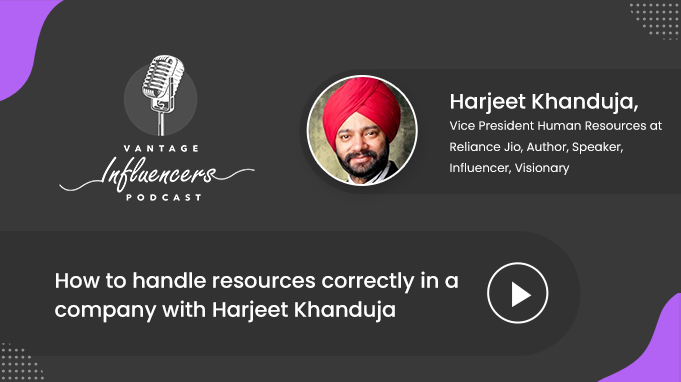
How to handle resources correctly in a company with Harjeet Khanduja
Episode Overview
In this episode of the Vantage HR Influencers Podcast, host Rohit speaks with Harjeet Khanduja, Vice President HR at Reliance Jio, about why engagement and accountability come down to basic human discipline rather than elaborate HR programs. Harjeet compares remote engagement to a marriage or to soldiers stationed at a border: what holds people together isn't grand gestures, it's the steady discipline of checking in, the same way a spouse calls every day just to ask about lunch. He translates this into a simple three step framework for building an accountable workforce: assign the work clearly, review it honestly, and guide the person through the gap, borrowing the same logic that makes an unpaid gully cricket team play like their reputation depends on it.
The sharpest point in the conversation is Harjeet's reversal of how most people read employee engagement research. He argues that companies aren't profitable because their employees are engaged: successful companies simply produce more engaged employees as a side effect of already doing everything else right, and treating engagement as the cause rather than the symptom leads leaders astray. He extends the same practical lens to OKRs (comparing them to a GPS route that only estimates the destination), to the future of work (predicting parts of remote and gig style employment are here to stay because they strip out infrastructure cost), and to reward technology, arguing its real value is letting HR recognize people individually and instantly instead of running one size fits all engagement activities.
Episode Highlights
- Harjeet frames engagement as a discipline built on daily, low stakes check ins, comparing it to a marriage or to soldiers at a border who stay connected to their purpose without needing grand gestures.
- His practical framework for accountability comes down to three steps: assign the work clearly, review it honestly, and guide the person through the gap, the same basics that make an unpaid gully cricket team play like the outcome matters.
- He reverses the usual reading of employee engagement research: profitable companies aren't profitable because employees are engaged, they simply produce more engaged employees as a byproduct of already running well.
- Feedback, in his view, should be instant and specific, like a cricket captain correcting a dropped catch on the spot, rather than saved for an annual or quarterly review cycle.
- He compares OKRs to a GPS route: the objective is the destination, the key results are the path, and the numbers are estimates that keep everyone oriented even when they don't land exactly.
- He expects parts of remote and gig style work to remain permanent, pointing to industries like contact centers where infrastructure makes up half the cost of employing someone.
About the Guest
Harjeet Khanduja, Vice President HR, Reliance Jio
Harjeet has set up multiple greenfield HR projects and has led HR for large multinational organizations across geographies including India, the US, and Canada. His experience spans industry sectors such as automotive, manufacturing, pharma, alternate energy, IT-ITES, telecom, digital, healthcare, and retail, with stints at business houses including Tata, Reliance, and Piramal. A Thomson Medalist from IIT Roorkee, he completed his management education at NMIMS and INSEAD.
Host
Rohit, Vantage Influencers Podcast Host
What You Will Learn
- How to use a simple assign, review, guide framework to build accountability in any team, remote or in office.
- Why instant, specific feedback beats an annual review cycle for improving performance.
- How to avoid the trap of reverse causation when reading employee engagement data.
- How OKRs work like a GPS for a business, setting direction and a route rather than a guaranteed arrival time.
- Why some remote and gig style roles are likely to outlast the pandemic that popularized them.
- How reward and recognition technology can make engagement individual and instant instead of one size fits all.
Key Topics & Timestamps
| Timestamp | Topic |
|---|---|
| 00:00 | Harjeet's journey into HR |
| 01:31 | Driving engagement in a remote work culture |
| 04:16 | Building an accountable workforce |
| 06:53 | Measuring engagement's real link to business performance |
| 09:49 | Using OKRs to align teams and track progress |
| 11:44 | Preparing India's young workforce for global quality work |
| 13:55 | Staying agile and aligned to employee value systems |
| 17:48 | Whether work from home is here to stay |
| 19:43 | HR trends reshaping the future of work |
| 22:21 | Using technology to reward and recognize employees |
| 24:50 | Advice on storytelling and communication |
| 27:04 | Favorite business books, movies, and HR leaders he admires |
| 28:10 | Advice for young HR leaders |
Full Transcript
Click to read the full episode transcript
Welcome to the Vantage HR Influencers Podcast. This podcast is sponsored by Vantage Circle, the leading employee benefits and engagement platform.
Rohit: Hi everyone, this is Rohit from the Vantage HR Influencers Podcast. And today with us we have Mr. Harjeet Khanduja, who has set up multiple greenfield projects and handled HR for multinational organizations across various geographies, including the US, India, and Canada. Harjeet's experience spans a range of industry sectors that include automotive, manufacturing, pharma, alternate energy, IT-ITES, telecom, digital, healthcare, and retail, and he has worked with business houses like Tata, Reliance, and Piramal. He is currently working as Vice President HR at Reliance Jio. Harjeet is a Thomson Medalist from IIT Roorkee and has completed his management education from NMIMS and INSEAD. Welcome to the show, sir.
Rohit: Sir, how did you get into the role of HR, and what got you excited about HR that you've spent such a long career in it?
Harjeet Khanduja: Look, it's destiny. I passed out from IIT and joined Tata Motors. I'm an industrial engineer by education, so I got into the industrial engineering department, which used to report into HR. That's how I grew into HR.
Rohit: We're going through a kind of crisis right now, during the COVID times, with a very long lockdown in the country. What can leaders do to drive engagement in a remote work culture, where they cannot physically touch or see people but still want to engage with their team members and their families?
Harjeet Khanduja: If you talk about leadership, it's like a marriage. Between a husband and a wife, there's no place for a third person. Or look at the army: soldiers at the border know exactly what their purpose is, what the country and the army stand for. The army has been doing engagement for a long time, people at the border stay in constant communication. It's this feeling of belonging that matters, whether you're working remotely or from an office.
Now, when you're working remotely, there's a sense of fear, almost like a long distance relationship where you can't tell for certain whether the other person is really with you or not. So there has to be discipline in communication. You'll have noticed that if you're married, your wife calls you every day around lunchtime: have you eaten, what did you have, what should I cook for dinner. It isn't a meaningful conversation on the surface, but it carries a lot of meaning in life. That's what engagement really is.
In a more professional sense, engagement isn't about throwing parties. It's about whether you're able to assign work properly. I follow a simple framework built around three steps: assign the work, review the work, and then guide the person based on that review. If you're assigning work, reviewing it, and guiding people, they stay engaged, because part of that process is understanding their problems, listening to them, and then teaching them how to solve those problems rather than solving everything for them yourself. If you follow that framework, you'll be able to drive a remote work culture in a fantastic way.
Rohit: When a company brings in an employee, they want to make that person accountable, both for their own goals and for the organization's goals. How can companies build accountable people right from the start, especially given how young India's workforce is? How can we create an accountable workforce?
Harjeet Khanduja: Have you ever played gully cricket? [Rohit confirms he has.] In gully cricket, does anyone pay you to play? No, they don't. So the question is, how do you make people accountable in gully cricket? You tell them clearly what their responsibility is: the ball shouldn't go past this point. You hold a quick team meeting and tell them we need to win this, for our lane, for our neighborhood. There's real respect built into that. If you start disrespecting people, they won't come back. There's a connection you build.
Business works exactly the same way. When we talk about mission, vision, values, role clarity, and clear objectives, that's exactly what you were already doing in gully cricket, just given fancy names for business. If you follow those basics, you'll be able to engage people the way you want.
In gully cricket, if somebody drops a catch, you give them feedback instinctively, right there: fix your grip, hold your hands like this. Feedback is instant, it isn't locked into some bureaucratic cycle. In corporates we generally treat feedback as an annual exercise, quarterly at best. Why can't it be instant? And when it comes to rewards, this isn't an era where you fill out paper forms. This is the age of platforms like Facebook: reward can be given on a technology platform instantly, and feedback can be given instantly too. So if you want to make somebody accountable, explain the role clearly, tell them what you're trying to achieve, keep giving feedback, and keep listening. That's how you get there.
Rohit: Very interesting. Are there ways HR leaders can measure the ROI of employee experience, so that employees stay engaged and stay with the company for years?
Harjeet Khanduja: When I was in my first job, my boss told me that a large majority of this is subjective, which itself is a very difficult thing to pin down. The way this actually works is in reverse order. What you do is look at successful companies and ask why they're successful. You'll find their employees are more engaged, and then you build a reverse hypothesis around that. Gallup has done research showing that business units in the top quartile of engagement have 21% higher profitability. But it isn't that engagement causes the higher profitability. It's the other way around: companies that are already more profitable end up with employees who are roughly 21% more engaged than the rest.
Here's another way to think about it. There's a belief that if you study, you'll score well, so getting marks means you were studying. But there are two ways of getting there: memorizing things, or actually understanding them. Once you understand a concept, you can answer whatever question comes your way, because you know the underlying idea. If you've just crammed it, you won't be able to do that. Engagement works the same way. There's no rocket science in it. If you can explain to employees what you're trying to do, and they understand what they need to deliver, and you follow basic discipline, it becomes a win win for you and for them.
This isn't only about logic either. When you're dealing with people, it's emotion raised to the power of logic. If you can bring people's emotion into your business, it multiplies whatever logic you're already applying.
Rohit: OKRs have become important in the Indian ecosystem too, popularized by leaders who helped implement them successfully at companies like Google. How can OKRs help leaders measure their performance?
Harjeet Khanduja: Let me ask you something: is Google Maps important? [Rohit says yes.] You thought about it for a second before answering, because if you're just sitting at home, Google Maps isn't important at all. It only matters once you want to reach somewhere: you put in a destination, you think about where you actually want to go, and it plots a path for you.
OKRs work the same way. The objective is the destination you want to reach, and the key results are the path you're going to take. Once you know both, whether you're a cab driver, your own driver, or driving yourself, you'll be able to reach your destination, and you'll have a sense of how long it'll take. It's a method of logical thinking that quantifies things. Google Maps doesn't guarantee you'll arrive in exactly 53 minutes, but it gives you a clear estimate, and if traffic is heavier, you know it could be off by ten or fifteen minutes either way. OKRs do the same thing for a business: it's a very good concept if it's implemented properly, but if you're doing it just to look fashionable, it has no value at all.
Rohit: India has a very young workforce, with thousands of students graduating every year, but there's also a disparity in the skills they carry into the workforce. How should Indian companies think about developing this young talent, whether it's for the domestic market or for international companies looking at Indian talent?
Harjeet Khanduja: Frankly, I wouldn't say we should be preparing our talent specifically for international companies. That should be an individual's own choice, whether they want to compete internationally or contribute at home. Our Prime Minister has been talking about being vocal for local, and I don't want to go down a separate path of training people purely for international companies. Instead, our people should be trained to a standard of international quality, so that companies outside India end up aspiring for that talent.
One of the things Indian education has already given the world is strong mathematical and analytical capability. The problem is the world has changed around us. Our education system trains you to remember everything for an exam, cram it up, and give the answer. But the world today works the way Google works: you ask a question, and an answer comes back to you. So we need to teach people to ask questions instead of just retaining facts. Once they can do that, they'll be sought after not just as IT talent, but as business talent too. The biggest problem right now is that people are moving into analytics without learning to question the data. We need to start questioning.
Rohit: As you've pointed out, companies are getting larger, and they also need to be agile, especially during a crisis like this one, and aligned with both employee and employer values. How can organizations stay agile and aligned to employee value systems, especially with millennials and Gen Z entering the workforce?
Harjeet Khanduja: The real question is, is there even an option? We tend to think, sitting inside a company, that we're the ones running the business. But there's a social system operating outside the company that sets the benchmark. Think about how chains like Pizza Hut and McDonald's built their brand around delivering in 30 minutes or the meal is free. The moment they set that expectation, it changed the ecosystem for everyone: employees now expect that anything in an organization should be able to happen in 30 minutes, because if pizza can, why can't other things? Some of that younger talent has effectively become the employer's benchmark now, and they demand accordingly. A lot of business growth has come from exactly this kind of shift in the wider social ecosystem.
Here's another example of that same shift: the arrival of video platforms that let you choose what to watch and when, instead of a fixed television schedule where you had to tune in at a specific hour because that's when the programme aired. That flexibility has arrived, and companies now have to respect it, which is hard, because they've been operating one particular way for a long time. Then suddenly a bigger shift like work from home arrives, something companies were debating whether to adopt, and after COVID they no longer have the option not to. On top of that, industries like contact centers have realized that if they let people work from home, they don't need the same infrastructure. In that industry, infrastructure can be about half of the total cost of employing someone: hire a person at two lakh rupees, and the actual cost of that person, once you add infrastructure, is closer to four lakh. If you enable people to work from a mobile phone instead of requiring dedicated infrastructure, you can scale much faster, and this opens up opportunities in the smallest towns, so people no longer have to move to a big city just to access that opportunity. Business works with society, and society works with business. That's how the collaboration happens.
Rohit: Do you think the work from home culture will remain permanently, or once the pandemic is over, do you think a portion of employees will keep working from home permanently? What do you think work will look like going forward?
Harjeet Khanduja: I think some of this will remain. There was a study suggesting a 41% increase in work from home, but the real number could easily be higher, even 200%. The constraint is infrastructure: do people have a laptop, do they have connectivity? Often the answer is no, people only have smartphones. Very few companies have invested in making sure work can actually happen on a smartphone instead of requiring a laptop.
I've seen some companies adapt well to this. Instead of hiring sales staff directly, some have built an app that works like a point of sale system on a person's own phone, so they can access it from home and effectively run their own small business as a sales associate, the same way certain gig economy platforms already operate. Other industries have started thinking the same way. I believe some of this work will shift not just into work from home, but into gig work altogether.
Rohit: So what do you think are the top trends that will shape HR going forward? You've been in the industry a long time and have seen a lot of change, but what do you foresee for India specifically?
Harjeet Khanduja: Let me give you an Uber style example. Uber is a platform operating in the physical world: the driver interacts directly with the customer, there's no manager in between. When there's no manager in the middle, you need an entirely new organization structure, one that's platform based rather than people based, connecting people directly with the customer.
Second, Uber gives instant feedback: the moment a driver finishes a trip, they get a rating, three star, four star, whatever it is. That's performance management happening instantly, feedback that develops the person in real time. Then there are incentive schemes layered on top, which is a further enhancement to performance, do this many trips and you'll earn this much extra. Hiring is completely digital too, with only a small in-person induction component, so the scalability of hiring is far higher, and the contract itself looks very different from a traditional employment contract.
Put all of that together and you're giving people flexibility, you're not monitoring time and attendance, and the real question becomes how much business a person is doing for you and how much you're paying them for it. Uber even runs a contact center, not for customers, but for drivers: if a driver feels something unfair happened, that contact center listens, motivates them, tells them they're doing well and will catch up, and if a customer genuinely did something wrong, they take it up with the customer directly. That's another version of HR delivered as a product. This is a company that was already doing all of this before COVID. I believe COVID is going to push a lot more companies toward this same model.
Rohit: So what you're describing is that incentivizing employees will happen faster, feedback will be faster, and rewards will follow faster too. How do you think technology can help HR when it comes to rewarding employees, especially since Vantage Circle itself is a reward and recognition platform?
Harjeet Khanduja: I'll go back to the same Uber style example. When that model first started, they began with an incentive scheme: whatever incentives and wages were owed got settled on a weekly basis. The second thing they did was change how recognition worked. Instead of just saying you got four stars or five stars, they started showing specific things, how many five star trips you'd completed, or that a particular driver was especially good at conversations with riders. That kind of recognition, across different fronts rather than a single number, is what actually feels good and motivates people. That's how a technology platform should work.
The part of HR that used to be about delivery is shifting into designing the platform itself: how you design campaigns, how you motivate people individually. If you want to run an engagement activity today, you can't just put everyone in one room the way you used to. Technology gives you the advantage of individualizing things instead. And when people are working from home on a platform, you're generating a lot of data. If you're able to use that data to get real insight, you can do wonders for employee engagement.
Rohit: That's a great insight. You're also very active on LinkedIn and an international speaker. What advice would you give young listeners on becoming better storytellers and speakers, since communication becomes so important as you rise up?
Harjeet Khanduja: Frankly, this is a bit of a myth. Leadership, in the true sense, is about providing direction, not about being a flamboyant communicator. Being a flamboyant communicator is an advantage, but communicating the right thing is far more important. Dr. Manmohan Singh gave the Indian economy its direction during his time; was he a great flamboyant communicator? Not really. On the other hand, I've seen examples of relatively unknown speakers whose talks have been watched by millions online despite not being particularly polished presenters. It isn't about being a flamboyant speaker, it's about how powerful your underlying message is.
The other thing that matters more in business is that communication is a two way street: it isn't enough to say something, you need to check what the other person actually understood. Wherever the person isn't on the same page, you have to correct that. That's why you'll notice that almost every CEO sounds like a broken record: they repeat the same message deliberately, because that's how you make sure it lands. You don't need to be a naturally great communicator to be a successful leader. Communication is an additional advantage on top of everything else, that's how I see it.
Rohit: Very nice. What's your favorite business book, or top three?
Harjeet Khanduja: I'm not a huge reader, but I've read a few management books over the years. I actually learn more from movies and shows. The Founder is one of my favorites, and Suits is a great web series if you want to pick up lessons about business.
Rohit: We'll put that in the show notes. Do you follow any HR leader or CEO that you look up to?
Harjeet Khanduja: I follow anyone who promotes positivity, who talks about the future in a constructive way, and who looks at things from different perspectives. There are a handful of HR leaders and writers I admire for exactly that reason.
Rohit: Do you have any advice for young HR leaders who want to build a career in HR and grow into a role like yours?
Harjeet Khanduja: The biggest strength of HR is whether you're able to empathize with people or not. Technology is going to take away the delivery part of HR work, but empathy is what will remain. See your people as people, not as resources. That's what I'd say.
Rohit: What's the best way people can reach out to you and learn more about you?
Harjeet Khanduja: I'm generally very open to that. LinkedIn, Facebook, Twitter, wherever, people can reach me.
Rohit: We'll put that in the show notes as well. Thank you so much for taking the time to speak with us.
Harjeet Khanduja: It's been a pleasure. Thank you, I really enjoyed interacting with you.
Thanks for listening to the Vantage HR Influencers Podcast. Do subscribe to the Vantage HR Influencers Podcast on Apple Podcasts and Spotify for new episodes.
FAQ
What is Harjeet Khanduja's framework for building an accountable workforce?
Harjeet describes a simple three step approach: assign work clearly, review it honestly, and guide the person through any gap between the two. He compares it to an unpaid gully cricket team, where people stay accountable not because they're paid, but because their responsibility is spelled out and the stakes are made clear. He argues this is the same logic behind mission, vision, and role clarity in a company, just given more formal names.
Does employee engagement actually cause higher company profitability?
Harjeet argues the causation runs the other way around. He references the Gallup finding that top quartile engagement business units show 21% higher profitability, but says this doesn't mean engagement drives profitability. Instead, he argues that already successful, well run companies naturally end up with more engaged employees, making engagement a symptom of good management rather than its cause.
Is remote and gig style work likely to remain after the pandemic, according to Harjeet?
Yes. Harjeet expects a meaningful share of remote and gig style work to stick around permanently. He points to industries like contact centers, where infrastructure can account for roughly half the total cost of employing someone, arguing that once companies enable people to work from a phone instead of an office setup, the cost and scalability advantages are strong enough that the shift won't fully reverse.
What does Harjeet Khanduja say is the most important quality for an HR leader?
Harjeet says the biggest strength in HR is the ability to empathize with people. He expects technology to increasingly take over the transactional, delivery focused parts of HR work, leaving empathy as the one quality that can't be automated away. His closing advice to young HR leaders is to see people as people, not simply as resources to be managed.
Related Reading
Also listen on