HR is Moving Beyond Policy Policing to Strategic Partnership
Episode Overview
Shiroz opens by pushing back on a common assumption: that HR's move toward strategy is a recent, sudden shift. In his view, the capability was always there, what changed is mindset. HR professionals, he argues, need to stop seeing themselves as custodians of policy and start seeing themselves as businesspeople who happen to sit in HR. That reframe changes everything downstream, from how HR sets priorities to how it decides whether its own work is actually landing.
He is just as direct about the limits of dashboards, which he says are good at showing what already happened but rarely explain why it happened or what to do next. To make the point concrete, he shares a story about giving a technical team room to experiment and fail without judgment, an approach that led directly to a product breakthrough. For Shiroz, that kind of safety, not another report, is what actually turns a function into a strategic partner, and the real test is whether success gets measured in business outcomes rather than internal metrics.
Episode Highlights
- HR's shift toward strategy isn't new, what changed is how HR professionals see their own role and whether they speak the language of business instead of policy.
- Dashboards are useful for showing what already happened, but real strategic value comes from digging into why patterns exist and what to do about them.
- Spending real time with business leaders, understanding how revenue actually gets made and where the pressure points are, is what lets HR design programs that help rather than repeat old policy.
- A story about giving a technical team room to experiment and fail without fear shows how psychological safety translates directly into innovation and measurable results.
- Credibility at the leadership table grows when HR measures its impact in business terms like revenue, efficiency, and cost, not in HR-only metrics.
- Even when HR isn't formally on a meeting's agenda, most action items eventually land on HR's desk, proof the function is already central to decision-making.
About the Guest
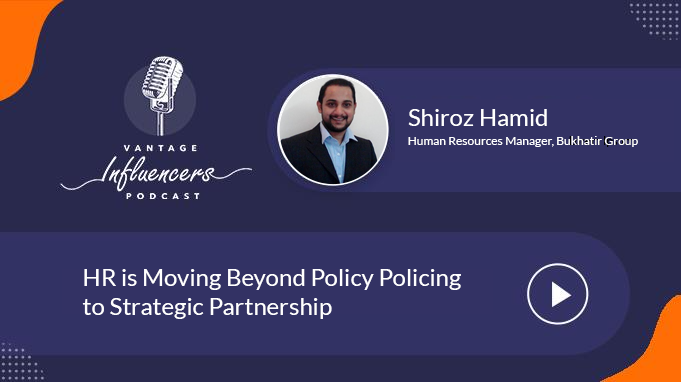
Shiroz Hamid, Human Resources Manager at Bukhatir Group
Shiroz leads people strategy across Bukhatir Group's construction, interior fit-out, and facade manufacturing businesses. His career spans more than two decades across the Middle East, Australia, and Asia, starting in HR at a Middle East construction group in 2006 and later including a stint as managing director of a state-run entity in Kerala, where he reported to a board of senior government officials and once presented to a parliamentary committee. That mix of corporate HR and public-sector governance experience shapes how he thinks about HR as a function built to handle both people and business complexity.
Connect with Shiroz on LinkedIn
Host
Sanjeevani Saikia, Vantage Influencers Podcast Host
What You Will Learn
- Why the shift from HR-as-policy-enforcer to HR-as-strategic-partner is more about mindset than circumstance
- How to tell the difference between dashboards that describe the past and data that predicts what comes next
- What it looks like to spend real time inside business operations before redesigning HR programs
- How psychological safety directly enables, or blocks, innovation and measurable business outcomes
- Why measuring HR's impact in business metrics, not HR metrics, is what earns a seat at the table
- What skills and mindsets HR professionals need to be heard at the C-suite level
Key Topics & Timestamps
| Timestamp | Topic |
|---|---|
| 01:33 | Shiroz's career path across the Middle East, Australia, and public-sector governance |
| 06:04 | Why HR's shift from policy enforcement to strategic partnership is a mindset change, not a sudden one |
| 09:11 | Walking the line between compliance, employee advocacy, and business alignment day to day |
| 12:30 | Moving HR data from descriptive dashboards to diagnostic, predictive insight |
| 15:29 | A real example of psychological safety turning directly into a product breakthrough |
| 19:26 | The skills and mindset HR needs to be heard and taken seriously at the C-suite level |
Full Transcript
Click to read the full episode transcript
Welcome to the Vantage HR Influencers Podcast. This podcast is sponsored by Vantage Circle, the simple and AI-powered rewards and recognition platform for employee engagement.
Sanjeevani Saikia: Hey everyone, welcome back to the Vantage Influencers Podcast. I'm your host, Sanjeevani Saikia, and today we are talking about something that's redefining the role of HR entirely. For years, HR has often been seen as a department that enforces policies, handles compliance, and occasionally gets blamed for saying no too often. But that perception, well, it's evolving, and so is the impact HR has on business. In today's episode, we are digging into a conversation that's long overdue: HR as a business enabler. What does it really mean to move beyond policy policing and step into a role that drives business strategy, growth, and innovation? Now, to explore this transformation, I'm joined by Shiroz Hamid, Human Resources Manager at Bukhatir Group. He brings a grounded, real-world perspective on how HR can move from the sidelines to the strategic core of an organization. So, without further ado, let's get started. Hi, Shiroz, it's a pleasure to have you on the show. Thank you so much for making the time.
Shiroz Hamid: Thank you. The pleasure is mine, too.
Sanjeevani Saikia: Before getting into the heart of the discussion, I always like to start with the person behind the perspective. You have had such an interesting career, and I think it'll really set the stage for what we are about to unpack. So, could you walk us through your career journey so far? What shaped your path and brought you to where you are today?
Shiroz Hamid: Well, I would say my career has been anything but linear, but honestly, I have enjoyed every twist and turn of the ride. It's been a kind of roller coaster, honestly. It all started back in 2003, after I completed my MBA, when I began my career in an engineering-related role. In 2006, like many, I was drawn to the Middle East, and I joined one of the construction groups there as an HR officer. Fortunately, I moved up quickly. Within a year, I was promoted to HR manager, handling two of the business units. That period was intense in terms of the market. I was navigating the global financial crisis of 2009 to 2010. It was tough, but it taught me so much about organizational resilience and the human side of navigating an economic downturn. That role really laid the groundwork for me in HR. I had the opportunity to work with some wonderful HR professionals, and I got to be part of major transformation projects, like implementing HR models, overhauling performance management systems, restructuring units, and re-engineering HR processes. I'd call it trial by fire kind of learning, but it was very good in terms of what I took away from it. After that chapter, I took a less conventional path. I stepped away and went back to university after almost a decade, and pursued a second master's degree in Australia. I took on odd jobs, including work in a kitchen, while I studied. It was good, but it expanded my worldview, both personally and professionally. I returned to the Middle East in 2013 and joined one of the biggest construction groups. I led the recruitment function again during a turbulent time. The company was dealing with government-related challenges, including a ban on the company at the time, and we had to stay solutions-focused. Then came one of the most humbling chapters of my life. I was appointed managing director of a state-run entity in Kerala. My predecessors were IAS and IPS officers, and I was reporting to a board with seasoned politicians and senior government officials, including the secretary of the department. I even had the chance to present to a parliamentary committee and a cabinet minister. That role gave me a broad view of governance, public policy, and how organizations are shaped at a macro level. After nearly two decades away, I came back to Dubai. Currently, I'm working for a well-established conglomerate, leading their construction contracting vertical. It's a business with almost 50 years of operations spanning construction, interior fit-outs, and facade manufacturing. It has been incredibly rewarding to help shape people strategy across different levels and verticals.
Sanjeevani Saikia: Wonderful, thank you so much for sharing your journey with us. I really appreciate it. With your permission, I would like to begin our conversation on today's topic. So, Shiroz, to begin with, it is fascinating how the role of HR is evolving from enforcing policies to actually shaping business direction. Now, this shift isn't happening in isolation, that's very clear. It's being driven by changing workforce expectations, the overall business environment, and this growing demand for agility and leadership. So, I would love to ask you, what do you think is really driving this shift, according to you? Why is HR suddenly being seen as a strategic partner rather than just the keeper of rules? What do you have to say about that?
Shiroz Hamid: I would say it's not a sudden change, it was always there. The only thing is HR professionals didn't fully understand their own importance within the organization. The first thing they have to do is realign their mindset. HR professionals need to see themselves not just as policy keepers, but as business enablers. Now, organizations are competing for talent. Earlier they used to compete on product or technology, but that's changed now. Organizations in this competitive age, it's the people who are defining the competitive edge. So the first thing HR professionals should do is change how they understand the business. They should start to understand the business deeply, rather than staying at a surface level. The shift starts when they understand the company's goals as deeply as any other department. Once you know what the business is trying to achieve, whether it's growth, efficiency, or innovation, HR should design processes, programs, and people strategies that support those outcomes. Now, this doesn't mean throwing compliance or employee wellbeing out the door. In fact, the real value happens when HR strikes the right balance. It's about being proactive rather than reactive, not just enforcing rules. It's about how HR can shape policies that are both compliant and people-centered, how HR can advocate for employees in a way that actually boosts engagement and, by extension, business performance. So it also means measuring your impact, not in terms of HR metrics, but in terms of how you are helping the business move forward. But for all of that to happen, the first thing HR professionals should do is spend time understanding the business and its operations. Then they can shift from being a gatekeeper to being someone who keeps the business safe and also helps it grow.
Sanjeevani Saikia: Indeed, that's true. Now, it's one thing to talk about strategic HR, but it's a whole different challenge to actually live it out day to day, like you do. Because HR still needs to ensure compliance, advocate for employees, and somehow also maintain ethical boundaries. And I guess these things don't really go away. So how do HR professionals like you walk that tightrope? How do you shift your mindset and operations to align with business goals without compromising on what makes HR, HR? What's your take on that?
Shiroz Hamid: As I said, the first thing HR professionals need to do is start speaking the business language rather than the HR language, especially when you're around business leaders. It starts with stepping out of the office and spending real time with operations. At least I would say spend one day with your business leaders, not just sitting with them, but trying to understand their challenges. You need to understand how the business is actually making money, not just reviewing the numbers, but watching the workflow, the people, and understanding the pressure points your business leaders face. Then you have to ask yourself, how, as an HR professional, can you help the team grow revenue or manage necessary costs? Once you understand that, it becomes much easier to shape your HR programs. Just don't keep pushing the same old policy that was created back when the company first opened its doors. Business changes, so should HR. Now, this doesn't mean throwing compliance out the window. In fact, the real value happens, as I said earlier, when HR strikes the right balance between compliance and creativity. You have to be proactive, not just reactive. Don't just impose rules, think about how to build policies that protect the company and support the people. How can we advocate for employees in a way that improves engagement and performance? It's about moving from gatekeeper to the person who really protects the business but also helps grow the people. That might mean rethinking how performance is managed, how to streamline HR processes, or coaching managers to lead with more empathy. And most importantly, start measuring success not just in HR metrics, that's the most important part. You have to measure your success in business impact. The numbers leaders really want to see are business numbers, not HR metrics. How much closer are you bringing the company to those business numbers? That's where HR can be considered a real strategic function.
Sanjeevani Saikia: You've just mentioned start measuring success not through HR metrics but business metrics. I think that's going to be a great takeaway from this response of yours, so I definitely agree with it. Now, shifting gears a bit, let's talk about something that's becoming more central to how HR delivers value, and that's data and analytics. We've seen how metrics can shape conversations and how they help HR align more closely with business goals. Now, from your perspective, how can HR teams leverage data not just to address issues when they come up, but to spot patterns, anticipate needs, and proactively shape outcomes that really move the business forward? What do you have to say about that?
Shiroz Hamid: There's a common misconception among people about HR dashboards. Don't get me wrong, dashboards are a powerful way to visualize a huge amount of data and communicate trends to business leaders. But here's the thing, they only show you what happened. That data won't show you why it happened, what's likely to happen next, or what actions you should take. In today's world of uncertainty, you may not be able to predict the future with complete accuracy, but if you dig into a problem to understand the root cause, HR can reduce the level of uncertainty. It can help leaders make more informed decisions. So I would describe dashboards as falling into different categories, one is descriptive, one is diagnostic, and one is predictive. The descriptive part might show attrition, but it's the diagnostic layer that tells you whether it's due to burnout, poor leadership, unclear role expectations, or misaligned expectations. That's where data becomes truly strategic, when it's used not just to spot issues, but to understand why they're happening. The data you're using shouldn't just be something you discuss at the end of a reporting period, it should be a continuous process. That's the point where HR has to act as a consultant. HR needs to shift from reporting symptoms to diagnosing the underlying system. That means going beyond surface-level metrics and looking at how performance variables connect, from workload and engagement to leadership style and team dynamics. So the goal is to move from reactive firefighting to proactive problem solving. When we use data to uncover connections, challenge assumptions, and guide decisions, HR becomes a true business partner, not just a function that shows business leaders a dashboard at the end of a reporting cycle.
Sanjeevani Saikia: You know, when it comes to impact, I think real stories speak louder than any theory. You don't often hear about HR playing a central role in things like expansion strategy or innovation, but I'm quite sure stories like these exist, even if they don't get the spotlight very often. So Shiroz, do you have an example where HR's strategic input directly shaped a big business outcome? Something like entering a new market or transforming how a product or service was delivered? Do you have any such story to share with our listeners?
Shiroz Hamid: Not so much as an HR professional, I can give you a better example from my time as a managing director. As managing director, one of the first initiatives I implemented was a suggestion box. It was simple, but it was very powerful, a way for employees to directly share their ideas for product improvements. The board decided to move forward with a product improvement initiative based on that. But we didn't stop there. We empowered our technical team with a dedicated project for product development, along with the freedom to experiment, and most importantly, the freedom to try and fail without fear. Mistakes happened, but they weren't penalized, they were treated as part of the innovation journey, as long as they stayed within agreed boundaries and budget. This created a psychologically safe space for creativity. As a result, we successfully developed the best metallic-colored balloons in India, a significant breakthrough for our market segment. That experience reaffirmed to me that HR's real role, whether through policy, culture, or leadership support, is to create an environment where people can contribute meaningfully, learn, and push boundaries. When employees feel safe to innovate, business results follow. If you're creating an environment where employees can't bring their true selves, there won't be any real innovation. If your employees are constantly worried about job security, or if, as an HR professional, you're creating an environment driven by fear rather than trust, you're shutting down psychological safety, and in the end, most people won't speak up. They won't challenge the status quo, even when it's necessary. If there's no psychological safety, innovation and growth require trust. When people feel safe, they're more likely to take on better ways of working and drive real change in their workplace.
Sanjeevani Saikia: Thank you so much for sharing this with us, really appreciate it. And one thing I would like to add, as a matter of fact, I often notice that HR typically has just two or three agenda points in core meetings. But interestingly, when we move to the action stage, almost every agenda item, whether related to operations, finance, strategy, or growth, inevitably requires HR's involvement.
Shiroz Hamid: Yes, that's the truth. HR is not just a support function, it's a central driver of decisions and outcomes. If you ask any HR professional, they may not even be invited to attend a board meeting. But after the meeting, most of those agenda items, their action points, will be directed to HR, whether directly or indirectly.
Sanjeevani Saikia: I think you've highlighted, again, a very crucial point. In most decision-making areas, HR's involvement is there, and it's very impactful in so many ways, so I truly agree with that. So let's zoom out for a second, we've talked about the why and the how, but now let's talk about the who, because showing up as a strategic partner isn't just about having the right tools, I believe. It's about how HR professionals carry themselves in those high-stakes conversations. So if someone in HR is thinking, okay, I'm ready to step into that bigger role, what do they actually need to double down on? Whether it's communication, business acumen, or just plain confidence, according to you, Shiroz, what skills and mindsets are non-negotiable if they really want to be seen and heard at the C-suite level?
Shiroz Hamid: First and foremost, I would say speak the language of business, not just HR. For example, as an HR recruitment partner, I used to describe myself as solving a business problem by bringing the right people in at the right time. So that's about recruitment, but not just recruitment as a function, you need to understand how it contributes to the business. Your leaders don't really want to hear about HR theories, they need to understand how your HR initiatives and ideas can impact revenue, productivity, cost, and risk. So the first thing you should do, especially during meetings, is simplify your concepts. Use simple language, speak in business language, tie it to the business case. And another thing most leaders appreciate is flexibility, being flexible enough to support operational realities. The real shift happens when HR stops walking into meetings with only an HR agenda and instead joins the conversation with business solutions that happen to be powered by people. I've noticed recently that many HR professionals have started taking finance classes to better understand the numbers, and that's a great step. But the point is, it's important not to get lost in the finance lens alone. As HR professionals, your superpower is connecting the dots between the numbers and the people behind them. It's not just about knowing the figures, it's about asking why these numbers look the way they do, what can be expected next, and what's driving these trends from a people perspective. That's where HR brings unique value, by translating numbers into human insight that supports smarter business decisions.
Sanjeevani Saikia: So you've just mentioned, speak the language of business, not just HR, and I think you've also highlighted that HR professionals must have the numbers right, that you have to focus on the numbers and speak the way a business person would speak. I think that's going to be a great takeaway for me as well as our listeners.
FAQ
Why does Shiroz say HR's shift toward strategy isn't a recent development?
Because in his view, the capability has always existed within HR. What changed is that HR professionals only recently started seeing themselves as business enablers instead of policy enforcers, and started speaking the language of the business rather than HR jargon.
What's the problem with relying only on HR dashboards?
Dashboards are good at showing what has already happened, but they rarely explain why it happened or what to do about it. Shiroz argues HR needs to move from descriptive reporting toward diagnostic and predictive analysis to become genuinely strategic.
How does psychological safety connect to business innovation, according to Shiroz?
He shares an example of giving a technical team the freedom to experiment and fail without fear, which led directly to a product breakthrough. His conclusion is that when employees feel safe to speak up and take risks, innovation and business results follow.
What should HR measure to prove its strategic value?
Business outcomes such as revenue, efficiency, and cost, not HR-specific metrics. Shiroz argues that leadership cares about business numbers, and HR earns credibility by showing how its work moves those numbers.
Related Reading
Also listen on