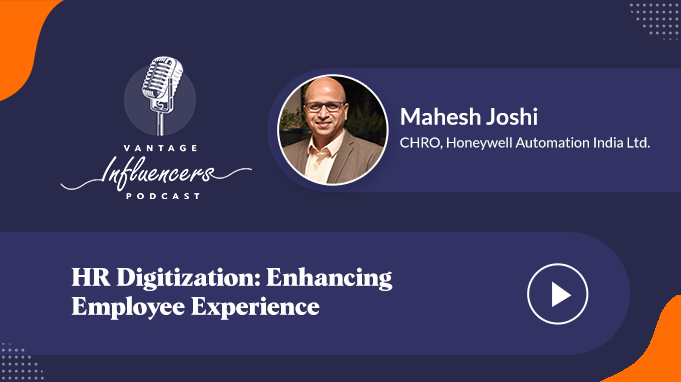
HR Digitization: Enhancing Employee Experience
Episode Overview
Mahesh Joshi has spent close to 25 years across healthcare, manufacturing, and technology, including a decade at Honeywell, where he now leads HR as CHRO of Honeywell Automation India Ltd. In this conversation, he traces HR's digitization journey from paper punch cards to face recognition, and lays out why most digitization efforts stall: organizations chase buzzwords instead of identifying what they actually need.
Mahesh's core argument is that digitization isn't a destination, it's "a journey without a fixed destination," and the difference between success and failure comes down to four recurring obstacles: fear of change, low technology adaptability, organizational maturity, and the endless demand for customization. His answer to all four is the same three words, repeated for emphasis: "involve, involve, and involve" — bringing employees and employee resource groups into the process before implementation, not after.
Episode Highlights
- Technology adoption is accelerating fast: telephones and televisions took two to three decades to reach mass acceptance, social media took two to three years, and ChatGPT hit one million users in five days versus four years for Netflix.
- The four recurring barriers to HR digitization are fear of change, low technology adaptability, organizational maturity, and the demand for heavy customization of standard platforms.
- Honeywell's compensation tool surfaces comparator baskets, internal parity, and payout history the moment a manager decides on a raise, and requires justification if the manager deviates from its recommendation.
- Honeywell's internal chatbot, "Red," handles compensation queries and approvals in a secured system, while predictive analytics, in use for roughly seven years, now recommends who should receive a retention bonus before attrition risk becomes visible.
- The average HR-to-employee ratio has grown from roughly 150–200 in the past to as high as 1,000–1,500 today, pushing HR's focus from data collection toward business acumen and culture-setting.
- Data privacy should be treated as an organizational culture, not a compliance checkbox, especially with India's new Digital Personal Data Protection (DPDP) Act reshaping vendor accountability.
About the Guest
Mahesh Joshi — CHRO, Honeywell Automation India Ltd.
Mahesh Joshi is a seasoned HR professional with extensive experience managing HR and Compensation & Benefits (C&B) functions, including compensation benchmarking, pay-for-performance incentive schemes, organization design, and job mapping. He has also strategized health and wellness and benefits programs, conducted payroll and compliance audits, managed expat compensation, and administered Employee Stock Ownership Plans (ESOP) and Restricted Stock Units (RSU).
Connect with Mahesh on LinkedIn
Host
Sanjeevani Saikia — Vantage Influencers Podcast Host
What You Will Learn
- Why HR digitization is a journey without a fixed destination, and why chasing buzzwords instead of identifying actual needs causes most implementations to fail
- The four most common barriers organizations face when digitizing HR: fear of change, technology adaptability, organizational maturity, and customization demands
- Why involving employees and employee resource groups before implementation, not after, is the single biggest lever for adoption
- Real examples of HR digitization in action: performance and compensation tools, an internal HR chatbot, and predictive analytics for retention
- How the average HR-to-employee ratio has grown from roughly 150–200 to as high as 1,000–1,500, and what that means for the modern HR professional's role
- Why data privacy should be treated as an organizational culture, not a compliance afterthought, especially as regulation like India's DPDP Act takes effect
- The risks of relying on AI-generated job descriptions and resumes, and why organizations need an explicit policy for evaluating them
Key Topics & Timestamps
| Timestamp | Topic |
|---|---|
| 01:14 | Mahesh's professional journey so far |
| 02:54 | Challenges in the transition to HR digitization |
| 14:57 | Enhancing employee experience with HR digitization |
| 21:28 | Examples of successful HR digitization implementations at Honeywell |
| 27:52 | How technology is reshaping the role of HR professionals |
| 37:53 | Ensuring privacy and data security in HR digitization |
| 45:19 | Emerging trends in HR digitization |
| 49:32 | End note |
Full Transcript
Click to read the full episode transcript
Sanjeevani Saikia: Hello everyone, welcome to another episode of the Vantage Influencers Podcast. I'm your host Sanjeevani Saikia, and today I invite you to join an insightful conversation on the topic, HR Digitization: Enhancing Employee Experience, with Mahesh Joshi, CHRO of Honeywell Automation India Limited.
Digital transformation of HR is revolutionizing the employee experience, making processes more efficient and engaging. HR digitization goes beyond automating routine tasks. It's about leveraging technology to create a seamless and enriched workplace environment. From AI-driven recruitment to onboarding and continuous feedback systems, these advancements are redefining how organizations interact with their employees. So to understand this topic in depth, let's begin the conversation.
Hi Mahesh, thank you so much for joining today's conversation. Before we get into today's topic, could you tell us a bit about your professional journey so far? We'd love to hear that.
Mahesh Joshi: First of all, Sanjeevani, thank you very much for having me, and very good morning to you. So currently I'm working with Honeywell Automation India Limited. I'm part of the Honeywell Group for the last 10 years. In my total career of about 25 years, I've worked across various different industries, starting from healthcare — I worked with Abbott Laboratories for around nine years. After that, I moved into the manufacturing space, an automobile company that's again a US multinational, for about three and a half to four years, and then subsequently I joined Honeywell. So for most of the last 24 years I've been with US multinationals, and I feel very blessed with the diversity of experience that I've had.
Sanjeevani Saikia: Wonderful, thank you so much for sharing your journey with us. So with your permission, I'd like to begin today's conversation on the topic. As organizations transition from traditional HR practices to digital solutions, they often encounter a multitude of challenges — ranging from resistance to change among employees to the complexity of integrating new technologies into existing systems seamlessly. I believe addressing these hurdles effectively is crucial for a smooth transition. So I'd like to know from you, what are the key challenges organizations face when transitioning from traditional HR practices to digital solutions, and how can these challenges be effectively addressed?
Mahesh Joshi: I think you've touched upon a very interesting topic. Let me step back and help you and the listeners understand why the digital journey is important. There are two things I'd really want to talk about. One, if you see the journey of digitization — old innovations like the telephone, radio, television, computers, electricity — took two, three decades to get acclimatized, for people to accept. If you subsequently look at social media trends, Facebook, Netflix, and other platforms, those were adopted in two, two and a half, three years. So the speed is lightning fast. Where we used to take four decades to accept a new technology, that dropped to two and a half years for social media.
I was reading an article a few years back on when ChatGPT was introduced — it touched one million users in five days. That's amazing, and Netflix took four years to get there. So just imagine, today we're talking about ChatGPT, then AI/ML in HR — we're at the last stage of a technology transformation where adoption is very, very fast.
But with that, I always see this as a journey — and on a lighter note, a journey without a fixed destination. Your destination keeps changing, and as an organization you really need to know where to stop. Because the biggest problem today is that organizations just go with the buzzwords. Everywhere, everyone is talking about digitization, tech HR, and evaluating HR and human capital management systems — the ones that come with every module, where you take the licenses and start implementing, and most of the time it's a failure. Why is it a failure? Because you don't really understand whether it's your actual requirement. It's like buying something because everyone else is buying it, and then post-purchase dissonance sets in once you start using it and realize it doesn't work the way you expected.
Once you identify the journey — okay, this is what I need — the biggest problem I see is change management. Why? Because in HR, we've gone through so many transformations already. Is this new for us? No — we went from personnel department to HR, to HR business partnership, to HR strategic business partner, to talking about a seat in the boardroom. These are all transitions we've seen — technological, people, and cultural transitions. And this is one more transition we need to deal with.
So ideally, the most important thing is fear of change. Today, most people think they'll lose their job or lose their importance. But I'd always say technology will take your job only if you don't evolve. If I keep doing the same repetitive work again and again and get comfortable, nothing new, I'll get replaced by technology — because technology can't think by itself. I know AI/ML has that ability eventually, but it needs a lot of data behind it. That's why repetitive jobs can be automated or technology-enabled, not innovative jobs.
Second is adoption of technology. Tell me one thing — if you have an iPhone, it has thousands of features, but we barely know a handful of them. That means our savviness with technology is itself a big challenge. We use an iPhone because everyone else is using it, it looks good, the speed is good, the security is good — those are the very basic reasons we start using it. But if you really want to succeed, you need the right adaptability, and only then can managers, senior leaders, and HR get the optimized benefit of the system.
Third is organizational maturity. Sometimes you're an industrial automation company that has worked a certain way, and you need transition time for people to adopt new things. But generally what we do is involve people only after implementation has already happened, so they never get the time to acclimatize and adopt the new technology.
And last but not least, which I've seen take the most time in my career, is customization. Every organization has a lot of requests for customization — they need tools in a very specific format, whereas providers like Workday or Oracle come with a standard suite that has to be customized. So on four major parameters I see: one, fear of change; two, adaptability and knowledge of how to use it; three, organizational maturity; and four, customization. These are the four very common problems every organization goes through. You may have unique challenges too — sometimes you need to discard the technology completely and re-work the data — but these four are what I majorly see in a digitization journey.
I don't want to stop only at the problems, though. How do we solve it? I see three magical words here, being very honest: involve, involve, and involve. The biggest problem today is that if I'm putting a HR digital technology piece into my system, I'll make sure there are four or five people from HR, and maybe a couple from operations, who come together and work on the entire journey — collating data, working with new partners, and so on. But the problem is we never think about the actual users, the extended team who will also be impacted. You need to create a process or platform early where everybody gets involved at the right stage and gives their input right at the beginning.
What that creates is a collaborative and cohesive environment for technology to get infused into the system, so everybody is able to use it effectively. And if I'm convinced myself, it becomes very easy for me to talk to my HR colleague and convince them in the same language, and then we speak together. The same can be done through your service teams, and through employee resource groups. I was actually talking to an HR colleague from a different company a few days back, and I learned something very interesting — they had involved all their employee resource groups while implementing their digital platform. The employee resource group, in their meetings and communication, started educating a lot of people, which surfaced a lot of the actual problems. That's what brings good suggestions, good partnership, and good adaptation.
Employee resource groups historically came about for fostering diversity — you've seen organizations implement diversity groups, then multi-lingual and multi-state groups, because a lot of companies have a challenge where they're based in one location and prefer hiring from that one location, which isn't very welcomed by the rest. Then LGBTQ groups, which are very common. And now what's coming up is generational, gender-based groups — baby boomers, millennials, Gen Z — because their expectations and thoughts are different. If you involve these groups that already exist within your organization, they do two things for you: one, they bring a diverse perspective, both on the job and from a mindset perspective; and two, they have their own networks — on Yammer, Teams, Facebook, Instagram — reach that you don't have, which helps extend your implementation to a wider group and makes it easier.
Sanjeevani Saikia: Now I'd like to understand the role of HR digitization in enhancing employee engagement. In what ways can HR digitization enhance employee experience and engagement within an organization? By leveraging digital platforms, HR departments can offer personalized experiences and streamline communication channels — I think exploring the ways HR digitization can transform employee experience is essential. What would you like to say about this?
Mahesh Joshi: I wouldn't put too much emphasis on "personal" experience, Sanjeevani, because if you go to any technology platform implemented by an organization, it's common for everyone — there's nothing as personalized as, say, Instagram or Facebook, where you have your own unique groups and friends. I'd want to put it a little differently.
Let me help you understand with an analogy first. If you remember, in the past when we didn't have much technology, one common challenge — and I'm not that old, but I have seen this — was that field staff or operators remote from the location would feel that all the activities only happen at the head office level; they didn't see the advantage. So the first basic advantage I see technology bringing to people is wider reach — a common platform to reach for everything, be it hiring, firing, performance, compensation, R&R, or health initiatives — everything is common across the board. That brings a sense of equalness to the organization.
Second, take point collection and point redemption for R&R — a lot of people collect points for good work or performance. Previously, once collected, it would be very difficult to redeem. Now with this kind of technology, a lot of platforms can integrate with each other and your span of technology becomes much wider. For example, I was talking to a couple of people at a conference whose HCM gives them the option that if you get an award today, instead of taking a photo and posting it on LinkedIn yourself, the HCM has a direct link to LinkedIn or Instagram. That's a seamless transition between multiple technologies, and it creates more engaged people because that's what they want.
Everyone is also looking for a one-stop shop. A lot of new HCMs and technologies are on WhatsApp now — you can apply for leave, do everything online through WhatsApp without even going into the HCM system. So the experience of employees, because of this digitization, has multiplied — being very honest. The only place I see a challenge, which we'll cover in the subsequent discussion, is data privacy.
Coming back to productivity — when you don't waste time on ten clicks or searching through ten windows, you automatically save time, and that adds to your productivity, whether personal or official; that's an individual's choice. If I want to use that saved time for exercising, accumulating 45 minutes at the end of the day, or doing something of interest like a bubble assignment, that's a choice enabled by the system. I've also seen a very interesting thing — some platforms now ask you, on your first login of the day, to click a smiley for how you feel — good, bad, or in between. That technology is also capturing the sentiment of the organization every day, which is dynamic and interesting, because a good day-sentiment usually correlates with good productivity.
So ideally, these things work in a few ways: one, simplification of the process; second, simplification gives satisfaction and a good experience to employees; and third, it also helps individual and organizational efficiency. I never see employee experience, satisfaction, or engagement as one-dimensional — it has to be multi-fold, and that's how I see this particular topic.
Sanjeevani Saikia: Interesting. Now shifting gears, Mahesh, could you share examples of successful implementation of HR digitization in companies, highlighting the tangible benefits they've experienced in terms of efficiency, cost savings, and employee satisfaction? I believe examples are a brilliant way to understand the subject matter in depth. What would you like to say?
Mahesh Joshi: I'd refrain from naming other companies, Sanjeevani, but since I work at Honeywell I can take the liberty of sharing what good things we're doing. When I started my journey, it was all Excel-based — actually, there was even a time when punch cards were used. I'm not that old, but I've seen that system in use, and today we've reached face recognition, in the very same company where I used to punch a card. Just imagine that journey.
Coming back to Honeywell — we proudly say we're a technology company, and that shouldn't be new for us; it's a routine way of life at Honeywell. This is my 10th year at the company, and looking back, we've improved a lot. It's common to say hiring-to-firing is all digitized — you'll get that with any HCM. But how all the peripheral activities link into the overall scheme of things is defined by the actual success of implementation.
For example, we use a very good performance development tool. We never had one common HCM in the past — we're actually in the process of creating a new HCM platform now — but even without that, our tools were talking to each other seamlessly. We have a performance development tool, and a compensation tool that has been the talk of the town since 2016 to 2018–2019, and even today, because of how uniquely it's placed. The amount of information it gives a manager at the time of deciding compensation for a person is a big success — for example, if you're giving me an increase in the annual cycle, at that point you'll see the comparator basket, internal parity, my history, my bonus payout history, and what recommendation the tool gives you. If you deviate from the recommendation, you have to justify it. It's like you just think it, and it's already implemented. That's a very effective implementation, and it doesn't happen in one day — it generally takes a couple of cycles to understand and mitigate the risk, understand the process problems, and then solve them over time.
We also have a very good tool called HR Direct — every employee who logs in gets something like a one-stop shop, like a supermarket, where whatever you want is available in one login. I also want to highlight two more things that may not be everywhere. We've introduced a chatbot called "Red." Red isn't limited to one function — if it's global compensation cycle time, it's used for that; if it's performance development time, it's used for that; if there are reminders, it handles those; if there are approvals pending in my queue, it's used for that; if I need to apply for an asset, I can do it from there. Why I'm highlighting this — WhatsApp or any Excel-based platform will have a lot of data-leakage or hacking challenges, but this is an internal bot integrated into the company system, giving us a lot of effectiveness in terms of safety, security, and a good experience.
The third and last thing I'd highlight is predictive analytics — something we're very good at, Sanjeevani. We've done this across HR, be it attrition, longer-term retention, increments, or retention bonuses — the tool actually tells us who to give a retention bonus to, as a recommendation, based on all the data analytics done in the backend. Predictive analytics is something we started around six or seven years back, and we're now excelling at it, and even extending it into our business interactions. These are good examples of implementation — not just at Honeywell; every organization will have similar examples, and those need to be amplified and highlighted.
Sanjeevani Saikia: Thanks again for explaining and introducing us to the "Red" system — really interesting to learn about, and thank you for the other pointers as well. I strongly believe technologies are poised to reshape traditional HR functions, requiring professionals to adapt and acquire new skills to remain relevant in the digital age. It'll be interesting to know how you view these technologies reshaping the role of the HR professional in the future, and according to you, what skills will become increasingly important in this evolving landscape?
Mahesh Joshi: I agree the role of HR will change over time. What I used to do in the past and what I do today is very different. For example, to take any decision, small or big, I used to spend time on three things: collecting the data — where there are naturally a lot of errors because there's no single source of truth — correcting the data after collection, and then analysis, and then the decision. If I wanted to present attrition data two decades back, it would take two to three days. Today, my tools give me a full presentation ready — I just need to go and talk. In 15 minutes I can log into my HCM tool, which talks to all our other tools, and it gives me the data.
What that entails for me is a lot of free time because of this technological enhancement — time I can use productively. That's why the average HR-to-employee span in the past was around 150 to 200 in general scenarios, which has now risen to as high as 1,000 to 1,500 — in technology companies, even up to 1,000 to 1,200 people supported by one HR person. What that changes for a person is that my major responsibility is now to make sure I'm putting in place the right organizational culture. Now, some people will say culture is HR's job — I'd say HR is an enabler, and we need to enable business leadership to build the right culture. Because when digitization happens, people can work from anywhere, there's flexibility, freedom of speech — you have people, even celebrities, using the power of speech however they want, but you can't allow that to happen unchecked in organizations. That means you need the right culture and maturity in place. So my first point is setting up the culture — policies should be in line with the digital changes we're making, and whatever employees use should operate within a framework, not free-flowing.
Second, the time that's freed up — you need to know how your business earns its dollar, the dollar value proposition, because only then can you add value by using that data effectively to give the right solutions to the business. Leaders, CHROs, HR directors — they need to know their job isn't only HR, it's also running the business; I'm a "business HR." So business acumen becomes paramount, now and in the future. The time you save on administrative work needs to be invested in business acumen and in making the entire organization digitally savvy — that's also HR's job. On a lighter note, the best content gets the best attention nowadays, so if you want to set up a culture and connect with people, you also need communication and content-creation skills to reach the maximum number of people and get the right attention.
Making the entire organization digitally savvy is very important — otherwise, leaders with 15, 17, 20 years of experience, whose technology exposure is from the past, are still operating with an unconscious mindset that hasn't caught up, even as they're asked to lead the organization with new technology. That's also HR's role — ensuring the organization has the right innovation lines and digital savviness. And I'm sure you've heard of the "metaverse" — a digital world where you could create a digital version of yourself and live a parallel life. There was a very interesting case registered in the UK involving a woman "raped" in the digital world. Just imagine — even if your organization is top-notch digitally, you still have to follow the law of the land, and the law of the land follows physical regulation. Does that fall under existing law or not? We don't fully know yet. As HR, we need to economize ourselves to this changing environment, and people need to know this isn't just you and me — it's a much larger team, and this is a job for HR: managing maturity in that digital space, workplace respect, managing behavior.
Another thing is data privacy — the Digital Personal Data Protection (DPDP) Act, recently regulated in our parliament, is something we need to really think through and implement. And last but most important is coaching and counseling — everyone has a different way of using technology, different understanding, different maturity levels, and you need to coach them to understand each other, their responsibilities, and their accountability.
As for individual skills — data analytics is the one you'll hear about constantly. In the past, you created the data yourself, so you inherently knew its integrity. Now the data is available to you, and you need to read it, get analytics out of it, correlate it to the business, and represent your business case — that's something every HR partner needs to learn now. You'll also hear about regulatory skills and coaching skills being important. That's how I see the HR landscape, and HR competency, changing.
Sanjeevani Saikia: You've already mentioned data privacy, and you've directed the conversation to another crucial factor — when companies move to digital HR platforms, keeping employee data private and secure is a big deal. We're talking about sensitive things like salaries and personal information. So how do we actually keep this data safe while still leveraging the benefits of digital HR platforms?
Mahesh Joshi: This is the most neglected question, I'd say, and in my view, the most important but most neglected. I represented a group a few days back and started with this exact point, because data privacy regulation is very different across each continent — not even just countries. The US is very different from India; Asia Pacific is very different, and even within Asia Pacific, China has a very different regulation compared to other Asian countries and India. Europe, more or less, has a standard approach, except for a few high-growth countries.
First, you need to understand what maturity level of data privacy you're currently at. I've seen companies where an entire payroll file — salary, bank account numbers, date of joining, name, gender — everything is in one file that gets circulated across departments: payroll sends it to finance for payment, finance sends it to the general ledger, and it comes back to HR for validation. That's a very open culture, and honestly, not a good one. That's why data privacy first has to be a culture — part of your integrity and compliance framework. Second is understanding the maturity level of your organization and acting accordingly; you can't change that overnight. Third, implementation of the DPDP Act will change a lot of things — the accountability of organizations along with their vendors becomes multi-fold. If I'm entering into a contract with a vendor and they mishandle my data, that's also a problem for Honeywell as a principle. So strong non-disclosure agreements, and dealing only with vendors who have the ability to protect data, become important.
Even today, people apply for loans or licenses, and an agent asks for an Aadhaar card and PAN card over WhatsApp, and people just send it — not realizing the repercussions. All of us, including me and you, aren't that well-cultured yet in protecting our own data. If you don't do it for yourself, how do you do it for others? That's the cultural shift needed if we want more digitized platforms. That's why, going back to individual HR partners, the change they need to bring to the table is creating that culture of how to operate within the digital environment — that ties into my earlier point about bringing the right organizational culture.
Sanjeevani Saikia: At what stage do you think India currently is in terms of data privacy? Do you think India is really getting good at it at this point in time?
Mahesh Joshi: Being very open with you, India is a technology hub. If you look at our internet usage and technology usage, we're extremely good, and our adaptability is very good. I personally feel we're very good at understanding technology — that's why GCCs are here, technology and software bases are here, we have captive and non-captive centers here. It's been an interesting journey over the last 15 years, I'd say, since IRDA and the insurance market opened up around 2008–2010, and technology subsequently came in.
We definitely have a lot of potential when it comes to AI/ML, which will bring a revolution in HR processes and automate a lot of tasks. But it'll also pose challenges, because our overall population isn't very quick to handle this kind of change management. I'm very bullish on the technology itself, but cautious about implementation — how we handle it — because if two or three major companies have a well-publicized failure from mishandling technology, we could go five, ten, fifteen years behind almost immediately. That's my concern.
In the future, you'll see big companies automating their hiring even further — using AI as digital chatbots for interviews, making offers automatically based on external and internal parity, without a compensation person even reviewing the offer. I attended a seminar recently that used real-based learning — two employees interested in acting came together to create a "reel" for the company. It's very common now — we all scroll Instagram and Facebook Reels and can't stop; you tell yourself five minutes and it becomes 45 or 50 minutes. If organizations create content that effectively, imagine your people hooked to what you're putting out — in L&D, public speaking, whatever your focus is. These are the kinds of new ideas you'll see coming up in the future.
Sanjeevani Saikia: Mahesh, we're arriving at the end of today's episode, and before we wrap up, let's take a moment to look ahead — the future of HR digitization is marked by several emerging trends. How will these emerging trends shape the future of HR, and what should organizations be doing now to stay ahead of the curve in this rapidly evolving digital landscape?
Mahesh Joshi: We've discussed a lot about how trends will come up in the future — I'd really want to talk about what organizations should do, and what cautious points they need to keep in mind. First, as I said at the start, don't run behind buzzwords — identify your need. If you don't understand your need, where to stop, what to spend, and your capacity and capability, you'll be stuck in a loop you can't get out of. This is a journey without a fixed destination, so as a person or a company, you need to know where you want to reach and stop, even as new vehicles, trains, buses, and trucks keep coming and going.
Second, people are fascinated by ChatGPT right now. I was listening to a thought leader in HR who shared a great point — he asked someone to create a job description, and they quickly used ChatGPT to generate it. But we wanted a job description for the future — and ChatGPT scans whatever cloud data is globally available, picks up keywords, and shows you the best possible scenario based on the past. That's already happened, and it's on the cloud. If you want to hire for the future, is that being addressed? Everything you create on ChatGPT may be a good reference point, but it may not be the finished product — because when you're driving a car, you can't drive by only looking in the rearview mirror. You can learn 10–15% from the past, but your driving needs to come from the front windscreen. We need to know how much reliance to place on this technology versus how much human intervention is required. And as I said, keep evolving — that's what keeps you relevant; if you're not relevant, the system will automatically make you irrelevant.
One more thing before we wrap up — suppose you're taking interviews and someone sends you a CV created on ChatGPT. If I ask ChatGPT to write a CV for an HR partner, it'll give me everything an HR partner is supposed to do — but did the candidate actually do all of that? Am I interviewing a chatbot, or am I interviewing the actual person? Sometimes resumes get inflated, and it becomes very difficult to verify. As a technology-forward organization, we should have a policy and process around handling such scenarios.
Sanjeevani Saikia: You've highlighted crucial points — an incredible response, I must say. So we've reached the end of today's podcast. Do you have any message for our listeners? Our audience would be delighted to hear it, and they might want to stay in touch — how can they reach out to you?
Mahesh Joshi: I'm basically reachable on LinkedIn — you can search Mahesh Joshi and Honeywell, and you'll see I'm currently leading Honeywell Automation India Limited as CHRO. If you'd like to send me anything personal, you can reach me by email as well.
From a messaging standpoint — a lot of new MBA students are entering HR, and I'd say a couple of things. First, don't fix in your mind that you only want to do one job, like HR business partner — take a full, holistic, 360-degree view of HR and be willing to do multiple roles, even in uncomfortable situations. You learn the most with a difficult boss, difficult peers, and difficult situations or jobs — otherwise, if everything is smooth sailing, you won't grow. Get into those situations, expose yourself, and you'll be better prepared for challenges that aren't anticipated, and you'll succeed as a professional. Best of luck to everyone. And Sanjeevani, before we end, I really want to thank you — you're awesome with your questions and how you conducted this podcast. We didn't even practice beforehand; this was the first time we spoke, at the podcast appointment itself, and it was so smooth. I really acknowledge the practice behind that.
Sanjeevani Saikia: Thank you so much, Mahesh, it was incredible to have you on our episode today. Really, thanks a lot.
Mahesh Joshi: It was a pleasure.
Thanks for listening to the Vantage Influencers Podcast. Please subscribe to the Vantage Influencers Podcast on Apple Podcasts, Spotify, and our YouTube channel for new episodes.
FAQ
What is HR digitization?
HR digitization is the use of technology to transform HR processes, from hiring and onboarding to performance management and compensation, into faster, more connected, and more employee-friendly systems. Mahesh Joshi describes it as going beyond automating routine tasks to creating a seamless, enriched workplace environment.
What are the biggest challenges in HR digitization?
Mahesh Joshi identifies four recurring barriers: fear of change among employees, low adaptability to new technology, organizational maturity (bringing employees in only after implementation instead of before), and the demand for heavy customization of standard HR platforms.
How can organizations overcome resistance to HR digitization?
Mahesh Joshi's approach centers on three words: involve, involve, and involve. That means bringing employees, extended teams, and employee resource groups into the process at an early stage, rather than only informing them after a system has already been implemented.
How is data privacy handled in HR digitization?
Mahesh Joshi argues data privacy needs to be treated as an organizational culture, not just a compliance checkbox, especially with regulations like India's Digital Personal Data Protection (DPDP) Act reshaping accountability for organizations and their vendors.
Related Reading
Also listen on