HR with Heart: Putting Emotions and Experiences First
Episode Overview
Anastasiia opens by pushing back on a familiar HR complaint: too many processes, too little humanity. She traces this rigidity to a defensive instinct that swept through the profession. Wanting to be taken as seriously as finance or accounting, HR built checklists, workflows, and rulebooks, and along the way it forgot that people are feeling beings first. Suppressing emotions at work does not make them disappear, she argues. It only delays them until a small trigger sets off a disproportionate reaction. Her alternative is to design processes around the emotions an organization wants people to feel at each stage, whether that is a sense of belonging during onboarding or a sense of mastery during performance reviews, and only then build the steps that support that feeling.
The conversation moves into what this looks like in practice. Anastasiia explains why she insists on non-anonymous feedback wherever she works: it forces people to own their words, express them constructively, and stay accountable to the person receiving them, instead of using anonymity as an outlet for unfiltered venting. She also warns HR professionals against becoming an emotional "rescuer," stepping in to resolve every conflict a colleague brings them. That instinct, however well-intentioned, denies people the chance to build their own capacity to handle friction. She closes with a reminder that employees carry emotions shaped by forces well outside the office, from economic uncertainty to world events, and that leaders who model appropriate vulnerability help normalize a healthier relationship with feelings at work.
Episode Highlights
- HR became overly process-focused because the profession wanted to be seen as "serious" as finance, and forgot to ask why each process exists in the first place.
- Suppressing emotions at work does not eliminate them. It builds pressure that eventually surfaces as an outsized reaction to a minor trigger.
- Good HR design starts with the emotion you want people to feel at each career stage, then builds the process around it rather than the other way around.
- Non-anonymous feedback keeps people accountable to what they say and creates room for real follow-up conversations, unlike anonymous, emotionally-dumped feedback.
- HR professionals should resist becoming an emotional "rescuer" for every employee conflict, since resolving problems for people prevents them from building their own coping skills.
- Emotions employees bring to work often originate outside it, and leaders who show appropriate vulnerability help normalize healthier emotional expression across a team.
About the Guest
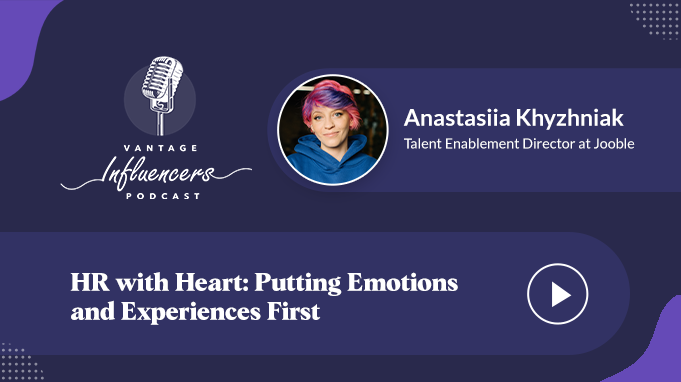
Anastasiia Khyzhniak, Talent Enablement Director, Jooble
Anastasiia is an HR professional with a background spanning recruitment, coaching, HR process design, and organizational strategy across international, tech-focused companies. She believes work should be enjoyable and that people are motivated to grow, create value, and contribute to their organization's goals. Her focus sits at the intersection of process design, individual support, and business strategy, and she stays engaged with emerging ideas across HR and the broader business world.
Connect with Anastasiia on LinkedIn
Host
Susmita Sarma, Vantage Influencers Podcast Host
What You Will Learn
- Why HR processes tend to become overly rigid, and how to recognize when that rigidity has gone too far
- How suppressed workplace emotions build up and eventually surface as outsized reactions
- A practical framework for designing HR processes around the emotions you want employees to feel
- Why non-anonymous feedback creates healthier accountability than anonymous feedback channels
- How HR professionals can support employees without becoming an emotional "rescuer" for every conflict
- Why external events shape employee emotions at work, and how leaders can model healthy vulnerability
Key Topics & Timestamps
| Timestamp | Topic |
|---|---|
| 00:30 | Episode introduction and guest background |
| 01:27 | Anastasiia's HR journey and current role |
| 03:43 | Why HR processes become overly rigid and process-focused |
| 06:10 | How rigid processes affect employees' emotional well-being |
| 09:22 | Strategies for integrating emotions into HR processes |
| 12:34 | Why supporting emotions is not about pleasing everyone |
| 15:07 | Avoiding the "savior" trap in HR support roles |
| 18:26 | A real-world example: non-anonymous feedback practices |
| 21:30 | Key takeaways on outside pressures and leaders modeling vulnerability |
Full Transcript
Click to read the full episode transcript
Welcome to the Vantage HR Influencers Podcast. This podcast is sponsored by Vantage Circle, the simple and AI-powered rewards and recognition platform for employee engagement.
The world of HR is witnessing a remarkable shift. Emotions and experiences are taking center stage, and the emphasis is on cultivating kindness and generosity.
Susmita Sarma: Hello listeners, welcome to the Vantage Influencers Podcast. I'm your host, Susmita, and today I have with me Anastasiia Khyzhniak, the human capital director at Jooble. In this episode, we'll be talking about HR with heart, putting emotions and experiences first. We'll explore Anastasiia's insights, experiences, and the lessons she has learned along the way. Anastasiia will be sharing some practical strategies, inspiring anecdotes, and thought-provoking ideas that will empower us all to cultivate a more compassionate and empathetic approach to HR. Let's begin.
Hello and welcome, Anastasiia. We are thrilled to have you as a guest on the Vantage Influencers Podcast today. Before we dive into the topic at hand, I would love to give our listeners a better understanding of who you are and the experiences that have led you to where you are today. Could you please take a moment to introduce yourself and share a bit about your personal and professional background?
Anastasiia Khyzhniak: Yeah. Hello. Thank you for having me here. I'm super happy to be here and to be able to share my experience with your listeners. To say it in short, I'm currently a human capital director with Jooble. It's an international company with Ukrainian origins that operates in 69 countries. Right now we work as a holding, but our biggest product is Jooble, a job aggregator that helps people search for jobs faster across different sources. We're very proud to help people find their dream jobs quicker.
Before Jooble, I worked in HR and recruitment for about 11 years, usually at tech companies with an international background, working with Swedish and French companies. I see my personal mission as helping companies build better relationships with their employees and create healthier working conditions, and I continue doing that at Jooble.
Susmita Sarma: That's a really interesting journey, Anastasiia, and you've learned and earned so much knowledge throughout your years of experience. We're so happy to have you with us today and excited to hear your thoughts on our topic. Let's begin. We have a really interesting topic today: why HR processes are not about steps and regulations, but about emotions and experiences.
Anastasiia, when we talk about HR processes, it encompasses various activities like recruitment, onboarding, performance management, compensation, and so on. As we delve into the intricacies of HR processes, it's important to acknowledge that sometimes these processes can become overly rigid and process-focused. In your experience, what are some of the potential reasons behind this rigidity, and how do you believe it can impact the overall effectiveness of HR functions within an organization?
Anastasiia Khyzhniak: Thank you, that's a great question. In my experience, a little bit when I started in HR, the profession wasn't seen as seriously as some others, like accounting or finance, which have specific processes and numbers. HR dealt with regulations, payroll, and those kinds of things, but building HR processes in an organization was seen as something very soft and intangible. You couldn't see the effects of good HR work right away.
So I think we wanted to overcompensate for that and say, "Okay, we're a serious profession too. We have processes, steps, guidelines, checklists." It might have gone a little too far in that direction, so we became very process-focused, and sometimes we stopped asking ourselves why we have a process, why we're following certain steps and guidelines. We forget the motive behind the process and just follow it.
Susmita Sarma: True.
Anastasiia Khyzhniak: Exactly. So sometimes I feel like we want to prove to the world that we're a very serious profession, and that's why we build this huge apparatus of process. But we forget that people aren't always rational, or even when we think we are, we still make decisions with our heart and then rationalize them afterward. We forget that people are feeling beings, and everything we do while working with people involves emotions as well.
Susmita Sarma: Now shifting our focus to the role of emotions in the workplace, it's an integral part of human nature and plays a significant role in everyone's work, including professional settings where rationality is usually emphasized. How do you believe the inflexible and rigid nature of HR processes can impact the emotional well-being and overall experiences of employees within an organization? And based on your experience, are there specific challenges or consequences that arise from a lack of acknowledgement of the role of emotions in the workplace, in the context of HR processes?
Anastasiia Khyzhniak: Yeah, very much so. As I said, people are feeling beings, and sometimes we feel sad or angry because of something that happens during our working hours. You can, as a human being, feel angry because someone oversteps your personal boundaries, and that's okay. It's a signal that something is going wrong, that you should raise the topic, give feedback, or talk about it.
But when we try to suppress those emotions, or when HR teaches people that work isn't the place for emotions, that we're here to be rational and work together, people start suppressing a lot. Emotions are like a river. You can't put a river in a small box and hold it there. Either you spend a lot of time and energy suppressing your emotions, or at some point you get a blowout, because you can't hold it any longer. Then you get situations where someone has a big angry outburst because they've been suppressing emotions for a long time, and a small, minor incident triggers it.
So that's what happens when we tell people that work isn't the place for emotions. I'd rather we teach people that any kind of emotion is okay. What matters isn't whether we feel them, but how we express them in a logical, healthy way that also respects the people around us. Otherwise, you get a lot of conflict and bad energy, or people get tired of wearing a mask and hiding their real emotions. Instead of focusing on work and building good team dynamics, people focus on not showing that they're angry or that a decision made them sad, because they feel they have to be "professional."
Susmita Sarma: So while HR leaders maintain the delicate balance between implementing necessary processes and regulations and addressing the emotional needs of employees, that's a big challenge for many HR leaders. How can they form effective strategies to integrate emotional considerations into their processes in a more harmonious way?
Anastasiia Khyzhniak: We're talking about HR right now, but I'd like to say this is also the work of leadership and the organization as a whole. HR can lead this work, but if leaders in the organization are also struggling to recognize their own emotions, it becomes very hard work for the HR function.
All in all, it starts with recognizing not only what kind of processes we want to build as an HR function, but also what kind of emotions we want people to feel, and what emotions we want to invoke through our work. For example, we recently redid our employee journey. Usually when people imagine an employee journey, they picture concise steps: pre-onboarding, onboarding, integration into the team, performance management, and so on.
Instead of focusing on specific steps or moments, we decided to describe, at a high level, what emotions or feelings we want to invoke in people. For onboarding, for example, we want people to feel a sense of belonging from the start. We want them to see how people are treated, read about the culture and values, and feel welcomed by the team, that they belong, that they're seen and heard.
So we try to focus on what feelings we want people to feel, and then we build the process based on that. It's still an onboarding process, but we try to design it flexibly, since we're a big company operating in different countries and contexts. Instead of one rigid process that fits every team, we ask ourselves how to create that sense of belonging in each specific team's onboarding process, and we plan the steps from there. That approach extends to any part of the employee journey. For performance, for example, it's about the feeling of mastery and constant development: I'm a professional, I know how to do my work, I feel trusted, and I feel I can keep growing.
Susmita Sarma: So when we talk about taking care of emotions, it's not just about trying to please everyone in the workplace. It's more about fostering a healthier mental and overall work environment for employees, isn't it?
Anastasiia Khyzhniak: Very true. I sometimes hear very different opinions about HR's role. In more regulated countries, I hear that HR is seen as being on the side of the company, so employees won't come and talk about their emotions because they're afraid HR will reprimand them, or push them out of the company if they're in conflict with a team lead. On the other hand, I also hear about HR specialists who become a kind of "mom" or "savior," where if someone brings any emotion, like a conflict with their team lead, the HR person swoops in to rescue them.
Instead, it's about helping people feel okay with their emotions, whatever they are, and helping them reshape their reaction: how to cooperate, how to do something productive with that emotion, how to express it in a healthy way. That's not about pleasing people, because sometimes you won't go and resolve someone's conflict for them. Instead, you'll teach them how to do it themselves. The person might be unhappy in the moment because their conflict is still unresolved. They wanted a resolution, they wanted you to go deal with it, and instead you say, "I'm not going to deal with it for you, but I can help you deal with it yourself. I can give you the skill so that next time it happens, you know how to understand and hear your own emotions." Some people will be very pleased with that outcome; in the long run, you're giving them tools to work with.
Susmita Sarma: This is a challenge, I think, that many HR professionals face when integrating emotions and experiences into their processes. Isn't it? People are often resistant to change, and sometimes overly dependent on leaders and HR.
Anastasiia Khyzhniak: Very true. In my own experience growing as an HR specialist and HR leader, I love the people I work with. When someone comes to me and says they had a conflict with a colleague and feel hurt, I want to help and resolve the conflict. I want to become a savior sometimes, but then I hold myself back, because if I do that for everyone, it takes a huge emotional toll on me. And instead of helping people grow, instead of giving them space to grow emotionally, I'd be taking care of them, which isn't good, because they'd still have to deal with those same emotions in their lives or in other workplaces where I'm not there.
So sometimes it feels like a harsh decision not to resolve someone's personal situation, but I remind myself that this person needs to go through this process. They need to get comfortable expressing anger, sadness, grief, or whatever it is. It's still difficult for me, even after being in this position for a number of years.
Susmita Sarma: At the same time, while HR has to think about all of this, I think it's also the employees' duty to think about HR. You want HR to be "with heart," but you often forget that HR is human too. Employees also play a big role in making HR's work easier.
Anastasiia Khyzhniak: True. And we sometimes forget that people's emotions can provoke HR specialists' emotions too. When someone comes to complain or is angry about something, it can provoke that emotion in you. So it's important for HR specialists to listen to their own reactions and the emotions provoked by a situation, and ask themselves: is this my emotion, or just a reaction to someone else's emotion? Am I getting defensive because I feel partially responsible for what the person is going through? It's important to work with your own experiences and emotional state, and to remember that HR professionals have the same emotions too, and that's okay. It's absolutely normal to get angry or sad because of a situation, but also to ask yourself what you can do with that emotion right now.
Susmita Sarma: Let's take a closer look at some real-world examples. Can you share HR practices or initiatives that have successfully placed an emphasis on emotions and experiences and resulted in positive outcomes for employees and the organization?
Anastasiia Khyzhniak: For example, performance reviews or feedback sessions. When we talk to employees about giving healthy feedback, I'm a supporter of non-anonymous feedback, because with anonymous feedback, it's easier to feel like you're not responsible for what you say. You can basically do an emotional dump, especially in writing, because you're not signing your name to it. Then, as the person receiving that very emotional feedback, you don't know who it's from and can't follow up or talk about the situation. You're just left holding someone else's emotions.
So whenever I join a company, like I did at Jooble, I always start with non-anonymous feedback first. Yes, we might get less feedback that way, but it's always feedback the person is genuinely ready to share, discuss, and give to another person directly. We also teach people, during feedback sessions, how to give feedback in a healthy way, not by labeling the person, saying things like "you did this wrong" or "you're a bad team player," but by talking about the situation itself: "what you did in this situation made me feel this way, and it would work better for me if you did this instead." That way, you're not judging the other person, you're talking about how you feel in a certain situation.
Considering that we all come from different backgrounds and previous jobs, and we're sometimes triggered by specific situations because of past experiences, you never know what might trigger someone else. When you know feedback will come to you if someone is unhappy, angry, or triggered by something, you can adjust and build healthier working relationships with other people. That's a good example of how emotions can be integrated into our processes.
Susmita Sarma: Brilliant, Anastasiia. As we near the end of this discussion, I'd love to hear your personal thoughts on the importance of emotions and experiences in HR, and what key takeaways or insights you'd like to leave our audience with.
Anastasiia Khyzhniak: Two important things to mention. First, people feel emotional not only because of our working conditions and what we do inside the company, but also because of what's happening outside it. In Ukraine, we see this very heavily because of the war. People feel all kinds of emotions right now because of a situation that's completely outside their control. The same can happen elsewhere. For example, we're seeing a wave of layoffs across companies in the US right now, which is also very troubling, and people worry and wonder whether they might be next.
So we work not only with the emotions that arise inside the company, but also with the emotions people bring in from outside, whatever is happening in the market or in their lives. We have to teach leaders, teach ourselves as HR professionals, and teach employees how to work with those emotions, because, as we discussed, you can't just shut them off or ask people not to bring them in. Telling someone going through a difficult situation in their private life not to bring it into work simply isn't realistic. So we have to be ready to work with difficult situations that weren't caused by work, while still giving people the space and the tools to process those emotions or channel them productively.
One more important thing we discuss at Jooble is that we want leaders to model specific behaviors, because those behaviors get adopted by people across the organization. Leaders should be able to show emotion and be vulnerable, to say, "this makes me sad" or "I feel triggered here." But with leaders, you also sometimes find that people are afraid of hierarchy, thinking that only leaders are allowed to show emotion while everyone else stays quiet about it. So there's a delicate balance where leaders should express their emotions in a way that leaves space for others to express theirs too, without overwhelming people with their own emotional state. We're still trying to find that balance, and I'd encourage other HR professionals and organizational leaders to explore this and talk about it more, because you'll definitely make mistakes and get into emotionally heated situations. But if you keep exploring it and talking about emotions, you'll allow people to feel them, you'll legitimize feelings in the workplace, and over time, it will make your workplace better.
Susmita Sarma: Wonderful, Anastasiia. Your insights and expertise on this topic have been truly invaluable, and I'm sure our audience will find this conversation informative and engaging. If they'd like to connect with you, what's the best way to reach out?
Anastasiia Khyzhniak: They can reach me on LinkedIn, they can find me directly or through Jooble, my company. I'd be happy to connect with professionals who are thinking about how to integrate emotions into their workplace, and if you have interesting ideas or practices for combining processes and emotions, I'd love to hear about your experiences. So don't hesitate to reach out and send me a message if you have something like that at your company.
Susmita Sarma: Wonderful. Once again, Anastasiia, thank you so much for your time and expertise. We truly appreciate it, and we look forward to the possibility of having you on the show again in the future. Best regards.
Anastasiia Khyzhniak: Thank you for having me. It was such a pleasure, and I'm happy to have been here.
Thanks for listening to the Vantage HR Influencers Podcast. Please subscribe to the Vantage HR Influencers Podcast on Apple Podcasts, Spotify, and our YouTube channel for new episodes.
FAQ
Why do HR processes become overly rigid?
According to Anastasiia Khyzhniak, HR processes became overly process-focused because the profession wanted to prove it was as serious as fields like finance or accounting. In building that credibility, HR leaned heavily on checklists, steps, and guidelines, and teams sometimes stopped asking why a given process exists in the first place.
How do rigid HR processes affect employees emotionally?
Rigid, rule-first HR processes send the message that emotions don't belong at work. When people suppress how they feel for long enough, those emotions don't disappear. They build up and eventually surface as an outsized reaction to a small, unrelated trigger.
What does it mean to design HR processes around emotions instead of steps?
Instead of starting with a checklist of onboarding or performance steps, this approach starts by defining the emotion an organization wants employees to feel at each stage, such as a sense of belonging during onboarding or a sense of mastery during performance reviews, and then designs the process to support that feeling.
Why does Anastasiia recommend non-anonymous feedback?
Non-anonymous feedback keeps the person giving it accountable for how they phrase it and gives the recipient someone to follow up with. Anonymous feedback, by contrast, can become an outlet for unfiltered emotional venting that the recipient has no way to discuss or resolve.
Related Reading
Also listen on