Impact Of Leadership Styles On Employee Motivation
Episode Overview
Christelle Biiga opens the leadership styles conversation by defining leadership as the ability to lead yourself before you can lead anyone else. A leader carries a vision, communicates it clearly enough that a team wants to follow rather than comply, and demonstrates through their own actions how invested they are in reaching it. She argues this distinction, between a boss who issues instructions and a leader who invites people into a shared goal, is what determines whether employees merely complete tasks or actually commit to outcomes. Communication, in her view, is the leadership style with the single biggest impact on motivation: teams disengage the moment they sense they are being told what to do without understanding why, and they re-engage once leaders open up the bigger picture and treat their input as valuable.
She extends the same logic to two areas leaders often get wrong: information and recognition. Rather than withholding sensitive details outright, Christelle recommends explaining why certain information cannot be shared, since employees who feel excluded from context begin to see themselves as expendable rather than part of the organization. On recognition, she pushes back against treating it as a once-a-year event tied to formal evaluations, arguing instead that leaders should look for small, frequent reasons to acknowledge effort, from a compliment passed on by a customer to an employee mastering a new skill. Left unaddressed, she warns, both blind spots quietly drive up turnover and the retraining costs that come with it.
Episode Highlights
- A leader is someone who can lead themselves first: having a clear vision, believing in it, and modeling the effort they expect from their team.
- Communication is the single most important leadership style for motivation, because employees disengage the moment they feel excluded from the bigger picture.
- Leaders who ask questions instead of issuing instructions in team meetings create a sense of ownership that drives employees to go above and beyond.
- When sensitive information cannot be shared, explaining why builds more trust than staying silent, since employees can sense when they are being kept in the dark.
- High turnover is expensive: every resignation forces a company to retrain a replacement, so keeping teams engaged pays for itself.
- Recognition works best as an ongoing habit, not a once-a-year evaluation ritual, rewarding small wins as consistently as major ones.
About the Guest
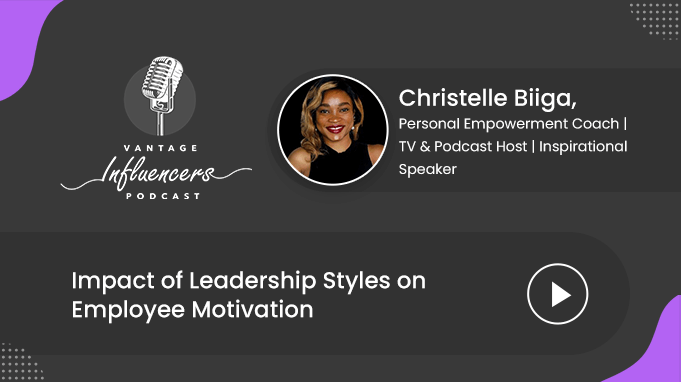
Christelle Biiga, Former Corporate Executive turned Personal Empowerment Coach, TV & Podcast Host, and Inspirational Speaker
Christelle Biiga moved from Cameroon to the United States years ago, pursuing what she calls her American Dream with limited English, no family or contacts, and roughly $2,500 to her name. Her journey nearly ended at the airport when an immigration officer wrongly accused her of coming to work as a prostitute, a decision that led to nine months in a detention center before she was granted the right to stay. She went on to take an entry-level customer service job at that same airport and was promoted to manager within a year, an outcome her employer said had never happened before at the company. She has since become a Personal Empowerment Coach, TV and podcast host, and inspirational speaker, and her story has been featured in multiple magazines.
Connect with Christelle on LinkedIn
Host
Susmita Sarma, Vantage Influencers Podcast Host
What You Will Learn
- How to define leadership as the ability to lead yourself before leading others.
- Why communication, more than any other leadership style, drives employee motivation.
- How to replace top-down instructions with questions that invite team input.
- How to handle sensitive information without making employees feel shut out.
- Why treating recognition as a frequent habit works better than an annual reward.
- How high turnover quietly costs a company far more than it appears to.
Key Topics & Timestamps
| Timestamp | Topic |
|---|---|
| 00:00 | Cold open and setting up today's episode on leadership styles |
| 00:36 | Introducing guest Christelle Biiga |
| 01:02 | Christelle's journey into the corporate world |
| 03:14 | Defining leadership and what it means to lead a team |
| 08:48 | The most important styles of leadership |
| 09:02 | Why communication is the single biggest driver of employee motivation |
| 14:34 | Staying a trustworthy leader without oversharing company secrets |
| 18:47 | Why rewards and recognition matter for motivation and performance |
| 26:06 | A book recommendation for leaders: Extreme Ownership |
| 28:20 | Closing thoughts and how to connect with Christelle |
Full Transcript
Click to read the full episode transcript
Welcome to the Vantage HR Influencers Podcast. This podcast is sponsored by Vantage Circle, the simple and AI-powered rewards and recognition platform for employee engagement.
In the corporate sector, there are a variety of leadership styles to choose from, and each style has its own way of motivating employees. Managers and leaders blend their own personalities into their leadership style and push their employees to achieve at a high level. What are the most important styles of leadership, and what impact do they have on employee motivation? Which leadership style is the most effective? Bringing in today's episode is guest speaker Christelle Biiga, a former corporate executive turned personal empowerment coach, TV and podcast host, and inspirational speaker.
Susmita Sarma: Welcome to the show, Christelle.
Christelle Biiga: Thank you so much. Thank you for having me.
Susmita Sarma: Great, okay. So before we start with today's topic on leadership styles and their impact on employee motivation, please brief us about your journey in the corporate world.
Christelle Biiga: Thank you. So my name is Christelle Biiga. I'm originally from Cameroon, and I moved to the United States a few years ago. The first job I got when I arrived was at LAX, and funnily enough, that airport has a lot of history for me before we even get to my journey as a corporate executive. When I arrived at LAX to start a new life in the United States, I almost got deported because an immigration officer said I was coming to work as a prostitute. For that reason, he said he couldn't let me in. Fast forward, I ended up in a detention center for nine months for immigration processing before I was finally granted the right to stay.
It was a really tough journey for me because I could barely speak English, and I had no family or friends here. But I made it through that experience, and the first job I landed was at that same airport, LAX. I started as a customer service representative for an airline, and in less than a year I became a manager, which was a surprise, because HR told me that had never happened before at the company, that someone became a manager in less than a year. It was a great experience for me, especially because, as I mentioned, I could barely speak English when I got here. The primary reason I got that position was that the airline was a French airline, so my French background was helpful for the passengers. I put my whole heart into the job and worked really hard, and when the position opened up, I was seen as the best candidate to take it. I stayed there for almost two years before branching out to start my own business. That's a brief summary of my experience in the corporate world.
Susmita Sarma: Okay, so Christelle, today's topic is about leadership styles and the impact they have on employee motivation. Before we get into that, I think we should first understand what leadership is, or what leadership style means in management. Would you like to define that?
Christelle Biiga: Absolutely. Leadership is really the ability to lead yourself and lead other people. That's the definition of leadership that I love, because to be able to lead other people, you have to first be able to lead yourself. What does leading people mean? As a leader, you should have a vision, that's why you're leading people. What is the goal? Where are you taking your team? You have to have a clear picture of what that destination looks like, and you also have to be able to convey that vision to your team in a way that makes sense to them, enough for them to be willing to follow you.
That's the difference between a leader and a boss. A boss just tells you what to do, and doesn't really care whether you believe in the vision or want to do it, just that you do it. But a real leader wants to bring you into the journey, because when people believe in the vision, when they believe in what the company is trying to achieve, their investment in that vision is different. So a real leader is someone who not only has a vision but also has the ability to share that vision with the team so they want to follow in that journey.
That's what I'd define as a real leader, a good leader: someone who can do those two things, create a vision that's appealing to themselves and to other people. That's why I say you have to be able to lead yourself first. How passionate are you about the goal or vision you've created for the company? Because when people look at you as a leader, they want to see how much you believe in that vision yourself, how much you're invested in whatever goal you're trying to achieve, or trying to help the team achieve. They want to see how much you believe in it and how passionate you are about it.
For example, when I was working at LAX, before me, the previous managers were struggling with the team. People called off all the time, made mistakes, and resigned quite often. The turnaround was really quick, every three to six months we'd have to hire and train someone new, which cost the company a lot of money. Every time you bring on a new employee, you have to train them, and during that training time the company isn't making money, it's technically losing money. So that turnaround wasn't profitable for the company, and we couldn't figure out what the issue was.
When I became a manager, the advantage I had was that I'd been part of the team myself, a regular agent before, so I knew the complaints agents had and where the breakdown was between management and the team. So when I became a manager, I came in with that knowledge and experience, and I was able to find a way to communicate and bridge the gap between the team and management. I did that by leading by example. I was a leader who showed I could get the job done, and I didn't mind rolling up my sleeves and doing it myself.
What started happening was that people began volunteering to do tasks without me having to ask, which they weren't interested in doing before. Before, it was just, this is my time, I clock in, I clock out, and I'm done, I don't care. But because I understood how they felt, I started leading by example. I'd show up on time or even earlier. People are always watching when you're a leader, they're analyzing everything you do. That's why I say you have to lead yourself first in order to lead others. If you're asking people to do something you're not invested in yourself, or asking them to achieve results you're not trying to achieve yourself, they won't want to do it, and they won't be motivated.
So when they started seeing how I showed up, how I got tasks done that weren't even part of my job as a manager, things I didn't have to do but did anyway when needed, that shift showed in their mindset. They stopped making excuses like "this isn't my job," and started volunteering to do things beyond what they were being paid for. That's what a leader is: you create a vision, you share that vision with your team, and you lead them by example, leading yourself first through that vision, so they can see how invested and passionate you are, and they're more likely to follow you.
Susmita Sarma: Yes, exactly, brilliant. So you've been in leadership positions for years now. What do you think are the most important styles of leadership?
Christelle Biiga: Communication. Communication is a game changer when it comes to leadership, because what usually creates a breakdown between a team and management is that the team feels like they aren't part of the communication. They feel like they're being told what to do without really knowing what's going on. When people don't see the big picture, they feel like they're just there to do their job and go home.
That was part of the reason people were getting less engaged, they felt left out of the conversation about what was happening and where the company was going. You want to give them the bigger picture, and the reason some leaders struggle with that is because it feels risky to share the vision. Some leaders believe employees don't need that much information, that they just need to know their task and get it done, that they don't need to know the bigger picture of where the company is headed. But when employees do know, they feel like they're part of something, and everybody wants to be part of something bigger than themselves.
So if you involve them in the conversation by sharing that bigger picture, letting them know where the company is going and why, and communication also means listening to the team, creating a space where they feel safe enough to share their ideas and give suggestions, rather than feeling like they just have to follow instructions. Open communication where people feel safe to give their ideas is really important, encouraging the team to feel like their ideas matter, that what they have to say is relevant, even if you don't end up implementing every idea. At least create the space for them to share those ideas during meetings and briefings.
When I ran briefings, it was really the team speaking more than me, because I was asking them questions to get them to participate. Even when I was on the team myself, I noticed that previous managers would come in and tell us what was expected, what the requirements were, what they expected from us. And of course, people would feel like they were just there to do their job and go home, they didn't feel like they belonged, so of course their investment and motivation would be different.
So I would ask them questions about what we were doing, what new strategies we had in place, what they thought about it, how they wanted to get involved. They started feeling like they belonged to the company, that they were part of it, and they became more invested, because now they didn't feel like they were just there to accomplish a task and go home, they had a sense of belonging, which every human being wants.
That's what you want to create with your team. A communication style that creates trust within the team, and makes them want to be part of what you're doing, so they go above and beyond to help you reach the results you want, because without that team, there's no way for you to reach those results. You want to bring them into that journey with you, and the way to do that is through two-way communication, not just giving information but also allowing them to express themselves, encouraging them to share ideas, which means they'll have to think and come up with solutions and new ways of doing things.
Some of the exercises I used to give them were things like, we have these systems in place, we have these ways of doing things, but nothing is set in stone. Maybe because you're the ones performing these tasks daily, you've noticed better ways of getting the job done more effectively, so I'd invite them to suggest what we could change, what we could do better, what could make it faster and more effective. Now they weren't just performing the task, they were looking for ways to improve it, which of course benefits the company in the long run, because the systems we have in place are sometimes outdated, and we don't always realize it. The people performing the task daily are in the best position to tell us what could change, but the only way for them to come up with those ideas and suggestions is if you open up the communication, if they know it's okay to innovate and suggest new ways of doing things. So communication, for me, is the biggest key to effective leadership.
Susmita Sarma: Okay, so another thing, Christelle, it's important to be a trustworthy leader, isn't it, and at the same time not spill company secrets. So how can you keep company secrets from your team while still being an effective leader?
Christelle Biiga: The first question is, what real secrets does a company actually have? That really depends on what the company does. If you're dealing with sensitive information, yes, there's a need-to-know basis at different levels, some people need certain information to perform their tasks, and others don't. It's important to recognize that, and at the same time, when people do need to know something, don't hide that information from them. If they sense you're hiding something, even if you can't fully disclose it, you should tell them why they can't have that information, that's how you build trust, because team members are smart people. They're human beings. If you explain something to somebody, they're more willing to work with you and say, I get it. But if someone just senses they're being kept in the dark, they start feeling like the company doesn't trust them, like they're not really part of it, and they lose the motivation to go the extra mile. They'll just come in, do their daily tasks, and leave.
Because if the company doesn't consider them part of it, and keeps hiding things from them, it's better, even when information can't be disclosed, to let them know, this is all we can tell you right now, for these reasons, and only certain people have access to this information for these reasons. That way, they don't feel left out or like they're being kept away from information because the company doesn't see them as part of it. That's really important, because people want to know they're not just being treated as numbers. That's often why employees aren't motivated, why they don't feel a sense of belonging, and why they don't find their work meaningful.
What allows people to find their work meaningful, and to want to keep doing it with passion over the years, is knowing they belong to something, that they're part of the company, not just a number. I saw that feeling a lot, and I had to change it for my team, because for a long time the sentiment was, we're just numbers here, they say that all the time. So I had to make them understand that we value their presence, that this company isn't the same without them, that we want their contribution, we want to know what we can improve, because they're part of this, it's like a family, people spend so many hours at work, sometimes more than with their own families, so it's important for them to feel at home even at work.
Even in a household, when we can't disclose certain information to our children or loved ones, we tell them why. It's the same with employees, they're human beings, they understand things, and you want them to know that if there's information not available to them, there's a reason for it, and it has nothing to do with them not deserving to know what's going on.
Susmita Sarma: Okay, so Christelle, how important are rewards and recognition for leaders when it comes to employee motivation and performance?
Christelle Biiga: It's huge, it's really, really important. I remember when I started doing end-of-year evaluations, that was an opportunity for me, because as leaders, especially at the management level, we don't always have time to connect with all the staff the same way on a daily basis. Sometimes employees don't really know what we think about them, they're left to guess, or they interpret our reactions during meetings or when something happens, without really knowing if we appreciate them or like their work. That evaluation period was a great opportunity to actually have a conversation, not just check boxes on a sheet of paper about their performance, but really take the time, even when there were areas they needed to improve, to talk it through and let them come to their own decisions about what might need to shift or change.
So evaluations are great, we just have to make sure staff don't see them as a punishment or a way to blame them for bad work. Even when we have employees who need to improve or aren't performing well, the evaluation shouldn't feel like a report card covered in red pen where you feel bad. It has to be a space where we connect, where we reinforce that we value them and their contribution, and that we want to keep them, so it's really about how to help them improve or shift certain things. It was also a place for me to learn about situations I wasn't aware of, because sometimes we only look at the results, whether they're satisfying or not, whether the job got done or the expected result was achieved, yes or no, without knowing the reasons behind those results. Evaluation time lets us uncover that, so we can support our team better.
That's really the key, when we have evaluation sessions, we should always come from a place of wanting our team to improve. If that's the mindset, we want to understand why performance isn't great in certain areas and how we can support them to do better, because remember, every time we let an employee go and hire someone new, we have to train them, and the company loses money in that process. The longer we keep employees motivated to stay and improve, the more the company wins. That's why it's important to use evaluation time to really understand why an employee isn't performing well in certain areas and figure out how to support them.
And of course, rewards are also great for motivating people to keep working as hard as they are and keep performing well. Rewards shouldn't be limited to a certain time of year, I always liked to create reasons to reward people whenever I could, even employees who weren't necessarily the best performers at the airport. I'd always find a reason to acknowledge them, maybe a passenger said something positive about them, or they helped solve a problem, we'd recognize that, maybe acknowledge it during a meeting just to make them feel good. Rewards shouldn't only happen at certain times of the year or the month when one employee gets acknowledged and everyone else is left wondering whether they're appreciated. We want to reward every little good action so people stay motivated, because if they don't feel rewarded or acknowledged, they start to feel like they're not valuable, and if they don't feel valuable, they'll look for somewhere else where they will be seen.
It shouldn't be limited to employee of the month or employee of the year, we should always be looking for any occasion or small trial where people show effort and reward it. If someone was being trained for a new position and can finally do it on their own, that's worth recognizing too, that way you can reward all your employees, not just the same one or two, because sometimes that's exactly why people start feeling like it's always the same people being recognized. Some employees do perform better than others, that's a fact, but we don't want the ones who aren't top performers to feel left behind, because they bring value too, and we want them to know we see and appreciate them.
The same way we let people know when they're underperforming, we also want to reward them when they do well, when they accomplish something, even if it has nothing to do with work directly. For example, if an employee helped a stranger at the airport who wasn't even our passenger, and we heard about it the next morning, I'd acknowledge that in the meeting, because it's still customer service, even if it wasn't for the company directly. We want to show the team that we see them, that we value what they do, even if it's not something that dramatically changes the company's bottom line. We still appreciate every little effort people put in to be good employees.
Susmita Sarma: Okay, so Christelle, what resources would you recommend to someone trying to improve their leadership skills, any books or podcasts?
Christelle Biiga: Yes, the best book I can recommend is called Extreme Ownership. I can't remember the author's name off the top of my head, but it was written by a retired general in the United States Army, and he used his experience as a general to really create a roadmap for what a real leader is. As a general, you're leading a team, and that book completely shifted my mindset about what a leader is.
In Extreme Ownership, he says a leader takes ownership of every result their team produces. If it's not good, the leader looks in the mirror and asks, what could I have done differently? Maybe in the way I communicated, I didn't share what I was expecting clearly enough for them to understand it and give me the result I wanted. So how can I explain it differently, how can I explain it better so they understand and give me the result I want? As a leader, you always want to take responsibility rather than blame the team, even when they don't get you the result you wanted. You want to ask yourself what you could have done differently, because you always want to take your leadership to the next level. If you stand for your team, and you're always trying to be strong and good for them, the team will keep getting better and better. The book is written by Jocko Willink and Leif Babin, it's an amazing book, Extreme Ownership, I'd highly recommend it if you can find it, it's powerful when it comes to leadership skills.
Susmita Sarma: Thanks for sharing that, Christelle. So finally, how can people connect with you?
Christelle Biiga: Yes, if you want to stay in touch with me, you can find me on LinkedIn under my name, Christelle Biiga, as well as on my other social media and my website. If you'd like to book me as a speaker to come talk to your organization about leadership, you can reach out through the contact details listed on my LinkedIn profile and website, and I can be scheduled from there as a speaker.
Susmita Sarma: Okay, great, this was a great conversation with you, Christelle. I hope you enjoyed it, and thanks a lot for joining me on the Vantage HR Influencers podcast.
Christelle Biiga: Thank you so much for having me.
Thanks for listening to the Vantage HR Influencers podcast. Please do subscribe to the Vantage HR Influencers podcast on Apple Podcasts, Spotify, and our YouTube channel for new episodes.
FAQ
How does Christelle Biiga define leadership?
Christelle defines leadership as the ability to lead yourself before you can lead other people. A leader needs a clear vision for where the team is headed and the ability to communicate that vision in a way that makes people want to follow, rather than simply comply. She contrasts this with being a boss, who tells people what to do without caring whether they believe in it.
Which leadership style has the biggest impact on employee motivation?
According to Christelle, communication is the single biggest driver of motivation. Teams disengage when they feel excluded from the bigger picture and are only told what to do. Sharing context, asking for input, and creating space for employees to voice ideas during meetings builds trust and makes people more invested in outcomes.
How can a leader keep certain information confidential without losing employee trust?
Christelle recommends transparency about the limits of transparency itself. When information cannot be shared, she suggests explaining why rather than staying silent, since employees who sense they are being kept in the dark start to feel undervalued and less motivated, even if the specific information genuinely needs to stay confidential.
Why does Christelle see recognition as more than an annual event?
She argues that limiting recognition to formal, once-a-year evaluations or "employee of the month" programs leaves most people feeling overlooked. Instead, she recommends acknowledging small wins as they happen, whether that is mastering a new skill or receiving a compliment from a customer, so recognition becomes a consistent part of daily work rather than a rare event.
Related Reading
Also listen on