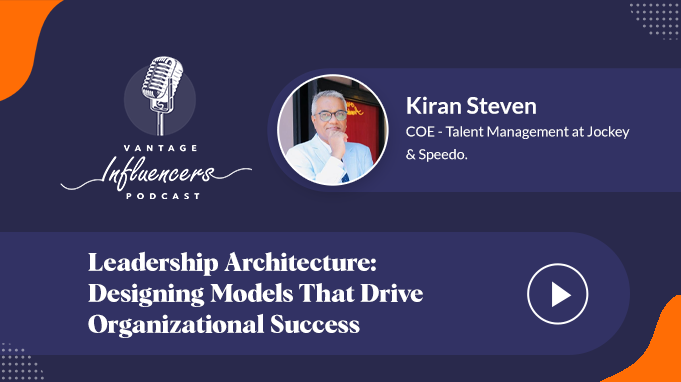
Leadership Architecture: Designing Models That Drive Organizational Success
Episode Overview
Kiran Steven opens by arguing that leadership architecture is far more than hierarchy or job titles: it is the deliberate blueprint an organization uses to define, create, and sustain leadership capability. He walks through six questions every leadership system should answer, from the culture it creates to how agile it remains as business context shifts, and uses Microsoft's shift from a "know it all" culture to a "learn it all" culture to show how structure and process must serve culture rather than control it.
Kiran also makes the case that emotional intelligence and inclusivity cannot stay at the level of stated values. He connects emotional intelligence to sharper stakeholder management and better decision quality, and reframes inclusivity as psychological safety and the freedom to challenge the status quo. Drawing on a real turnaround where leadership metrics were rebuilt around manager-controlled behaviors, he shows how patience and consistent measurement, not overnight change, produced double-digit gains in engagement and mobility. He closes by outlining the leadership traits, like curiosity, learnability, and resilience, that he believes will matter most as AI, hybrid work, and multigenerational teams reshape what leadership looks like.
Episode Highlights
- Leadership architecture is a blueprint, not a policy: it must define, create, and sustain leadership capability across six questions covering culture, competencies, selection, development, measurement, and adaptability.
- Structures and systems should serve culture, not control it, illustrated through Microsoft's "learn it all" shift under Satya Nadella and the retirement of stack ranking.
- Emotional intelligence sharpens coachability, decision quality, and stakeholder management, while genuine inclusivity means psychological safety and welcoming ideas that challenge the status quo.
- A real leadership model redesign that added manager-controlled engagement metrics took two years to show results: reduced attrition, higher internal mobility, a 7% engagement lift, and more decisions made at lower levels.
- Leadership success can now be measured through concrete signals like team sensing scores, one-on-one quality, and ethical decision-making, not just felt anecdotally.
- As AI, hybrid work, and multigenerational teams reshape expectations, future-ready leadership architecture must reward curiosity, learnability, resilience, and AI fluency instead of rigid authority.
About the Guest
Kiran Steven, COE - Talent Management at Jockey & Speedo (Page Industries)
Kiran Steven is an HR leader with over two decades of experience spanning HR business partnering, strategic leadership alignment, talent management, and organizational development across manufacturing, retail, and IT, including stints at Hewlett Packard, Siemens, Continental Automotive, and Arvind Lifestyle Brands. He is a certified Behavioral Assessor and NLP Practitioner who has conceptualized and implemented development and assessment centers for mid and senior-level professionals across Indian and multinational companies. He currently heads Talent Management at Page Industries Ltd. (Jockey & Speedo), overseeing performance and talent management for over 3,000 employees across sales, corporate, and manufacturing functions in India.
Connect with Kiran on LinkedIn
Host
Riha Jaishi, Vantage Influencers Podcast Host
What You Will Learn
- How to define leadership architecture using the six core questions of culture, behavior, identification, development, measurement, and adaptability.
- Why structures and systems should serve culture rather than control it.
- How emotional intelligence shapes coachability, decision quality, and stakeholder management.
- What genuine inclusivity looks like beyond a stated value, including psychological safety.
- How to measure whether a leadership model is actually working, using concrete manager-level indicators.
- Which leadership skills, like curiosity, learnability, resilience, and AI fluency, matter most for navigating an unpredictable future.
Key Topics & Timestamps
| Timestamp | Topic |
|---|---|
| 01:28 | Kiran's HR journey across manufacturing, retail, and IT |
| 02:54 | Defining leadership architecture as the blueprint that creates and sustains leadership capability |
| 07:15 | The foundational elements of a leadership model: structure, culture, competencies, and adaptability |
| 11:13 | Why emotional intelligence and inclusivity must be design principles, not just values |
| 18:03 | A real example of leadership architecture driving business performance and culture change |
| 24:31 | How data and analytics reveal whether a leadership model is actually working |
| 31:19 | How AI, hybrid work, and multigenerational teams are reshaping leadership architecture |
| 39:33 | Designing leadership models that prepare leaders for an unknown future |
Full Transcript
Click to read the full episode transcript
Welcome to the Vantage Influencers podcast. This podcast is sponsored by Vantage Circle, the simple and effective recognition platform for employee engagement.
Riha Jaishi: Hello, listeners. Welcome back to another episode of the Vantage HR Influencers podcast. I'm your host, Riha, and today we're diving into a topic that lies at the very heart of every successful organization: leadership architecture. In a world where change is constant and expectations are high, the real challenge isn't just finding good leaders, but also designing a system that consistently develops them. Leadership architecture goes beyond titles or hierarchy. It's the blueprint that aligns leadership capabilities with business goals and culture. And to help us decode how organizations can design leadership models that truly drive performance and growth, I'm joined by Kiran Steven, COE Talent Management at Jockey and Speedo. Welcome to the show, Kiran. It's a pleasure to have you with us today.
Kiran Steven: Thank you, Riha. It's a great pleasure to talk to you and be part of this esteemed podcast. I really am honored to be here.
Riha Jaishi: Great, we are equally delighted. So to kick things off, can you briefly take us through your professional journey so far? We are eager to learn about your journey.
Kiran Steven: Oh, that's great. It's been a long journey, but definitely an exciting one of around 20 plus years. I've been through and through a professional in HR, but have been fortunate and blessed to have diversified into all facets of human resources, be it HR business partnering, strategic leadership alignment, talent management, or organization development, and also diverse in terms of the sectors I have worked in, whether it's manufacturing, retail sales, or IT. So I've had exposure to all these aspects. It's been a journey of two decades working with great leaders, great teams, and great companies like Hewlett Packard, Siemens, Continental Automotive, and previously Arvind Lifestyle Brands, and so on and so forth.
Riha Jaishi: That's such an inspiring journey, Kiran. Thank you for sharing it. So with your permission, I'd like to delve into our topic further, shall we?
Kiran Steven: I'm looking forward to that.
Riha Jaishi: Great. So to begin with, Kiran, could you break down what leadership architecture really means in today's organizational context?
Kiran Steven: That's a great question to start off with, because you've touched the fundamental part of leadership architecture: its contextualization to the current, changing business landscape. If you look at it traditionally, leadership architecture was associated with leadership models and leadership development. But if you look at a comprehensive definition, leadership architecture is a blueprint of how an organization defines, creates, and sustains its leadership capability. I'm very consciously using those three words, defining, creating, and sustaining, and the phrase leadership capability.
Any leadership architecture in any organization should try to address six core fundamental questions from an efficiency and efficacy point of view. First, what kind of environment is the leadership architecture going to create? That's a cultural outcome, what kind of culture you want people in the organization to experience. The next core aspect is what behaviors and competencies you want leaders to exhibit so that this culture is actually experienced by people. The third aspect is how you identify these leaders, in terms of what kind of evidence-based selection you're going to use. The fourth, which is very important, is how you grow these leaders so that the environment gets created and experienced consistently. That's about nurturing leadership, developmental journeys and pathways. The fifth aspect, which is important but hugely ignored, is how you measure and reward these behaviors, meaning your scorecard and what kind of reward you associate with them for leaders and managers. The last one, which is very contemporary and relevant, is how flexible and agile your leadership architecture is, so it can stay relevant to a changing business context instead of being recreated from scratch; it should be able to be modified and run so the organization stays relevant. If leadership architecture is able to address these aspects, then organizations have done a fantastic job of defining and understanding leadership architecture at its core.
Riha Jaishi: Kiran, I must say it's a great start to our session. The manner in which you've given such a detailed explanation of leadership architecture, and the definition of how it's a blueprint of how organizations define, create, and sustain leadership capabilities, is a very strong point, including all the aspects you've addressed. It's something to really look forward to and keep in mind going forward.
Kiran Steven: Thank you so much.
Riha Jaishi: Okay, so moving ahead. When designing a leadership model, what are the foundational elements leaders should prioritize? Structure, culture, competencies, or adaptability? What do you think?
Kiran Steven: I'll give you an example. Take Satya Nadella, as the head of Microsoft Corporation: he brought in a big cultural change. Microsoft was known for a culture of "know it all," and he moved it to "learn it all." From a culture point of view, that's the environment Satya Nadella wanted to create, sustain, develop, and make everyone experience. That's important from an environment point of view.
Point two: if this experience of "learn it all" isn't built into the competency model or the behavioral model, how will it be exhibited from a leadership point of view? Leaders have to first exhibit those behaviors and provide evidence to employees, and then it becomes the DNA of the organization. So the behavior and competence part is very important.
The third aspect is structure and processes. Structures are static while culture and behavior are dynamic, so you have to understand both. Structure is important for an organization, so are systems and processes, but it's very important for structure and processes to serve the culture, not control it. Taking the Satya Nadella and Microsoft example again: if "learn it all" wasn't built into the hiring process, promotion process, or reward process, would it be experienced by everyone, or would it help the leadership architecture become effective? Ideally, no. These are subsystems that have to be in place. And of course, from a cultural point of view, flexibility and adaptability are very important, how adaptable, agile, and flexible you are to learn new things and shed old baggage.
In fact, at Microsoft, there was a stack ranking system that wasn't promoting a "learn it all" culture, and it was taken off. So if you look at culture (learn it all), behaviors from leaders, systems that enable it, and a mindset that's adaptable, flexible, and agile, that's how the whole aspect of these core fundamentals comes together.
Riha Jaishi: That's such a great point about learn it all and the behaviors and the structure. It seems that these elements tend to play together rather than operate in isolation, right?
Kiran Steven: Yes, there has to be a synergetic aspect. Each has to complement the other. If one of the pegs falls off, that's a great point you brought in. They have to work in tandem, complementing each other, and that's how organizations will grow.
Riha Jaishi: Great, thank you. So moving ahead, do you think a leadership architecture should integrate emotional intelligence and inclusivity as design principles, and not just values? What do you have to say about this?
Kiran Steven: Very important question, because when it comes to emotional intelligence and inclusion, most organizations treat them as part of their value system, displayed on notice boards and across the media. But fundamentally, these can't just be values; they have to be integrated into the system we spoke about earlier. They're not just fundamental from an inclusion perspective in leadership architecture, they're also performance critical. There's a business imperative when you include both.
Let's look at emotional intelligence first. What does it impact when you make it part of a leadership architecture system? It impacts three or four aspects. One, it impacts coachability: the ability of leaders to ask, because they're emotionally intelligent, empathetic, and understanding of the people and context they're working in. As a leader, your coachability becomes very strong, leading to development of the team and, in turn, the organization. The second aspect is that EI impacts the quality of decisions an organization makes. If you separate out EI, you get a unipolar or bipolar approach to decision-making. But when you include EI, decisions become holistic, comprehensive, and well-informed, impacting not just the business but the whole environment. The third aspect is managing stakeholders. Everyone has a stakeholder environment, and stakeholders are different, so you can't employ the same philosophy or approach with each one. You have to understand the need, the context, the urgency, and then respond or engage with them, that's inclusive engagement.
Now coming to inclusivity: when I say inclusive, I mean inclusion of thought. Many organizations that list inclusivity as a value should ask themselves: does your leadership architecture create an environment with a platform for cross-fertilization of ideas, which leads to innovation velocity? Does it welcome ideas even if they're unconventional or completely different from the traditional way of doing things? Point one. Point two: does your architecture have an inbuilt psychological safety aspect, so it's okay to fail, okay to experiment, okay to come up with a completely different idea and challenge the status quo? That's inclusivity for me. If a leadership architecture, as a process and system, has these elements taken care of, it has a clear, direct impact on business performance.
Riha Jaishi: Kiran, you've given some amazing pointers here, a big takeaway. First, on emotional intelligence, the aspects you mentioned about how it impacts coachability of leaders, quality of decisions, and managing stakeholders, and your perspective on inclusivity, how it's more about cross-fertilization of thoughts and ensuring psychological safety. These are some important aspects and pointers we really need to look at, right?
Kiran Steven: Yes, and I think many organizations today are understanding the importance of these aspects and trying to build them in, because it's very important. It's also a cultural shift, and culture takes time to build, sustain, and grow, so it's baby steps for most organizations. A few have matured in this, and the most progressive organizations have built in the ability to challenge the status quo and bring in different concepts. Google wouldn't have been Google if this wasn't there, in terms of experimentation, challenging the status quo, and bringing in new processes. That's just a thought for all of us to consider.
Riha Jaishi: Absolutely, that's a great perspective. Now, moving forward, can you share an example where leadership architecture has directly influenced business performance or cultural transformation?
Kiran Steven: This is one example very close to my heart, from one of the organizations I worked with previously. Historically, the organization had grown through acquisitions, so there was a lot of legacy in the system with many small subcultures, though the most predominant culture was that of the company that had taken over.
When it came to promotion criteria, traditionally the organization maintained a combination of tenure in the role plus utilization, meaning how well the manager utilized the team's performance, whether they achieved or beat targets. That was the decision: tenure plus performance. As the organization wanted to grow, expand, and build a culture of pay for performance, a new leadership architecture was incorporated. The first thing we looked at, from a promotion criteria standpoint, was whether we could add qualitative parameters to ensure the leader or manager exhibited certain behaviors that were part of the leadership architecture.
We decided to look at engagement, specifically what's actually in the manager's control. For example, team sensing, essentially an NPS-like score for the manager, based on how the manager's behavior affects an employee's work, development, connection, well-being, and ultimately performance. That's something completely controllable by the manager. We also looked at how many quality one-on-ones the manager had done in terms of career or aspirational conversations. Plus, there were other aspects like attrition and mobility scores. Those were the parameters we included as part of the evaluation process.
Once we included this, there was resistance and change, because of change management. But the leadership stood firm and demonstrated it across the organization, and as I said, culture takes time. Two years down the line, we saw clear results: attrition was reduced, not drastically, but the manager was no longer the main driver of attrition. Internal mobility and cross-functional movement increased because managers were having career conversations and people were expressing their aspirations. That had a big impact on the engagement score, which increased by 7% at the org and manager level over two years, a brilliant result. The last thing, and my biggest personal takeaway, was that decision-making also started happening at lower levels, not just at the hierarchical top. That speaks to empowerment and delegation, the ability to take decisions, even wrong ones, with the safety net to do so.
It was a two-year process that required management patience, because it was a change process. Culture wasn't built overnight; there were challenges along the way. But two years down the line, the first results were visible, and today nobody questions it. It's part and parcel of the process.
Riha Jaishi: That's such a wonderful example, Kiran. It really shows how intentional leadership design, the leadership architecture you described, can change the overall culture and outcomes. It has impacted positively in every aspect, right?
Kiran Steven: Absolutely. And you used a very nice phrase: intentional leadership. Many leaders need to ask themselves whether they're being intentional in their approach or just going with the flow of the day. That intention is very important, and you have to be intentional in every aspect of your leadership.
Riha Jaishi: Okay, moving ahead. How important is data or analytics in evaluating whether a leadership model is actually working, and what kind of metrics matter most?
Kiran Steven: Let me go back a bit. I'm speaking purely from the metric of a leadership model or architecture's success. Historically, how was leadership expressed? Leadership was felt: we'd say a person is a great leader because we experienced it, maybe saying that JRD Tata or Ratan Tata was a good leader because we experienced it. But today, the dynamics have changed, because leadership doesn't rest at the hierarchy anymore; everyone is a leader in the organization, everyone owns and is accountable for something. So experience alone becomes a secondary, subjective factor.
The good news is that leadership can now be measured, and data is available to measure it. From an employee perspective and an architectural delivery perspective, the questions become: is my leadership architecture helping me achieve my organizational goals? Is it helping create the culture we wanted, like the "learn it all" example? Does it cascade down across hierarchy, or is it limited to the top? These are indicators you'll find in your engagement survey or leadership pulse survey. But at the next level, there are lead indicators too, tied to what's controllable by the manager for their team: does it provide an experience of engagement, safety, growth, and well-being? Today, if an employee feels okay going to their manager and saying they're having challenges with their work, or that they're stressed out and need a time-out, that kind of environment matters. Does the manager take hard decisions the right way, that's ethical leadership, and that can also be measured. Does the manager value my contribution, do I have a say in team meetings, do I know how my work is impacting the team, department, and organization? These are all measurable today, and they give you fantastic leadership data, not just at the organizational level but at the ground level, where each individual has a seat.
An organization is built of people, and the first level of leadership hierarchy is the manager, who has a direct influence on the team's impact, which resonates up through the department to the organization. So your architecture's success or failure has a lot of measurable data points. One important thing to highlight: when measuring the success or efficacy of a leadership architecture, it's important to understand what stage the organization is in, whether it's in a growth phase, a startup phase, or a mature stage. That context matters a great deal for the leadership lens.
Riha Jaishi: That's absolutely true. I really liked how you explained the different aspects of leadership, from manager control to ethical leadership, connection, and ground-level leadership, and particularly that point about understanding the stage of the organization before you can measure it properly. So data really helps figure out whether leadership tactics or solutions are effective, something you can track and improve over the long run, right?
Kiran Steven: That's right. Today, data has become so dynamic, and that's why analytics plays such an important role. With Gen AI and other aspects of artificial intelligence coming in, we're sitting on a goldmine of analytics. How judiciously and intelligently we use it is up to us, but it's available. The intent and intensity of our usage becomes very important.
Riha Jaishi: Well said. Okay, moving ahead, since we were talking about AI, let's proceed with the AI question. AI, hybrid work, and multigenerational teams are reshaping the workplace. How should leadership architectures evolve to stay relevant?
Kiran Steven: Brilliant question, because you've added three dimensions, not just AI, but also the hybrid and remote working concept, and multigenerational workers. This is the paradox we're seeing: all three are happening in organizations right now. AI is playing its role, hybrid is playing its role, and we also have a multigenerational workforce.
From a leadership point of view, the concept of a leader is changing dramatically. Historically, a leader was the go-to person, the one who knew it all, did it all, the last stop in decision-making. But today the paradigm has changed drastically, especially after COVID, and it's become more fluid. Today, it's okay for a leader to be vulnerable, okay for a leader to not know everything, okay for a leader to ask questions, clarify, and seek help. The macho persona of a leader has changed drastically. Second, the relationship between employees and employers, meaning management, has drastically changed, especially after COVID. Earlier there was a clear divide between management and employees; today that difference is blurred, and it's more of an equal footing. That's why we're talking about flat structures and open office environments, because the relationship between management and employees is now almost on equal footing.
What has AI done here from a leadership architecture point of view? It has democratized learning and knowledge. Knowledge is available at your fingertips, on your device, through whatever prompt you give it. Gen Z has said no to authority and yes to autonomy. And we have a workforce dynamic where millennials, who are now 40 plus, are managers grappling with a Gen Z that wants autonomy, not authority. And hybrid work has said, forget presence, only believe in outcomes.
So coming to your leadership architecture: does it provide for competencies where curiosity and learnability of a leader are also measured? Does it provide platforms for autonomy, where people irrespective of hierarchy can be leaders, project leads, or leads on a stretch assignment? It doesn't always have to be the top person; it can be whoever is best positioned to take the lead, the most knowledgeable person. Does your architecture provide those kinds of frameworks? The third aspect is ensuring outcomes matter: how you do it, where you do it, as long as it's within timelines, meets objectives, has quality standards, and is done ethically, shouldn't matter. That's what a hybrid workforce expects. At the end of the day, performance matters. Given the context of AI, knowledge is available; how you use it is what's important, and that's where experienced people come in with their experience. How do you bring the energy of Gen Z together with the experience of senior folks? How do you give autonomy and empowerment to people while stepping back as a mentor, asking quality questions that help them grow? That's how the whole dynamic plays out.
So the question is: how does your leadership architecture accommodate this? It has to be always improving, flexible, agile, and accomplished. Only when these three things happen does it become relevant to the business context we're working in.
Riha Jaishi: Kiran, you've wonderfully addressed all three of these aspects and how they relate to leadership architecture, how it's evolving and impacting all three. And particularly, like you said, it ends on the note that it's all about being agile and flexible, that's the new foundation for evolving with the times, and that's how things can positively impact, right?
Kiran Steven: Yes. Another important aspect is that earlier, everything we did was built for a 10 to 15 year purpose, so we were designing for more perfect, permanent models. Today, it's so dynamic and evolving that every organization is essentially in beta mode, always learning, evolving, and adapting. The maximum shelf life of a leadership competency today is about three years. The competency itself may remain, but the behavior descriptor attached to it can drastically change. Leadership architecture for a startup is completely different from that of a mature organization. That's the whole context, and these dynamics become very important.
Riha Jaishi: Okay, so before we wrap it up, let's conclude with another question. How can organizations design models that prepare leaders not just for the present, but for the unknowns of the future as well?
Kiran Steven: That's another brilliant question, because you mentioned unknowns of the future, and by definition, the unknowns of the future are unknown. But it's a very important question. Can we predict the roles of the future? Maybe, maybe not, not 100%. What would a role look like in 2030 or 2040? We don't know; we can only predict based on our imagination. Did we predict 15 or 20 years ago that AI would take so many jobs? No. Did we predict that hybrid working would become as normal as it is today? No. These things have been dynamic and changing, so prediction becomes difficult.
What's important is, keeping that ambiguity or unknown in mind, and looking one step ahead at any given point in time, can we prepare people for the jobs of the future? From a leadership architecture perspective, certain soft skills in a leader are very important: curiosity, learnability, resilience, and ethics. These are skills that still need to be groomed. You're also looking at AI fluency, nobody talks about "digital" anymore because we've already moved past that, we're talking about AI fluency, and about sustainable leadership.
Take curiosity in a leader as an example. What's your understanding of curiosity in a leader?
Riha Jaishi: Curiosity would be to learn about the team, to encourage them, or to help them adapt to situations.
Kiran Steven: Great, you used the word "learn." When you say learn new things, new frontiers, is the leader consciously, intentionally learning? That's intellectual curiosity: whether it's "I don't know, so I am learning" or "I love learning, so I am learning," both cater to intellectual curiosity from a leadership point of view. Going one level down, the second aspect is empathetic curiosity: do I know my team, not just as employees but beyond, do I know what kind of work they enjoy, what motivates them, what demotivates or derails them? That's empathetic curiosity. The third aspect is self-introspective curiosity: does the leader introspect on how their own values are playing out and impacting the team and organization?
To marry these into leadership architecture: do you celebrate or hire for curiosity? Does it incorporate that, since you're preparing for the future? Do managers seek feedback not just on performance but on their own approach? Do they display humility, saying "I don't know, I want to know"? Are failures celebrated in a way that encourages this? If this gets incorporated and becomes part of the organization's DNA, you're fundamentally preparing for the unpredictable. Your competency stack has to be fluid enough to accommodate new skills and move forward.
The second important aspect is that, at any given point in time, learnability and adaptability have to be built in. Learnability today is also different from the traditional idea of classroom training or e-modules. The preference for how people learn is different for each person, I might prefer learning by observation, you might prefer learning by doing or experimenting. Does the organization understand people's learning preferences, and does it build systems and processes to cater to those preferences, so it's ready for whatever unknown future comes? Those are the two aspects I feel are important: understanding what's there, taking one step at a time to prepare the organization for the unknown, since we don't know what's coming, and building a resilient system that can sustain and manage even a full U-turn. Those are the aspects that will help an organization move forward with its architecture.
Riha Jaishi: Kiran, such amazing pointers. The biggest takeaway is curiosity, that's something all leaders out there should have ingrained in them, looking not only to the present but to the future, to keep pace with what's coming. Secondly, learnability and adaptability, these need to be built into the DNA of leadership, along with building a resilient system. These are some important aspects that leaders should keep in mind as they move into the unknown future, to tackle whatever comes their way, right?
Kiran Steven: Yes, that's right, because the more adaptable and flexible leaders are, the more relevant they become, for their own sake. To stay relevant, you need to look at the unknowns, prepare for them, adapt to them, and grow over time. Those are very important aspects. You also have to have a sense of what's happening not just in your immediate environment, but across the world. For example, tariffs somewhere or a war somewhere could have a lot of impact at a broad, uncontrollable scale, or something like a mandatory 12-hour shift policy, I'm just giving an example, these are things you need to sense and build around. And I'd say that today, your architecture should have AI fluency built in, and that goes beyond just ChatGPT.
Riha Jaishi: Absolutely, well said, Kiran. So, we've finally come to the end of our session. Before wrapping up, I'd like to thank you for joining us today and sharing your wonderful and incredible insights. It's been more than a pleasure hearing your perspective on leadership architecture and designing leadership models that genuinely drive performance and growth. We really appreciate your time and expertise, and I'm sure everyone tuning in is inspired and walking away with a wealth of information to ponder.
Kiran Steven: Thank you, thanks for having me. It's been an honor to be on this platform, the Vantage podcast, and to speak with you. The questions you asked made me introspect a lot, both while speaking and while thinking. It's an honor and a privilege to be here. My hope is that a little bit of the insight I shared today has an impact overall and influences some people in some way. That's my intent.
Riha Jaishi: It's wonderful. Have a great day ahead.
Kiran Steven: Thank you.
Riha Jaishi: Yes, it will definitely. These were some impactful insights, and I'm sure everyone is going to learn a lot from this, including me. Thank you once again, Kiran. And to our listeners, thank you for tuning in. We hope you found today's conversation as enlightening as we did. Until next time, take care, and we'll see you soon. Thank you, bye-bye.
Thanks for listening to the Vantage HR Influencers podcast. Please do subscribe to the Vantage HR Influencers podcast YouTube channel for new episodes.
FAQ
What is leadership architecture, according to Kiran Steven?
Kiran Steven describes leadership architecture as the blueprint an organization uses to define, create, and sustain its leadership capability. It addresses six core questions: what culture leadership should create, what behaviors and competencies leaders must exhibit, how leaders are identified, how they are developed, how their impact is measured and rewarded, and how adaptable the system is to a changing business context.
Why should leadership architecture include emotional intelligence and inclusivity as design principles?
Emotional intelligence and inclusivity are often treated only as company values, but embedding them into the leadership system directly affects coachability, decision quality, and stakeholder management. Genuine inclusivity means building psychological safety so employees feel safe proposing unconventional ideas and challenging the status quo, which has a measurable impact on business performance.
How can organizations measure whether their leadership model is working?
Leadership can be measured through manager-controlled indicators such as team sensing scores, one-on-one quality, engagement, and ethical decision-making, alongside broader signals like internal mobility, attrition, and engagement survey results. It is also important to factor in the organization's stage, whether it is a startup, growth phase, or mature company, when interpreting these metrics.
How should leadership architecture evolve for AI, hybrid work, and multigenerational teams?
Leadership architecture should reward curiosity, learnability, and AI fluency rather than rigid authority. It should create platforms for autonomy so leadership can come from anyone with the right expertise, not just hierarchy, and it should judge performance by outcomes rather than presence, while remaining flexible enough to adapt as skills and business needs shift roughly every few years.
Related Reading
Also listen on