Leveraging Relationships For Leadership Success
Episode Overview
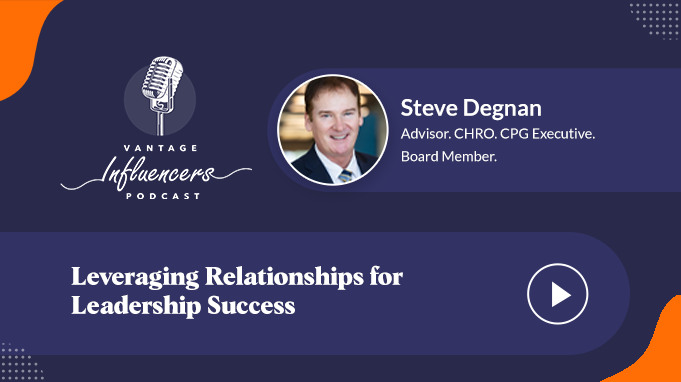
Steve Degnan joins the Vantage Influencers Podcast to make the case that relationships, not just hard work, quietly decide who moves ahead and who gets stuck. He walks through why so many professionals stumble into their relationships by accident instead of building them with real intention, and why that gap is actually an opportunity for anyone willing to be deliberate about it. Using a personal story from early in his career, he describes an unexpected job offer, a mentor who asked for two weeks before responding, and the trust that turned a moment of uncertainty into an unplanned promotion.
Steve also talks about how a small, unplanned act of kindness toward a new colleague who was struggling to fit into a big organization ended up opening a door much later, in a way he never could have predicted. He pushes back on the idea that being sharp-edged or purely results-driven is the fastest way to get ahead, arguing instead that habits like empathy, active listening, and genuine curiosity compound over time. He closes with a candid take on staying relevant through constant, incremental learning rather than waiting for one big moment of reinvention.
Episode Highlights
- Steve argues that most people stumble into professional relationships instead of building them with real intention, and that intentionality itself is a genuine competitive advantage.
- He shares a personal story about an unexpected internal job offer, a mentor who asked for two weeks before responding, and how that trust turned into a surprise promotion.
- Steve describes how being kind to a new colleague who was struggling to find his footing quietly opened a door much later in an unexpected way.
- He breaks down his motto, Win Friends, Influence People, and Kick Ass, starting with defining what winning looks like in your specific role.
- Steve reflects on shifting from avoiding lunchtime networking to embracing it once he realized it was where trust and real business got built.
- He closes with practical advice on staying adaptable, from following a couple of trusted voices in your field to experimenting with new tools like AI in small, low-stakes ways.
About the Guest
Steve Degnan, Former Chief HR Officer, Nestlé Purina North America
Steve spent 32 years at Nestlé and Nestlé Purina North America, including 19 years as Chief HR Officer at Purina, where he helped manage a workforce of 10,000 associates and supported the company's rise to the top of the pet food industry. He holds a bachelor's degree in management from La Salle University and an MBA from Washington University in St. Louis, and his career also included HR leadership at Nestlé USA along with earlier roles in production and logistics. A former U.S. Army officer, Steve now advises emerging leaders, serves on nonprofit boards including the Starkloff Disability Institute, and is writing his first book on relationships in leadership and career growth.
Connect with Steve on LinkedIn
Host
Susmita Sarma, Vantage Influencers Podcast Host
What You Will Learn
- Why building relationships intentionally is a career advantage that most professionals overlook
- How trust and loyalty with a mentor can lead to unexpected promotions
- Why small acts of kindness toward new or struggling colleagues can pay off much later
- How to apply the "Win Friends, Influence People, and Kick Ass" philosophy to your own career
- Why habits like active listening and informal relationship-building, even over lunch, matter for leaders
- How to stay adaptable and competitive by building small, consistent learning habits
Key Topics & Timestamps
| Timestamp | Topic |
|---|---|
| 01:08 | Steve's background and the career milestones that shaped his perspective |
| 03:06 | The projects and challenges Steve is engaged in since retirement |
| 05:41 | Steve's philanthropic work and nonprofit board involvement |
| 07:22 | How Steve strategically leverages relationships to reach professional goals |
| 11:02 | A specific career challenge where relationships made the difference |
| 15:22 | Advice for career frustration and the "Win Friends, Influence People, and Kick Ass" motto |
| 19:51 | Staying adaptable and competitive in a fast-changing job market |
Full Transcript
Click to read the full episode transcript
Welcome to the Vantage HR Influencers Podcast. This podcast is sponsored by Vantage Circle, the simple and AI-powered rewards and recognition platform for employee engagement.
Susmita Sarma: Hello everyone, and welcome back to the Vantage Influencers Podcast. I'm your host, Susmita Sarma, and I'm excited to bring you another exciting episode full of valuable insights and inspiration. Today we are excited to have Steve Degnan with us. Steve is a speaker, consultant, and thought leader with a passion for empowering individuals and organizations to reach their full potential. Through this conversation, Steve will help us explore how building strong relationships can propel a career and enhance your leadership. Steve will share a personal career challenge he overcame through networking, offer advice on managing career setbacks, and discuss how to stay agile in today's dynamic job market. Join us as we uncover the power of relationships in achieving long-term success. Thank you for joining us today, Steve.
Steve Degnan: Thanks for having me on. I really appreciate the opportunity.
Susmita Sarma: Pleasure's mine to begin with, Steve. Our audience would love to hear more about your background and the pivotal moments that have shaped your career so far. Could you share some insights into your professional evolution, including some key milestones and experiences that have influenced your current role and perspective?
Steve Degnan: Sure, absolutely. I grew up on the east coast of the United States. I went to university in Philadelphia, at La Salle University. I ended up being a trustee at La Salle for the last ten years, and I actually just rolled off. I spent four years in the Army after university, and that was a formative experience for sure. That was in what was then called West Germany, which is now just Germany. I happened to be there during the Cold War, while the Berlin Wall fell, so a very memorable situation. After the military, I found myself at Nestlé, and later Purina, which was acquired by Nestlé, and I spent 32 years in total at the company, the last 19 of those up until 2023 being the Chief HR Officer for Purina. It was a wonderful run. I was blessed to be in such a role for such a long time, so I decided to try a few other things afterwards. But there were plenty of milestones and interesting experiences along the way. Nestlé let me see the world literally, through travel and meetings and exposure to different markets and different people, which was wonderful. And Purina was just the ultimate expression of a winning organization. No matter what function you looked at or what activity was going on in the company, the emphasis was to win. It was an honor to work there, and I took away a lot of great lessons.
Susmita Sarma: Yeah, undoubtedly, Steve, you have been involved in various projects throughout your career. So could you tell us about some of the projects you're currently engaged in? We're interested in learning more about the challenges you're tackling and the innovative approaches you are implementing currently.
Steve Degnan: Absolutely. So, like I said, that was a great run for close to 20 years as the Chief HR Officer at Purina. But like everybody else, you want to keep challenging yourself if you want to keep learning. So admittedly, once I retired in 2023, there were a few months where I did absolutely nothing, because when you're at it and grinding for so long and you decide to take a break, sometimes it's just good to stop. So I did a little bit of that. But along the way I had joined four or five nonprofit boards, so retirement actually gave me a chance to dive deeper on some of those, which I've been doing. That's a form of community service, you might say. And then beyond that I've done some advising and some coaching and some mentoring, very informal at this point. And the one I'm really excited about, I've taken on the project of trying to write a book, and I think I've found a topic that no one else has really addressed. You might say during my career a lot of people came to me asking for advice, and especially in the last 20 years, probably literally hundreds. And when I sat back and thought about whether there were any recurring themes in what people were struggling with in their careers and their work life, I always came down to three topics. The base one was results. The more complicated ones were relationships and reputation. So those are the three, you might say, and I've started to go after that and break it all down and put it into a book, and flip it, not just to dwell on the problems, but really offer some advice and some practical solutions for people who are working their way through large organizations, which can be pretty tough. I'd say the larger ones can be the most complex and offer the most challenges, but I hope to have a product that can help anybody refine the way they approach their job and their life.
Susmita Sarma: Yeah, brilliant, Steve. And while I was researching a bit about you before this podcast started, I came to know about some of your philanthropic endeavors as well. Would you like to tell us about that?
Steve Degnan: I'm happy to, thanks for the opportunity to talk about them. So, like I said, I just rolled off the board of trustees for La Salle University. Big learning opportunity, it's a great school in Philadelphia, highly recommended. There's a lot going on in higher ed in the United States, you might say it's a disruptive environment, and I was happy to be part of an effort to address that and to basically help recreate what the organization was doing there, under the leadership of a great president, his name's Dan Allen. Through my association with Purina, I got involved with an animal rescue group called Joybound. They recently rebranded themselves and are doing a wonderful job. They're one of the most large and influential animal rescue organizations on the West Coast, and that's still ongoing, I continue to do that. There are also two local charities I'm involved with. One is a nonprofit that does poverty alleviation work in the city of St. Louis. And finally, I chair the board of what's called the Starkloff Disability Institute, which helps people with disabilities find employment, and that one is thriving as well. Thanks for the opportunity to talk about all that.
Susmita Sarma: Brilliant. Yeah, Steve. So your approach to leadership emphasizes the critical role of relationship building, from what I have gathered. You have articulated how cultivating strong networks contributes to long-term career success. Could you elaborate on how you strategically leverage these relationships to achieve your professional goals? Additionally, why do you believe this is essential, not just for senior executives, but for everyone at all levels of the organization?
Steve Degnan: So I'd say it's probably not talked about enough in the current environment. There are big debates percolating everywhere about the role of remote work and all of these other things. I would say relationships are the core of everything everybody does if you're in an organization. There are people who maybe don't need to worry so much about them, you might think of actors or singers or entertainers of some sort, but even they have managers and producers they should strive to get along with. So I think if you put some intention behind trying to develop relationships in a real, healthy way, you're seizing an opportunity, because a lot of people are stumbling into it. I think of myself early on, I got lucky, I had a few mentors, people who really cared about me. If I go back and really discern whether I was really going after that with intention, probably not. I probably approached it just like everybody else, thinking if I work hard, I'll get noticed. But relationship building matters at your level, it matters beneath you if you're a leader in the organizational structure, and if you're a leader, even all the way up to the C-suite, it's that much more critical that you do this well. And in the book I talked about, I'm trying to break this down into components. Under relationships, I'm trying to illustrate things like how you demonstrate team spirit or being a good teammate. How do you demonstrate commitment? It's one thing to talk about it, but what does it mean, what does it look like? How do you demonstrate empathy and kindness for a teammate, and how do you collaborate effectively? How do I avoid biases against people in the room I'm trying to work with and not let them sidetrack me? How do I maintain my personal composure if I'm under stress and working with others? And how do I have a learning and growth mindset? That's just a few. We try to illustrate those with stories. The thing I like about the book I'm writing is that it's not research-based, it's observation-based, it's what I experienced during my career, and I hope it'll be helpful to people. If you go into these situations thinking about it ahead of time, like, I need to demonstrate that I'm eager about this, I need to demonstrate that I'm paying attention, I need to demonstrate that I care about the topic in the room, maybe I should put my phone away, maybe I should close my laptop, maybe I should make eye contact with the people in the room, those are the kinds of things we'll talk about. Not everyone's doing this, so if you really start to think about it, it's an opportunity and a way for you to stand out.
Susmita Sarma: Yes, amazing, Steve. And talking about this, if you reflect on your career, do you remember any specific instance when you encountered a significant challenge, particularly focusing on interpersonal dynamics and relationship building, that played a crucial role in overcoming this hurdle?
Steve Degnan: Sure, it's easy to generalize, right? I've had roles in manufacturing, logistics, and HR, and all of those offer you plenty of frustration and opportunities to problem solve. You have to have good relationships to do that. But if I try to zero in on a career issue, I was a younger HR manager, this is probably more than 20 years ago, maybe 25. Everyone was getting promoted around me and I was not, and I was on a hard assignment that required me to be out of the office five days a week, traveling to a lot of distribution centers doing some project work, which was a great job and a great opportunity. Someone else in another department had noticed what I was doing and approached me to see if I was interested in working for them. It was an industrial engineering group that had a lot of different names over the years, at the time it was called the Operations Improvement Team. I had done some work to support them and they liked me, so they offered me a role informally, and they were throwing a lot of money at me. I had this moment of, okay, what do I do? I had a mentor who had recruited me into human resources. Do I go straight to that person and tell him what's going on? I was torn about it, and I wasn't doing anything for a few days. I found myself walking out into the parking garage with my boss at that time, a wonderful person named John Holloway, who had been a mentor, and I just blurted out, hey John, someone's throwing this opportunity at me with a lot of money. He held his tongue, which was unusual, and he looked at me and said, can you give me two weeks? And I said okay, and I trusted him. After two weeks he came back, and not only did he match whatever raise they were offering me, he actually promoted me to director, which anyone can relate to as a huge career milestone. If I break that down into relationships, I'd say a couple of things. Number one, if a mentor has done a lot for you, you owe them a little bit of loyalty, and I think I did that in that situation. Number two, it adds up to the concept of trust, he said give me two weeks, and I did, and I trusted him to come back, and I wasn't even expecting what he had done for me. That's one example. If I look at later on, I was reflecting on this while prepping for the call, Nestlé had bought Purina in 2002. I had not yet gone to Purina, I didn't move there until 2004. Their head of HR started coming to the Nestlé head office in the US for trips and meetings, and like any other new person, they didn't really have friends there and got a bit ignored. I just unconsciously started talking to this person who was running HR at Purina, joking around. It can be difficult to join a big new organization and bring two organizations together, and I could see this gentleman was struggling with that. I just started joking around with him, and we developed somewhat of a relationship. I found out later, when I was nominated to come to Purina, that helped a lot, and Jim had endorsed me just based on the fact that I was kind to him when he was joining a big new outfit. You never know how things turn out in the end, and who you're talking to. If you just have a policy of being nice to people, I got lucky on that one, but if you do it consistently and offer some empathy and kindness, it can really come back and help you later on. Those are two examples.
Susmita Sarma: It has been invaluable hearing such stories from someone with your depth of experience, Steve. And looking forward in your journey, what advice do you have for individuals who are navigating career frustrations and seeking to advance professionally? Also, it would be great if you could mention your motto, and how you apply it in day-to-day interactions and strategic decision-making.
Steve Degnan: Okay, I think the motto you're referring to is Win Friends, Influence People, and Kick Ass. I'll address the "kick ass" component first. I really think that means defining winning in your area, whatever it is, whatever your job is, even if it's an entry-level job and you're fresh out of university, you've got to make whatever you do incrementally better than the person who was doing it before you. You've got to figure that out. As you advance in your career, always define what winning is. For me, over many years at Purina, I just wanted to benchmark and be sure that whatever we were doing in the human resources function was better than everybody else. I was lucky because that organization had that spirit built into the culture. In other situations you might be fighting against the grain to do that, but you still have to do it, and you've got to develop the resilience and the consistency to keep coming back to it. So define what winning is. I was lucky as a young person to be sent to a Dale Carnegie course that really builds out this "win friends and influence people" idea, and Dale Carnegie has written more about it and can explain it best. But I think you can really settle a lot of issues and get through life easier if you try to be pleasant and meet people where they're at. So, back to the beginning of your question, my advice would be to build good habits with other people early on, and it's never too late to start. I certainly had an edge to me coming out of the military, which is probably why that first boss of mine sent me to the Dale Carnegie course, to learn that you can get more done by being pleasant than by being edgy. Being edgy is entertaining, and we tend to admire those people in culture, movies, and entertainment, but on a day-to-day basis, that old saying that you can catch a lot more flies with honey than with vinegar is very much the case. As an example, when I moved from Nestlé to Purina, I was never the type of person who liked to spend my lunch hour talking to people, I liked to use lunch to get work done so I could leave on time and be productive. I learned there was a lunch culture at Purina for good reason, that's how business got done and that's how relationships were built. So for what seemed like five years, it seemed like all I did was go to lunch, but we were talking about business, greasing the gears of the organization when we were together like that. If you reach a certain level and you're a leader, part of your responsibility is to get along with others to advance the business, and that was a hard change I had to make. I'm glad I made it. I still never really enjoyed it a whole lot, but I still wanted to get things done, so I had to find ways to do it, and I would still accept lunch invitations as much as possible to help the organization advance. What else are you doing when you do that? You're building a reputation, you're listening, you're seeking to understand, and people appreciate that. So build these good habits early on, because it gets a little harder to build them later, you can still do it, but it takes a lot more effort.
Susmita Sarma: Brilliant advice, Steve. But again, with the rapidly shifting workplace landscape, based on your experience, what would you advise our audience who may be struggling to keep pace with these changes, to stay adaptable and competitive?
Steve Degnan: I'm going to try real hard not to offer the same platitudes a lot of people might. I would say the concept of growth mindset is real, it's something that started to be taught in schools in the United States, and a lot of athletics coaches use it too. For me it means always seeking, always learning, always trying to find the next thing. You might be busy in your job and personal life, a lot of people are managing families while trying to get things done at work, but my advice is to add little chunks of learning to your habits every single day. A lot of people don't do this. You should have little updates coming into your email if you're not doing this yet on your industry or function. I thought when I retired I might stop doing that, but I kind of missed it, so I still have HR newsletters I subscribe to, and some from the food industry, just to see what's going on every day and stay abreast of the latest and greatest. You should have a couple of people in your discipline that you admire and follow, whether you're in finance, supply chain, or manufacturing. For me, in the HR world, it was always Dave Ulrich and a gentleman named John Sullivan, who were great thinkers on a number of topics. Dave's more of a strategist, John Sullivan goes deep and hard on recruiting, which I always believed was the beginning and end of a lot of problems you can avoid by finding the right people. I followed those two rather religiously, and actually had both of them come speak at the company a couple of times. What I'm saying is if you do that every single day and have something coming into your inbox, sometimes you skip it because you're too busy, but most days you at least scan it, and a couple of days you go deeper on a few articles. You'll be surprised how much further ahead of everybody else you'll be. I think the topic of the day right now is AI, and if you start paying attention to it and just reading the headlines, you might be doing a little more than everybody else. And if you go a little deeper when you see an interesting article on your area and how it applies, it might be revolutionary for you at some point because you'll get some insight. I have a good friend, and I saw him over the weekend, and he had an app on his phone where you can put in a few facts about a person and it'll write a song and put it to music using AI. We were laughing and having a lot of fun with that, but that's an example of a person experimenting a little, trying things they normally wouldn't. I left that meeting thinking, yeah, I ought to go a little deeper on that myself. No one can have a set-it-and-forget-it career anymore, where you learn something in university or get certified on a topic and now you're set for the rest of your life. That can't be anybody's policy anymore. I think everybody's got to get used to being in a constant learning mode. It's just a tweak in how we pay attention and what we pay attention to, and it can even be rewarding. But that would be my two cents on that, for what it's worth.
Susmita Sarma: Steve, it has been a pleasure having you on our podcast today. Your deep insights and personal anecdotes have truly enriched our discussion. Thank you so much for sharing your stories and expertise with our audience.
Steve Degnan: Once again, thank you, I appreciate the opportunity.
Susmita Sarma: We can't wait to hear from you again soon.
Steve Degnan: Okay, thank you.
FAQ
Why does Steve Degnan believe relationships matter at every level of an organization?
Steve argues that relationships are not just a soft skill reserved for senior executives, they are the foundation of how any organization functions. He believes people who build relationships with real intention, rather than assuming hard work alone will get noticed, create a genuine edge for themselves no matter where they sit in the org chart.
What does Steve Degnan's motto "Win Friends, Influence People, and Kick Ass" mean?
The "kick ass" part means defining and delivering on what winning looks like in your specific role, and continually trying to do it a little better than whoever did it before you. The "win friends, influence people" part draws on classic ideas about building genuine rapport, and Steve argues that being pleasant and building trust gets people further than being sharp-edged or purely transactional.
What career lesson did Steve Degnan learn from trusting a mentor with a competing job offer?
Early in his career, Steve was offered a lucrative move to another department and brought it to a mentor rather than acting on it immediately. The mentor asked for two weeks to respond, then came back not only matching the offer but promoting Steve to director, a moment Steve credits to the loyalty and trust built into that relationship.
How does Steve Degnan recommend staying adaptable in a changing job market?
Steve recommends building small, consistent learning habits, like scanning a few industry newsletters daily and following a couple of trusted thought leaders in your field, rather than relying on one certification or degree to carry an entire career. He also encourages low-stakes experimentation with new tools, including AI, to stay ahead of change.
Related Reading
Also listen on